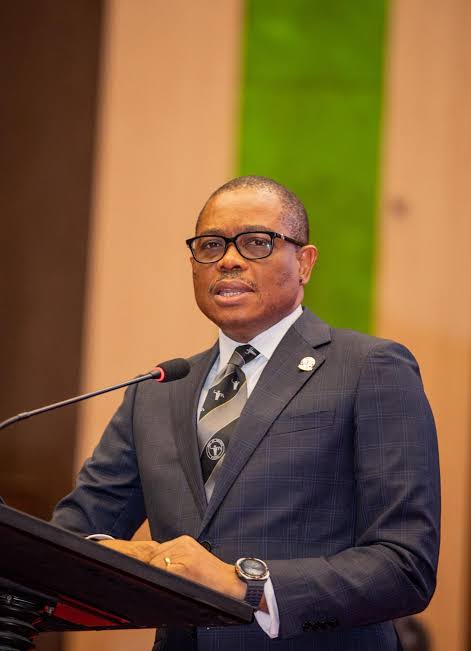
PORT HARCOURT — What began as a complaint about access to the Nigerian Bar Association’s national secretariat quickly evolved into one of the liveliest exchanges at the Association’s Annual General Conference on Thursday, as NBA President Afam Osigwe, SAN, and senior lawyer Afeez Akangbe squared off over administrative procedures, election transparency and the future of the Bar’s electronic voting system.
The exchange, punctuated by interruptions, applause and competing interpretations of recent events, momentarily shifted attention from the conference agenda to questions that have lingered within the Association since the conclusion of its national elections: How the NBA should balance administrative efficiency with accessibility, and whether concerns raised about the electoral process should remain part of the Association’s public conversation.
Akangbe opened the discussion by recounting his experience at the NBA National Secretariat, where he said he waited for about two hours while attempting to resolve issues relating to stamp processing. Describing the restrictions as unnecessarily rigid, he questioned why members seeking legitimate assistance could not gain easier access to the relevant offices.
The intervention drew an immediate response from both the NBA President and the General Secretary, Dr. Mobolaji Ojibara.
Taking the microphone, Osigwe defended the operational procedures at the secretariat, explaining that the Stamp and Seal Department was structured primarily to deal with NBA branches as administrative units rather than individual walk-in requests. Allowing unrestricted access to the production section, he argued, would disrupt workflow, slow the processing of stamps and seals nationwide and compromise the orderly handling of sensitive verification materials.
The President maintained that the restrictions were designed not to frustrate members but to ensure that an already busy unit could function efficiently while meeting requests from branches across the country.
The discussion, however, did not end with administrative procedures.
Akangbe broadened his remarks to the conduct of the NBA’s national elections, renewing concerns about the transparency of the electronic voting process and arguing that the Association still lacked a sufficiently auditable electoral system capable of inspiring universal confidence.
Osigwe responded swiftly, reminding delegates that the elections had been concluded and the results formally declared. While acknowledging that every electoral process offered lessons for improvement, he cautioned against repeatedly reopening contests that had already run their course, urging members instead to channel their energy towards strengthening future elections.
He also suggested that some of the difficulties experienced during the polls were attributable not to systemic failure but to practical issues surrounding One-Time Password (OTP) verification, including how candidates and their campaign organisations managed voter verification during the election period.
The exchange drew audible reactions from different sections of the conference hall, reflecting the fact that the Association’s electoral process continues to generate strong opinions among members despite the conclusion of the polls. When Osigwe concluded his remarks, many delegates responded with sustained applause, signalling support for his position that the Association should focus on institutional improvements rather than continuing to relitigate a completed election.
The moment served as a reminder that, although the NBA has moved into a new administration, debates over governance, administrative accountability and electoral reform remain very much alive within the Bar. Even a routine question about access to the national secretariat proved capable of reopening broader conversations about transparency, member engagement and confidence in the Association’s internal democratic processes.
For many delegates, it was one of the most animated moments of the conference—a glimpse into an Association still negotiating the balance between robust internal criticism and the need to move forward after a fiercely contested election.