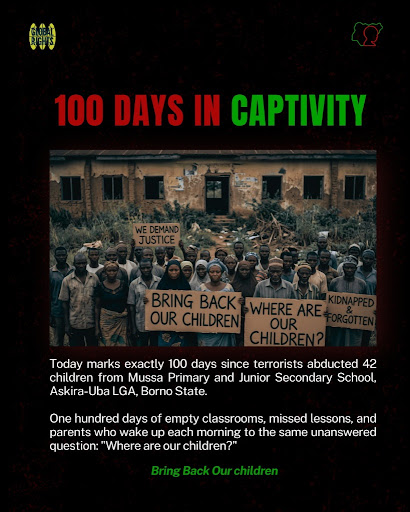
For 100 days, the families of 42 children taken from a Borno school have waited for their return. At the same time, new figures show just how profitable kidnapping has become in Nigeria.
One hundred days is a long time to wait for a child.
For the families of the 42 pupils and students abducted from Mussa-Biri in Borno State, every day since May 15 has brought the same uncertainty: where are their children, and when will they come home?
The passage of time has become part of the ordeal. The children have missed lessons, examinations, family occasions and ordinary days that should have been spent in school and at home. Their parents have been left to live with the worst kind of uncertainty — knowing that their children are alive only through the hope that someone, somewhere, is still working to find them.
On August 21, nearly 100 days after the abduction, parents and community leaders travelled to Abuja to press the Federal Government and the Borno State Government to intensify efforts to secure the children’s release. Reuters reported that the families were protesting the prolonged captivity and the lack of certainty about the fate of their children.
The timing of their appeal could hardly be more significant.
A report released by SBM Intelligence has put a startling price on Nigeria’s kidnapping crisis. Between July 2025 and June 2026, the organisation recorded 7,825 people abducted in 1,713 incidents. At least 1,142 people were killed during the period, while confirmed ransom payments reached ₦7.78 billion — more than three times the amount recorded in the previous year.
Nigeria is no longer dealing with isolated ransom crimes scattered across the country.
There is now an economy around kidnapping.
And the children of Borno are caught inside it.
A hundred days without an answer
The Mussa abduction is part of a disturbing pattern in which schools and communities in the North-East have repeatedly been turned into targets.
On June 29, gunmen attacked Government Day Secondary School in Lassa, also in Borno State, while students were taking their NECO examinations. Thirty-six students were among those abducted, according to reports. The attackers were said to have entered the community after disguising themselves as traders.
Ten of the students were later rescued after troops engaged the attackers. Others remained missing.
The sequence recalls the country’s earlier school abductions: Chibok in 2014 and Dapchi in 2018, followed by a succession of attacks in which schools became places of vulnerability rather than safety.
The details differ from one incident to another. The fear is the same.
For families living in affected parts of Borno, sending a child to school can now carry a calculation that should have no place in a functioning education system: whether the journey is worth the risk.
That is the deeper damage inflicted by these attacks.
A kidnapped child is not the only victim. Fear reaches into the classroom, the home and the community long after the gunmen have disappeared.
The business behind the guns
The SBM figures provide an uncomfortable explanation for why kidnapping remains so difficult to contain.
The organisation recorded ransom demands totalling about ₦22.9 billion during the period under review. Of that amount, approximately ₦7.78 billion was actually paid.
The proportion of ransom demands that resulted in payment also rose sharply, from 5.35 per cent in the previous year to 34 per cent.
That is a significant change in the economics of the crime.
Kidnappers do not need every demand to succeed. A sufficient number of successful payments can finance the next operation, purchase weapons and logistics, compensate collaborators and sustain criminal networks.
SBM’s findings are particularly striking in relation to Boko Haram’s JAS faction, which the organisation linked to about 90 per cent of the confirmed ransom payments, or roughly ₦7 billion from eight incidents.
Two cases illustrate the extraordinary sums involved.
The report says approximately ₦5 billion was paid following the abduction of 416 people from Ngoshe in Borno, while another ₦2 billion was paid after 315 pupils and staff were taken from St Mary’s School in Papiri, Niger State.
At that level, kidnapping ceases to look like opportunistic crime.
It begins to resemble a revenue system.
Why the Oyo rescue matters
The events in Oyo State earlier this year provide an important comparison.
On May 15, the same day the Mussa pupils were abducted, gunmen attacked a school in Oriire Local Government Area of Oyo State and took pupils and teachers.
The Federal Government responded with a high-level security intervention. National Security Adviser Nuhu Ribadu, Chief of Staff Femi Gbajabiamila, Defence Minister Christopher Musa and Inspector-General of Police Olatunji Disu were among senior officials who visited the affected area.
After 56 days in captivity, the hostages were rescued in an operation involving the military, police, Department of State Services and other security agencies. Eight suspected members of the kidnapping gang were subsequently arrested, according to the Presidency.
The Oyo operation demonstrated that the Nigerian security system can bring considerable resources to bear when the circumstances and intelligence permit it.
It also leaves a question hanging over Borno.
What is being done, with comparable urgency and resources, to find the children of Mussa and the students still missing from Lassa?
The comparison should not be turned into an accusation that the lives of children in one part of Nigeria matter more than those elsewhere. There is not enough evidence for such a conclusion.
But the contrast is difficult for the affected families to ignore. They have seen that large-scale rescue operations are possible. They want the same determination applied to their children.
The North carries the greater burden
The geographical distribution of the kidnapping figures is perhaps the most revealing part of the SBM report.
Of the 7,825 people recorded as kidnapped during the year under review, 7,334 were in northern Nigeria — approximately 94 per cent of the national total.
The North is therefore not experiencing a marginal part of Nigeria’s kidnapping crisis.
It is carrying most of it.
That reality should force a different conversation about security policy.
The problem is no longer simply how to respond when a kidnapping occurs. It is how to make kidnapping sufficiently difficult, sufficiently expensive and sufficiently unrewarding that armed groups cannot continue to operate it as a dependable source of income.
That requires more than patrols and rescue operations.
It requires intelligence, financial investigation, border surveillance, protection of vulnerable communities, disruption of supply networks and prosecution of those who facilitate ransom payments and the movement of criminal proceeds.
The money has to be followed.
The families pay twice
There is another side to the ransom economy that rarely appears in official statistics.
Families often bear the first financial cost of an abduction.
They borrow.
They sell property.
They empty savings.
They depend on relatives and friends.
And, in some cases, they become targets for a second layer of exploitation.
In August, The Guardian reported that one Borno family had allegedly been defrauded of ₦1.5 million by people who falsely claimed to be acting for the kidnappers.
The financial damage can therefore continue even while the victim remains in captivity.
For the family, however, money is only one part of the loss.
There is the child’s education, the disruption to family life and the psychological burden of not knowing what tomorrow will bring.
After 100 days, those losses are no longer temporary.
A school should never be a ransom opportunity
Nigeria has spent more than a decade confronting the consequences of attacks on schools.
Chibok became a global symbol.
Dapchi became another national trauma.
The attacks in Borno now threaten to turn such tragedies into routine entries in the country’s security reports.
That cannot be allowed to happen.
When parents begin withdrawing children from school because they fear abduction, insecurity has achieved something more profound than the kidnapping of individual victims. It has begun to interfere with education itself.
The consequences will last considerably longer than the period of captivity.
A child who loses months of schooling may fall behind classmates. A family that moves away may never return. A community that loses confidence in its schools can gradually lose confidence in the State itself.
This is why the Mussa children cannot be treated simply as another unresolved security incident.
What 100 days should mean
There has been official activity.
Senator Ali Ndume has called for intensified military efforts to rescue abducted people in Borno, while Governor Babagana Zulum has said security agencies were working to secure the release of the children.
Those efforts deserve to be recognised.
But after 100 days, the families are entitled to ask what progress has been made.
How many credible leads have been developed?
What intelligence has been gathered?
What resources have been committed?
What is preventing a successful rescue?
What is being done to ensure that the children are not forgotten while the security agencies pursue the kidnappers?
Families do not need speculation. They need truthful information.
And ultimately, they need their children.
The number that should shame Nigeria
₦7.78 billion. That is the amount SBM Intelligence says Nigerians paid in ransom over the 12-month period it examined.
Behind that number are thousands of individual stories: people dragged from their homes, travellers seized on roads, farmers taken from their fields and children removed from classrooms.
The money tells only part of the story. The other part is measured in empty chairs. In parents waiting beside telephones. In children whose education has been interrupted. In communities that no longer believe that the State can protect them. And in the growing confidence of those who have discovered that kidnapping can pay.
Nigeria cannot afford to treat the ransom economy as an unavoidable feature of life.
The money must be traced. The networks behind it must be dismantled. Those who facilitate it must face prosecution. Communities at risk must receive protection before another convoy of gunmen arrives at another school.
Most of all, the country must resist the temptation to become accustomed to missing children.
The 42 pupils and students taken from Mussa-Biri have now spent 100 days in captivity.
Their parents have spent 100 days waiting.
Nigeria should not ask them to wait for another milestone before demanding an answer.
Bring the children home.