A bruising AGM debate exposes a troubling contradiction: Can the Nigerian Bar Association credibly campaign against money politics in government when its own highest office is increasingly seen as the preserve of candidates with deep pockets?
PORT HARCOURT — The Nigerian Bar Association’s Annual General Meeting took an uncomfortable turn when a debate over the rising cost of internal elections forced the Bar to confront a question it has long directed at Nigerian politicians: How much money should it take to buy a place at the table of power?
The issue surfaced during floor contributions when Rotimi Iseoluwa Jacobs, SAN, warned that the financial demands of contesting the NBA presidency had reached a point at which professional merit alone might no longer be enough to secure a realistic shot at the office.
Jacobs put the figure at about ₦1 billion, arguing that no lawyer aspiring to become NBA president could realistically enter the contest without access to an enormous campaign war chest.
His intervention went beyond the cost of an election.
He questioned the Bar’s moral authority to criticise politicians for the sums spent on elections while allowing a similar culture to develop within its own organisation.
The comparison was uncomfortable precisely because lawyers occupy a peculiar place in Nigeria’s democratic life. The NBA routinely speaks on electoral integrity, corruption, accountability and the abuse of public resources. Its members challenge questionable government expenditure in court and publicly demand greater transparency from elected officials.
If obtaining the presidency of the country’s foremost professional legal organisation requires hundreds of millions of naira—or anything approaching the figure suggested by Jacobs—the Bar faces a question about its own democratic accessibility.
Does the NBA risk creating the very kind of money-driven politics it condemns outside its walls?
Jacobs pointed particularly to the culture surrounding campaigns: dinners, “hangouts”, sponsorships, transportation, accommodation and other forms of logistical support offered to prospective voters and branch members. What may once have been modest efforts to meet colleagues and explain a candidate’s programme have, he suggested, evolved into an expensive competition in which candidates are expected to demonstrate their capacity to spend.
The consequence, he argued, is that a lawyer may have the professional reputation, experience and ideas required to lead the Association and still be unable to compete because the cost of entry has become prohibitive.
That possibility strikes at the heart of professional self-government.
An association whose leadership is effectively accessible only to those able to finance an expensive national campaign risks narrowing the pool from which its leaders can emerge.
Osigwe’s turns the question back on the bar
NBA President Afam Osigwe, SAN, did not dispute the underlying problem.
His response, however, shifted responsibility away from candidates and towards the Association’s own membership.
Osigwe told delegates that the issue of campaign expenditure had already been addressed during the NBA’s constitutional reform process. Measures intended to reduce the cost of elections—including restrictions on lavish social engagements and candidate-funded “hangouts”—had been proposed as part of the reform exercise.
The membership rejected them.
That history, Osigwe argued, cannot simply be forgotten whenever the consequences become uncomfortable.
The point was straightforward: candidates operate within a system created and maintained by the Association’s members. If members expect candidates to spend heavily in order to secure their support, and then reject rules designed to reduce the cost of campaigning, the resulting expense cannot fairly be blamed on candidates alone.
In effect, the Bar had been given an opportunity to change the rules and had declined it.
Osigwe’s intervention therefore introduced a second question into the debate.
If lawyers themselves demand expensive campaigns, who exactly is responsible for the money being spent?
Candidates can spend only because somebody is willing to receive what they offer.
A culture of expensive campaign events cannot survive on candidates’ ambitions alone. It requires an electorate willing to participate in—and, in some cases, expect—the machinery surrounding those campaigns.
That makes the problem considerably more difficult to solve.
The economics of an NBA election
The scale of the problem is easier to understand when the NBA election is viewed as a national political exercise rather than a conventional professional association contest.
A candidate for the presidency is not campaigning in one city.
The contest stretches across branches and geographical zones, requiring candidates to build relationships with lawyers throughout the country. Travel, accommodation, meetings, campaign materials, communications, mobilisation and election-day logistics all come with costs.
Then there are the less formal expectations.
Candidates are expected to be visible. They must meet lawyers. They must attend branch events. They must maintain relationships with influential figures and persuade thousands of voters that they can lead the Association.
As campaign culture becomes more elaborate, each candidate’s spending becomes a benchmark for the next.
A candidate who spends more creates expectations that the next candidate must match.
The result is an electoral arms race.
And an arms race eventually changes the character of the contest.
The central question ceases to be simply who can lead?
It becomes who can afford to campaign?
Okocha draws the line
Former NBA President Chief Onueze Chukwujinka Joe Okocha, SAN, brought another dimension to the discussion when he addressed references to “junior lawyers” and eligibility for the presidency.
His intervention distinguished between two issues that had begun to overlap in the debate: Whether a lawyer is legally qualified to contest, and whether that lawyer can afford to contest.
The NBA’s constitutional requirements establish who may aspire to the presidency. Those requirements are separate from the financial realities of mounting a nationwide campaign.
A lawyer may satisfy every formal qualification and still find the practical cost of competing beyond reach.
That is the more difficult problem.
Eligibility can be written into a constitution.
Accessibility depends on the political culture surrounding the election.
And that culture is created not only by candidates but by voters, branches and the institution itself.
The paradox of the Bar
The argument carries a particular sting because of the NBA’s place in Nigerian public life.
The Bar has spent decades arguing that elections should not become auctions, that political office should not be captured by wealth and that citizens should not have to possess enormous financial resources before they can participate meaningfully in democracy.
Those principles do not stop at the courthouse door.
They apply to professional associations as well.
The NBA is not the Federal Government and an NBA election is not a general election. The resources involved are incomparable, and the constitutional stakes are different.
But the underlying principle remains familiar.
If money becomes the decisive advantage in choosing leaders, merit and ideas begin to compete on unequal terms.
That is the concern Jacobs placed before the AGM.
Osigwe’s response exposed the other side of the equation: Reform cannot succeed if the membership rejects the rules intended to restrain campaign expenditure.
Between those two positions sits the real challenge.
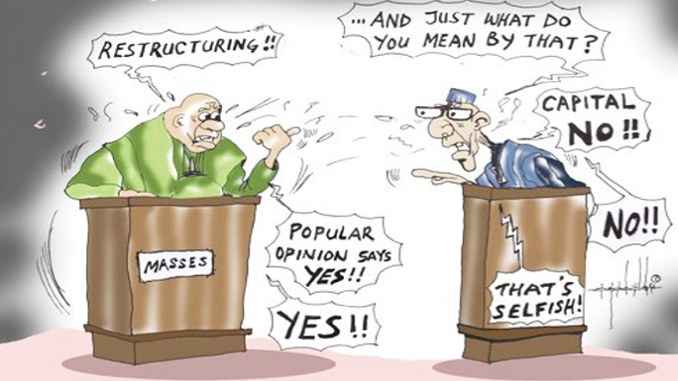
The NBA cannot ask candidates to spend less while leaving voters accustomed to expensive campaign rituals. Nor can it expect members to demand leaner campaigns while continuing to reward candidates who can afford the most elaborate mobilisation.
The system reproduces itself.
Who can afford to lead the Bar?
The ₦1 billion figure raised by Jacobs should therefore be treated not merely as a startling campaign estimate but as a warning about the direction of internal democracy within the profession.
If the cost is genuinely approaching that level, the consequences extend beyond individual candidates.
Young partners in successful law firms may be discouraged from contesting.
Public-interest lawyers may find the contest inaccessible.
Lawyers from less affluent practices may decide that the presidency is simply beyond their reach.
And the Association could gradually draw its leaders from an increasingly narrow economic circle.
That would be an unintended consequence of a system in which nobody has formally barred poorer candidates from contesting, yet the practical cost of doing so performs the same function.
There is a difference between the right to contest and the capacity to compete.
The first can exist on paper while the second disappears in practice.
The Bar’s unfinished reform
The AGM debate did not produce an immediate solution.
Perhaps that is fitting.
The problem is not one that can be solved by telling candidates to spend less. It requires the NBA to examine the incentives that make spending necessary in the first place.
The Association could revisit campaign spending rules, impose meaningful expenditure limits, regulate candidate-funded social events, strengthen disclosure requirements and consider mechanisms that reduce the financial burden of nationwide campaigning.
But any reform will ultimately require the consent of the people who vote.
That is precisely where the irony of the debate lies.
The lawyers demanding cheaper elections are the same electorate that determines whether the rules governing those elections change.
The candidates may be spending the money.
The voters help determine whether spending remains politically useful.
And the Association itself decides whether the system continues.
The price of power
There was something larger than an argument about campaign expenses in the exchange at the AGM.
The NBA was looking into a mirror.
For years, lawyers have warned Nigeria about the corrosive effect of money on public office. They have challenged electoral malpractice, questioned campaign finance practices and argued that democracy loses something when wealth becomes the principal qualification for political influence.
Now one of their own senior members is warning that the same logic may be taking root inside the Bar.
Osigwe’s response makes the picture more complicated, because the membership has already rejected one attempt to impose restraints on campaign spending.
That leaves the NBA with an uncomfortable choice.
It can continue with an electoral culture in which candidates compete through increasingly expensive mobilisation and accept that wealth will inevitably influence who can run a credible campaign.
Or it can redesign the system so that a lawyer’s ability to lead the Association depends less on the size of his or her campaign purse and more on professional record, ideas, integrity and the confidence of colleagues.
The argument at the AGM did not settle that question.
It did something more useful.
It put the price of power on the table.
And once lawyers begin asking whether it takes ₦1 billion to become president of the Nigerian Bar Association, the question is no longer merely how much an election costs.
It is who can afford to participate in the democracy of the Bar—and what happens to the profession when too many good lawyers cannot.