Home Blog Page 6

After 14 years of waiting, Nigerian woman dies hours after giving birth to quintuplets

A 45-year old woman, Mrs Mary Yaduyan, has died a few hours after delivering a set of quintuplets, five baby boys, at a specialist hospital in Akure, Ondo State.

It was gathered that the deceased had been childless for over 14 years before she eventually conceived in 2025 through an in vitro fertilisation (IVF) procedure.

Mary was said to have passed away following a complication identified by medical experts as a pulmonary embolism, few hours after she was delivered of the babies via caesarean section.

Read Also “She Knew She Might Not Survive”: Kano father of 14 recounts wife’s final moments after delivering quintuplets

The hospital, known for handling multiple births, was thrown into mourning following the sudden death, which occurred about four hours after what had been described as a successful delivery.

The woman had reportedly undergone regular antenatal care without major complications throughout the pregnancy.

Speaking with Ondo State Government publication, Hope Newspaper, the lead consultant, who does not want his name in print, expressed sadness over the situation, saying someone he cared for, did not make it at last.

He said that the patient had a history of uterine fibroids, which were surgically removed two years prior to the procedure.

According to him, the pregnancy progressed smoothly until about 31 weeks, when she experienced premature rupture of membranes and was placed under close medical supervision.

The doctor said the medical team adopted conservative management to prolong the pregnancy to a safer gestational age, while monitoring for signs of infection and other complications.

“The patient later complained of chest pain, prompting the involvement of a consultant cardiologist.

“However, initial assessments did not indicate immediate danger,” he said.

“Following the delivery, the patient remained stable, with normal vital signs, including blood pressure and oxygen levels normal. Medical personnel, including a consultant anaesthesiologist, reportedly monitored her closely due to the high-risk nature of the delivery.

“Everything appeared normal after the operation. There was no sign of excessive bleeding, and her vital signs were stable.”

He added that the sudden deterioration was later attributed to ‘pulmonary embolism’, a condition caused by blood clot blocking vessels in the lungs which could occur without prior warning.

Despite swift resuscitation efforts, the patient could not be revived.

Speaking with the publication, the elder sister of the deceased, Mrs. Olusola Ajayi, recounted the final moments before her sister’s demise.

“She called me when I arrived at the hospital and said she wanted to eat rice with red oil without stew. Later, she changed her mind and rejected the food,” she said.

Ajayi explained that the family was informed the surgery would take place around 10 a.m., adding that they were on a video call with the deceased’s husband, who is outside the country, throughout the procedure.

“After the delivery, we were all jubilating. We even called our mother to inform her that everything went well. We were celebrating and encouraging ourselves,” she added.

She said she was later told to get medications for the newborns and immediately went to purchase them.

“But when I returned, I saw many people gathered in the room, and she was no longer responding when I called her. That was how we lost her,” she said.

Ajayi confirmed that doctors attended to her sister throughout and that the family made every effort to ensure she received the best care.

“We did everything we could, but God Almighty knows why it happened this way,” she concluded.

The travails of Nestoil and the travesties of courts

By Chidi Anselm Odinkalu

In a week in which the Nigerian judiciary at all levels has been the focus of considerable civic and party-political energy, it may seem odd to expend bandwidth on the travails of an investor or businessman, but Ernest Azudialu-Obiejesi is no ordinary businessman. The story of the ongoing ordeal in the Nigerian court system involving him, his wife, Nnenna – an entrepreneur in her own right – and various companies in which they are cross-invested, will for long be studied as an example of how disreputable dispute resolution constrains development and can blight even the ablest.

These cases involve the control of assets running into billions of dollars and claims concerning the structure and enforcement of secured credit transactions whose value is equally mouthwatering. The issues and sums involved are consequential for the fate of Nigeria’s economy. The performance of the courts has been just as consequential but for mostly the wrong reasons.

These cases have worked their way with dutiful relentlessness through every nook and cranny of the Nigerian court system. In the past six months alone, they have traveled through multiple judges of the Federal High Court; up to the Court of Appeal; and then to the Supreme Court from where they have returned to the Federal High Court. These cases have also generated tens of thousands of pages of court filings and records and thousands of billable hours for the most expensive lawyers in Nigeria.

As with many such cases involving commercial transactions at the sharp end, these cases can seem interminable, and their narrative can appear complex. Amidst the fog of legal attrition, however, the plot is discernible. What they reveal about how courts can dissipate a country and its wellbeing bears close attention.

Better known as “Obijackson”, the name of the trading company under which he first made his foray into the Piranha-infested waters of Nigerian enterprise in 1983, Ernest Azudialu-Obiejesi is one of Nigeria’s richest. In 1991, during the heady days of military rule, he ventured beyond trading and founded Nestoil, an engineering, procurement, construction, and commissioning company active in the provision of services to the hydrocarbons and adjacent sectors in the country.

Neconde Energy, another company founded by Obijackson, is a leading indigenous operator in hydrocarbons exploration and production in Nigeria. Among other holdings, Neconde Energy owns 45% of Oil Mining Lease (OML) 42. The remaining 55% is owned by the Nigeria National Petroleum Company (NNPC) Exploration and Production Limited (NEPL).

These companies are part of the Obijackson Group, which employs over 3,000 Nigerians directly. Up to 15,000 indirect jobs depend on their operations too.

As with many operators in the hydrocarbons and adjacent sectors, it is not unusual for such companies to require lines of credit from financial institutions. Indeed, this can itself be proof of the value and profitability.

In December 2022, the First Bank Group led a syndicate of financial institutions, including 16 Nigerian banks, in restructuring and consolidating the long-term indebtedness of Nestoil into a pool designated as “Global Facilities” and under a document known as Common Terms of Agreement (CTA). The consortium also included some lenders who were non-Nigerian, such as the Africa Export-Import (Afrexim) Bank, headquartered in Cairo.

The CTA contained provisions governing applicable law as well as dispute resolution forum. It appears that the parties agreed that the applicable law will be English law and the forum for resolution of disputes will be England. How or why they made this choice is not in issue at this moment.

Neconde Energy – together with Obijackson and Nnenna Obiejesi – guaranteed this transaction.

Around 22 October 2025, the second anniversary of the onset of his judicial career, Deinde Isaac Dipeolu, a judge of the Federal High Court in Lagos, issued an order at the instance of the FBNQuest Limited, a Merchant Bank, and First Trustees Limited, both members of the First Bank Group, authorizing a receiver/manager appointed by them to take control of the assets of Nestoil and Neconde Energy. The basis was a claim that there had been a default in the debt which crystallized enforcement against the assets on which the debt was secured. Importantly, the order declined to extend judicial protection to the receiver/manager.

The understanding of the creditors appeared to be that those assets included a mini-skyscraper known as Nestoil Tower, located in a choice part of Victoria Island in Nigeria’s commercial capital in Lagos. The occupants of this building include staff of Nestoil and of Neconde Energy. However, the building is owned by another company called Drawcock Estates Limited, which was not party to the Global Facilities or the CTA.

One year earlier, on 8 October 2024, another judge of the Federal High Court, Ambrose Lewis-Allagoa, had apparently issued an order restraining “any persons whatsoever”, from taking such adverse enforcement action against the building. This order was not challenged.

Similarly, prior to the CTA, in 2019, another judge of the same court, Muslim Sule Hassan, had made another order requiring the parties – in a formulation that has now become familiar to Nigerians – to preserve the status quo ante bellum.

It appeared that Deinde Dipeolu had set out to anchor a young judicial career on a distinguished track-record of controversial ex parte orders involving both hydrocarbons interests and bankers. On the last working day of 2024, 30 December, again at the instance of the First Bank Group, he dutifully issued an order freezing the accounts of General Hydrocarbons Ltd in a dispute concerning credit facilities to the operators of OML 120. However, three weeks earlier, his colleague, Ambrose Lewis-Allagoa appeared to have issued an order restraining such action.

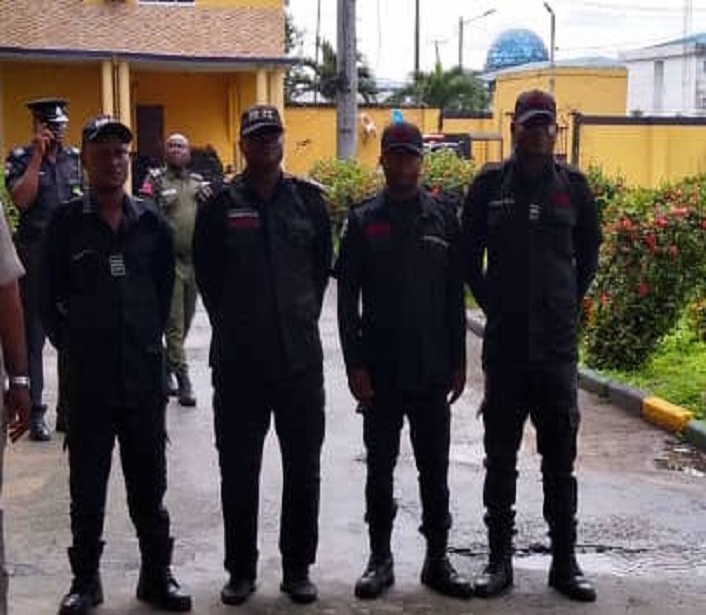
Deinde Dipeolu’s order of October 2025 threatened to ransack the life of Nestoil and the Obijackson Group as a going concern. To enforce the order, the Nigeria Police Force deployed to seal Nestoil Tower. Following a petition by Obijackson alleging judicial malpractice, the Chief Judge of the Federal High Court transferred the case to another judge of the court, Daniel Osiagor who, on 20 November, vacated Deinde Dipeolu’s ex parte orders. This enabled the company to – temporarily at least – return to its headquarters building.

The First Bank Group filed a notice of appeal on 21 November 2025 against Daniel Osiagor’s decision. On 26 November, unknown to anyone, they followed this up with an application ex parte asking the Court of Appeal to issue a “restorative injunction” returning them to the building and affording judicial protection to the manager/receiver.

At this time and on this day, however, no records of appeal had been prepared or transmitted records to the Court of Appeal. So, there was no appeal before the Court. Mind you, the lower court had declined judicial protection to the receiver/manager. So, there was nothing about that to “restore” either.

Yet, the following day, 27 November, a three-judge panel of the Court of Appeal sat promptly and, in the absence of an underlying appeal, granted the application for “restorative injunction” without hearing the other side. If anything qualifies as judicial miracle, this was it.

But this Court of Appeal had only just begun its career in judicial miracles.

In the third week of January 2026, they disqualified lawyers instructed by Obijackson and Nnenna Obiejesi, his wife, as well as Neconde Energy, from participating in the proceedings. According to the Court of Appeal, only the receiver/manager (the validity of whose appointment was disputed) could exercise that right. The audacity of this reasoning did not pass the smell test.

On 10 April 2026, the Supreme Court agreed, accusing the Court of Appeal in this case of having “abdicated its judicial responsibility and enabled blatant abuse of process of court when it granted the application.” Stronger judicial condemnation is difficult to imagine.

Now that the Supreme Court has settled the matter of legal representation, the parties must return to the High Court for the underlying dispute. How long this will take or how many more twists of judicial malefaction could accompany the journey to a resolution of the mouthwatering sums involved is anyone’s guess. Investors elsewhere desiring to make Nigeria a destination and looking at this will be forgiven if they were to decide to sit it out or find a more sensible destination.

A lawyer and a teacher, Odinkalu can be reached at [email protected]

The views expressed by contributors are strictly personal and not of Law & Society Magazine.

Former NLC Deputy President Comrade Akinlaja rejoices with Comrade Oladiti as new NUPENG National President

Former deputy President of Nigeria Labour Congress (NLC), Hon. Joseph Akinlaja has congratulated the new president of the Nigeria Union of Petroleum and Natural Gas Workers (NUPENG), Comrade (Dr) Salimon Akanni Oladiti (JP).

Oladiti and 15 others were returned as members of the National Executive Council of the umbrella body of junior workers in the oil industry at the 6th Quadrennial Delegates Conference of NUPENG held in Lagos last weekend.

In a congratulatory message signed by Akinlaja, he described the election of the former national trustee of NUPENG and former National Chairman of PTD as president of the union for a term of four years as well deserved and an affirmation of the trust, confidence and belief that members reposed in his capacity and experience to lead the them to loftier heights.

Comrade Akinlaja who was also former General Secretary of NUPENG expressed optimism in Comrade Oladiti’s capacity to advance the cause of workers in the oil and gas industry, lead with courage, fairness and inspire hope for a more secure and prosperous future for all members.

The statement read in full: “I want to extend my heartfelt congratulations on your impressive and deserving election as President of the Nigeria Union of Petroleum and Natural Gas Workers (NUPENG).

“Your election is a powerful testament to the confidence that the Branches in the formal and informal sectors of the Union have in your dynamic leadership, steadfast commitment to the welfare of Nigerian oil and gas workers, and your visionary efforts in strengthening a robust, respected, and impactful labor movement.

“As someone who also exceled as National Chairman of PTD for two consecutive terms, your dedication to workers’ welfare, your engagement with both government and private sector stakeholders, and your principled approach to national issues truly set you apart as a leader of exceptional courage and integrity.

“I believe that your mandate will bring about greater unity, love, cohesion, inclusivity, innovation, and productivity within this great and irrepressible Union, and further establishing NUPENG as a strong voice in Nigeria’s industrial landscape with many landmark achievements for all and sundry in the Union.

“It is our sincere prayer that Almighty God will in His mercy grant you wisdom, strength, good health, long life and abundant grace to lead with uprightness and vision,” Comrade Akinlaja stated.

Atiku, Obi, Kwankwaso are Tinubu’s most reliable campaigners

By Farooq Kperogi

There is really no opposition in Nigeria in the true sense of the word. There are only politicians who have been temporarily kicked out of the inner sanctum of power and influence but who share no fundamental difference with the current temporary occupants of the power structure. Nonetheless, if all the people vegetating on the margins of the power structure came together, they could easily displace those within it in 2027.

Although the coalition of so-called opposition politicians angling to get back to power in 2027 has not articulated a coherent blueprint to show that it will be different from President Bola Tinubu (I strongly believe they are indistinguishable from him), it can effectively instrumentalise the crying incompetence, in-your-face corruption, ethnic bigotry, insufferable arrogance, unabating misery and insouciance that have become the hallmarks of Tinubu’s administration to convince a traumatised nation that it can offer an alternative.

It doesn’t matter if they will replicate or even exacerbate Tinubu’s unrelieved disaster when they get to power. Even the prospect of temporary relief from Tinubu’s unending torment is enough to get most people to give them a chance. But they have shown that they lack the discipline, cohesion and foresight required to wrest power from Tinubu.

Even before they have had a chance to come together, they are splintered. This became clear in the aftermath of the Supreme Court ruling that restored David Mark’s leadership of the ADC. Neither Peter Obi nor Rabiu Kwankwaso said a word about it.

There are credible rumours that Obi and Kwankwaso didn’t react to the Supreme Court judgement because they had already moved on. They are said to be heading to the NDC and no longer care about what happens to the ADC.

In other words, we are back to the 2023 factionalisation of the “opposition”. Both Obi and Kwankwaso appear to be allergic to the internal democratic processes of political parties. They want to be canonised as candidates without contest. Since they can’t find that, they are moving away.

Atiku Abubakar may emerge as the candidate of the ADC if the ADC survives, that is. He might choose Rotimi Amaechi as his running mate. Should this happen, the opposition will be fatally fractured, as it was in 2023.

Even now, the verbal darts between Atiku’s supporters and Obi’s and Kwankwaso’s supporters are more caustic and more venomous than the exchanges between either camp and Tinubu’s supporters.

In fact, Tinubu is the net beneficiary of their maximalist posturing and internal warfare. Obi and Kwankwaso supporters say they would rather let Tinubu continue for another four years than support Atiku’s aspiration to replace him. Atiku’s supporters, for their part, say they would rather put up with another Tinubu term than support an Obi/Kwankwaso presidency.

Beyond their crude, petulant name-calling, Obi and Atiku supporters advance arguments in support of their positions, both of which benefit Tinubu. Obi’s supporters say since it isn’t the turn of the North to produce a president, Buhari, having ruled for eight continuous years before Tinubu took over, if another southerner can’t be presented as the opposition’s candidate, they would rather support Tinubu to complete the South’s turn.

Read Also: Built for Greatness, Now Breeding Survival: The tragedy of UNN

Read Also: Echoes of Trauma: When justice becomes a wound

Atiku’s supporters, on the other hand, turn that logic around and say that if Obi is supported to displace Tinubu in 2027, he would “eat into” the North’s turn, which they believe should start in 2031. They don’t believe Obi’s promise to rule for only one term since there is no legally binding or constitutional constraint that would forbid him from reneging on his promise.

There is a precedent for this in Goodluck Jonathan, who was “allowed” to complete Umaru Musa Yar’adua’s term on the understanding that he wouldn’t seek another term in 2011. He not only ran and won in 2011, he ran again in 2015 and almost won.

So, the argument of Atiku’s supporters is that supporting Tinubu to complete his term benefits the North more than supporting Obi because there is certainty, in their reckoning, that power will move to the region without contest after Tinubu’s term. It’s irrelevant if Tinubu’s policies incinerate them before power rotates back to the North.

It isn’t the logic or admissibility of the arguments of both camps that is the issue here. The point at issue is that in fighting each other, the opposition is fighting for Tinubu. His economic strangulation of the masses of our people takes the back seat. The insecurity that is ravaging the country, which he seems either unable or unwilling to confront and stamp out, is rendered irrelevant.

In other words, Tinubu’s most potent weapon isn’t INEC with its partisan chairman or a compromised judiciary. It is the opposition. Interestingly, the two main groups in the opposition like to accuse each other of “working for Tinubu” to ensure that their candidate doesn’t win. The truth is that they are both assets to Tinubu and are working for him for free. They are both weapons fashioned against each other for the benefit of Tinubu.

And that’s why I consider Tinubu’s excessive, underhanded zealousness in suffocating the ADC and other opposition parties from becoming viable platforms to challenge him a self-sabotaging strategic blunder. He could have a clear win, because of the selfishness and disunity of the opposition, and still be dogged by a crisis of legitimacy because he didn’t allow a fair contest.

On April 23, I wrote a Facebook post about two contradictory impulses of Nigerian politicians. I said Nigerian politicians are some of the most incurably optimistic specimens of humans you can find on earth. That’s why you have opposition politicians who can’t even agree on who their candidate will be in 2027, say with cocksure certitude that they can wrest power from a man who defied all odds to get to power while out of it and has since consolidated power by ensuring that INEC and the judiciary are in his pocket.

But I also pointed out that Nigerian politicians can be some of the most cowardly people while outwardly projecting faux bravery. That is why a politician who has 32 governors, INEC, the judiciary, an unrivalled war chest and a gravely divided opposition is still so fearful of his chances of winning that he doesn’t want the opposition to even have a platform to challenge him.

Tinubu joked on April 14, 2026, that he could send Godswill Akpabio to the opposition to “scatter them”. Days later, on April 20, his chief of staff, Femi Gbajabiamila, publicly urged ADC lawmaker Leke Abejide to remain in the party so that he could “fight them” and “scatter them”. Abejide said yesterday that Gbajabiamila was only joking, just like his boss, Tinubu.

An English proverb says, “Many a true word is spoken in jest.” That is, people often reveal serious truths while pretending to joke.

ADC’s fate is currently hanging in the balance, and if the past is any guide, the David Mark leadership of the party might lose in the federal high court. That would be an avoidably self-inflicted political injury for Tinubu. He doesn’t need to use the instruments of the state to “scatter” the ADC, the NDC, the PRP or any other potential platform opposition politicians might need. The opposition is doing a better job “scattering” itself than he can ever do, even with the instruments of the state.

Tinubu may not need to defeat the opposition because the opposition appears determined to defeat itself. An opposition that lacks the self-denial, strategic patience and moral urgency necessary to galvanize popular resentment and win power doesn’t deserve power.

Until Atiku Abubakar, Peter Obi, Rabiu Kwankwaso and others understand that power is rarely handed to the disunited, the vain and the impatient, they will remain Tinubu’s most reliable unpaid campaigners.

The views expressed by contributors are strictly personal and not of Law & Society Magazine.

Intimate Affairs: Where did all the wife materials go?

By Funke Egbemode

There is an extra lament in town. It is not the price of petrol or diesel . It is more troubling than the mean charges of estate agents and rising cost of aso-ebi. It is this: “There are no more wife materials.”

You hear it in barbershops, at buka tables, in Uber rides, and whispered with despair in bachelor flats where devouring noodles has become a lifestyle. The men sigh, shake their heads like village elders and conclude, “Women of nowadays…”—as if they themselves are not also “men of nowadays.”

But let us not rush to crucify a whole gender. This matter is not as simple as Ankara vs. miniskirt or prayer warrior vs. party hopper. Finding a life partner has always been serious business. Bestsellers have been written on it and blockbuster movies made on the theme . It only looks harder now because illusions have multiplied and patience has reduced.

So, dear serious-minded dude, before you start considering becoming a Baby Daddy out of despair and desperation, sit down. Let’s talk.

First, it is not true that there are no good wife materials left anywhere.

There are still many around.

What has gone extinct is discernment.

The problem is not that good women don’t exist. The problem is that many men are shopping for wife material in showrooms meant for entertainment.

It is like going to a nightclub at 2 a.m., seeing flashing lights, bottles popping, and then complaining that nobody there looks like your grandmother who woke up at 5 a.m. to pray and  made breakfast for 10 people before 7 am.

My brother, context matters.

If you fish in a pond, don’t expect a whale.

Take the case of Kunle and his Instagram standards.

Kunle was 34, a banker with a steady job and a mother who had started sending him pictures of “very decent girls.” But Kunle had standards. Not ordinary standards—Instagram standards.

He wanted beauty that could trend, a body that could cause traffic, and a lifestyle that would make his friends green with envy.

He found her. They are a-plenty on social media, selling the mirage.

Ada was stunning. Soft skin, perfect curves, and a social media presence that could intimidate small countries. Kunle fell like a mango in harmattan.

Within months, they were inseparable. Vacations, expensive dinners, designer gifts—Kunle was living the dream. Until reality knocked.

Ada did not believe in “stress.” Cooking was stress. Managing money was stress. Even basic emotional support was… stress. What she believed in was “soft life”—financed, preferably, by Kunle.

When Kunle’s finances began to groan under the weight of luxury, cracks appeared. Arguments started. Respect evaporated. Eventually, Ada left—with her bags, her beauty, and her belief that another sponsor would soon emerge.

Kunle sat in his empty apartment, staring at the wall like a man who had just watched his generator pack up during Champions League final.

His conclusion? “There are no good girls anywhere, only opportunists.”

But the truth? Kunle did not look for a wife. He shopped for a fantasy.

So where should a serious man look?

Let’s be honest. Wife material is not written on anyone’s forehead. It is revealed in patterns, in consistency, in values that don’t shake when nobody is watching. If you are serious, your search must also be serious.

First, look where values live.

Good partners are often found in places where values are practised, not performed. Workplaces, professional circles, volunteer groups, faith communities, academic environments—these are places where people are known beyond makeup and captions.

When you see someone consistently show up, treat others with respect, handle responsibility with grace—you are seeing raw material. Not packaging.

Because marriage is not packaging. It is content, lifetime content.

Pay attention to how she treats people who she can make money or contact from.

Watch how she speaks to waiters, how she treats her siblings, how she handles disagreement.

Anybody can be sweet when things are going well. The real person appears when things don’t go their way.

A woman who is kind without audience, respectful without reward, and grounded without pressure—that one is not common. If you see her, don’t be forming hard guy. Walk up to her and give your best pitch ever. She is likely the one you have been waiting for.

Listen more than you talk

Many men are in love with the idea of being heard, but they don’t listen.

If you actually listen, you will hear everything: her values, her priorities, her fears, her worldview. Does she respect family? Does she believe in partnership or dependency? Does she take responsibility for her life?

These things don’t hide. They whisper. But you must be quiet enough to hear them.

Musa was not flashy. He worked in a logistics company and lived a simple life. His friends often teased him for being “too calm.”

He met Zainab at a colleague’s small birthday gathering—not a party, just a few people, food, and laughter. Zainab was not the loudest in the room. She wasn’t trying to impress anyone. But Musa noticed something.

She helped the host clean up without being asked. She listened when others spoke. When a disagreement came up, she didn’t raise her voice; she made her point and smiled.

Curious, Musa struck up a conversation. Weeks turned into months of friendship. No rush. No pressure.

Over time, Musa saw consistency. Zainab was the same person everywhere—steady, thoughtful, respectful.

When he eventually expressed his intentions, there was no drama. They spoke like adults, involved their families, and built something solid.

Today, their home is not perfect—but it is peaceful. And in a world full of noise, peace is luxury.

Musa did not complain about scarcity. He recognised value.

There is also a way a dude looking for a wife must present himself.

Let’s not pretend , this is one-sided matter. Some men are looking for angels while behaving like walking headaches. Bad men looking for good girls no longer works. Today’s ready-to-marry women have what my people call ‘oju inu’, inner eyes. Simply put, discerning spirit.

If you want a good partner, you must also be partner-worthy.

Define what you actually want

Not vibes. Not pressure from your mother. Not competition with your married friends.What do you truly want in a partner? Values, character, lifestyle, vision—be clear. Because if you are not clear, anything shiny will distract you.

Make sure you are ready and stable.

Emotional stability. Financial responsibility. Mental maturity.

Marriage is not a rehabilitation centre. If you are broken, fix yourself before inviting someone into the mess.

A serious woman is not looking for a project. She is looking for a partner.

Be honest about your intentions

If you want something serious, say it. Early.

Stop hiding behind “let’s see how it goes” when you already know you are not serious. You will only attract people who are also not serious—or worse, hurt someone who was.

Clarity saves time. And heartbreak.

The Hard Truth Men Don’t Like to Hear

Sometimes, the “scarcity” you are complaining about is actually rejection.

The women you call “wife material” are seeing you—and quietly saying, “Not this one.” Painful? Yes. But necessary.

Because instead of blaming the entire female population, it may be time to ask:

Am I the kind of man a good woman would choose?

Do I bring peace or pressure?

Am I consistent or confusing?

Self-reflection is not weakness. It is strategy.

My final thoughts; is the problem scarcity really or selectivity?

We are not in a season of scarcity. We are in a season of visibility.

Everybody is seen. Everybody is heard. And everybody is choosing.

The good women are there—but they are no longer waiting quietly to be picked. They are also evaluating, also deciding, also rejecting.

So, dear serious-minded dude, if you want a life partner, stop chasing noise.

Start recognizing substance.

Stop performing.

Start becoming.

Because in the end, marriage is not about finding a perfect person.

It is about finding someone whose imperfections you understand, whose values align with yours, and whose presence brings you peace—not pressure.

And when you find her, you will not need a committee to tell you she is “wife material.” Your spirit will rest, in the middle of all the chaos of building a life and career, finding someone who gives you rest.

These twins were born within minutes of each other – but have different dads

Twins Michelle and Lavinia Osbourne

Twins Michelle and Lavinia Osbourne have always shared a special connection.

But when Lavinia clicked on an email with results of an at-home DNA test in September 2022, she was filled with a sense of dread.

“Maybe subconsciously I knew,” she says.

Her test results revealed something astonishing: non-identical twins Lavinia and Michelle don’t have the same father.

Click here to continue reading.

Australia wants to become the first country to eliminate a cancer – can it?

Chrissy Walters' daughter is part of a generation Australia hopes will grow up without the burden of cervical cancer

Six months after finally giving birth to her first child, following a years-long struggle to conceive, Chrissy Walters was told her daughter would likely grow up without her.

Walters had suffered a major bleed while at home in Toowoomba – a small city two hours inland of Brisbane – and several hospital visits, doctor appointments and biopsies later, the then 39-year-old was handed an advanced cervical cancer diagnosis.

“I just said to [my husband] Neil… there has been a huge mistake,” Walters recalls.

Click here to continue reading.

Built for Greatness, Now Breeding Survival: The tragedy of UNN

By Alex Onyia

There was a time in this country when a man looked at the future and refused to accept mediocrity.

His name was Nnamdi Azikiwe.

In 1960, as Nigeria stood on the edge of independence, he didn’t just celebrate freedom, he designed it. He envisioned a university that would not copy the colonial system, but challenge it. A university that would produce thinkers, builders, and leaders for a new Africa.

That dream became University of Nigeria, Nsukka.

It was bold. It was revolutionary.

The first indigenous university in Nigeria. Built on the American educational model. A place where merit, curiosity, and innovation would define the African mind.

Read Also: The Decline and Potential Resurrection of the University of Nigeria, Nsukka: A Historical and Contemporary Analysis

UNN was not just a school, it was a statement: “We can think for ourselves.”

But today… walk into those hostels. And try not to feel your chest tighten.

Rooms built for 4 students now hold 10. Mattresses laid on bare floors. Broken windows patched with cardboard. Toilets that have forgotten what water feels like.

Walls that have absorbed decades of neglect, sweat, and silence. This is not just decay but rather this is betrayal. Because how do you place a young girl or boy full of dreams, full of fire into an environment that slowly erodes their dignity?

How do you expect brilliance to thrive where basic humanity is absent? We like to talk about moral decline, about distractions, about “this generation.” But nobody wants to talk about what happens when young people are forced to survive, not learn.

When privacy disappears. When safety becomes uncertain. When the line between resilience and desperation begins to blur.

Environments shape behavior. And somewhere in those overcrowded rooms, something is being lost. Focus. Discipline. Innocence. And then, the most painful part. The silence. Not the silence of peace but the silence of fear.

Students who speak up risk intimidation. Staff who demand better conditions are quietly sidelined. Voices that should drive reform are sometimes treated like threats. So people learn. They learn to whisper instead of speak.

They learn to endure instead of question. They learn that survival in the system often means compliance.

But a university is supposed to be the birthplace of ideas, not a place where courage is punished. When truth becomes dangerous, education becomes hollow.

University of Nigeria, Nsukka was built to raise giants. Today, too many are being trained to tolerate.

And the painful truth is this: A nation that neglects its students is failing but a nation that silences its students is collapsing.

We must go back to basics and restore the dignity of man.

The views expressed by contributors are strictly personal and not of Law & Society Magazine.

[Video] High Fuel, Low Pay: When survival becomes a luxury

Photo Credit: Nairametrics

By Ladidi Sabo

A viral street interview capturing the raw frustration of an ordinary Nigerian has reignited a familiar but unresolved national debate: why does fuel feel more expensive in Nigeria—despite the country being one of Africa’s largest oil producers?

The woman at the center of the now-circulating video did not cite policy papers or economic models. Her argument was simpler—and more devastating. Nigerians, she said, are paying fuel prices that feel crushing not because they are the highest in the world, but because they exist within an economy where wages are low, living conditions are harsh, and social support systems are weak.

Her point cuts to the heart of Nigeria’s economic paradox: in wealthier countries, fuel may cost more per litre, but incomes, infrastructure, and quality of life soften the impact. In Nigeria, by contrast, even moderate increases in petrol prices ripple through every layer of daily survival—from transportation to food costs—turning fuel into a symbol of economic strain.

That strain is unfolding against a troubled domestic refining landscape. As of early 2026, Nigeria’s hopes for energy independence rest largely on the Dangote Refinery—a 650,000 barrels-per-day mega-project widely seen as a game changer, yet still unable to single-handedly resolve the affordability crisis.

While the refinery represents unmatched scale and investment, it operates within a broken system. Fuel prices in Nigeria remain tied to global market dynamics, meaning that even increased local production does not automatically translate into cheaper pump prices. For millions of Nigerians, the expectation that domestic refining would bring relief has yet to materialize.

Beyond Dangote, the rest of Nigeria’s refining sector tells a more troubling story. State-owned facilities in Port Harcourt, Warri, and Kaduna—once pillars of national energy strategy—have remained largely non-functional despite more than $27 billion reportedly spent on rehabilitation over the past decade. Critics point to a familiar mix of mismanagement, outdated technology, and systemic inefficiencies.

Smaller, modular refineries, once touted as a flexible solution, are also struggling to gain traction. Operators face chronic crude shortages, high operational costs, and limited access to financing. Even policies designed to support them, such as the naira-for-crude initiative under the Petroleum Industry Act, have faltered in implementation, leaving many plants operating far below capacity.

Compounding the crisis is insecurity in the oil-producing Niger Delta, where pipeline vandalism and crude theft continue to choke supply chains. The result is a system where local refiners cannot access the very resource Nigeria exports in abundance.

Industry groups say modular refineries could meet up to 10 percent of Nigeria’s diesel demand under the right conditions. For now, they contribute less than 3 percent—another missed opportunity in a country long plagued by energy contradictions.

The dominance of Dangote’s refinery, while significant, also underscores a deeper structural imbalance. Unlike smaller operators, it benefits from independent infrastructure, financial muscle, and the ability to source crude internationally when local supply falters. It is, in many ways, an exception in an otherwise fragile ecosystem.

Yet even that advantage has limits. Without broader reforms, spanning supply chains, infrastructure, and economic policy, the benefits of large-scale refining risk being diluted before they reach ordinary citizens.

For Nigerians, the issue is no longer just about fuel, it is about fairness. The viral video’s central question lingers: what does it mean to compare fuel prices globally when the realities of income, welfare, and opportunity are so starkly unequal?

As the country grapples with inflation, stagnant wages, and rising living costs, fuel has become more than a commodity. It is now a daily referendum on governance, economic planning, and whether Africa’s largest oil producer can finally translate resource wealth into real relief for its people.

Watch the video below.

Islamic cleric accused of sexually abusing young girls inside mosque

An Islamic leader of a Queens mosque was arrested after being accused of gr0ping and molesting multiple young girls.

Tajul Islam, 55, was arrested on Monday, April 27, by the Queens Child Abuse Squad on charges of sexual abuse, forcible touching, and unlawfully dealing with a child for multiple alleged disturbing incidents that occurred over a week in April, according to the NYPD.

Islam, a religious leader at Masjid Bilal Queens Islamic Center in Jamaica, allegedly approached a 10-year-old girl inside the storefront mosque, grabbed her bre@st, and touched her inner thigh, according to a criminal complaint obtained by QNS.

The cleric, who also lives in the mosque, committed the same act again on Monday — approaching and gr0ping another 10-year-old girl, the complaint alleged.

He was cuffed roughly four hours after the most recent incident unfolded, the outlet said.

Islam was arraigned on Tuesday and pleaded not guilty to the charges.

He was ordered held on $25,000 bail by Judge Sharifa Nasser-Cuellar, who also issued temporary orders of protection, court records show.

The NYPD is now asking other possible victims or individuals with knowledge of the incidents to come forward by calling the NYPD’s S£x Crimes Hotline.

TIPS