The constitutional questions behind President Tinubu’s directive to the EFCC over Osun’s frozen accounts
By Law & Society Constitutional Review
The controversy over the freezing of Osun State Government’s accounts has generated more heat than light. Political arguments surfaced almost immediately. One side accused the Federal Government of attempting to influence a governorship election. The other defended the Economic and Financial Crimes Commission (EFCC), insisting that the anti-graft agency was merely carrying out its statutory duty. Lost amid the exchanges was a constitutional question whose significance stretches far beyond the fortunes of any administration or political party.
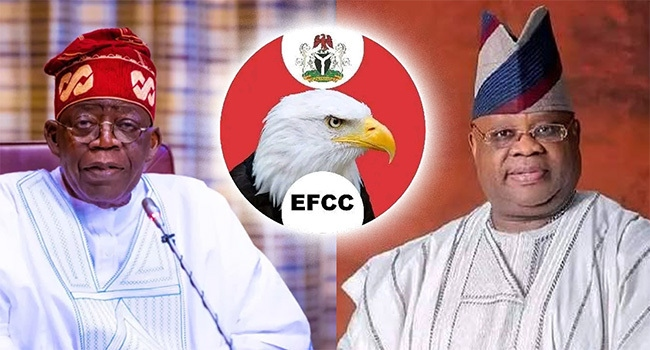
President Bola Ahmed Tinubu’s response to the controversy transformed what might otherwise have remained a routine dispute over anti-corruption enforcement into an important constitutional moment. In a public statement, the President directed the EFCC to return to court and seek to vacate the order freezing the accounts of the Osun State Government, explaining that although he had consistently allowed law enforcement agencies to operate without interference, the timing of the order—coming only days before the governorship election—risked undermining public confidence in the integrity of the electoral process.
The statement immediately divided opinion. Some praised the President for acting to preserve confidence in the election. Others questioned whether the directive itself compromised the operational independence he had just reaffirmed.
The debate, however, has been framed too narrowly.
The real constitutional issue is not whether the President may express concern about the political consequences of an investigative decision. Nor is it simply whether the EFCC should exercise restraint during an election period. The more enduring question begins at the point where the Commission left its offices, approached a court and obtained a judicial order.
That step changed the character of the dispute.
Once judicial proceedings commenced, the controversy ceased to belong exclusively to the Executive. It entered a constitutional space occupied by three institutions, each exercising distinct powers under the Constitution: the Presidency, the EFCC and the Judiciary. Understanding how those powers intersect is essential to understanding why the Osun episode deserves closer attention than the political arguments it has generated.
More Than Politics
Constitutional democracies are not tested only when institutions clash over power. They are tested when institutions, each acting within what they believe to be their lawful authority, arrive at different conclusions about where the public interest lies.
The President considered the imminent election and concluded that the timing of the freezing order threatened public confidence in the democratic process. The EFCC evidently believed that its investigation justified immediate action and persuaded a court to grant the order it sought. The court, acting on the material placed before it, exercised judicial power by issuing the order.
Each institution was performing a different constitutional function.
That is why reducing the controversy to a contest between the Presidency and the EFCC misses the larger picture. The constitutional architecture is more complex than that.
The President heads the Executive Branch. The EFCC is a statutory agency established by the National Assembly to investigate and prosecute economic and financial crimes. The Judiciary exercises the judicial powers of the Federation under Section 6 of the Constitution. Their responsibilities occasionally overlap, but they are neither identical nor interchangeable.
The Osun controversy sits precisely at that intersection.
The Executive’s Constitutional Responsibility
The President’s constitutional position is neither symbolic nor ceremonial. Section 5 of the Constitution vests the executive powers of the Federation in the President, extending to the execution and maintenance of the Constitution and all laws made by the National Assembly.
Those powers carry immense responsibility. The President is expected to ensure that government functions effectively, maintain public order and protect the democratic process. He is also politically accountable for the actions of executive agencies. Even where operational decisions are made without presidential involvement, the public often attributes responsibility to the Head of State.
President Tinubu acknowledged that reality in his statement. He explained that although he had no prior knowledge of the EFCC’s application to freeze Osun’s accounts, actions taken by federal institutions are inevitably credited to the Presidency. He reiterated that anti-corruption agencies should be allowed to discharge their statutory functions independently and without political interference.
Standing alone, that proposition reflects an important constitutional value. Institutions created by law are expected to perform the functions assigned to them by law.
Yet the statement did not end there.
Having affirmed institutional independence, the President directed the EFCC to approach the court and seek to vacate the freezing order because of the proximity of the governorship election.
It is here that the constitutional analysis begins—not because the President expressed concern, but because the concern took the form of an executive instruction directed at an agency already engaged in pending judicial proceedings.
The EFCC’s Constitutional Position
Much of the public commentary has described the EFCC as an “independent” institution. That description requires careful qualification.
The Commission was established by the EFCC (Establishment) Act as a specialised anti-corruption agency with extensive investigative and prosecutorial powers. It is designed to investigate financial crimes, prosecute offenders and, where necessary, approach the courts for orders preserving assets or preventing the dissipation of property under investigation.
Its operational mandate is intended to shield investigations from improper influence. That objective explains why successive administrations have often emphasised the Commission’s professional autonomy.
Autonomy, however, should not be confused with constitutional isolation.
Unlike the courts, the EFCC is not a separate arm of government. It forms part of the Executive Branch, albeit one entrusted with specialised statutory responsibilities. Recognising that constitutional reality does not diminish the importance of operational independence. It simply acknowledges that the Commission occupies a distinctive position within the executive structure established by law.
That distinction becomes significant once litigation begins.
The Constitutional Turning Point
Every investigation follows a familiar path.
Investigators gather evidence.
Suspects are questioned.
Documents are examined.
Assets may be traced.
Throughout that process, decisions remain administrative and investigative in character.
The constitutional landscape changes once the agency invokes judicial power.
When the EFCC approached the court and obtained an order freezing Osun State’s accounts, the dispute acquired a different legal character. The order was no longer merely the product of an executive decision. It became an order of a court exercising judicial authority under the Constitution.
That transition is more than procedural.
It reflects one of the fundamental principles of constitutional government: although the Executive may initiate proceedings, the court assumes responsibility for supervising its own process once judicial proceedings have commenced.
The distinction is easily overlooked because the same agency remains involved. Yet the source of legal authority has changed. The freezing order derives its continuing force not from the EFCC’s investigation but from the court’s decision to grant the application placed before it.
That is why the constitutional conversation cannot end with questions about executive supervision of the EFCC. A third institution has entered the picture.
The Judiciary.
From that moment onward, every subsequent step—including any application to discharge or vary the order—falls within the court’s supervisory jurisdiction over its own proceedings.