How a young student from Offa is turning a whiteboard, a marker and a smartphone into a classroom for thousands of learners
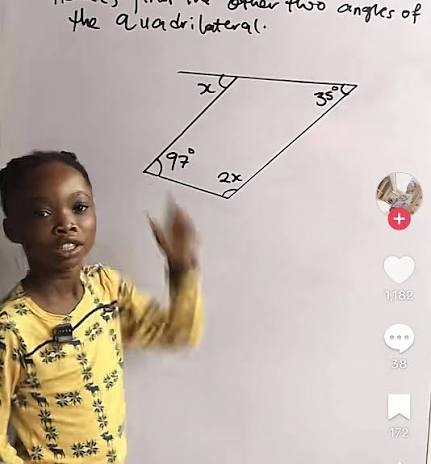
OFFA, KWARA STATE — The classroom is small. There is no projector, no laboratory and no elaborate teaching equipment. There is simply a whiteboard, a marker and a smartphone mounted on a tripod.
Yet from that modest setting in Offa, Kwara State, nine-year-old Charlotte Muritala has found an unusual way to make mathematics less intimidating for children watching her online.
A Junior Secondary School 2 student, Charlotte uses TikTok to explain mathematical problems that many pupils encounter with apprehension: algebraic fractions, cross-multiplication, lowest common multiples and other calculations that can quickly become confusing when the steps are not properly understood.
She does not present herself as a celebrity teacher. She stands before the whiteboard, writes out the problem and works through it carefully, explaining what she is doing as she goes.
That simplicity appears to be part of the attraction.
For a generation of children growing up with smartphones and short-form video, Charlotte’s lessons bring mathematics into a space they already understand. The phone that might otherwise be used only for entertainment becomes, for a few minutes at a time, a classroom.
And the teacher is one of their own generation.
From a fascination with numbers to teaching others
Charlotte’s interest in mathematics began when she was much younger.
She says she enjoys working with numbers and, particularly, breaking difficult problems into smaller pieces.
“I started liking mathematics when I was small—I love mathematics because I enjoy numbers. First, I like breaking hard problems into small parts. That makes it easier for me. So I solve it step-by-step. If I don’t get it at first, I choose another method,” she says.
Mathematics is often presented to children as a subject in which an answer is either right or wrong. Charlotte’s explanations introduce another idea: that reaching the answer can involve trying, making a mistake, changing direction and trying again.
“If I don’t get it at first, I choose another method,” she says.
For pupils struggling with mathematics, that may be more encouraging than another formula written on a blackboard.
A classroom built around a phone
Charlotte’s emergence on TikTok is also a reminder of how quickly the boundaries of the traditional classroom are changing.
Social media is frequently criticised for the amount of time young people spend online and for the difficulty parents and educators face in separating useful content from distraction. Charlotte’s videos offer a different possibility.
A mathematical explanation that might last several minutes in a conventional lesson can be presented in a short video that a pupil can pause, replay and follow at his or her own pace.
Her audience can also extend far beyond the classroom in Offa.
The account, @9charlotte3, has become a platform through which she shares her lessons with viewers interested in learning or improving their mathematics.
What makes the experiment particularly striking is its lack of sophistication. Charlotte does not need an expensive studio to teach. The basic equipment is enough.
The whiteboard provides the workspace. The marker supplies the explanation. The smartphone connects the lesson to everyone watching on the other side of the screen.
Learning without fear
Charlotte’s method is largely built around taking a difficult problem apart.
Rather than attempting to solve an equation in one leap, she works through it in stages, explaining why each operation is being performed. When one approach does not work, she is prepared to try another.
That method may sound obvious to an experienced mathematician, but it can make a considerable difference to a child who has already convinced himself or herself that the subject is too difficult.
Her advice to other pupils is equally straightforward: keep practising, accept mistakes and do not give up.
It is a message worth hearing in a subject in which fear of getting the wrong answer can sometimes become a bigger obstacle than the mathematics itself.
Behind the camera
Charlotte’s growing online presence has not happened without support at home.
Her mother created the initial digital platform to encourage her interest and give her an outlet for sharing what she knows. Her father, meanwhile, is said to place emphasis on maintaining a balance between her studies, her online activities and the ordinary experiences of childhood.
That balance is particularly important as attention around the young mathematics enthusiast grows.
Being able to explain algebra to an online audience at nine is remarkable. But Charlotte is still a child, and her education and wellbeing have to remain more important than the size of her following.
Her parents’ role is therefore not simply to help her produce more videos. It is to ensure that the opportunity created by her talent does not become another source of pressure.
A different way to see mathematics
There is a broader story in Charlotte’s small online classroom.
Nigeria has no shortage of children with curiosity and ability, but opportunities to develop those abilities are often unevenly distributed. A child in a smaller town may have limited access to specialist teachers, enrichment programmes or advanced learning materials.
Digital platforms cannot solve those structural problems. A TikTok account cannot substitute for well-equipped schools, trained teachers or reliable educational infrastructure.
But it can provide another route to knowledge.
Charlotte’s videos show what can happen when a young learner is encouraged to understand a subject deeply enough to explain it to someone else.
The significance may lie less in the number of followers she eventually attracts than in the children who watch one of her lessons and discover that the problem they feared is actually solvable.
For Charlotte, the method remains uncomplicated: take the problem apart, work through it carefully, try another approach when necessary and keep practising.
From a whiteboard in Offa to a smartphone screen anywhere in the world, that is becoming her classroom.
Channels Television – Charlotte Muritala 9-Year-Old Math Genius Turning TikTok Into Classroom This news report provides additional context and video footage of Charlotte Muritala conducting her lessons, demonstrating her step-by-step approach to solving mathematics problems on camera.