Justice, democracy and development will headline the four-day gathering as lawyers prepare to examine some of the country’s most pressing institutional and constitutional challenges
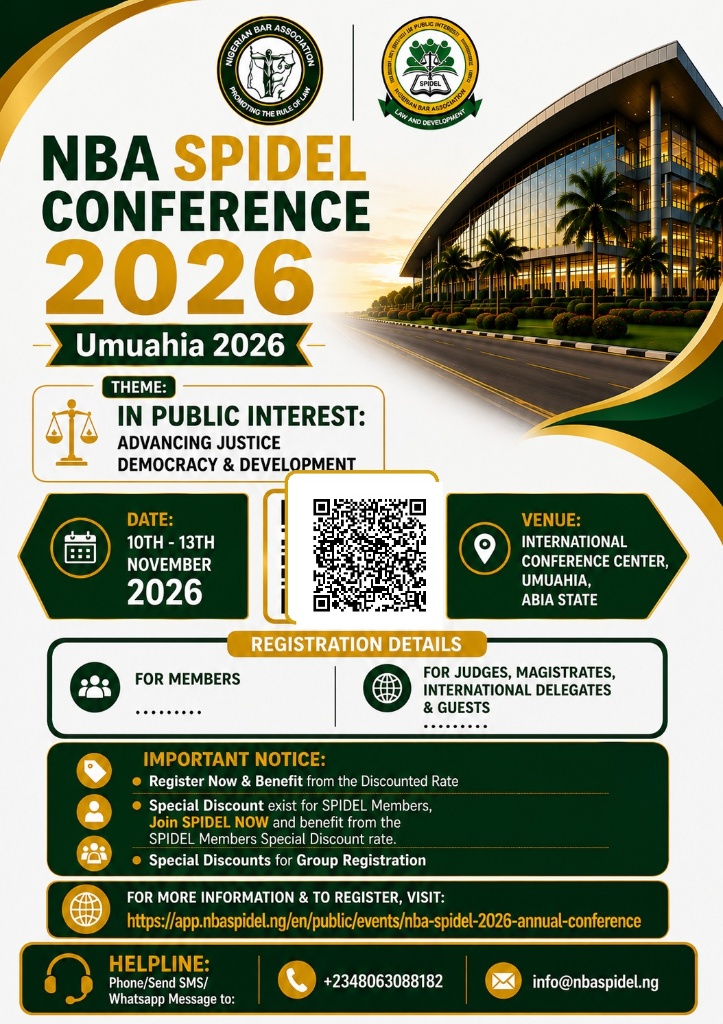
UMUAHIA, ABIA STATE — The Nigerian Bar Association Section on Public Interest and Development Law (NBA-SPIDEL) is taking its public interest mandate to Umuahia in November, where lawyers, judges, human rights advocates, policymakers and other stakeholders will gather for its 2026 Annual Conference.
The conference, scheduled for November 10 to 13 at the International Conference Centre, Umuahia, will be held under the theme, “In Public Interest: Advancing Justice, Democracy & Development.”
The choice of theme places the conference squarely within some of the most consequential questions facing Nigeria’s legal system and democratic institutions, particularly as the country moves towards the 2027 general elections. Electoral credibility, access to justice, judicial independence, human rights, criminal justice reform and the relationship between law and development are expected to feature prominently in the discussions.
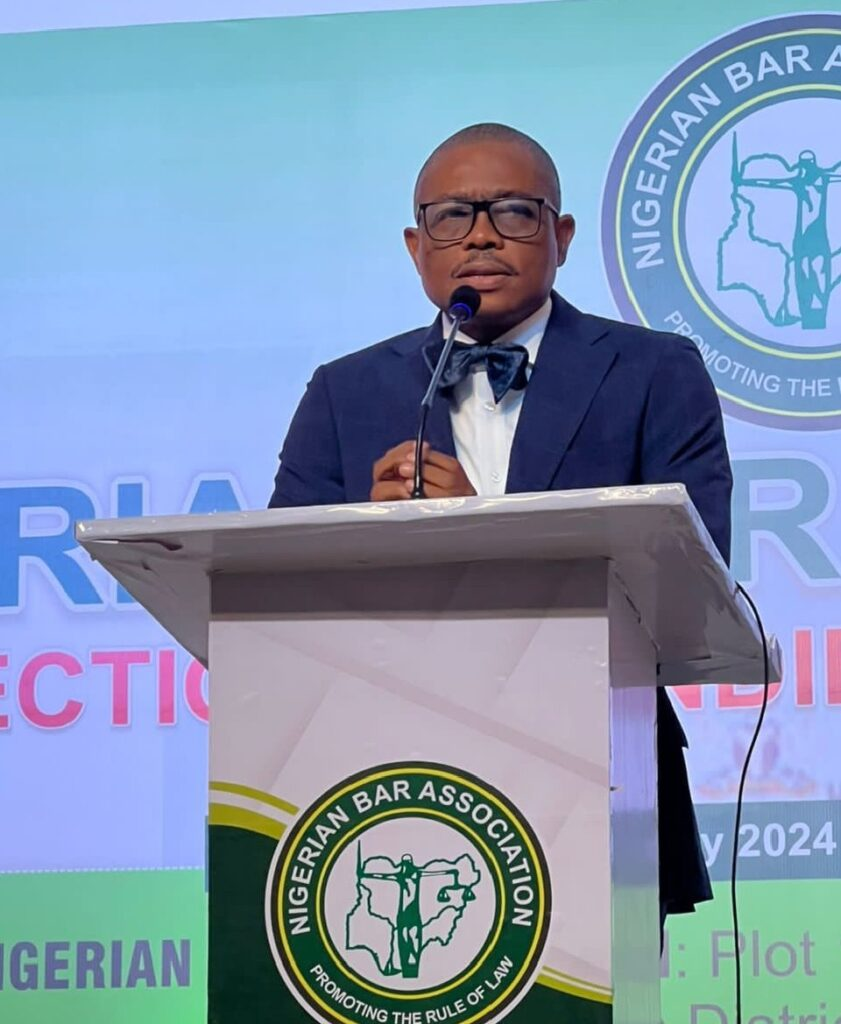
For NBA-SPIDEL Chair, Associate Professor Uju Agomoh, the value of such a gathering should not end when delegates leave the conference hall.
She has argued that the section must move beyond the production of papers and resolutions that are rarely followed through, and instead use its conferences to develop practical recommendations capable of influencing legislation, policy and the administration of justice.
That approach is likely to shape the Umuahia meeting, where public interest lawyers will have an opportunity to examine not only the state of the law but also the gap between legal guarantees and the experience of ordinary Nigerians.
The conference is being organised by a Conference Planning Committee chaired by Sir Ejike Ezenwa, SAN, working with a Local Organising Committee headed by the Abia State Solicitor-General, Paul Ogubunka.
The committees are responsible for the arrangements surrounding the four-day programme, including accommodation, transportation, security and other logistical requirements for delegates expected from across the country.
Abia’s justice reforms
The conference also comes at a time when Abia is undertaking a number of reforms within its justice sector.
At the inauguration of the Local Organising Committee, the Abia State Attorney-General and Commissioner for Justice, Ikechukwu Uwanna, SAN, said the state was renovating and constructing 17 court facilities as part of efforts to improve the administration of justice.
Uwanna also pointed to legislative changes being pursued by the state, including a Restorative Justice Law and amendments to the Administration of Criminal Justice Law.
Those developments provide a useful backdrop for a conference devoted to public interest and development law. Court infrastructure, criminal justice administration and alternatives to conventional punishment are not merely matters for lawyers and judges; they affect how quickly disputes are resolved, how accused persons are treated and how effectively citizens can enforce their rights.
Restorative justice, in particular, has become part of a wider conversation about whether the criminal justice system should rely so heavily on incarceration and punishment when some offences and disputes may be better addressed through processes that include accountability, restitution and rehabilitation.
For a section of the Bar whose work is closely associated with public interest litigation and law reform, the Abia experience offers a practical setting in which some of those questions can be examined.
A conference with a wider brief
NBA-SPIDEL has, over the years, become one of the principal platforms within the Nigerian Bar for discussions around public interest litigation, human rights, constitutionalism, access to justice and institutional reform.
The Umuahia conference will extend that conversation to the relationship between justice and development.
Nigeria’s legal challenges increasingly intersect with economic and social questions. Congested courts, prolonged detention, inadequate legal representation, police accountability, prison conditions, electoral disputes and weak enforcement of judgments all have consequences beyond the courtroom.
The same is true of democratic governance.
As political activity begins to gather momentum ahead of 2027, questions about the independence of institutions, the credibility of elections and the protection of civil liberties are likely to occupy increasing space in public debate. Lawyers will inevitably find themselves at the intersection of many of those disputes.
The conference therefore offers SPIDEL an opportunity to ask a larger question: what should public interest law achieve when the formal existence of rights does not necessarily translate into their enjoyment?
That question is particularly relevant to the section’s work in strategic litigation and law reform, where successful advocacy is measured not simply by a judgment but by whether the judgment changes conduct, policy or the lives of the people affected.
Registration opens
Registration for the 2026 conference has opened, with early-bird rates available to delegates. Discounted rates are also available to registered SPIDEL members, group participants and judicial officers.
The four-day conference will hold from November 10 to 13, 2026, at the International Conference Centre, Umuahia, Abia State.
Organisers expect more than 2,000 participants, including lawyers, judges, magistrates, human rights practitioners, policymakers and other stakeholders.
For registration and conference information, delegates can visit the official NBA-SPIDEL conference portal.
The gathering comes at a time when the Nigerian legal profession is being asked to look beyond its traditional role as an interpreter of law and to confront the institutional failures that often determine whether the law works at all.
For SPIDEL, Umuahia will provide another opportunity to put that question before the profession—and to ask what happens after the conference papers have been delivered, the speeches made and the delegates have gone home.