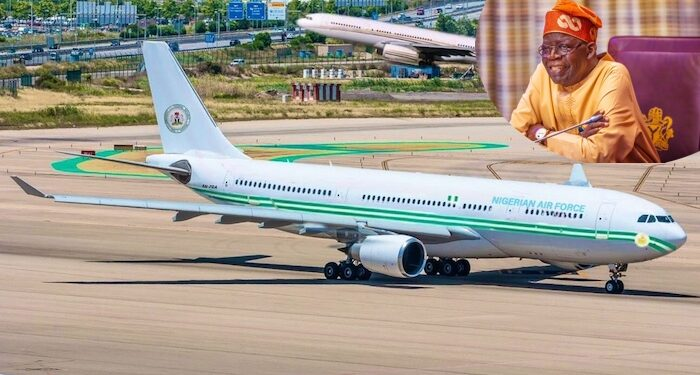
As the President embarks on his 52nd foreign trip, a report by West Africa Weekly puts his time abroad at 261 days and presidential travel expenditure at N37.6 billion
There is a price to keeping a presidency in the air. The question is whether Nigeria is getting enough back for what it spends.
A president does not have to be everywhere to govern effectively. The leaders of the world’s most powerful countries understand that the presidency is ultimately about what happens at home: the roads that connect communities, the hospitals that keep people alive, the schools that prepare the next generation and the institutions that give citizens confidence that government is paying attention to their lives.
Donald Trump, who occupies the most powerful political office in the world’s largest economy, travels abroad when American interests require it, but much of the business of his presidency is conducted from Washington. Foreign leaders come to the White House, diplomats negotiate on America’s behalf and an enormous government machinery continues to function without requiring the President to be physically present in every foreign capital.
That makes the scale of President Bola Tinubu’s travels a legitimate subject for public scrutiny.
In a report published under the headline “Tinubu Has Spent 261 Days Abroad, 52 Trips, N37.6bn—Enough to Build Roads, Hospitals and Schools Across Nigeria,” West Africa Weekly calculates that Tinubu has made 52 foreign trips since assuming office on May 29, 2023, spending approximately 261 days outside Nigeria. The report puts presidential travel, logistics and foreign-exchange expenditure between June 2023 and April 2026 at N37.64 billion.
Those figures, if accurately reported, present more than a question about how often a President travels. They invite Nigerians to consider what public expenditure says about the priorities of a government presiding over an economy in which millions of citizens are struggling with the cost of food, transportation, healthcare, education and energy.
Two hundred and sixty-one days is almost nine months. Fifty-two foreign trips amount to an average of more than one trip every three weeks since Tinubu took office. His latest departure, a three-week vacation in Europe, adds another lengthy absence to that record.
There is nothing inherently wrong with a Nigerian president travelling abroad. Heads of government must meet counterparts, pursue investment, attend international summits and represent their countries. Some diplomatic and economic engagements can only be conducted effectively at the highest political level.
The question is whether the frequency and cost of those journeys are justified by what they produce for the country.
That question becomes harder to avoid when the government is simultaneously asking Nigerians to absorb the consequences of difficult economic reforms. Petrol remains expensive, food prices have risen dramatically, transport has become a burden for many families and public infrastructure continues to fall short of what a country of Nigeria’s size and resources should reasonably expect.
The Presidency has defended Tinubu’s travels as necessary engagements and has described his latest absence as a period of rest before the demands of the 2027 political season intensify.
The argument deserves to be heard.
So does the other side.
Public office carries not only privileges but a responsibility to explain how public resources are used. When tens of billions of naira are spent on presidential travel while citizens struggle to pay for necessities, the issue cannot be reduced to whether the President is entitled to travel.
It becomes a question of value.
What did Nigeria receive in return?
Which journeys produced agreements that have translated into jobs, investment or infrastructure?
Which generated measurable diplomatic gains?
And how does the government justify the cost at a time when it is demanding sacrifices from citizens?
These are not questions about whether a President should ever leave Nigeria. They are questions about whether the time spent away, the money expended and the results delivered remain in reasonable proportion.
That is the debate opened by the West Africa Weekly report—and it is a debate that cannot be settled by counting boarding passes alone.
The full report is reproduced below.
President Bola Tinubu departed Abuja on Sunday for a three-week vacation in Europe, his 52nd foreign trip since assuming office on May 29, 2023. This means he has now spent approximately 261 days outside Nigeria, visiting at least 30 countries. France has been his most frequent destination, followed by London and the United Arab Emirates. While he vacations, petrol is N1,310 per litre, food inflation is over 20 per cent, and the Presidency’s travel bill has hit N37.64 billion in just three years.
The Presidency, through Sunday Dare, defended the trip as a well-earned break for the President to “refuel” ahead of the 2027 election campaign. Bayo Onanuga said Tinubu would return to join the “hectic campaign”. But the figures tell a different story: from June 2023 to April 2026, the Presidency spent N37,639,227,853.51 on presidential trips, logistics and foreign exchange. The highest expenditure was in 2024, when more than N25.26 billion was spent, driven largely by foreign exchange allocations and funding for the Presidential Air Fleet. In 2023 alone, the State House spent N9.18 billion in just six months. The First Lady’s trips also attracted N700.7 million in forex between 2023 and 2024.
That N37.64 billion could have built thousands of kilometres of roads, equipped hundreds of primary health centres, or provided school meals for millions of children. Instead, it has been spent on flights, hotels and foreign exchange for the President and his entourage. In January 2026 alone, Tinubu spent 22 days abroad, including 10 days in France as part of his end-of-year vacation. In 2025, he spent N2.7 billion on travel. The 2026 budget allocated another N6.14 billion for international travel. When he returns from this latest trip, he will have spent more than nine months of his presidency outside the country.
Former Vice President Atiku Abubakar has led the criticism, accusing Tinubu of abandoning his post while the country burns. “Consider what Bola Tinubu is leaving behind. Petrol priced beyond the reach of ordinary people. Families rationing food. Transport fares that have turned a journey to one’s own village into a luxury. Insecurity that buries Nigerians week after week. And in the middle of all this, President Tinubu has packed his bags for three weeks in Europe,” Atiku said. Peter Obi has also criticised the frequent trips, noting that Tinubu prefers to stay abroad and only returns to welcome APC defectors. Political science professor Jideofor Adibe described the travels as “overdone,” arguing that Nigeria’s diplomatic architecture already provides adequate mechanisms for international engagement.
While Tinubu vacations, petrol prices keep rising, food costs keep climbing, and Nigerians keep struggling. The Presidency insists these trips are necessary to attract investment and strengthen diplomatic ties. But the results are not visible to ordinary Nigerians. N37.64 billion has been spent on travel in three years. That same money could have built roads, paid teachers, equipped hospitals or fed the hungry. Instead, it has been spent on flights, hotels and foreign exchange for the President and his entourage. The man who made Nigeria expensive has chosen a boarding pass over a fire extinguisher, and Nigerians are left to wonder when he will finally stay home and do the job he was elected to do.