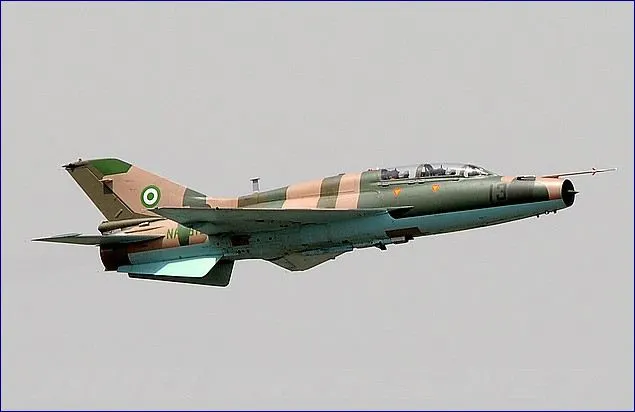
Nigeria’s military posture in West Africa is under renewed scrutiny after reports emerged that the Nigerian Air Force (NAF) executed rapid, precision airstrikes to help foil a coup attempt in the Benin Republic — even as Nigerians question why similar decisive force has not been deployed against armed groups inside Nigeria.
According to counter-insurgency analyst Zagazola Makama, NAF fighter jets — acting with the full consent of Beninese authorities — struck at fleeing coup elements attempting to escape Cotonou in armoured vehicles after loyalist forces regained control from mutineers aligned with Lt. Pascal Tigri.
The strikes, Makama said, were conducted in a tightly coordinated 30-minute window, disabling escape routes and halting the retreat of hostile elements.
Residents in parts of Cotonou reported hearing explosions and seeing smoke rising from targeted zones. Security sources said the air operations prevented regrouping attempts and neutralised several vehicles used by the plotters.
“The operation was meticulously planned and executed,” Makama noted, citing sources familiar with the mission. “Our objectives were clear: prevent destabilisation, block escape corridors, and support regional stability in partnership with Benin.”
A top Nigerian military official, speaking on background, added that the mission adhered to international operational protocols, emphasising intelligence-driven targeting and efforts to minimise civilian exposure.
“The Nigerian Air Force remains committed to safeguarding regional security and preventing any spillover that could threaten our borders,” the officer said.
The intervention followed Tigri’s short-lived broadcast announcing the dissolution of state institutions before loyalist troops restored control. Several key members of the coup faction attempted to flee southward, prompting Nigeria’s rapid aerial response.
Domestic Questions: Why Precision Abroad, But Not at Home?
The operation has sparked debate across Nigeria, where banditry and mass abductions remain a persistent threat.
Critics note that the same government capable of launching high-speed cross-border precision strikes has struggled to address violent criminal networks within Nigeria.
The contrast is especially stark in states like Zamfara, where Governor Dauda Lawal has repeatedly said he knows the exact locations and movements of bandit leaders but lacks authority over federal security agencies.
“Wherever a bandit leader is in Zamfara State, I know it,” the governor declared in a viral video. “With my phone, I can show you where they are today.”
Yet the federal government has not acted on his claims.
The dilemma resurfaced after victims kidnapped from a Christ Apostolic Church in Kwara State were released. A presidential spokesperson, Bayo Onanuga, confirmed that security agencies opened communication channels with the abductors to secure the victims’ safety — raising questions about Nigeria’s reliance on negotiation instead of decisive action.
The contrast has fueled public frustration:
If Nigeria can deploy missiles to stop a coup abroad, why does its response to domestic armed groups appear restrained?
For now, the precision strikes in Benin mark one of Nigeria’s most forceful military interventions outside its borders in recent years — a move analysts say underscores Abuja’s growing willingness to confront regional threats before they escalate.