


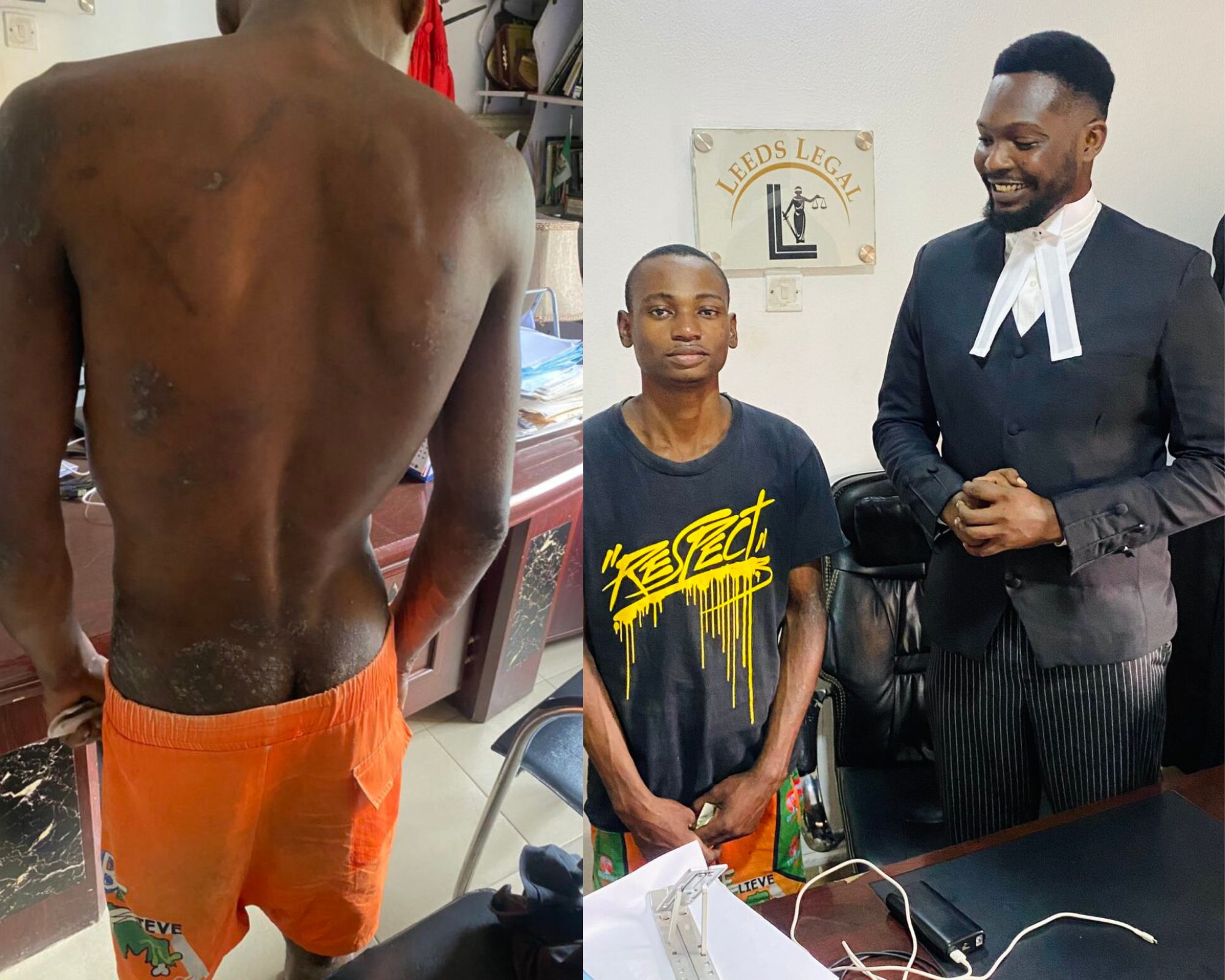
How did a 12-year-old get here?? What kind of system will allow a mere preteen to remain incarcerated for 10 years without trial and without giving a hoot? And when did 12-year-olds start going to jail and mixing with hardened criminals? Emeka’s story is the story of our unfeeling, calloused and broken justice system.
July 11 was supposed to be a routine prison visit for Alex Umuchioke Ogoke, a lawyer with the Legal Aid Council of Nigeria and Leeds Legal Firm. Ogoke had walked into that Nigerian correctional facility in Imo State to request the usual list of indigent inmates in need of pro bono legal representation.
He did not expect to find a gaunt, sickly young man slumped by the records desk, begging the officers for money to buy garri. Ogoke was taken aback by how young and how sick the boy looked. So, he requested his case file.
The officers told Ogoke the boy’s name was Emeka Nzeruike. He was hungry but he had no family. His case file shocked Ogoke. “I asked how long he had been in custody, and they said since 2015. I asked his age. He said 22,” Ogoke recounted. “That meant he was just 12 when he was arrested.”
Nzeruike had spent a decade behind bars, without trial, without conviction, and without anyone checking on him. He had simply vanished into the cracks of Nigeria’s criminal justice system. The deeper Ogoke looked, the more disturbing the details he found.
EMEKA, THE BOY ALONE
Nzeruike was arrested in 2015 in Imo, alongside an adult, for stealing. Both were charged and granted bail by a magistrate in Iho.
While the other suspect’s family secured a surety and got him out almost immediately, Nzeruike remained locked up.
“He had no one,” said Ogoke. “His mother was already dead, and his father had remarried and moved to Benue State. He never once came to visit Emeka. Not in ten years.”
When the lawyer eventually tracked Nzeruike’s father down, he learnt that the man had no relationship with his son and even if he did, he was too poor to have rescued him anyway.
Nzeruike himself had told the lawyer that he had not seen his father in the four years leading up to his arrest. As a lonely 12-year-old, he was stuck in prison with no one to bail him out and no way to meet his bail conditions.
Determined to find some kind of family link, Umuchioke travelled to Nzeruike’s ancestral village in Ikeduru. There, he met the boy’s grandmother, the only relative he remembered.
“I had to go to Emeka’s village, Ikeduru, and I found his grandmother, the only person he knew before prison. She was shocked. She thought I was coming to tell her Emeka had died. She lives in abject poverty, surviving by farming other people’s land,” Ogoke recounted.
She kept asking, “Is he really alive?”
DIE OF HUNGER OR DIE OF BEATING: GLIMPSE INTO PRISON LIFE
In prison, Nzeruike had learnt to survive in brutal ways.
“People told me that whenever food vendors came, Emeka would snatch a piece of bread and eat while they beat him,” the lawyer said. “He told me he had nothing to lose. It was either die of hunger or die from beating.”
The first time he ever bought soap, he told Ogoke, was the day he gave him some money.
The details of Nzeruike’s story in prison are not surprising.
According to the 2025 Appropriation Bill, the federal government allocates just N1,270 (about $0.84) per day to feed each inmate across Nigeria. That figure is over N500 short of what it costs to provide one healthy meal. A single healthy meal according to the NBS costs an estimated N1,651 per serving.
BROKEN JUSTICE SYSTEM
The lawyer said this case was one of the hardest he has ever handled. For days, he chased leads at the wrong magistrate’s court.
“We were going to the wrong division entirely,” Ogoke said. “The records said one thing, but Emeka remembered being taken somewhere else as a child.”
It turned out the case was filed in the Iho Magistrate Court, not Nwabosi as previously thought. Ogoke said, “We finally found the court that charged him and pulled out the record. He had been granted bail all along.”
Record-keeping failures, Ogoke said, are rampant. Even worse are the distortions that happen at the earliest stage of prosecution. These errors, according to the lawyer, are courtesy of the police.
“In similar cases to Nzeruike’s, the police write 18 or 19 on the charge sheet. It’s a common trick to bypass child protection laws. And magistrates often don’t question it,” the lawyer explained.
FIJ has reported how overcrowded courts, limited judicial capacity and the sheer volume of cases cause severe delays. At press time, Nigeria has an estimated six judges per million citizens. For the poorest detainees, this often means indefinite incarceration.
“When I went to pick Emeka up from prison after his discharge,” Ogoke said, “another minor was being brought in. His name was Onyemachi Amadi. He had just been remanded for allegedly stealing palm kernel oil.”
The lawyer said that more than half of prison inmates today were either innocent or victims of police oppression. “I’m currently handling the case of 14 boys from the North. They were picked up randomly at a junction, held at the station for five days, then dumped in prison. They’ve now been there for over two months. This is how it starts. Two months, then four, then a year.”
Ogoke continued: “These people are too poor to afford legal help. Some are even breadwinners. So their detention devastates entire families. That’s why we keep calling for criminal justice reform.”
ANOTHER CHANCE AT LIFE
Today, Nzeruike is finally free but the scars are deep. He is currently in hospital, receiving treatment for malnutrition and rashes.
The lawyer told FIJ that he and his team were arranging therapy.
“He’s lost in this world,” Ogoke said. “He doesn’t understand what’s happening around him. After therapy, we’ll ask him what he wants, whether to go to school, learn a skill, or both and support him.”
For the first time, the lawyer made a public call for support. Donations have poured in through the law firm’s account, helping to fund Nzeruike’s recovery.
But the bigger questions remain unanswered: How many more boys are locked away, forgotten by both state and family? How many others never get a visit from a lawyer?
Ogoke concluded with a plea:
“Magistrates must be more circumspect when ruling on minors. Courts should be mindful of inmates like Emeka who are technically free but cannot perfect bail because they have no one.
“And I say this to fellow lawyers—visit detention centres. Take up pro bono cases. People are suffering. We need more people to join this fight.”
This article was originally published on 31.07.2025 by Foundation for Investigative Journalism






A heartbreaking failure of justice. No child should disappear into the system like this — ten years without trial is not just negligence, it’s inhumane. Those responsible must be held accountable.