By Agbeze Ireke Kalu Onuma, AI-KO
It started as a joke. Just a catchy phrase, something tossed into the air for the ensuing political campaigns, designed to soften the hard edges of raw ambition. In the buildup to the 2027 elections, the term “City Boy” entered Nigeria’s everyday language as a way to describe Bola Ahmed Tinubu. It was meant to show his cosmopolitan style, the confident swagger of a Lagos political godfather who had spent decades building networks and wielding influence in the country’s commercial capital. The nickname created a contrast with his rivals, painting him as sophisticated and urbane, a man of the city in a nation where cities represent opportunity, progress, and the dream of escape from rural hardship. It was campaign slang, nothing more, or so it seemed at the time.
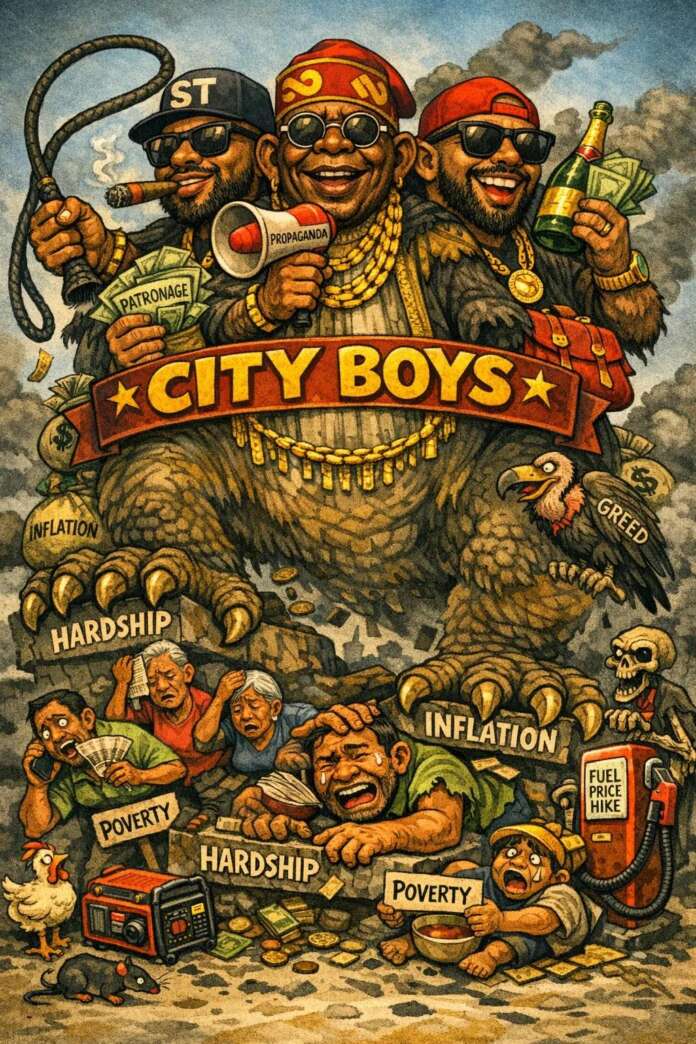
But as the months passed, bleeding into the difficult, grinding reality of 2026, that harmless campaign nickname grew into something far more substantial and deeply concerning. Today, the City Boys Movement is no longer just a hashtag trending on Twitter or a design printed on campaign t-shirts. It has evolved into a fully operational, heavily funded national political infrastructure, one that is already laying the…
Let us begin by saying something that should be obvious but has become strangely difficult to say in public: there is a movement among us, and it calls itself by a name that sounds like it belongs to the streets but was actually born in boardrooms. The City Boys Movement has emerged with the force of a sudden storm, appearing on our television screens, filling our social media timelines, rallying young Nigerians in stadiums and public squares, wrapping itself in the colors of youth and ambition and hope. They come bearing gifts—not just promises, but actual things: branded polo shirts, rechargeable fans, bags of rice, cash transfers, the kind of help that lands in the hands of a struggling mother and makes her feel, for a moment, that someone sees her. They speak the language of empowerment. They tell young people that their time has come, that they should not wait for anyone to hand them power, that they should rise and claim what belongs to them. They have celebrities on their side: musicians who fill stadiums, actors who command massive followings, influencers whose every post reaches millions. They have business moguls whose names are synonymous with wealth and success. They have, most importantly, the proximity to the highest office in the land, the kind of access that ordinary Nigerians can only dream of. And they have organized themselves into a machine that moves with purpose, that shows up where it needs to show up, that knows how to activate crowds, that has learned the lessons of political organizing and applied them with the discipline of people who are used to getting what they want.
You have seen them. Seyi Tinubu, the president’s son, standing at podiums in front of thousands, speaking about the future of Nigerian youth as if he has lived that future himself. Obi Cubana, the businessman whose wealth is so visible, so celebrated, so wrapped in the culture of opulence that he has become a symbol of what is possible in Nigeria, standing alongside politicians, distributing money at rallies, lending his name and his influence to the project of keeping things exactly as they are. Entertainers whose songs are the soundtrack of Nigerian life, whose faces are known to every young person from Lagos to Maiduguri, standing on stages and telling their fans that the president is working hard, that we must be patient, that criticism is a tool of the enemy. They are everywhere. They have become so familiar, so present, so impossible to ignore, that many Nigerians have begun to accept them as a natural part of our political landscape, as if it has always been normal for billionaires and presidential offspring to lead youth movements.
The City Boys Movement, championed by Seyi Tinubu and supported by prominent Igbo businessmen including Obi Cubana, Cubana Chief Priest, and Zenco, represents something more than just another support group for a president seeking re-election. It acts as a mirror, reflecting Nigeria’s unresolved historical tensions, its deep class divisions, and the ongoing struggle between what elites want and what the people need. This essay takes a historical look at the City Boys Movement, breaking down its different parts and placing it within a wider comparative framework. By examining earlier movements from history where power gathered against the people, we can spot patterns of elite manipulation, the way popular energy gets used by the powerful, and the deadly outcomes that often follow when political deals prioritize strategic interests over democratic substance. The title of this essay—”This Too Shall Pass Away”—serves both as a warning and a quiet meditation. It reminds us that today’s powerful political structures, like all those before them, carry inside themselves the seeds of their own change or eventual disappearance.
To understand what the City Boys Movement really is, we have to pull apart its parts and see how they fit together. According to its spokesperson, Emana Amawhe, the movement is a broad-based coalition open to every Nigerian. But the evidence suggests something else. Its origins go back to the 2023 presidential election, where it started as a youth advocacy platform supporting Tinubu’s campaign. Today, it has grown into a sophisticated mobilization machine, claiming to have a presence in all 774 local government areas across the country. It recently absorbed the National Councillors Forum, which brings together eight thousand eight hundred elected representatives from polling units nationwide. That is not a small operation. That is a political infrastructure designed to reach into every corner of the country.
The leadership structure of the movement reveals its true character. Seyi Tinubu, the president’s son, serves as its champion, what some call the grand patron. Beneath him are prominent businessmen who act as zonal coordinators. Obi Cubana, for instance, holds the position of South-East Zonal Coordinator, tasked with bringing young Igbo entrepreneurs behind the president’s re-election campaign. This kind of arrangement represents what political scientists call the fusion of economic capital with political power. It is a setup that history has shown tends to serve elite interests first and foremost, often at the expense of broader democratic participation. When wealthy businessmen become the face of political mobilization, the question naturally arises: who is really being served, and what are they expecting in return?
The movement’s own words about itself deserve a close look. Amawhe insists that members are people who are well accomplished in their fields, successful businessmen, professionals with good reputations. He says they are individuals with first addresses who are not seeking political appointments. But that very language—accomplishment, first addresses, reputation—reveals the class character of the organization. This is not a movement of struggling market women or unemployed graduates. It is an organization of people who have already made it, seeking to protect and extend their position by getting close to state power. There is nothing wrong with successful people being politically active, but the question is whether this kind of movement opens up politics or closes it down.
One defender of the movement, Enyinnaya Appolos, wrote with remarkable honesty about its philosophy. He said politics is not a charity drive, that it is a ruthless marketplace of interests where political, economic, and ideological forces must be strategically aligned. This view reduces democratic participation to a business transaction. It takes the idea of citizenship and turns it into investment, with voters seen as shareholders looking for returns. The movement’s buses, bought by members matching their words with action, become less about democratic engagement and more like advertisements for a particular way of doing politics. In this model, wealth buys access, and access buys influence. The poor and the struggling need not apply, except as spectators or, at best, as recipients of what the wealthy decide to give.
This brings us to the core ideology of the City Boys Movement. It is not really about governance, about how to run a country well, about fixing roads or building hospitals or creating jobs. It is about the commodification of poverty, the transformation of hardship into a resource that can be traded. The movement thrives on what can be called the “Agbero-ization” of Nigerian politics. An agbero, in Lagos slang, is a transport worker who controls access, who demands payment for passage, who operates through a mixture of muscle and negotiation. When politics becomes like this, it glorifies the hustle, rewards being close to power rather than being productive, and demands unthinking loyalty in exchange for small favors.
The movement’s public events follow a pattern. They roll into poor neighborhoods with shiny cars and loud music, distributing branded bags of rice, small amounts of cash, and what they call empowerment materials. But this is not empowerment. Empowerment would mean giving people the tools to stand on their own, to build businesses, to send their children to school, to access healthcare. What the City Boys offer is a down payment on future loyalty. It institutionalizes a begging culture, turning the fierce, independent spirit of Nigerian youth into a docile hand stretched out for whatever falls from the table. The movement sells a counterfeit gospel: that the president has somehow banished poverty because his wealthy friends can occasionally throw food to the crowd from the back of an expensive truck.
But we must stop. We must take a breath. We must ask the question that sits at the very heart of everything: who are these people, really? Not the branding, not the Instagram posts, not the carefully curated images of charity drives and empowerment seminars, but the actual human beings behind the movement. When you strip away the slogans and the hype, what do you find? You find a familiar class, the kind of Nigerians who have always existed in our political landscape but have rarely been so bold as to claim they represent the masses. You find children of power, people whose surnames opened doors that remain closed to the rest of us. You find beneficiaries of old networks, people who inherited not just wealth but the knowledge of how wealth is made in Nigeria—through contracts, through connections, through the ability to get a phone call returned at Aso Rock. You find men and a few women whose proximity to the presidency is their primary credential, the single most important fact about their public identity. They were not forged in the chaos of Oshodi traffic, in the darkness of Abijo GRA with dead transformers, in the queues at embassies where people stand for hours hoping for a visa to a country that might treat them like human beings. They were forged in boardrooms and private schools, in gated estates and VIP sections, in spaces where the struggles of ordinary Nigerians are theoretical problems to be solved with focus groups and talking points, not lived realities to be endured every single day.
Let us be plain. Seyi Tinubu stands at a podium not because he has built anything for the masses, not because he has endured the hardship of the unemployed graduate or the market woman who borrows money at dawn to buy goods she will sell at a loss before sunset. He stands there because his father is the president of Nigeria. That is the sum total of his qualification. He did not campaign for votes. He did not build a movement from the ground up by going from village to village, listening to farmers talk about their yields, hearing from mothers whose children have malaria and cannot afford medicine. He did not spend years organizing communities, learning the patience and humility that genuine leadership requires. He was born into a situation, and that situation has given him access to resources and platforms that would take most Nigerians several lifetimes to acquire. And yet, we are asked to treat his movement as organic, as grassroots, as the authentic voice of a generation that is drowning in debt and despair. We are asked to believe that this man, whose life has been insulated from every hardship that defines the Nigerian experience, somehow understands what it means to be young and Nigerian in 2026. We are asked to trust him with our political future, to align ourselves with his project, to see him not as what he is—the son of the president leveraging his father’s position—but as a leader who emerged from the people.
Obi Cubana built a business empire that many Nigerians admire. There is no question that he is a successful entrepreneur, that he has created jobs, that his name is associated with a certain kind of Nigerian excellence. But we must ask ourselves: what is the source of that empire? It is built on consumption, on the celebration of opulence, on the very same inequality that the City Boys Movement claims to want to address. His wealth is visible in the cars he drives, the houses he builds, the parties he throws, the lifestyle he displays for millions of followers. There is nothing inherently wrong with wealth honestly earned, but there is a profound hypocrisy in using that wealth to buy political loyalty from a population that cannot afford to feed itself. When Obi Cubana stands on a stage and tells young people to support the president, he is not speaking from a position of shared experience. He is speaking from a position of immense privilege, and that privilege is built on a system that has failed the very people he is addressing. The young man in Port Harcourt who sees Obi Cubana’s fleet of cars and dreams of one day owning his own does not think about the structural barriers that prevent him from starting his own business. He does not think about the fact that he cannot get a loan because interest rates are astronomical and banks require collateral he does not have. He does not think about the fact that even if he had a brilliant idea, he would have to navigate a regulatory environment designed to extract from him, not to support him. He thinks: if this man can make it, so can I. And the movement banks on that aspiration. It does not need to promise the young man that the system will change. It only needs to promise that if he aligns himself with the right people, if he shows loyalty to the right leaders, if he is patient and hardworking and grateful, he too can become a City Boy. This is the most seductive form of co-optation. It turns the desire for a better life into loyalty to the very structures that make a better life impossible for the majority. It offers not a ladder that anyone can climb but a rope that only a few can grasp, and it makes sure that those who grasp it are too busy holding on to ask where the rope is leading.
There is a class dimension here that everyone sees but few articulate openly, because to name it is to risk being called bitter or jealous or unpatriotic. The City Boys are the visible tip of a class that has learned to thrive in Nigeria by mastering the art of access. They are the ones who know how to get a phone call returned at Aso Rock. They are the ones who can secure an import license when others wait for years. They are the ones who can turn a presidential handshake into a contract worth millions. Their success is not a testament to the openness of Nigerian society but to its closedness. In a truly open society, success would be distributed across thousands of paths: the brilliant engineer who builds something that changes the world, the innovative farmer who revolutionizes agriculture, the dedicated teacher who transforms a generation, the honest civil servant who makes the system work for everyone. In Nigeria, success too often funnels through a single narrow channel: the channel of political connection. The City Boys are the most visible swimmers in that channel. They did not dig it. They did not create the system. But they have learned to navigate it with extraordinary skill, and now they want to convince us that their skill is our salvation. They want us to see their ability to extract from the system as evidence that the system works, when in fact it is evidence that the system works only for them.
Think about what it means to be young in Nigeria today. Think about the graduate who finished university three years ago and has been sending applications ever since, watching his hope turn to frustration turn to despair. Think about the young woman who started a small business with her savings, who watched it collapse under the weight of diesel costs and a naira that loses value faster than she can adjust her prices. Think about the young man who learns a trade, who apprentices for years, who finally opens his own shop, only to be squeezed by taxes and levies and the constant demand for “settlement” from officials who see his hard work not as something to protect but as something to extract from. Think about the millions of young Nigerians who have left the country in the past few years, who have taken the risk of crossing the Sahara, who have drowned in the Mediterranean, who have ended up in countries where they are treated as less than human, all because they could not see a future in the land of their birth. These are the young Nigerians that the City Boys Movement claims to represent. These are the people they say they are fighting for. And yet, when you look at the movement’s leaders, when you examine their lives and their backgrounds, when you ask what they have sacrificed and what they have built and what they know of the struggles they claim to champion, the gap between rhetoric and reality becomes a chasm.
This is not to say that wealthy people cannot care about the poor, or that the children of powerful people cannot have genuine concern for the masses. There are plenty of examples throughout history of people born into privilege who used that privilege to serve others, who dedicated their lives to justice, who fought against the very systems that elevated them. But the City Boys Movement does not fight against systems. It defends them. It does not seek to restructure the Nigerian state so that it works for everyone. It seeks to persuade us that the state, as it is, is working as hard as it can and we simply need to be patient. It does not ask why Nigerian youths must depend on handouts from billionaires to survive. It does not question why the state cannot provide jobs, healthcare, education, clean water, reliable electricity. It simply repackages the failure of the state as the generosity of the wealthy. And in doing so, it becomes the most effective defender of a status quo that has brought Nigeria to its knees. The handouts that the movement distributes are not a solution to poverty; they are a way of making poverty bearable, of taking the edge off the hunger just enough that people do not take to the streets. The empowerment programs are not about giving people the tools to become independent; they are about creating dependency, about making sure that people understand that their survival depends on the goodwill of the powerful. This is not leadership. This is management. It is the management of discontent, the management of hunger, the management of a population that has been pushed to the edge and is being kept from falling by the occasional distribution of crumbs.
Now let us turn to the second question that has bothered me, the one that cuts even deeper than the first. What qualifies these people to speak to us about politics and our relationship with power? This is not a rhetorical question. It is a question that should be shouted from every street corner, repeated on every radio station, carved into every political discussion until it cannot be ignored. What qualifies a businessman whose wealth depends on political patronage to tell us how to relate to power? What qualifies an entertainer whose craft is the performance of excess to teach us about governance? What qualifies the son of a president to lecture us on citizenship? What qualifies someone who has never had to fight for anything in their life to tell us that we should be patient, that we should endure, that we should trust the process? The answer, of course, is nothing. Nothing qualifies them except the audacity that wealth and proximity confer. They speak not because they have earned the right through service or through struggle, but because they have positioned themselves in the spotlight. And in a country where the spotlight is itself a commodity bought and sold by those with access, positioning becomes the only qualification that matters.
Let us be precise about what genuine qualification for political leadership would look like in a healthy democracy. It would look like a lifetime of organizing communities, of understanding the material conditions of ordinary people, of testing ideas against reality. It would look like a record of accountability: promises made and kept, failures admitted and learned from. It would look like independence: the ability to stand up to power, to speak truth when it is uncomfortable, to prioritize the interests of the many over the comfort of the few. None of the City Boys leaders possess these qualifications. They have not organized communities except to rally them for photo opportunities. They have not understood the material conditions of ordinary people except as data points for their charitable distributions. They have not tested ideas against reality because they have no ideas beyond the idea that the current arrangement should continue. And they have certainly not demonstrated independence. Every public appearance they make is a performance of loyalty, a reaffirmation that they belong to the president’s camp. When they speak, they are not expressing independent judgment; they are executing a strategy that has been designed for them, a script that has been written by people who understand that the best way to protect power is to surround it with voices that sound like they come from the people.
Consider what the City Boys actually say when they speak about politics. Do they talk about policy? Do they discuss industrial policy, educational reform, healthcare financing, judicial independence, electoral integrity, security sector reform? Do they offer detailed proposals for how to create jobs, how to stabilize the currency, how to fix the power sector, how to make Nigerian agriculture competitive on a global scale? They do not. They talk about loyalty. They talk about gratitude. They talk about the president’s good intentions. They talk about how hard he is working. They talk about how those who criticize him are enemies of progress, agents of destabilization, people who do not love Nigeria. This is not political discourse. This is the language of a court, not a republic. It is the language of subjects talking about their king, not citizens talking about their elected officials. And it is effective precisely because it avoids the difficult questions. By focusing on personality and loyalty, the movement distracts from the substance of governance. It turns politics into a morality play where the only virtue is fidelity to the leader and the only sin is dissent. In such a framework, there is no room for debate about whether the country is better off than it was four years ago, whether policies are working, whether resources are being used wisely, whether the lives of ordinary Nigerians have improved. There is only the simple binary: you are with us or against us.
What is especially striking is the poverty of the movement’s political philosophy. When pressed, when asked to explain why they are doing what they are doing, when asked to justify their role in Nigerian politics, its defenders fall back on a crude pragmatism. Politics is a marketplace of interests, they say. Everyone is looking out for themselves. The City Boys are simply playing the game better than others. If you do not like it, you should learn to play better yourself. This is a confession, not a defense. If politics is nothing but a marketplace of interests, then there is no such thing as the common good. If everyone is simply looking out for themselves, then there is no such thing as citizenship, no such thing as collective responsibility, no such thing as the bonds that should hold a society together. If the City Boys are simply better at playing the game, then the game itself is the problem, and they are its champions, not its critics. The movement offers no vision of what Nigeria could become. It offers only a strategy for surviving what Nigeria is. And that strategy is fundamentally conservative: hold on to what you have, align with power, do not rock the boat. For a country that desperately needs transformation, for a country where the youth are leaving in droves because they cannot see a future, for a country where the gap between the rich and the poor grows wider every day, this is not leadership. It is the opposite of leadership. It is the management of decay.
The relationship between citizens and power in a democracy is supposed to be one of accountability. We lend power to our leaders. We give them authority for a limited time, and we expect them to use that authority in our interest. When they succeed, we renew our consent. When they fail, we withdraw it. This is the basic bargain of democratic life. The City Boys Movement inverts this relationship entirely. It teaches that power is not something we lend but something we serve. It teaches that our relationship to power should be one of alignment, not accountability. Join the winning team, they say. Negotiate your turn. Do not fight the system; find your place within it. Be patient, because one day it will be your turn to benefit. This is not political education. It is political domestication. It is the training of a population to accept its subordinate position, to see itself not as the source of legitimate authority but as the beneficiary of elite benevolence. It is the slow, steady process of turning citizens into subjects, of replacing the language of rights with the language of gratitude, of making people believe that they should be thankful for whatever crumbs fall from the table of the powerful.
There is something deeply insulting, almost violent, about being lectured on patience, sacrifice, and nation-building by people who will never experience the consequences of the policies they defend in the way the average Nigerian does. When a City Boy tells you to endure subsidy removal, he is not the one trekking home because transport fares have doubled. He is not the one standing at the bus stop for two hours, watching buses pass by because he cannot afford the fare. He is not the one calculating, in the middle of the month, whether he will have enough money to get to work and still feed his family. When a City Boy tells you that reforms take time, he is not the one whose child has dropped out of school because fees are now unaffordable, because the money that was supposed to go to school fees has been spent on food, on transport, on the basics of survival. When a City Boy insists that we must support the president, he is not the one whose small business has collapsed under the weight of diesel costs and a collapsing naira, who has watched years of hard work disappear because the economic environment has become impossible. Their relationship with power is not mediated by fear, hunger, or insecurity. It is mediated by opportunity. Power, for them, is not a distant, unresponsive force that makes their lives harder; it is a familiar, accessible tool that can be used to open doors, to secure contracts, to protect interests. So when they speak about politics, when they tell us how we should relate to power, they are not speaking from the same place as the rest of us. They are speaking from the balcony, not the street. They are speaking from the air-conditioned room, not the open market. They are speaking from a position where politics is a game to be played, not a matter of life and death.
And yet, they insist on playing the role of interpreters, middlemen between the ruler and the ruled. They tell us what the president really meant when he gave that confusing speech. They explain why we should give him more time, why the critics are unpatriotic, why the protests are misguided, why the suffering we are experiencing is necessary for progress. They do not invite us to question power; they invite us to rationalize it. They do not encourage us to organize independently, to build our own institutions, to demand accountability from those who govern us; they encourage us to align ourselves with those who already have power, to attach ourselves to the moving train rather than asking where the train is going. Their language is full of soft coercion. If you are truly patriotic, you will support this. If you are truly enlightened, you will understand this. If you are truly serious about your future, you will join us. It is a subtle but deadly inversion of civic education. Instead of teaching citizens that power must be held accountable, that leaders serve at the pleasure of the people, that dissent is not unpatriotic but essential to democracy, they teach citizens that power must be protected from the people for their own good, that questioning the leader is a sign of immaturity, that loyalty is the highest political virtue.
Historically, this role—the role of the interpreter, the broker, the bridge between power and the people—has always been dangerous. In colonial times, there were local chiefs and intermediaries who translated the language of empire to the colonized, who explained the decrees of the colonial administration, who softened the brutality of occupation with talk of civilization and order. In military regimes, there were civilian technocrats and intellectuals who explained decrees and justified suspensions of rights as necessary for stability, who told the people that democracy was a luxury they could not afford, that discipline was what the country needed. In every era, there have been people who stand between the oppressed and the oppressor, not to dismantle the system, but to make it more palatable, to make it seem less like oppression and more like the natural order of things. The City Boys are the latest iteration of this class. They are not revolutionaries; they are interpreters of power. They do not seek to redistribute power; they seek to stabilize it, to make it acceptable, to dress it in the language of youth and aspiration so that it does not look like what it is: the rule of a small elite over a large population that has been systematically excluded from the benefits of the country’s resources.
What makes this moment particularly dangerous is that the City Boys are operating in a time of unprecedented youth awareness and digital visibility. Young Nigerians today are more politically conscious than ever before. They have seen #EndSARS. They have watched elections in other countries where power changed hands peacefully. They have access to information that previous generations could only dream of. They understand, at least intuitively, concepts like accountability, transparency, and rights. They know that their leaders are supposed to serve them, not the other way around. The City Boys step into this space not as neutral actors but as counter-programming. They offer a version of youth engagement that is safe for power: branded, controlled, loyal. They take the language of activism—movement, youth, empowerment, change—and empty it of its radical content. They use the same words that genuine activists use, but they mean something different by them. When a genuine activist says movement, they mean a collective effort to change the structure of power. When a City Boy says movement, they mean a campaign to support a particular leader. When a genuine activist says youth, they mean a generation demanding its place in the sun, challenging the elders who have failed them. When a City Boy says youth, they mean a demographic to be mobilized, a source of energy to be channeled in directions that serve existing power. When a genuine activist says empowerment, they mean giving people the tools to become independent, to build their own lives, to hold power accountable. When a City Boy says empowerment, they mean distributing resources in a way that creates dependency and gratitude. In doing so, they do not just mislead; they actively contaminate the political imagination. They make it harder for genuine movements to emerge, because they flood the space with imitation. They create confusion about what political engagement should look like. They make young people wonder: is this what activism is? Is this what it means to be politically engaged? And if this is what it means, why would anyone bother?
There is a deeper question here, one that goes to the heart of what it means to be qualified to speak about politics in a democracy. And the answer is that, in a democracy, everyone is qualified to speak about politics. That is the point. Citizenship itself is the qualification. The mother of four struggling to pay school fees has as much right to speak about education as any billionaire who has never stepped into a public school. The young man who cannot find work has as much right to speak about the economy as any businessman who has never filled out a job application. The woman who has to walk miles for clean water has as much right to speak about infrastructure as any contractor who has built roads that wash away after one rainy season. The market woman who wakes up at four in the morning to travel to the market, who sells goods all day, who counts her profit at night and wonders how she will survive until tomorrow, has as much right to speak about the economy as any economist who has never experienced poverty in their life. In a democracy, the qualification to speak about politics is not wealth. It is not education. It is not proximity to power. It is citizenship. It is the fact of living in the society, of being subject to its laws, of bearing the consequences of its decisions. That is the only qualification that matters.
What the City Boys Movement does is not to claim that only the wealthy should speak. That would be too crude, too obviously undemocratic. What it does is something more insidious. It uses its wealth to drown out other voices. It fills the public square with its rallies, its buses, its social media campaigns, its branded merchandise, its celebrity endorsements, its constant presence, until the voices of ordinary Nigerians are reduced to background noise. It does not silence them directly. It does not send thugs to shut down town hall meetings. It does not arrest critics. It simply makes itself so loud, so visible, so omnipresent, that the quiet voice of a citizen speaking at a community meeting becomes inaudible by comparison. It makes it so that when the media covers politics, they cover the City Boys and their events, because those events are big and flashy and photogenic, because they come with celebrities and freebies and crowds that can be counted. And the citizen who is speaking quietly about the issues that affect their community, who is organizing at the grassroots, who is building something that does not make for good television, becomes invisible. This is how democracy dies, not with a bang but with a brand. It dies when the public square is so saturated with the voices of the wealthy that the voices of the ordinary can no longer be heard. It dies when the media treats the opinions of billionaires and presidential offspring as more important than the opinions of citizens. It dies when young people come to believe that the only way to be heard is to attach themselves to power, to become part of the machinery, to learn the language of loyalty and gratitude.
So let us answer the question directly, the way it is asked in barbershops in Surulere, in front of television sets in Onitsha, in the passenger seats of danfos crawling through our city traffics, in the conversations that happen everywhere that the movement does not control. What qualifies the City Boys to speak to us about politics and our relationship with power? Nothing but their wealth, their connections, and their willingness to use both to serve the interests of those already in power. They are not qualified by any measure that would matter in a democracy worthy of the name. They do not represent us. They do not answer to us. They have not earned our trust. They have not sacrificed for us. They have not shown that they understand our lives or care about our futures beyond the utility we represent as bodies to be mobilized, as numbers to be counted, as votes to be delivered. And the fact that they have been given such prominence, that they are treated by the media and by political commentators as legitimate voices in our national conversation, is itself a measure of how far our democracy has drifted from its promise. It is a measure of how we have come to accept that the right to speak about politics belongs not to the citizen but to the man with the microphone, not to the people but to those who have learned to perform power convincingly. And the man with the microphone, in Nigeria today, is almost always a City Boy.
But we must be careful not to lose the thread. It is easy to focus on the individuals, to make this about Seyi Tinubu or Obi Cubana or the entertainers who lend their faces to the movement. But the City Boys Movement is not just a collection of individuals. It is a structure, a system, a way of organizing political loyalty that has deep roots in Nigerian history. It is the latest version of something that has always existed: the use of patronage to control the population, the channeling of resources through networks of loyalty, the construction of a class of intermediaries who sit between power and the people and translate the demands of the former into the language of the latter. The individuals come and go, but the structure remains. And the structure is designed to do one thing: to protect those at the top from the demands of those at the bottom. It is a buffer, a shock absorber, a way of managing the relationship between rulers and ruled so that the rulers never have to face the full force of popular discontent. When people are hungry, when they are angry, when they are ready to take to the streets, the City Boys step in with their rallies and their handouts and their carefully crafted messages about patience and loyalty, and they redirect that anger into support for the status quo. They do not solve the problems. They make the problems bearable. They take the edge off the pain just enough that people do not rebel. And then they go back to their lives, to their boardrooms and their private schools and their gated estates, secure in the knowledge that they have done their job.
This is why it matters to ask who they are and what qualifies them. This is why it is not just a matter of intellectual curiosity or political debate. Because if we do not ask these questions, if we simply accept the City Boys as natural leaders, as legitimate voices in our political conversation, then we are accepting the structure that produces them. We are accepting that politics is a game for the wealthy and the connected, that ordinary citizens have no role except to cheer from the sidelines, that our relationship to power is one of submission rather than accountability. We are accepting that the only way to be heard is to attach ourselves to those who already have power, that the only way to get resources is to show loyalty to those who control them, that the only way to have a future is to hope that one day we will be lucky enough to be chosen by the powerful. And that is not democracy. That is something else. That is a system that has learned to wear the clothes of democracy while preserving the substance of oligarchy
Let us think about what genuine youth leadership would look like, so that we can recognize it when we see it. Genuine youth leadership would come from young people who have experienced the failures of the system firsthand, who have struggled to find jobs, who have watched their businesses collapse, who have been denied opportunities not because they lacked talent but because they lacked connections. Genuine youth leadership would be rooted in communities, not in boardrooms. It would emerge from the long, patient work of organizing, of listening, of building trust. It would not be handed down from above but built from below. Genuine youth leadership would not tell young people to be patient; it would demand that the system change. It would not ask young people to align themselves with power; it would build alternative structures of power that answer to the people. It would not distribute handouts that create dependency; it would fight for policies that give people the tools to become independent. It would not use the language of activism to serve the interests of the powerful; it would use the language of justice to challenge them. And most importantly, genuine youth leadership would not be afraid to tell the truth. It would not soften the failures of the government. It would not excuse the incompetence. It would not dress up corruption as politics. It would call things what they are, and it would demand accountability.
We have not seen that from the City Boys. We have seen the opposite. We have seen young people with access to power telling the rest of us that power is doing its best. We have seen young people who have never known hunger telling the hungry that they must endure. We have seen young people who have never been denied a job telling the unemployed that they must be patient. We have seen young people who have never struggled to pay school fees telling mothers who cannot afford to send their children to school that the reforms will work eventually. And we have seen these same young people treated as heroes, as leaders, as the voice of a generation. This is not leadership. This is betrayal. It is the betrayal of the generation they claim to represent, the betrayal of the young Nigerians who are suffering, the betrayal of the millions who are looking for a way out, who are hoping for something better, who are desperate for someone to speak the truth.
The City Boys will tell you that they are doing what they can. They will say that they are helping people, that their empowerment programs are making a difference, that their rallies give young people hope. And there is some truth to this. The food they distribute does feed people. The cash transfers do help families survive another week. The branded shirts do make young people feel seen. But this is not enough. It is not nearly enough. And it is not leadership. It is charity. And charity is not a substitute for justice. Charity is what the powerful give to the powerless when they have no intention of changing the structures that keep the powerless in their place. Charity is a bandage on a wound that requires surgery. Charity is the distribution of crumbs while the feast is reserved for the few. And the City Boys know this. They know that the problems facing young Nigerians are structural, that they require systemic change, that no amount of charity can fix what is broken. But they do not talk about structural change. They do not demand systemic reform. They do not challenge the structures that produce poverty and inequality. They simply manage them. They make them bearable. And in doing so, they become part of the problem, not part of the solution.
So where does this leave us? Where does it leave the young Nigerian who is struggling, who is looking for a way out, who is hearing the City Boys speak and wondering if they are right, if patience is the answer, if loyalty to the powerful is the path to a better life? It leaves us with a choice. We can accept the City Boys as our leaders, as the voice of our generation, as the interpreters of our political reality. We can accept that politics is a game for the wealthy and the connected, that our role is to support the winning team, that our future depends on aligning ourselves with those who already have power. Or we can reject that. We can reject the idea that wealth is qualification. We can reject the idea that proximity to power is legitimacy. We can reject the idea that our voices do not matter unless they are amplified by the resources of the wealthy. We can build our own movements, rooted in our own communities, speaking our own truths. We can demand accountability from those who govern us. We can refuse to be managed, to be pacified, to be bought. We can insist that our relationship to power is one of accountability, not loyalty. We can build a politics that is worthy of the name, a politics that does not just distribute crumbs but demands justice.
This is not easy. The City Boys have resources that we do not have. They have access that we cannot match. They have platforms that we cannot buy. They have the attention of the media and the blessing of the powerful. They will continue to hold their rallies, to distribute their handouts, to speak their carefully crafted messages. They will continue to present themselves as the voice of youth, as the future of Nigerian politics. But we do not have to accept it. We can see them for what they are. We can understand that their wealth is not a qualification but a disqualification, that their proximity to power is not an asset but a liability, that their fluency in the language of loyalty is not a sign of leadership but a sign of co-optation. We can recognize that the City Boys Movement is not a movement of the people but a movement of the powerful, dressed in the clothes of the people. And we can choose to build something different. We can choose to build a politics that comes from below, that speaks the truth, that demands justice, that will not be bought. We can choose to be citizens, not subjects. We can choose to hold power accountable, not serve it. We can choose to be the voice that the City Boys drown out, but that refuses to be silenced.
Who are these City Boys? They are the offspring of a system that has failed the Nigerian people, dressed in the clothes of success. They are the beneficiaries of a political economy that extracts from the many to enrich the few, now asking the many to applaud the arrangement. They are not monsters. Most of them are simply people who have played the game as it was given to them, who have done what anyone in their position might do. But that is precisely the point. Their ordinariness, their willingness to accept the rules as they are, their decision to work within the system rather than challenge it, is what makes them so dangerous. They offer no alternative. They propose no restructuring. They do not ask why it is that Nigerian youths must depend on handouts from billionaires to survive. They do not question why the state cannot provide jobs, healthcare, education. They simply repackage the failure of the state as the generosity of the wealthy. And in doing so, they become the most effective defenders of a status quo that has brought Nigeria to its knees.
What qualifies them to speak to us about politics and our relationship with power? Nothing but their wealth, their connections, and their willingness to use both to serve the interests of those already in power. They are not qualified by any measure that would matter in a democracy worthy of the name. They do not represent us. They do not answer to us. They have not earned our trust. And the fact that they have been given such prominence, that they are treated by the media and by political commentators as legitimate voices in our national conversation, is itself a measure of how far our democracy has drifted from its promise. It is a measure of how we have come to accept that the right to speak about politics belongs not to the citizen but to the man with the microphone. And the man with the microphone, in Nigeria today, is almost always a City Boy.
But it does not have to be this way. The microphone does not belong to them. The public square does not belong to them. The future does not belong to them. It belongs to all of us. And the only question that remains is whether we will take it.
To truly understand where the City Boys Movement might lead, we have to look beyond Nigeria’s borders and back through history. There are patterns here that repeat themselves across time and place, and recognizing them can help us see what is at stake.
Consider Bacon’s Rebellion in colonial Virginia, in the year 1676. This was a foundational event in American history, one that scholars still study for what it reveals about power, race, and class. Nathaniel Bacon was a wealthy planter, a man with connections to the colonial government. He put together a coalition of poor whites, indentured servants, and enslaved Africans to rise up against Virginia’s leaders. On the surface, it looked like a popular uprising against the rich and powerful. But historians have shown that Bacon’s true goals were far from democratic. His movement was mainly directed against Native American communities, whom he wanted to push off their land. His leadership served to take the real grievances of poor people—landlessness, debt, exploitation—and redirect them into violence that ended up strengthening the colonial system rather than challenging it.
What happened after Bacon’s Rebellion is even more telling. The Virginia elite were terrified. They had seen poor whites and enslaved Blacks join together against the government. That alliance was a nightmare for those who held power. So they deliberately made racial divisions deeper and more rigid. They passed laws that made slavery a racial category, that gave poor whites just enough status to keep them from joining forces with Black people again. The rebellion became a justification for more brutal slave codes, for a system of white supremacy that would last for centuries. The rebellion was used as a fear tactic to divide the poor against each other.
The City Boys Movement is obviously not the same as a colonial rebellion. It is not violent, at least not yet. But it operates through similar dynamics of elite co-optation. By getting successful businessmen to support an incumbent president, it channels the hopes and energy of Nigerian youth into a structure that keeps things as they are rather than challenging them. The leaders of the movement present themselves as champions of the people, but their interests are not the same as those of ordinary supporters.
Another historical pattern comes from Europe, where scholars have studied centuries of violence across the fourteenth, seventeenth, and twentieth centuries. These were periods marked by war, plague, and persecution. What they show is how power tends to consolidate during crises. When elites feel threatened, they tighten their grip. They narrow political participation. They tell people that their own survival is the same as the common good. The City Boys Movement reflects this logic in its constant emphasis on supporting the winning team. One member of the Imo State Council of Elders, Willie Amadi, put it plainly. He said that when something is obvious, it is better to join the winning team and negotiate your turn than to fight. This winning team mentality is a fundamental rejection of democratic principles. It assumes that power is something to be accommodated, not something to be challenged. It treats citizens as spectators watching a game between elites, not as participants in their own governance. History shows that when people learn to accept rather than demand, they become unable to resist when power goes too far.
Nowhere is the controversy around the City Boys Movement more intense than when it comes to the participation of Igbo businessmen. Critics have called this a betrayal, especially given that the movement is supporting a Yoruba president for re-election. This comes against the backdrop of Peter Obi’s strong 2023 presidential campaign and the massive youth support that gathered around the Obidient Movement. Many Igbo people saw Obi’s campaign as a historic opportunity, a chance for the Southeast to finally produce a president after years of marginalization. For prominent Igbo businessmen to now turn around and support Tinubu feels to many like a slap in the face.
Amadi, the elder from Imo State, defends this participation by reaching back into history. He invokes the Nigerian Civil War of 1967 to 1970, describing the Igbo attempt at secession as an offense that carried the punishment of death or at least life imprisonment in the eyes of other ethnic groups. He notes the fast economic recovery after the war, despite the punishment of giving Igbo people only twenty pounds each, a reference to the infamous policy that left many Igbo families destitute after the conflict. He suggests that this resilience remains scary and frightening to other Nigerians. In other words, Amadi is saying that Igbo people have to be strategic, that they cannot afford to make enemies, that supporting the president now is a way to keep the door open for an Igbo president later.
This kind of thinking reveals a tragic calculus at the heart of the City Boys Movement. Political participation becomes reduced to ethnic negotiation. Igbo businessmen support a Yoruba president as a kind of investment, hoping that when the time comes, the favor will be returned. Amadi envisions a scenario where, after Tinubu’s second term, constitutional amendments made possible by the ruling party’s legislative majority might create a level playing ground to negotiate the presidency with either the Hausas or the Yorubas. This approach treats governance as ethnic bargaining. It reduces citizens to representatives of their ethnic groups. It ignores the possibility that people from different backgrounds might come together around shared interests like jobs, security, education, and healthcare. The City Boys Movement, despite its claims to be national in character, operates within this ethnic logic. Igbo businessmen are being asked to support a Yoruba president in exchange for some future consideration. That is not democracy. That is a deal among elites.
The emergence of the Village Boys Movement as a response to the City Boys reveals the class and cultural dimensions of this moment. Where the City Boys celebrate urban wealth and access, the Village Boys align themselves with grassroots authenticity and populist feeling. One writer, Obinna Chima, has warned that this divide threatens to replace ideas with insults, policies with personality attacks, and democratic persuasion with online hostility. But the Village Boys phenomenon also reflects something deeper: the recognition that the City Boys Movement represents a particular class interest dressed up as generational change. The original City Boys versus Village Boys talk on Nigerian social media, while often humorous, carries real anxieties about class, exposure, and belonging. Being a City Boy becomes something to aspire to, while being a Village Boy becomes a stereotype to escape from. When politics grabs hold of this cultural divide, it becomes deeply troubling. It takes what could have been a conversation about inequality and aspiration and turns it into a proxy war between political factions, each claiming to be the real Nigeria while dismissing the other as fake or opportunistic.
The historical record is clear about what happens when political competition turns into identity-based mobilization. Violence often follows. The centuries of European violence mentioned earlier, with their wars, persecutions, and massacres, show how quickly elite manipulation of popular feelings can lead to mass death. Nigeria’s own history offers plenty of warnings closer to home. The coups of 1966, the civil war that followed, the various communal conflicts that have broken out across the country in the decades since—all were preceded by political mobilizations that framed ethnic or regional interests as fundamentally opposed, that reduced democratic competition to a zero-sum game where one group’s gain had to be another group’s loss.
The City Boys Movement, whatever its leaders intend, operates within this dangerous tradition. By framing political support in ethnic terms—Igbo businessmen supporting a Yoruba president, with the promise of a future Igbo presidency—it reinforces the logic of ethnic bargaining that has so often led to conflict. And by tying this support to an incumbent president seeking re-election, it blurs the line between democratic participation and elite accommodation. When politics becomes a matter of backing the winning team rather than debating ideas, citizens lose the ability to imagine alternatives. When political participation means being mobilized by wealthy businessmen with first addresses, ordinary people learn that their voices do not matter. When ethnic bargaining replaces issue-based politics, the possibility of cross-ethnic solidarity, which is the only real foundation for lasting democratic stability, begins to disappear.
More immediately, the polarization between City Boys and Village Boys carries tangible risks. As Chima has warned, if left unchecked, this could lead to physical attacks as elections get closer. The online hostility that already marks their interactions—insults, stereotyping, personal attacks—has historically been a precursor to physical violence. When political opponents are framed not as fellow citizens with different views but as enemies to be destroyed, the path to violence becomes short. The Nigerian Observer has noted that the rhetoric of enmity and hatred spread on social media and messaging apps undermines the social cohesion of citizens, breeds distrust and intolerance, sows panic, provokes people to illegal actions, and creates the ground for conflict. This is not alarmism. It is historical observation. Every major outbreak of political violence in Nigeria was preceded by similar rhetoric, similar dehumanization, similar framing of political competition as a fight for survival.
Perhaps the most deadly effect of movements like the City Boys is how they eat away at democratic substance. When politics becomes about strategic alignment with winning teams rather than serious discussion about policy and vision, citizens lose the capacity to imagine that things could be different. When political participation means being mobilized by wealthy businessmen, ordinary people learn that their voices do not matter. When ethnic bargaining replaces issue-based politics, the possibility of cross-ethnic solidarity disappears. The defenders of the City Boys Movement argue that they are simply exercising their constitutional rights. Appolos writes that members are investing their time, money, networks, and influence in a candidate they believe aligns with their interests, and that this is how politics works globally. But this defense misses the point entirely. The question is not whether the movement is legal. Clearly it is. The question is whether it represents a healthy development for Nigerian democracy. The historical record suggests it does not.
A comparative perspective reveals a pattern that repeats across time and place. Movements that start as expressions of popular discontent are often captured by elites who redirect that energy toward elite goals. Bacon’s Rebellion is one example. The various populist movements of twentieth-century Europe that were taken over by fascist parties offer another. The transformation of anti-colonial movements into authoritarian regimes after independence provides still another. The City Boys Movement fits this pattern imperfectly, since it began as an elite project rather than a popular one, but it shows similar dynamics of co-optation. The movement’s use of City Boy culture, which started as an organic expression of urban Nigerian identity, represents an attempt to harness popular energy for elite political objectives. The Village Boys counter-movement, whatever its limitations, represents a recognition of this co-optation and an attempt to reclaim popular politics from elite manipulation.
Another theme that emerges from history is the growing role of economic power in political mobilization. The City Boys Movement is led by successful businessmen, and this is central to what it is. These businessmen, as Appolos notes, operate within power blocs, regulatory minefields, and harsh fiscal realities. Their political choices are shaped by economic interests: access to contracts, favorable treatment from regulators, protection from policy changes that could hurt their businesses. This mixing of economic and political power has historical precedents, from the merchant oligarchies of medieval Italian cities to corporate influence on modern American politics. But in Nigeria’s context, where state power controls access to enormous resources, the alignment of successful businessmen with incumbent presidents carries particular risks. It creates a class of political entrepreneurs whose interests are tied to the continuation of existing power structures, regardless of whether those structures have popular support or deliver good policies.
Both the City Boys and Village Boys movements claim to represent Nigerian youth, but they embody very different ideas about what generational change should look like. The City Boys represent a model where young people gain access to power by getting close to established elites: Seyi Tinubu using his father’s position, wealthy businessmen using their money to gain political influence. The Village Boys represent a model where young people challenge established elites directly, demanding accountability and real change. History offers mixed lessons on generational change. Revolutions led by young people have sometimes produced genuine transformation, but they have also produced new forms of tyranny. Elite co-optation of youth energy has sometimes produced stability, but it has also produced stagnation and the continuation of inequality. What is clear is that real generational change requires more than replacing old faces with young ones. It requires transforming the structures that concentrate power and wealth in the first place.
We have seen this exact beast before in Nigeria’s own recent history. In the late 1990s, as General Sani Abacha was plotting to transform himself from a military dictator into a civilian president, a massively funded, state-backed youth machine was born. It was called Youths Earnestly Ask for Abacha, or YEAA, led by a man named Daniel Kanu. Like the City Boys, YEAA was heavily bankrolled by state-aligned elites. They distributed imported rice, branded televisions, and cash to calm a traumatized nation. They organized the famous Two Million Man March, bringing young people to Abuja to dance and cheer for their own oppressor. The movement was designed to create the appearance of popular support for a dictator who had killed and imprisoned his opponents. It was a propaganda tool dressed up as a youth movement.
History warns us that such movements are geared toward promoting the survival of power against the people. The deadly effect is that they crowd out real civic engagement and create a terrifying illusion of popular consent. When a government realizes it cannot deliver basic services like electricity, security, or economic stability, it builds a fake political youth wing to protect itself from the anger of the streets. Groups that start by handing out campaign flyers and bags of rice can easily become enforcement militias when the gifts stop buying peace. Mussolini had his Blackshirts. Abacha had YEAA. The City Boys Movement is walking a historically blood-soaked path where young people are trained to see their fellow suffering citizens as political enemies.
But history also teaches that hunger is a volatile thing. You can rent a crowd for a rally, but you cannot rent their stomachs forever. We saw the first major crack in the City Boys facade just days ago in Owerri, Imo State. What was supposed to be a grand display of empowerment turned into absolute chaos. Angry, desperate residents disrupted the rally, pushed past the organizers, and aggressively took the empowerment materials that were being handed out. That violent disruption was not just a security failure. It was a profound political statement. It was ordinary people rejecting the choreographed performance of the elite. When the gap between the billionaire distributing gifts and the starving person receiving them becomes too big, gratitude quickly turns to rage. Owerri proved that you cannot permanently pacify structural starvation with a branded bag of rice. Eventually, people will take the bag and reject the brand.
It is precisely this revulsion that has given birth to the counter-narrative: the Village Boys Movement. Emerging as a response to the urban, elite-driven machinery of the ruling party, this platform, convened by figures like Maazị Tochukwu Ezeoke, presents itself as the moral opposite of the City Boy culture. It draws battle lines for 2027 not along party lines but along value systems. While the City Boys represent wealth gained through access, patronage, and being close to power, the Village Boys champion a philosophy of earned prosperity. They argue that wealth should follow value, and power should follow service. It is a desperate but necessary attempt to rescue Nigerian political identity from the grip of the hustler mentality.
If you stand at a bus stop in Ojuelegba or walk through the markets of Onitsha or sit with young men in a cybercafé in Kano, you will hear a version of the City Boys Movement that never makes it into newspaper columns. People do not talk about political theory or historical parallels. They talk about the man down the street who suddenly has a new motorcycle after he was seen at a rally. They talk about the small shop owner whose nephew got a “contract” to supply bottled water for a movement event, money that paid for three months of rent. They talk about the local government chairman’s brother-in-law who now coordinates “youth sensitization” and drives a car that none of them can name. At the street level, the City Boys Movement is not an abstraction. It is a visible redistribution of opportunity—but only for those who attach themselves to the structure. Everyone else watches, calculates, and quietly resents. The genius of the movement, from a certain angle, is that it creates a class of beneficiaries small enough to be manageable but visible enough to create the illusion that the system works for some. The tragedy is that those who benefit are often not the most talented or the most hardworking, but simply the most available, the most willing to wear the branded T-shirt and shout the right slogan. This is how political machines reproduce themselves across generations: by creating a layer of middlemen whose survival depends entirely on the continued existence of the machine.
There is a theory of politics that circulates in Nigerian popular discourse, rarely written down but understood by almost everyone. It holds that the country is not governed by laws or institutions but by what people call “connection.” Connection is the ability to reach someone who can reach someone who can unlock a resource. The City Boys Movement is connection made visible, organized, and scaled. When a young person sees Obi Cubana standing next to the president’s son, what registers is not ideology but proximity. The movement becomes proof that connection exists, that it is possible to be inside the circle, and that the only real mistake is to be outside. This is a profoundly anti-democratic lesson, because it teaches that power is not something you earn through contribution or hold accountable through voting, but something you access through affiliation. The movement does not have to say this explicitly. Its structure says it. Its aesthetics say it. Every photograph of a wealthy businessman shaking hands with a political heir says it. The theory that emerges from the street is not a theory of citizenship but a theory of patronage: find the right patron, attach yourself, and wait for your turn. The City Boys Movement is that theory given organizational form.
Failed governance has a particular signature when it tries to entrench itself. It does not usually announce its failures. Instead, it builds what scholars might call a “parallel political economy” that runs alongside the formal state. The formal state continues to exist—it collects taxes, passes budgets, employs civil servants—but it ceases to be the primary means through which people experience governance. Instead, governance becomes a series of transactions mediated by political networks. The City Boys Movement is a perfect vehicle for this shift. It distributes goods that the state should distribute: food, cash, sometimes medical care. It organizes people in ways that the state should organize them: through local government structures, through ward-level meetings, through youth assemblies. It creates a shadow system of governance that is accountable not to the constitution or to voters but to the political patron at its apex. When people begin to look to the movement for what they should be looking to the state for, the state itself becomes a shell. The movement then points to its activities as evidence of its own legitimacy, and the cycle deepens. This is entrenchment not through force but through substitution: replace the functions of accountable governance with the functions of a patronage network, and the network becomes indispensable.
There is a nuance that often gets lost in the outrage about the City Boys Movement, and it is this: many of the young people who participate in its activities are not fools or traitors to their class. They are rational actors navigating a landscape of scarcity. When a young graduate in Aba has been unemployed for three years, when his younger siblings are looking to him for school fees, when his parents are aging and unable to support themselves, the offer of a small stipend to stand at a rally is not a moral compromise. It is survival. The movement understands this perfectly. It does not need to convince young people of its ideology. It only needs to make itself the most accessible source of relief in an economy that offers none. This is the true insidiousness of the model: it turns desperation into loyalty, not through coercion but through the simple arithmetic of need. The movement’s leaders can afford to be generous with small sums because the sums are small and the desperation is vast. And because the desperation is vast, there will always be another young person ready to take the place of one who becomes disillusioned. The movement does not need to win hearts. It only needs to outlast hope.
The effect of all this on Nigerian civil society has been quiet but profound. Independent civic organizations—those that try to hold power accountable, track budgets, monitor elections, advocate for policy change—have found themselves competing with a well-funded political movement that offers the same language of “youth empowerment” but with immediate material rewards. Why attend a civic education workshop when you can attend a City Boys rally and leave with a bag of rice and a cash transfer? Why spend weekends learning about your rights when you can spend them wearing a branded polo shirt and being seen with people who matter? The movement does not have to attack civil society directly. It simply makes civil society’s offerings look abstract and slow in comparison to its own tangible, immediate distributions. Over time, this hollows out the space for independent organizing. Young people who might have been activists become foot soldiers. Energy that might have gone into demanding structural change gets absorbed into the machinery of elite consolidation. This is not a conspiracy; it is a structural effect of how resources flow in a deeply unequal society.
There is another effect that operates at the level of psychology and aspiration. The City Boys Movement, through its relentless visibility and its celebration of wealth, subtly shifts what young Nigerians consider possible. It normalizes the idea that success comes through proximity to power, not through innovation or hard work in the traditional sense. The entrepreneur who builds a business from nothing, the professional who rises through merit, the artist who succeeds through talent—these figures become less visible in a media landscape dominated by images of luxury cars, private jets, and handshakes with politicians. The message, whether intended or not, is that the real path to success is to attach yourself to the right people. This has generational consequences. If a whole cohort of young people grows up believing that political connection is the only reliable route to prosperity, the country loses the entrepreneurial energy that might have built new industries, the intellectual independence that might have solved old problems, the civic courage that might have demanded better governance. The movement’s celebration of its wealthy patrons becomes a form of soft authoritarianism: it narrows the imagination of what a good life looks like.
Theories of political transition often focus on moments of crisis: coups, elections, protests. But entrenchment often happens in quieter ways, through the slow normalization of relationships that should be abnormal. The City Boys Movement is a case study in this kind of normalization. It takes the idea of a businessman funding political campaigns, which is common in many democracies, and stretches it into something far more extensive: a permanent, nationwide infrastructure of mobilization that operates between elections, that absorbs state resources and state attention, that blurs the line between party and government, between private wealth and public power. The movement normalizes the idea that the president’s son should have a political organization of his own, that billionaires should be zonal coordinators, that local government councillors should pledge allegiance to a private movement rather than to their constituents. Each of these, taken alone, can be dismissed as politics as usual. Taken together, they constitute a slow reconfiguration of what politics is. And because it is slow, because it happens through a thousand small events rather than one dramatic seizure of power, it is harder to resist, harder even to name.
One angle that rarely gets discussed is the gender dimension. The City Boys Movement, in its name and its imagery, is explicitly masculine. It celebrates a certain kind of man: the hustler, the spender, the man who provides, the man who has made it. Women appear in its events as beneficiaries, as supporters, as part of the crowd, but rarely as leaders, rarely as the architects of the structure. This is not accidental. Political machines in Nigeria have historically been male-dominated spaces, and the City Boys Movement is continuing that tradition. But in doing so, it also closes off opportunities for women to build independent political identities. When political participation is organized through masculine networks, women are relegated to the margins, their concerns deprioritized, their leadership potential untapped. This has long-term consequences for governance: policies that affect women—healthcare, education, economic inclusion—tend to receive less attention when women are not at the table. The movement’s name is not just branding; it is a statement about who belongs and who does not.
There is a paradox at the heart of the City Boys Movement that is worth sitting with. It presents itself as a movement of the youth, yet it is organized by older men and built around the son of a president who is himself an elder statesman. It claims to speak for the future, yet its methods are drawn from the playbook of the past: the same patronage politics, the same elite bargaining, the same mobilization of poverty for political ends. The movement’s youthfulness is aesthetic rather than structural. It uses the language of young people—hustle, vibes, City Boy energy—but it does not empower young people to make decisions, to set agendas, to hold leaders accountable. This is a kind of generational appropriation: the movement takes the symbols of youth and deploys them in the service of a political project that ultimately reinforces gerontocratic control. The young people who fill its rallies are props in a drama written by their elders. And the tragedy is that many of them know this, but the need for the bag of rice, the cash transfer, the chance to be seen, outweighs the knowledge. This is not ignorance. It is the logic of survival operating under conditions of extreme scarcity.
If we step back and look at the longer arc, what becomes visible is a pattern of political decay masked as renewal. The City Boys Movement is one iteration of a phenomenon that has appeared repeatedly in Nigerian history: the capture of youth energy by elite interests. In the First Republic, there were youth wings of the major parties that served as mobilizers and sometimes as thugs. In the Second Republic, the same pattern repeated, with young people used as political muscle in exchange for small favors. Under military rule, there were “voluntary” organizations that provided cover for authoritarian consolidation. In the current democratic dispensation, we have seen the Transformation Ambassadors of Nigeria, various “support groups” for incumbents, and now the City Boys Movement. Each generation, the packaging changes, the technology improves, the scale grows. But the underlying logic remains the same: use the energy, the desperation, the hope of young people to serve the interests of those already in power. And each time, the young people are left, after the election, after the movement fades, with nothing but memories of rallies and perhaps a few faded T-shirts. The cycle repeats because the structure of inequality that makes it possible remains untouched.
What would a genuine youth movement look like in Nigeria? This is a question worth asking, not as a rhetorical exercise but as a way of clarifying what the City Boys Movement is not. A genuine youth movement would be independent of any political patron. It would have its own resources, raised from its own members, not dependent on state funds or billionaire benefactors. It would have a clear set of principles—accountability, transparency, inclusion—that it applied regardless of which party was in power. It would train its members not to cheer for leaders but to analyze policies, to track budgets, to demand performance. It would build alliances across ethnic and religious lines based on shared interests rather than shared identities. It would be willing to criticize any leader, including those it helped to elect, because its loyalty would be to principles rather than to persons. And it would understand that real empowerment is not a bag of rice but the capacity to shape the conditions of one’s own life. The City Boys Movement is not this. It is the opposite of this. And calling it a movement obscures the fact that it is, in essence, a machine.
There is a final angle that touches on time itself. The phrase “this too shall pass away” is a meditation on impermanence, but it is also a political claim. It asserts that no political arrangement, no matter how formidable, lasts forever. The City Boys Movement may seem overwhelming now. It has money, connections, the weight of incumbency. But history is littered with movements that had all these things and still crumbled. They crumbled because they were built on interests that eventually diverged. They crumbled because the people they exploited eventually turned against them. They crumbled because the conditions that sustained them changed. The movement’s leaders should understand this, because they have seen it before. They have seen the movements of Abacha fade. They have seen the coalitions of past presidents dissolve. They know that political capital is not the same as permanent power. The question is whether they are willing to learn from that history, or whether they will repeat it, convinced that this time the structure will hold. The street knows better. The street has seen it all before. And the street, in its own way, is waiting.
We must conclude with a sobering reality check for those building this structure of power. This too shall pass away. That is not just a hopeful saying. It is the law of history, observed over and over again. No political machine built solely on the exploitation of human misery has ever lasted forever. Where is Daniel Kanu today? Where are the sprawling, invincible structures of YEAA? They vanished like smoke the moment the state power that funded them disappeared. The same will happen to the City Boys Movement. It may have the motorcades now, the presidential backing, the billionaire socialites. It may succeed in temporarily blinding a hungry population with flashy transactional politics. But a movement without a soul is just a mob waiting for its paycheck. When the money runs out, or when the hunger finally becomes stronger than the fear, the very young people who were mobilized will be the ones to take apart the stage.
The phrase this too shall pass away appears in various cultural traditions as a reminder to be humble in success and hopeful in hard times. For the City Boys Movement, it could serve both purposes. In success, it should remind its leaders that today’s alignment may be tomorrow’s irrelevance. In adversity, it should remind critics that today’s frustration may lead to tomorrow’s transformation. But the passing of movements does not guarantee the passing of their consequences. What we do today, what we build, what we tolerate, what we resist, shapes the world that our children will inherit.
The choice before Nigeria is not whether to have movements like the City Boys. Such movements are inevitable in any society with deep inequality and ethnic diversity. The choice is whether these movements will operate within a democratic framework that channels competition toward constructive ends, or whether they will contribute to the wearing away of democratic norms and the consolidation of elite power. History offers clear guidance. When power consolidates against the people, the people eventually take it back, often with violence, often at great cost. The wiser course is to make sure that power serves the people from the beginning.
Every era in Nigerian politics has had its slogans, its movements, its branded hope. There was the Green Revolution, the Better Life for Rural Women program, the Transformation Agenda, Change, Next Level, Renewed Hope. They rise, they dominate the airwaves, they shape a few years, and then they fade. Often they leave behind disappointment, disillusionment, and deeper cynicism. The City Boys Movement fits into this cycle. It may grow, expand its structures, hold rallies, trend online, even help deliver electoral victories. But unless it breaks from the historical pattern, unless it becomes genuinely centered on the people, independent, and accountable, it will pass away like the others. It will become another chapter in the story of how youth energy was captured, branded, and spent in the service of power.
The important question is not whether the City Boys Movement will last. It probably will not, at least not in its current form. The real question is what will outlive it. Will it leave behind a generation trained to defend power, or a generation that learned, through disappointment, to demand better? Will it deepen the culture of patronage, or will it provoke a backlash that pushes young people toward more independent organizing? History suggests that elite movements pass away. But the lessons they leave behind can either harden resignation or ignite a new seriousness about building real, people-first structures.
If there is any hope in this moment, it is that more young Nigerians are politically aware than ever before. They can see the pattern. They can compare promises with reality. They can tell the difference between empowerment and enlistment. And maybe, just maybe, they will be the ones to finally build a movement that does not need a City Boy or any other patron to exist. A movement that does not pass away with one man’s power, because it was never built for him in the first place. A movement rooted in the dignity of every Nigerian, whether they come from the city or the village, whether they have first addresses or struggle to find their next meal. That is the movement worth waiting for, worth working for, worth believing in. Until then, we watch, we remember, and we remind ourselves: this too shall pass away.
References
Amadi, W. (2026, March 22). The City Boys Movement, Peter Obi and the betrayal issues (Matters arising). The Source.
Amawhe, E. (2026, February 9). City Boy Movement not for political jobbers seeking appointments. The Eagle Online.
Appolos, E. (2026, February 13). City Boys Movement: Obi Cubana, Chief Priest, Zenco, others need no one’s permission. The Eagle Online.
Canning, J., & Lehmann, H. (Eds.). (2004). Power, violence and mass death in pre-modern and modern times. Routledge.
Chima, O. (2026, February 21). Between City Boys and Village Boys’ movements. ThisDay.
Harari, Y. N. (2004). Power, violence, and mass death in pre-modern and modern times [Review of the book Power, violence and mass death in pre-modern and modern times, by J. Canning & H. Lehmann, Eds.]. Project MUSE.
Nigerian Observer. (2026, March 18). The intricacies of the City Boys vs Village Boys movement and its implications for Nigerian youth.
Nwikegwu, E. O. (2026, March 15). 8,800 councillors join City Boys’ Movement in Owerri, back Tinubu re-election. The Sun Nigeria.
University of Richmond. (2020, September 8). Blogpost 9/9: Power dynamics of the past and today. University of Richmond Blogs.
Vanguard. (2026, February 10). We’re not political jobbers seeking appointments—City Boy Movement spokesperson. Vanguard.
The views expressed by contributors are strictly personal and not of Law & Society Magazine.