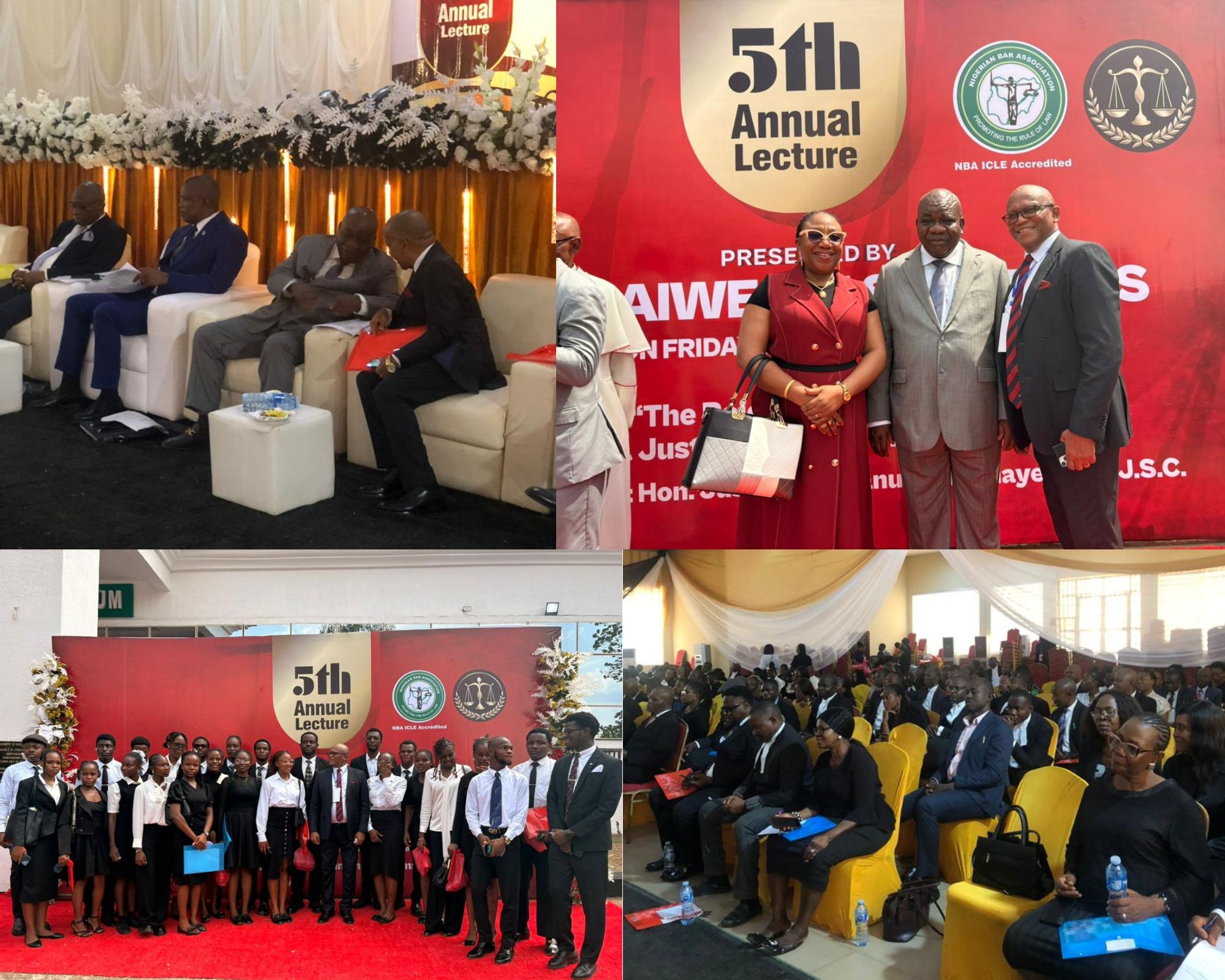
Nigeria’s justice system is facing a deepening credibility crisis, with systemic delays, conflicting judgments, and eroding public trust threatening the very foundation of the rule of law, a Supreme Court Justice has warned.
Delivering a blistering keynote at the 5th Annual Lecture of Akaraiwe & Associates in Enugu, Emmanuel Akomaye Agim said both judges and lawyers must share responsibility for what he described as the growing dysfunction within the legal system.
Rejecting the popular narrative that places blame solely on the judiciary, Agim insisted that legal practitioners are often the “primary drivers” of many of the system’s failures—ranging from frivolous lawsuits and forum shopping to deliberate delays and abuse of court processes.

“The courts and legal practitioners are the custodians of the rule of law,” he said, warning that their collective failures directly determine whether Nigeria’s legal system remains strong—or collapses under pressure.
A System Strained by Delays and Contradictions
Agim painted a troubling picture of justice delivery in Nigeria, where cases can drag on for decades—sometimes lasting up to 25 years from trial courts to the Supreme Court—effectively denying citizens meaningful access to justice.
He highlighted widespread practices such as endless adjournments, interlocutory appeals, and procedural technicalities that stall trials, noting that these tactics are frequently driven by lawyers but enabled by the courts.
In some instances, he said, judgments are delivered years after proceedings conclude—despite constitutional provisions requiring decisions within 90 days.
Conflicting Judgments and Legal Uncertainty
The Justice also addressed the growing concern over contradictory court rulings, including at the Supreme Court level, warning that such inconsistencies undermine legal certainty and public confidence.
He attributed many of these conflicts to lawyers who re-litigate already settled issues or ignore binding precedents, as well as courts that fail to resist such arguments.
Agim reaffirmed the doctrine that where Supreme Court decisions conflict, the most recent ruling prevails—an approach aimed at restoring clarity but one that continues to generate debate within legal circles.
Corruption Allegations and ‘Mob Justice’ Against Courts
In one of the most striking parts of his speech, Agim pushed back against widespread claims that Nigeria’s judiciary is corrupt, describing many of the allegations as “baseless,” speculative, and often politically motivated.
He accused some lawyers of fuelling public distrust by attacking court decisions in the media—sometimes without even reading the judgments—thereby “misinforming the public” and weakening confidence in the justice system.
Such conduct, he warned, risks turning public opinion into a weapon against the judiciary, creating what amounts to “mob justice” driven by misinformation.
A Call for Reform—and Responsibility
Agim stressed that the survival of Nigeria’s legal system depends on the ethical conduct, competence, and discipline of both the Bench and the Bar.
He called for stricter adherence to judicial precedents, greater efficiency in court processes, and a renewed commitment by lawyers to uphold—not undermine—the administration of justice.
“The strength or weakness of the legal system,” he concluded, “depends on how the courts and legal practitioners perform their roles.”
With public confidence waning and systemic flaws increasingly exposed, his message was clear: without urgent reform and accountability, Nigeria’s justice system risks losing its authority as the ultimate arbiter of law and order.
Click here to download the paper.