Home Blog Page 25

Police say mother gave infant whisky before child was found unresponsive

A Wisconsin couple, Kevin McCall and Christina Davis, was arrested and charged with two counts of chronic neglect of a child after a 1-year-old child was found dead in her crib “covered in urine and feces”

Christina Davis allegedly gave her 1-year-old daughter Fireball whiskey to help her “pass out” before later returning from work to find the infant dead in her crib.

After responding to reports of a “pulseless nonbreathing child” on Feb. 22, police officers and firefighters arrived at the residence of Kevin McCall, 20, and Christina Davis, 23, to find the couple standing on the front porch with the 1-year-old victim, according to criminal complaints obtained by WISN and Law & Crime

While the young child was taken to the hospital and pronounced dead shortly after, Davis’ 6-year-old daughter from a previous relationship allegedly told the police that she often had to help care for the younger child when the adults were away. 

The complaint alleges that Davis told police that she and McCall woke up around 9:30 a.m. and made sure the children were asleep before they both left the house to get Popeyes, per Law & Crime. After the couple returned with the food, Davis went to work while McCall allegedly stayed home with the kids. 

When she returned home around 2 p.m., Davis allegedly said that she saw her 6-year-old child standing in the corner as punishment for stealing the TV remote. McCall also told police that he “whooped” the girl.

After seeing that McCall was busy fixing a video game controller, Davis told police she went to the other room to find her 1-year-old “stiff” with her eyes rolling backward, after which she told McCall to call 911.

McCall allegedly claimed that he and Davis had left the children home alone “at least 25 times in the past six to seven months,” WISN reported, citing the criminal complaint. On this occasion, however, he was home but admitted to “never” feeding or changing the baby’s diaper while Davis was at work. 

Fireball Cinnamon Whisky
Fireball Cinnamon Whisky.Gregory Rec/Portland Portland Press Herald via Getty

In addition to finding the infant “covered in urine and feces,” investigators described the home as having a “strong odor” and being “unkempt,” per the outlet. 

When speaking to detectives, the 6-year-old girl allegedly claimed that McCall and Davis often asked her to babysit the younger child before showing them a bottle of “medicine” they would use to make the baby “pass out”: a 50 mL bottle of Fireball whiskey. 

“I don’t think it is medicine,” she reportedly told detectives, per Law & Crime.

While denying that she ever gave the baby alcohol, Davis told police that what her daughter told investigators “was a lie” and that she only ever gave the toddler “cold and flu medication.” She also allegedly claimed that she depended on her 6-year-old to help around the house because McCall “does not provide any assistance.”

In the complaint, the medical examiner stated that they did not find any signs of “trauma, illness, or infection” that pointed to a clear cause of death. 

McCall and Davis were both arrested and charged with two counts of chronic neglect of a child. They are being held at the Milwaukee County Jail on $10,000 bond, per jail records seen by PEOPLE.

“At this time, evidence has not been presented to a trier of fact; therefore, the defendant is presumed innocent,” McCall’s attorney Russell Jones says in a statement to PEOPLE. “That presumption remains unless a trier of facts finds otherwise, beyond a reasonable doubt. Therefore, I encourage all concerned to wait until the evidence is presented before passing judgment. “

PEOPLE reached out to Davis’ attorney for comment.

Source: https://people.com/mother-allegedly-gave-infant-fireball-to-make-her-pass-out-later-found-baby-dead-11971000?utm_term=All%20Push%20Subscribers&utm_medium=browser&utm_source=people.com&utm_content=20260509&utm_campaign=130637576

Awolowo: Legacies and prophecies, By Lasisi Olagunju

An old firm of architects with a rich history of project design and delivery sent a letter to the Sierra Leonean government on September 15, 1960. In that letter, the firm listed some of the projects it was handling in Nigeria. The multi-storey building called Cocoa House in Ibadan was on that list.

But the story of Cocoa House began long before that letter was written. The 26-storey structure did not emerge as an idle elephant on Ibadan’s skyline. It was Obafemi Awolowo’s answer to the need for a total-package commercial edifice.

The architects described it as a multipurpose venture “aimed at providing office space as well as leisure facilities through a nightclub, swimming pool and cinema complex.”

That perhaps explains why the skyscraper came with a roof garden and has in its shadows, what the Transnational Architecture Group describes as “a circular building clad in mosaic, topped with a dome,” complete with “a splayed cantilevered entrance leading to a swimming pool with beautiful concrete diving boards and viewing gallery.”

For a government that had worked hard at providing free education for all, putting affordable healthcare and food security as priorities, with “life more abundant” as its central mantra, a space for work and leisure was simply the icing on the cake, the crown on a kingdom of values.

There were many more edifical monuments in brick and policy from that government. But because time kills witnesses to history, counter-historians are, today, on the prowl, poisoning public memory with insidious distortions. To what end, we can only speculate.

Late American sociologist and professor, C. Wright Mills, describes “the present as history and the future as responsibility.” Because revisionists continue to undermine the past, poison the present, and threaten the future with deliberate inversions of truth, I put a date to what I started with and insert dates into what comes next.

The Nigerian government established a commission in April 1959 to project the country’s tertiary education requirements for the following 20 years. At the head of that commission was a British botanist and educator, Sir Eric Ashby. The commission did its work and submitted its report. But the report ignored the educational aspirations of the Western Region.

Professor J. F. Ade Ajayi wrote in 1975 that the majority report of the Ashby Commission recommended that the jointly owned University College, Ibadan, was sufficient to serve the educational needs of the Western Region while other regions could have brand-new universities. The commission, Ajayi said, failed to grasp the urgency with which the West viewed universities as instruments of regional development.

The response of the Western Region under Chief Obafemi Awolowo was swift. The West immediately assembled its own team to work on its own university. The result was the establishment of the University of Ife, today known as Obafemi Awolowo University. Significantly, the solid policy foundation for that university had already been firmly laid before Awolowo left office as Premier of the Western Region on December 12, 1959.

Read Also: 2027: Nigeria’s political dynasties tighten grip as power becomes a family inheritance

Read Also: The Trinity of State Decay (III): The architecture of resurrection

The story of the University of Ife best explains Awolowo’s philosophy of education and development. Education, to Awolowo, was central to human and societal progress. He valued it, mobilised his people around it and funded it robustly throughout his years as Premier. Western Nigeria still preens like a peacock today because, at its foundation, it had a leadership that understood the meaning of knowledge and the place of education in the making of a valuable future. Those who lacked that grace are today a problem to everyone. As philosopher Alfred North Whitehead warned: “In the conditions of modern life, the rule is absolute: the race which does not value trained intelligence is doomed.”

A remembrance service holds every May 9 in honour of Awolowo and in celebration of his good deeds. This year’s washeld last Saturday with the Bishop of Remo and Archbishop of the Lagos Ecclesiastical Province of the Church of Nigeria (Anglican Communion), the Most Reverend Michael Olusina Fape, saying in fewer words, and in a more elegant way, what I have struggled to say above: remembrance in all cultures comes either as honour or infamy. “Nobody will want Judas to come again. Only the righteous are remembered fondly for their deeds.”

“There’s something special about Chief Obafemi Awolowo, ”the bishop continued. “He was a man of faith who believed in God wholeheartedly, and this reflected in his leadership, which impacted positively on the people. His name has continued to re-echo in all spheres of human endeavour — education, agriculture, health and many others.”

Preaching on the theme, “What Will You Be Remembered For?” the cleric, with a heavy heart, expressed disappointment with politicians who parade themselves as progressives and disciples of Awolowo without reflecting his values in governance. According to him, many who wear the progressive label today are, in reality, retrogressive because they make life harder for the people they govern.

‘Progressive,’ like ‘democracy,’ has become a debased and abused word in Nigeria — loudly proclaimed, but rarely reflected in governance or in the condition of the people. I recommend

‘The So-Called Progressive Movement: Its Real Nature, Causesand Significance’ by Charles M. Hollingsworth to anyone watch- ing today’s powers loudly parade themselves as progressives.

Hollingsworth argued that the progressive movement was not always truly progressive in the historical sense, but often quite the opposite. Nor was it genuinely democratic or constitutional in spirit; rather, it was essentially a class movement aimed at the arbitrary control of other classes.

The heart of progressivism is selfless service; otherwise, the badge becomes a mask for masquerades plundering the sacred grove. No one becomes good suddenly. Goodness is rooted either in nature, in nurturing, or in both – upbringing and legacy.

As we remember Awolowo almost four decades after his transition, we should look at the tree from which came the beneficial fruit.

Writing under the pen name, John West, in the Daily Service of March 8, 1959, Alhaji Lateef Jakande gave remarkable insight into the making of the man called Awolowo:

“To understand Obafemi Awolowo, one must know his father. For he is a chip of the old block if anybody ever was.

Those who knew him say David Shopolu Awolowo was one of the first Christian converts in Ikenne. He was converted in 1896. His industry was proverbial: he was honest, truthful, hated hypocrisy and never minced his words. A successful farmer and sawyer, Awolowo was also a capable organiser and was the president of about five thrift societies.

“David was not a politician. But his own father was; the latter having acquired a taste for public life from his grandfather. David’s father was head of the Iwarefa, the Executive Council of the Oshugbos, who were the rulers of the town in those days. And in this office, he left a record of strict impartiality and firmness in the administration of justice. His own grandfather was also an astute politician. He was the Oluwo of Ikenne, next in rank to the Alakenne and head of the Oshugbos — and wielded great power and influence in the public life of his day.

“And so we have all the ingredients that go to make up the Awolowo we know. It is given to few to combine so well all the sterling qualities of his noble ancestors.”

That heritage produced a leader who understood both the psychology of colonial domination and the tragedy of post-colonial failure. In ‘Path to Nigerian Freedom’, published in 1947, Awolowo wrote with painful foresight: “Given a choice from among white officials, chiefs, and educated Nigerians as the principal rulers of the country, the illiterate man, today, would exercise his preference for the three in the order in which they are named. He is convinced, and has good reason to be, that he can always get better treatment from the white man than he could hope to get from the chiefs and the educated elements.”

How hauntingly relevant does that sound today? Across the country, 66 years after independence, swelling numbers of disappointed Nigerians now openly romanticise colonial order — not because colonialism was good, but because post-colonial leadership has failed to justify independence in the eyes of ordinary citizens. Some even sadly ask Donald Trump to come and rescue them from Nigeria, the way Moses rescued the Israelites from Egypt.

George Grant (1918–1988) did a reading of Socrates and concluded that the price of goodness is the heavy burden borne by those who choose to stand for truth and morality in societies ruled by injustice. To be good in a bad world, Grant argued, often demands sacrifice, suffering and, sometimes, personal ruin.

Awolowo did well and, because he did well in a perverse world, he had to endure severe emotional torture and physical restriction. He was falsely accused; witnesses were called against him before a commission of inquiry, yet he was denied the opportunity to cross-examine them. He suffered, but survived it all.

Where did he get the strength?

John West’s 1959 piece provides a window into that defining trait of Awolowo. According to him, Chief Awolowo had been taught by his father “the Shakespearean injunction to beware of entering into a fight but once in, never to disengage himself from it until he has beaten his opponent or he himself has been worsted in the encounter.” John West added that anyone who had Awolowo as an opponent knew “to his cost that that lesson was not taught in vain.”

In one moment of deep emotional reflection, William Shakespeare wrote in Julius Caesar that, “The evil that men do lives after them; the good is oft interred with their bones.” Yet, in the case of Awolowo, the reverse is very true. Thirty-nine years after his transition, the good he did continues to define standards of leadership, governance and public morality in Nigeria.

Perhaps that is the ultimate meaning of legacy. It is someone’s deep thought that long after power fades, after wealth disappears and after noise quietens, what survives is character, vision, and sacrifice. Awolowo understood this truth early. That is why, decades after his passing, Nigeria still invokes his name whenever leadership fails, whenever governance loses direction and whenever the people search for standards against which to measure those who govern them today.

The views expressed by contributors are strictly personal and not of Law & Society Magazine.

2027: Nigeria’s political dynasties tighten grip as power becomes a family inheritance

By Johnson Agu

As millions of Nigerians struggle with rising food prices, insecurity and the daily grind of survival, another battle is quietly unfolding behind the scenes: the grooming of political heirs. Across party lines and regions, the children and relatives of Nigeria’s political heavyweights are steadily positioning themselves for power, raising troubling questions about dynasty politics, access, and whether democracy is gradually becoming a family business.

While ordinary Nigerians battle worsening economic hardship, rising insecurity and bitter political divisions, another reality is quietly taking shape behind the scenes of the country’s political establishment: the rise of political heirs.

Across Nigeria’s major political families, sons, daughters and close relatives of influential political figures are steadily emerging into positions of power ahead of the 2027 elections, reinforcing growing concerns that political leadership in Africa’s largest democracy is increasingly becoming hereditary.

A viral political chart circulating online titled “2027 Elections: The Rise of Political Heirs” captures what many Nigerians say has long been happening quietly within the nation’s political structure. The document highlights a growing list of second-generation politicians linked to some of the country’s most powerful political figures.

Among those listed are Yusuf Muhammadu Buhari, son of former President Muhammadu Buhari; Bello Mohammed El-Rufai, son of former Kaduna governor Nasir El-Rufai; Idris Abiola-Ajimobi, son of late Oyo governor Abiola Ajimobi; and others connected to political heavyweights such as Atiku Abubakar, Adams Oshiomhole, Sule Lamido and Abdullahi Ganduje.

For many observers, the development reflects a deeper structural problem within Nigerian politics where access to power, influence, party structures and public visibility often remains concentrated within a small political elite.

The irony, critics argue, is striking.

While supporters of rival political parties engage in fierce online battles and sometimes violent confrontations on behalf of politicians, many of the political actors themselves appear united by a shared objective: preserving influence within their families and political networks.

On the streets, however, the realities facing ordinary Nigerians continue to deteriorate.

Inflation remains crushing. Food prices continue to soar. Youth unemployment remains alarming. Insecurity persists across several regions, with kidnappings, killings and displacement becoming almost routine in many communities.

Yet even amid growing public frustration, Nigeria’s political establishment appears focused on succession planning.

Analysts say the emergence of political heirs is not entirely new. Political families have existed for decades in Nigeria, much like in other democracies. What appears different now, however, is the increasing visibility and normalization of dynastic politics at a time when public trust in governance is already severely strained.

Critics warn that such trends risk deepening public cynicism about democracy itself.

For many young Nigerians struggling to survive in a harsh economy, the message can appear painfully clear: while millions fight for opportunities, access to political power often remains reserved for those born into influential families.

Supporters of the politicians involved argue differently. They insist that children of politicians should not be denied participation in politics simply because of their family backgrounds, noting that many are educated, experienced and politically active in their own right.

But opponents argue that the issue is larger than individual competence. They say the concentration of power within political bloodlines raises difficult questions about merit, inclusion, internal democracy and equal access to leadership opportunities.

The optics are particularly sensitive at a time when many Nigerians increasingly feel excluded from governance and abandoned by the political class.

For critics, the rise of political heirs reflects a widening disconnect between Nigeria’s rulers and the realities confronting ordinary citizens.

As access to the basic necessities of life becomes increasingly difficult, and frustration spreads across the country, many fear that the 2027 elections may further expose a political system increasingly dominated not by ideology or public service, but by entrenched networks determined to retain power across generations.

And while the masses argue passionately over party loyalty, ethnicity and political personalities, Nigeria’s elite families appear to be preparing quietly for the next transfer of power, not necessarily from one party to another, but from one generation of political insiders to the next.

Celebrating a journalist, Abiodun Adeniyi as vice chancellor, By Martins Oloja

The Chairman of the Board of Trustees (BoT) and Founder of Baze UniversityDatti Baba-Ahmed, this week approved the appointment of a new Vice-Chancellor and Registrar for the University following a rigorous and competitive selection process. Accordingly, Professor Abiodun Adeniyi, has been appointed as Vice-Chancellor of Baze University, Abuja with effect from 6 May 2026. Adeniyi, a distinguished scholar of communication and media epistemology, steps into the role after serving as Registrar of the University.

Professor Adeniyi may not be popular with young people and even scholars. He is a product of The Guardian ‘School of Journalism’ we fondly call Rutam House that has produced so many great journalists and technocrats. I would like to let people know that President Tinubu’s big media man, Bayo Onanuga was at The Guardian. Lest we forget, one of our best, Dapo Olorunyomi of Premium Times also passed through Rutam House. Even political giants such as Governorship hopeful in Ogun State, Senator Solomon Olamilekan, Adeola Yayi and former Governor of Ekiti State, Dr. Kayode Fayemi were associates at the Rutam House. Former Corps Marshall and CEO of FRSC and former Minister of Aviation, Osita Chidoka also passed through the solid Rutam House. Not many too even in the media would recall that the current Managing Director and Editor-in-Chief of The Sun, Onuoha Ukeh began serious journalism from The Guardian. Do people know too that the Great Kabiru Yusuf, Publisher and Chairman of Daily Trust and Trust Tv, was part of the pioneer associates of The Guardian on Sunday.

That is where it all began for the prolific political journalist, Abiodun Adeniyi that we are celebrating today.

No one among those who worked with Professor Adeniyi including yours sincerely, would be surprised by the grace that propelled him to this academic height. He wrote great stories for the great newspaper, The Guardian and under a very brilliant Political Editor, the late Akpo Esajere who was always waiting for his copies from the Abuja Bureau. It is a time to celebrate Adeniyi, really.

One of the early accolades landed on the newspaper’s registered Alumni Association’s platform, ”When The Flagship Led”, formed by the notables who built the brand equity in the first ten years (1983-1993). The Platform has been registered with the CAC. The first remarkable message from the legendary Kingsley Osadolor, former Editor, The Guardian on Sunday and former Deputy MD/Editor-in-Chief, was quite significant. His words:

‘Congratulations, Prof. Abiodun Adeniyi, on your elevation to the position of Vice-Chancellor of Baze University, one of the country’s leading private universities. Prof. Adeniyi now joins an enviable list of media practitioners who transitioned into academia and climbed the stairs to reach the pinnacle of university governance. They include Prof Femi Onabanjo (Lead City University), Prof Dayo Alao (Adeleke University), Prof Abubakar Rasheed (ex- New Nigerian, ex-VC, Bayero University, ex-Executive Secretary NUC), Prof Nosa Owens-Ibie (Caleb University), Prof Umaru Pate (Federal University, Kashere), and Prof. Jide Oluwajuyitan (ex-Guardian). So, our erudite yet remarkably humble Prof Adeniyi is in league with Prof Oluwajuyitan as Rutamites who have become VCs.

“As Editor of The Guardian of Sunday in the 1990s, Adeniyi was one of my trusted and reliable sources of editorial contributions. On the 30th Anniversary of June 12 in 2023, I ensured he was one of our resource persons when we had a series of NTA’s “Good Morning Nigeria” editions devoted to that electoral landmark. I recalled the reports he filed 30 years earlier, and along with Tonnie Iredia, who was at the Election Management body at the time, the insights were memorable.

Since the 1990s, Adeniyi and I struck a friendship that has endured, and I have been immensely proud of his ascendancy in academia. Prof, congratulations once more. As we always say, we shall speak.
Best wishes,
Kingsley.

Professor Adeniyi’s story should be used by education authorities here to deconstruct how to take advantage of professionals and technocrats to rebuild our broken walls especially in education. There should be a recourse to the much needed integration of ‘town and gown’ in the tertiary education sector. Adeniyi’s rise and rise should not be seen as a flash in the pan. It is only a private university where bureaucracy is somewhat efficient that could have detected his talent and experience before migrating to the academia.

We are blessed here but politicians who specialise in recruiting a cabinet of mediocrities into the highest levels of governance systems won’t understand the value of merit-based administration. That is the message from Dr. Yusuf Datti Baba-Ahmed the Founder of Baze University who placed merit above other considerations and our fault lines. Let’s celebrate the essential Adeniyi.

Abiodun Adeniyi is a Professor of Communication and Media Epistemology at Baze University, Abuja, where he continues to provide exemplary administrative leadership alongside a sustained commitment to scholarship and teaching. Notably, he is the first academic in Nigeria to hold the position of Registrar while retaining full professorial standing, a distinction that reflects both his intellectual stature and the deep institutional confidence reposed in him. His contributions to academia, journalism, and public discourse have earned national recognition, including commendation by President Bola Ahmed Tinubu, who described him as a distinguished scholar, accomplished media intellectual, and committed nation builder whose work continues to enrich national development.

Before this appointment, he had served as Dean of the School of Postgraduate Studies, having previously held the positions of Deputy Dean, University Orator, and for several years, Head of the Department of Mass Communication, roles through which he made significant contributions to the development of the University’s academic structure and postgraduate culture.

A scholar of international repute, Professor Adeniyi is a British Chevening Scholar and holds a Doctor of Philosophy (PhD) and a Master of Arts degree in International Communications from the University of Leeds, alongside a Bachelor of Science degree in Sociology (Second Class Upper Division) from Ahmadu Bello University and a Postgraduate Diploma in Journalism from the Nigeria’s International Institute of Journalism. His academic formation reflects intellectual rigour, global exposure, and a longstanding dedication to the advancement of communication scholarship and democratic values through responsible media engagement and thought leadership.

Professor Adeniyi’s academic and professional career reflects a rare synthesis of theory and practice. Before transitioning fully into academia, he had a distinguished career in journalism, rising through the ranks from reporter to desk editor. He covered politics and national affairs with notable depth and insight at The Guardian, Nigeria. This professional grounding continues to inform his scholarship, particularly in journalism studies, political communication, media ethics, and critical discourse analysis.

In the academia, he has taught and mentored students across a range of institutions in Nigeria and internationally, including the American University of Nigeria and the University of Leeds, his alma mater. He has also served, and continues to serve, as Visiting or Adjunct Professor at institutions such as Kogi State University, the University of Abuja; the National Open University of Nigeria, and Miva Open University. In these roles, he has made substantial contributions to teaching, postgraduate supervision, curriculum development, and the mentorship of younger scholars and professionals. In addition, he has served extensively as an external assessor for promotions to the professorial cadre and as an examiner of numerous doctoral theses, further underscoring his standing within the academic community.

Professor Adeniyi is widely acknowledged as a pioneering voice in Diasporic Communication, as well as the first Professor of Mass Communication produced by Baze University. His research spans international and transnational communication, migration and diaspora studies, development communication, strategic communication, global media communication, and cultural studies.

Besides, he is respected as a prolific scholar with an extensive body of publications, including books, edited volumes, journal articles, and policy-oriented research. Among his notable works are the co-edited volume Media and the National Security Question: Communicating (In)security in Nigeria, West Africa and the Sahel (Palgrave Macmillan, 2025); and single-authored works such as Diasporic Communication in the Digital Age (2022) and New Hidden Narratives of African Migration: Exploring Media and the Contestation of Place (Palgrave Macmillan, 2026).

He is also completing a forthcoming book on Roots and Networks: Memory, Migration and Digital Belonging in Africa. His scholarship is both theoretically grounded and policy relevant, reflecting a deep engagement with contemporary societal challenges and a sustained effort to shape critical conversations around governance, media, migration, and society in Nigeria and beyond.

Beyond academia, Professor Adeniyi has made substantial contributions to public policy, governance, and development communication. He has also been Deputy Chairman of the National Values Charter Committee, a strategic national initiative on reorientation and civic renewal.

His consultancy footprint is extensive, having served as Communications Consultant to major international development organisations, including the World Bank Economic Reform and Governance Project, the UK Department for International Development, the European Union, and the International Organisation for Migration. He has designed and implemented communication strategies for key national institutions, including the National Bureau of Statistics and the Nigerian Extractive Industries Transparency Initiative, while contributing to high-level policy and institutional reform initiatives across governance and public sector management.

As an engaging public intellectual, Professor Adeniyi is a regular media analyst on national and international broadcast platforms, and a sought-after speaker, moderator, and facilitator at high-level conferences, policy dialogues, and executive training programmes across Nigeria and beyond. His interventions consistently bridge the gap between academia, policy, and practice.

Within the scholarly community, he has contributed significantly to knowledge production and dissemination as Editor in Chief and Associate Editor of reputable academic journals, while also playing a pivotal role in securing accreditation and developing postgraduate programmes in Mass Communication.

Professor Adeniyi has, in the course of his sustained research in media, migration, and diaspora studies, delivered scholarly lectures and undertaken fieldwork across several African countries. In recent years, his academic engagements have taken him to key intellectual and policy hubs, including Johannesburg and Cape Town in South Africa; Accra; Nairobi; Kigali; Banjul; and Freetown, experiences that continue to enrich the empirical depth and continental relevance of his work.

His contributions have been recognised through several honours and distinctions, including his election as a Fellow of the Chartered Institute of Communication and Development, alongside other recognitions reflecting excellence in scholarship, institutional service, and professional practice.

His contributions to academia, journalism, and public discourse have earned national recognition. On the occasion of his last birthday, President Bola Ahmed Tinubu congratulated Professor Adeniyi and described him as “a distinguished scholar, accomplished media intellectual, and committed nation builder whose contributions to academia, journalism, and public discourse have continued to enrich national development.” The President further commended his longstanding dedication to intellectual excellence, institutional service, and the advancement of democratic values through responsible media engagement and thought leadership, while also acknowledging his role in mentoring younger scholars and shaping critical national conversations around governance, media, and society in Nigeria.

At the heart of Professor Adeniyi’s career is a deep commitment to intellectual inquiry, institutional development, and societal advancement. His work embodies the ideals of scholarship in service of society, rigorous, relevant, transformative, and deeply invested in national development and civic renewal.

I would like to celebrate this very cultured journalist and journalism scholar who returned to serve the country when it wasn’t expedient to do so in 2008 when he completed his doctoral degree in the United Kingdom.

I hope Nigeria’s leaders at all levels would realise from this story that there is no alternative to the power that meritocracy can bring to this time that knowledge rules for country and global competiveness.

The Trinity of State Decay (III): The architecture of resurrection

By Max Amuchie | The Sunday Stew

In the last two weeks, Parts One and Two diagnosed a structural mutation in the Nigerian state: a dual sovereignty system in which the Institutional Mirage performs authority while the Shadow Order exercises it, sustained by The Insecurity Triad as a mechanism of mutual reproduction.
What remains is the hardest question in political theory: not what is happening, but whether it can be reversed.
The answer is yes—but not through reform.
Systems that reproduce decay cannot be repaired within their own logic. They must be structurally interrupted.
The Trinity does not collapse. It is displaced.

From Ritual Governance to Peripheral Presence

The first reversal targets the geography of illusion.
The Institutional Mirage is concentrated in the symbolic centre—where governance is performed through summits, communiqués, and administrative ceremony—while dissolving at the periphery where authority is actually tested.
This produces a distorted state: visible in Abuja, absent in the borderlands.
To reverse the Trinity, the state must abandon Ritual Governance—the substitution of performance for presence—and return to the empirical occupation of territory.
This is not military occupation. It is administrative presence as sovereignty.


A state exists not when it speaks in the capital, but when:
a child attends a functioning school without paying a parallel tax of fear;
a farmer harvests without negotiating with non-state authority;
a dispute is resolved by a recognised court faster than an armed intermediary.
Governance is not restored by declaration. It is restored by continuity.
Where state presence becomes routine, the Shadow loses its monopoly on predictability.

From Pacification Bargaining to Sovereign Integrity

The second reversal confronts a deeper failure: negotiated sovereignty.
The state has increasingly drifted into a system of Negotiated Sovereignty sustained through what may be described as Pacification Bargaining—the purchase of temporary calm from rival authority structures through ransom logic, amnesty arrangements, protection payments, or informal accommodation.
This is not strategy. It is dependency disguised as pragmatism.
Every bargain strengthens The Insecurity Triad by:
monetising abduction economies;
legitimising territorial extraction;
reinforcing the Shadow’s role as a negotiating sovereign.
The result is a system of self-financing violence in which each concession funds the next cycle of coercion.
Pacification Bargaining does not resolve insecurity. It institutionalises it.
Each transaction deepens the perception that coercion is profitable, territorial pressure is negotiable, and sovereign authority is conditional rather than absolute.
Sovereign recovery therefore requires rupture in this economy.
The state must reassert a non-negotiable monopoly over:
taxation;
adjudication;
legitimate force.
Integrity, in this context, is not moral posture. It is institutional refusal to participate in markets of coercion.
A state that bargains over its coercive authority is not managing insecurity—it is outsourcing sovereignty.

The Critical Break: Dismantling the Insecurity Triad

To dismantle The Insecurity Triad is to break the loop between performed sovereignty and enforced sovereignty.
This cannot be achieved through security operations alone, though coercive force remains an essential and non-negotiable instrument of restoring empirical sovereignty. It requires something deeper: the reconstruction of institutional credibility in the very spaces the Institutional Mirage has abandoned.
It requires the state to stop performing governance and start delivering it. To stop negotiating the terms of its own authority and start enforcing them.
To recover the map—not in abstraction, but in detail: name by name, community by community—that armed actors are actively redrawing through coercion, taxation, and enforced renaming.
Dismantling the Triad is therefore not only a security task. It is a reversal of political geography itself.

The Cartographic Re-occupation of the Republic

The Shadow Order does not only occupy land. It reorganises meaning.
Through what may be understood as Constitutional Erasure, it renames territories, restructures local identity, and replaces the symbolic map through which authority is recognised.
Once this occurs, sovereignty is no longer contested physically alone—it is contested cognitively.
Cartographic Re-occupation is therefore not symbolic politics. It is structural restoration.
It requires three coordinated acts.
First, administrative re-anchoring: the immediate restoration of functioning institutions—schools, clinics, courts, and local administration—under continuous state presence.
Second, symbolic restoration: the reassertion of original geographic and civic identities through formal public renaming and constitutional recognition.
Third, cognitive consolidation: governance must cease to appear as intervention and become the default condition of life.
The state is not restored when it returns to territory. It is restored when territory returns to the state’s cognitive map.

Intellectual Closure: The State After Fragmentation

The deeper insight of this architecture is that sovereignty in Nigeria is no longer singular.
What has emerged is a fragmented order in which authority is distributed between competing logics of governance—one performed, one enforced, both partially functional, neither complete.
This is where African political thought clarifies the structure beneath the surface.
The logic of adaptive survival described by Jean-François Bayart explains why the state persists even as it weakens. Achille Mbembe explains how survival itself becomes managed rather than guaranteed.
Together, they clarify the central claim of the Trinity: this is not collapse. It is reorganisation.

Closing Movement
Nigeria does not face a singular collapse of authority. It faces a structured competition between performed sovereignty and functional sovereignty.
The Mirage still speaks in the language of the state.
The Shadow still governs in the language of necessity.
Between them, society survives by navigating two competing logics of order.
The question is no longer who governs.
It is whether governance itself can be reassembled into a single coherent structure.

The Reversal Condition: Sequential Sovereignty Restoration

The Trinity is reversible, but only in sequence.
Protection must be restored before compliance can shift.
Compliance must shift before territorial credibility stabilises.
Territorial credibility must stabilise before institutional authority can move from performance to function.
Any inversion of this order produces relapse.
The system is not resistant to reform. It is resistant to mis-sequencing.
The Trinity reverses only when sovereignty becomes empirically enforceable again through the sequential reconstitution of protection, compliance, and territorial credibility, thereby disrupting the mutual reproduction loop between the Institutional Mirage and the Shadow Order sustained by The Insecurity Triad.
Where this sequence fails, the loop does not weaken. It adapts.

The Social Contract Is Not Broken — It Is Being Replaced

There can be no social contract in a state where the sovereign performs authority it does not possess, negotiates with rivals it cannot defeat, and watches—from the polished corridors of Abuja—as the names of its own communities are erased from the landscape it claims to govern.
The conventional framing of Nigeria’s crisis describes a broken social contract: the state has failed its obligations, and the people are paying the price.
That framing is not wrong. But it is insufficient.
A broken contract implies a single agreement that has lapsed—and the possibility, in principle, of renegotiation and restoration.
What the Trinity of State Decay reveals is something more structural.
The social contract is not merely broken. It is being replaced.
In the spaces where the Institutional Mirage does not reach—in the northwest, northeast, and Middle Belt, in renamed villages and abandoned farmlands—a rival contract is being written.
On rival terms. Under rival authority. With rival consequences for those who refuse to sign.
The Shadow Order does not offer freedom. It offers a different captivity—one organised around extraction, fear, and the brutal clarity of power that does not pretend to be something it is not.
Within its own logic, it is internally consistent and therefore predictable.
And in conditions where protection becomes uncertain and uneven, predictability itself begins to function as a substitute for legitimacy—not as consent, but as adaptation under constraint.

The Institutional Mirage, by contrast, sustains a different form of instability: the unpredictability of protection, the inconsistency of enforcement, and the performance of authority that does not reliably translate into outcomes.
It is this asymmetry—between predictable coercion and unpredictable protection—that accelerates the silent transfer of compliance from formal sovereignty to rival order.

Conventional state failure frameworks assume a linear erosion of capacity.
The Trinity departs from this by demonstrating a dual-state condition in which formal and rival sovereignties coexist, interact, and reinforce decay.
Nigeria is not a failed state.
It is a state in the grip of a Trinity.

The Definition

Drawing on the full architecture of the foregoing analysis, I now offer a formulation of the Trinity of State Decay theory:
The Trinity of State Decay is the decoupling of a state into rival sovereignties: the Institutional Mirage, which performs authority without fully possessing it, and the Shadow Order—or competing Shadow Orders—which exercises de facto authority in spaces the Mirage has vacated, both sustained by The Insecurity Triad as the mechanism of their mutual reproduction.
The Trinity intensifies where the Mirage fragments into competing centres of performed authority, accelerating the transfer of empirical sovereignty to rival structures.
The Trinity reverses only when sovereignty becomes empirically enforceable again as a stable condition of governance.
This condition is not defined by the mere presence of the state, but by the alignment of three realities: protection must be enforceable, compliance must orient toward the state, and territorial authority must remain continuous.
Where these diverge, sovereignty fragments.
Where they converge, sovereignty reconstitutes.
Recovery is not repair or return. It is the production of a new equilibrium in which the Mirage collapses into function, the Shadow is displaced, and The Insecurity Triad loses its organising role.
This condition is produced through sequence: protection must precede compliance, compliance must precede territorial credibility, and territorial credibility must precede institutional function. Any inversion produces relapse; where the sequence holds, the loop breaks.
While derived from the Nigerian case, the Trinity offers a generalisable framework for analysing state decay in contexts where formal sovereignty persists alongside entrenched systems of rival governance.
Stay seasoned.

•Concluded

Dr. Max Amuchie is the CEO of Sundiata Post and architect of The Insecurity Triad Analytical Framework, and the Trinity of State Decay theory. He writes The Sunday Stew, a weekly syndicated column on faith, character, and the forces that shape society, with a focus on Nigeria and Africa in a global context.
X — @MaxAmuchie | Email: [email protected] | Tel: +234(0)8053069436

The views expressed by contributors are strictly personal and not of Law & Society Magazine.

Nigeria: The rise of judicial verdict without judgment

In many ways, political harlotry in a court’s name is increasingly an international affair…

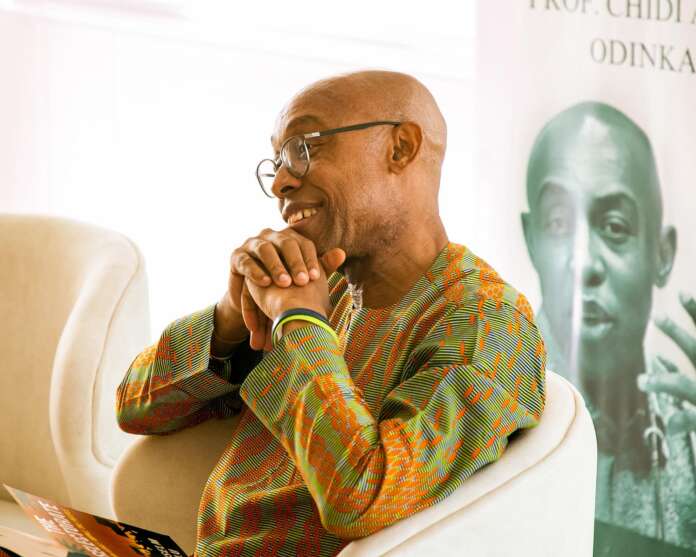
By Chidi Anselm Odinkalu

When the Economist described Nigeria over 18 years ago as a “democracy by court order”, it ventured into prophetic journalism. In the period since then, partisan politicians have become comfortable with playing second fiddle to judges, a sizeable number of whom have emerged as the most avid tribe of belligerents in the mortal combat of Nigerian politics.

In many ways, political harlotry in a court’s name is increasingly an international affair. In a recent article for the Journal of Democracy, Andrew O’Donohue of the Harvard Radcliffe Institute outlines five ways in which “courts frequently undermine democracy.” They can do this by enabling authoritarianism, undermining credible elections, restricting participation and associated civic rights, empowering non-elected elites, or indulging in a jurisprudence of excess of jurisdiction.

Many will recognize these patterns in Nigeria. When he addressed the annual conference of the Nigerian Bar Association (NBA) in August 2025, the Sultan of Sokoto complained that judicial verdicts in the country had become a “purchasable commodity.” In a rigged judicial market, it is evident that the winners will almost always be the most powerful. In Nigeria, they are politicians.

As dangerous as it may sound, the commodification of court orders is by no means the worst form of political prostitution of courts in Nigeria. The methods by which a judge in Nigeria can procure judicial complicity in partisan project have become a lot simpler.

When the Court of Appeal delivered its now infamous judgment in the appeal by interim Chair of the African Democratic Congress (ADC), David Mark, against the interim order of the Federal High Court in the case instituted by provocateur, Nafiu Bala Gombe, the three-man panel dwelt at considerable length on determining primacy between the enrolled order of a court on the one hand and the text of a court’s ruling on the other.

According to the Court of Appeal, whenever there is contradiction between these two, the latter must prevail. There is a deafening eloquence, however, to what the court could not bring itself to say: that it is anomalous for such a contradiction to occur in the first place. Yet, these days, that occurs with disquieting regularity.

It is possible to explain this as human error not entirely unconnected with the febrile atmosphere under which Nigeria’s judges work. This cannot be excluded entirely but even if that were to be the case, much of the stress is self-inflicted. Replicating a practice more closely associated with sex workers, some judges appear keen to crawl the political kerb, strutting their judicial wares for the attentions of grasping, partisan customers who are only too happy to gratify them.

From habitually granting politicians implausible and inexplicable shunts on the queue of judicial dysfunction which exist for lesser mortals only; through creating exceptional jurisprudence without precedent in cases involving political parties and politicians; to assuming jurisdiction in cases in which that is explicitly excluded, a not insignificant number of judges in Nigeria appear increasingly of the view that prostitution is too important an enterprise to be abandoned to sex workers alone.

These practices appear to be always designed to cause maximum benefit to one side in high profile partisan disputes or maximum political damage to another. When, for instance, the Supreme Court assumed appellate jurisdiction to decide a case that was still pending in the Federal High Court in Port Harcourt, the court did not pretend to be doing law. It simply chose a side in a partisan dispute and inflicted maximum damage on another side, while weaponising the fullest panoply of its constitutional standing.

Even this tendency could be managed, if the tale were to stop here and no further, but it does not. The phenomenon of mutually contradictory orders by courts of equal jurisdiction, Africa Report has cautioned, “threatens to lead Africa’s largest democracy into chaos.”

On 22 April 2026, the Supreme Court decided that it lacked appellate jurisdiction over a decision of the Court of Appeal sitting as the final instance in appeals from decisions of the National Industrial Court of Nigeria (NICN). Two weeks later, on 8 April, the same court inexplicably claimed jurisdiction to overturn a decision of the Court of Appeal in an appeal originating from the NICN and involving a former Deputy Governor of Kogi State. The same Supreme Court cannot turn around tomorrow and claim seriously that it is overworked.

One trick in the tool-box of judicial duplicity is the art of the indecipherable court order. Quite often, it is written in mangled syntax or in Latin. Nigerians are now weaned on a diet of judicial orders requiring a return to status quo ante-bellum by judges who are too lazy or cannot be bothered to say clearly when the bellum began or how.

The result is that “instead of court decisions bringing finality to disputes, they now generate fresh controversies because different parties interpret the same judgment to suit their political interests.” This is all very deliberate or at least foreseeable. One writer has described Nigeria’s courts in this role as “authors of confusion.” Olusegun Adeniyi says this is the “judicial route to anarchy.”

Another practice is the art of judicial verdict without judgment. More than a fortnight after the Supreme Court handed down the judgments in the party-political disputes involving the leadership of the Peoples’ Democratic Party (PDP) and the ADC, respectively, the judgments remain unpublished.

Similarly, nearly one week after a judge of the High Court of the Federal Capital Territory (FCT) reportedly issued a judgment in defamation requiring the Socio-Economic Rights and Accountability Project (SERAP), a non-governmental organization, to pay N100 million to two officers of the State Security Service (SSS), the judgment is still an item of judicial oral tradition. Despite the best efforts of many, no one has seen it.

This phenomenon of judicial verdict without judgment creates damage and feeds confusion in many ways. In the dispute over the Kano Emirate two years ago, for instance, Abdullahi Liman, then a judge of the Federal High Court in Kano, infamously ruled that an ex-parte ruling did not have to be seen by nor served upon a party before it could be binding on that party.

The flagrant audacity of requiring a party to inhale like oxygen a judicial order issued without having been afforded a hearing to begin with was of course not of any bother to a judge who seemed comfortable to trade impunity for judicial deliberation. He chose to foist on Kano an entirely avoidable reality of two Emirs asserting judicially backed claims over one stool and got promoted to the Court of Appeal while at it.

There is, of course, the fact that in politically tense situations, judicial verdict without judgment is often patented for irreversible harm. In the by-election into the Ebonyi South Senate seat necessitated in 2024 by the appointment of David Umahi as a Minister, Hyeladzira Nganjiwa, a judge of the Federal High Court, waited until two days before the ballot to make a pronouncement in open court disqualifying the candidate of the PDP, Silas Onu, from the contest.

It did not matter that the judge knew very well that he lacked jurisdiction in the matter because the claimants in favour of whom he made the order manifestly lacked standing to sue. The design was to weaponize judicial power in favour of the candidate of the ruling party and to crater the support of the opposition candidate without publishing any judgment. Over six months later, the Court of Appeal vacated the crooked order, but the judge had procured his design.

Litigants in cases involving party political interests have for long been used to judgment without justice. The phenomenon of verdict without judgment is new, however, because the absence of judgment is itself injustice and the vacuum in time until it is produced can do damage, both foreseeable and unpredictable. The scary thing is that it’s impossible to say that this is not deliberate because there is evidence to show that judgments can be available on the day they are issued. Some Nigerian judges do that as a matter of habit. Why many of their peers choose not to do so should bother the Chief Justice of Nigeria.

A lawyer & a teacher, Odinkalu can be reached at [email protected]

Lightning Tragedy: Police Inspector killed on duty in Borno

A police inspector, Abdulkadir Garba, popularly known as “Buratai,” has died after he was struck by lightening while on duty in Maiduguri, Borno State.

The spokesperson for the Borno State Police Command, ASP Nahum Daso, confirmed the incident in a tribute on Friday, May 8, 2026.

According to Daso, the officer was struck on Wednesday alongside his senior colleague, ASP Wazani Adamu, who survived the incident.

He said both officers had attempted to seek shelter before the rain started but were caught by lightning before reaching their destination.

“The rain often comes with its own blessings, but this one arrived with a heartbreaking streak of tragedy,” the PPRO wrote.

“It was on a quiet Wednesday, 7th May, 2026, at about 2:19pm, when Inspector Abdulkadir Garba, popularly known as “Buratai” a Police Officer widely respected for his dedication, commitment, and passion for duty was carrying out his routine responsibility of coordinating vehicle parking opposite Borno State Police Command Headquarters alongside his senior colleague, ASP Wazani Adamu.

“As strong winds began to gather, both officers reportedly attempted to seek shelter before the rain started. But in a sudden and devastating moment, a loud thunderclap echoed through the atmosphere, followed instantly by a powerful lightning strike that hit both officers while they were still on duty.

“While ASP Wazani Adamu survived in what may be described as a miracle, unfortunately, Inspector Abdulkadir Garba who was the direct impact sadly lost his life with partial burns on his body.

Read Also: Tales My Patients Told Me: Thunder fire you?

“In a cruel twist of nature, a man who stood daily under the scorching sun and uncertain weather to maintain order and serve humanity lost his life, not to violence or conflict, but to the force of the storm.

“Inspector Abdulkadir Garba was more than a Police Officer to many, he was a familiar face, a hardworking officer, and a symbol of dedication to service.

“His sudden passing has left shock, grief, and painful memories in the hearts of colleagues and members of the public who knew him.

“Sometimes, life reminds us how fragile and unpredictable it can be. One moment, duty calls. The next moment, eternity answers. May his soul rest in perfect peace.”

₦210 trillion, “hidden spending,” and the constitutional crisis brewing inside NNPCL

Why Nigeria’s explosive Senate probe could become the biggest public finance reckoning since the return to democracy

By Ladidi Sabo

For years, allegations of corruption inside Nigeria’s oil sector have come wrapped in familiar language: “opacity,” “leakages,” “reconciliation issues,” “subsidy gaps,” “unremitted revenue.”

But the figures now confronting the Nigerian Senate are no longer politically survivable abstractions. They are constitutional questions. And potentially, criminal ones.

At the core of the storm is Nigerian National Petroleum Company Limited (NNPCL), Nigeria’s most strategic and historically controversial public enterprise, now facing intense enquiry over approximately ₦210 trillion in disputed financial entries spanning 2017 to 2023.

The implications extend far beyond accounting irregularities.

This investigation may ultimately test whether Nigeria’s anti-corruption architecture is capable of confronting elite financial opacity at the highest levels of state power, or whether institutional accountability remains selective, politically negotiable, and structurally weak.

A Financial Discrepancy Larger Than Entire National Budgets

The Senate Public Accounts Committee, chaired by Aliyu Wadada Ahmed, is examining two categories contained in NNPCL’s audited statements:

  • ₦103 trillion classified as accrued expenses and liabilities.
  • ₦107 trillion listed as sundry receivables.

Combined, the disputed entries exceed multiple years of Nigeria’s federal budgets and represent one of the largest publicly disputed financial discrepancies ever associated with a state-owned institution in Africa.

What has alarmed lawmakers is not merely the scale of the figures, but the apparent inability, or unwillingness, of NNPCL to provide granular documentation capable of satisfying constitutional oversight requirements.

The Senate’s concern is legally significant because audited financial statements submitted to the National Assembly are not political memoranda; they are accountability instruments carrying statutory and constitutional implications.

At a time when universities, hospitals, and infrastructure projects remain underfunded, billions spent on corporate rebranding risk reinforcing public perceptions of elite detachment from economic reality.

Under Section 85 of the 1999 Constitution, public institutions entrusted with national revenue are subject to audit scrutiny and legislative oversight.

The constitutional principle is straightforward: Public money cannot disappear into accounting categories too vague to verify.

The JV Cash Call Problem: Why Lawmakers Are Alarmed

One of the most contentious explanations offered by NNPCL reportedly concerns the ₦103 trillion liability entry, which the company broadly attributed to Joint Venture (JV) Cash Call obligations. The legal and structural problem with that explanation is obvious.

Nigeria formally exited the traditional JV Cash Call regime in 2016 under reforms designed to eliminate exactly the type of opaque liabilities now under scrutiny.

If lawmakers are correct, then the persistence of enormous “JV obligations” years after the framework’s abolition raises several troubling possibilities:

  • improper financial classification,
  • legacy liabilities lacking reconciliation,
  • off-book obligations,
  • or accounting practices inconsistent with public sector transparency requirements.

The Senate’s criticism that NNPCL failed to properly categorize the liabilities into identifiable heads, legal fees, operational obligations, retention costs, contractual liabilities, goes directly to the heart of fiduciary accountability.

Without detailed disclosure, neither lawmakers nor the public can independently determine whether the liabilities are legitimate, duplicated, inflated, contingent, or potentially fictitious.

And in public finance law, opacity itself becomes a governance failure.

₦107 Trillion in “Sundry Receivables”: An Auditor’s Nightmare

Even more controversial is the second entry: ₦107 trillion recorded as sundry receivables.

According to lawmakers, NNPCL linked the figure to JV debts and obligations tied to unnamed, and allegedly defunct, financial institutions. That explanation has triggered intense scepticism.

In modern corporate governance, receivables of that magnitude would ordinarily require:

  • identifiable counterparties,
  • documented obligations,
  • recovery status,
  • impairment assessments,
  • and clear audit trails.

When those disclosures are absent, the figures risk appearing less like reconciled receivables and more like unresolved accounting placeholders. That distinction matters enormously.

Because if state-owned enterprises can warehouse trillions inside unverifiable accounting classifications, then parliamentary oversight itself risks becoming performative rather than substantive.

The World Bank’s “Hidden Spending” Bombshell

The controversy surrounding NNPCL has intensified further following the World Bank’s April 2026 Nigeria Development Update, which warned of a “hidden spending system” responsible for more than ₦34.53 trillion in federation revenue deductions between 2023 and 2025.

According to the report, approximately 41 percent of federally generated revenue never reached the Federation Account before being spent, deducted, or withheld through pre-distribution mechanisms.

The allegation cuts to the core of constitutional federalism in Nigeria. The Federation Account is not discretionary executive property.

Under Section 162 of the Constitution, revenues belonging to the federation are supposed to be centrally paid in before lawful distribution to federal, state, and local governments.

If revenues are systematically deducted before remittance, the constitutional implications become profound.

Critics argue this effectively creates a parallel fiscal structure operating outside transparent appropriation and legislative scrutiny.

The Federal Government has denied that the funds are “missing,” insisting the deductions represent legitimate fiscal mechanisms including statutory transfers, tax refunds, and cost-of-collection charges.

Legally, however, the key issue is not semantic.

It is whether the deductions complied with constitutional appropriation procedures, disclosure standards, and public finance laws.

The ₦5.8 Billion Rebranding Controversy

Compounding the crisis is public outrage over NNPCL’s reported ₦5.8 billion expenditure linked to its transition from NNPC to NNPCL following the Petroleum Industry Act.

For many Nigerians enduring inflation, subsidy shocks, and collapsing purchasing power, the optics have been devastating.

The controversy is not merely symbolic.

It touches directly on principles of proportionality, procurement transparency, and fiduciary responsibility in public expenditure.

Civil society organizations including Socio-Economic Rights and Accountability Project (SERAP) have demanded investigations into approvals, procurement processes, and expenditure justification.

At a time when universities, hospitals, and infrastructure projects remain underfunded, billions spent on corporate rebranding risk reinforcing public perceptions of elite detachment from economic reality.

Why This Investigation Matters Beyond NNPCL

This is no longer simply about one corporation.

The Senate probe has evolved into a referendum on Nigeria’s broader governance culture.

Several questions now loom:

  • Can institutions overseeing strategic national assets be meaningfully audited?
  • Can legislative oversight survive political pressure?
  • Can anti-corruption mechanisms confront elite financial opacity consistently?
  • Or will the investigation dissolve into procedural delay, selective accountability, and public fatigue?

These questions matter because Nigeria’s oil sector has historically existed inside a peculiar accountability vacuum—simultaneously central to national survival yet persistently shielded from transparent scrutiny.

The danger for the Nigerian state is not only financial loss. It is institutional erosion.

When citizens lose confidence that public institutions can account for national wealth, democratic legitimacy itself begins to weaken.

A Defining Test for Nigeria’s Republic

What is unfolding around NNPCL may become one of the defining institutional tests of Nigeria’s Fourth Republic. And it is not because Nigerians are unfamiliar with corruption allegations.

Rather, it is because the scale, constitutional implications, and economic timing of these revelations are colliding at a moment of deep national hardship.

Citizens facing inflation, subsidy removal, energy insecurity, and declining living standards are now watching trillions circulate through disputed accounting structures while public trust continues to collapse.

The ultimate question is brutally simple: Will this investigation produce accountability; or merely another chapter in Nigeria’s long history of financial scandals too large, too political, and too entrenched to resolve?

Kidnappers demand ₦20m ransom for abducted NYSC member in Abuja

A wave of anxiety has gripped the family of Miss Eunice Ameh, a serving National Youth Service Corps (NYSC) member and lawyer, after suspected kidnappers reportedly demanded N20 million ransom for her release following her abduction in the Federal Capital Territory (FCT) Abuja.

Eunice was reportedly kidnapped in the FCT after she left her workplace in the Maitama area on Tuesday, 6 May, 2026. Family sources said she was last seen around 5:40 p.m. after closing from duty at Blades and Butchers Ltd, a livestock and value-added products company where she worked as Sales Manager.

According to relatives, the young corps member had only recently resumed the job and was approaching the completion of her NYSC programme, including her final Community Development Service (CDS) activities.

“She left work and was heading home to Life Camp when her phone suddenly went unreachable,” a family member said, explaining that repeated attempts to contact her proved unsuccessful as both of her mobile lines were switched off.

The disappearance was immediately reported to the Maitama Division of the Nigeria Police Force, while the NYSC was also alerted. Initial reports suggested that no contact had been made by the abductors.

However, fresh developments indicate that the kidnappers later reached out to the family, demanding N20 million for her release. The demand has intensified fears among relatives, who have continued to appeal for swift intervention from security agencies.

The FCT Police Command had earlier confirmed that an investigation had been launched into her disappearance. Police spokesperson, Josephine Adeh, said operatives were actively working to trace her whereabouts and unravel the circumstances surrounding the abduction.

The incident has sparked renewed concern among residents of Abuja over rising cases of kidnappings and ransom-related crimes, particularly in residential and commuting corridors within the city.

As at the time of filing this report, there has been no official confirmation from the police regarding negotiations with the abductors or any breakthrough in efforts to secure her release.

The Ameh family continues to call on security agencies and the public for assistance, expressing hope that she will be safely rescued and reunited with her loved ones.

Source: https://eighteenelevenmedia.com/family-cries-out-as-kidnappers-demand-n20m-for-abducted-nysc-member-in-abuja/

Kidnapped Kaduna pregnant woman who gave birth in bandits camp freed after ransom payment

Love Marcus, a kidnapped resident of Gidan Waya community in Lere Local Government Area of Kaduna State, who gave birth in captivity has regained her freedom after the payment of ransom.

Mrs Marcus was abducted while heavily pregnant. The bandits also k!lled her husband during the attack.

Her testimony was shared on Friday, May 8, 2026 during a victims’ support and trauma counselling programme held in Kaduna for survivors of kidnapping and violent attacks across the state.

The programme, a two-day intervention tagged “The Rod and the Staff”, was organised by the Christian Awareness Initiative of Nigeria in partnership with Palace Alliance and held at ECWA Kaduna South DCC, Angwan Yelwa, Kaduna.

According to punch report, the gathering brought together clergy, survivors, and Christian leaders from the 23 local government areas of Kaduna State to provide emotional and spiritual support for victims of insecurity.

Speaking on her behalf, Rev. Fr. Yakubu Jerry of the Catholic Diocese of Kafanchan said Mrs Marcus was abducted alongside other villagers when armed men invaded her community.

He said her husband was k!lled during the attack, while she was taken away despite being pregnant.

“She was heavily pregnant when they took her. Her husband was killed in the attack. She was left in deep pain and confusion,” he narrated.

He added that the victims were marched through difficult terrain into the forest, where they were subjected to harsh conditions.

“She was struggling, and even when she could not walk fast, they kept pushing and beating her. Each time she fell, they beat her again despite her pregnancy,” he said.

According to him, the abductors demanded ransom from families of the victims, with negotiations stretching over several weeks.

He said about N40 million was initially paid before additional demands were made, raising the total to about N70 million, while extra logistics costs imposed on families pushed the figure to approximately N77 million before the victims were released.

It was also disclosed that two of the abducted persons died in captivity.

In one of the most disturbing revelations at the event, facilitators said Mrs Marcus gave birth inside the bandits’ camp before her eventual release.

“She gave birth in the camp by the grace of God,” one of the clerics said.

After their release, the victims were taken for medical treatment and psychological support as part of rehabilitation efforts.

However, Mrs Marcus continues to suffer severe emotional trauma, particularly as she now has to cope with the loss of her husband while raising a child born under captivity.

“Whenever she looks at the baby, she remembers her husband who is no more. She is going home to an empty place,” a facilitator said.

Speaking at the event, the Executive Director of the Christian Awareness Initiative of Nigeria and Chairman of the Northern Christian Association, Rev. Joseph Hayab, said Nigeria’s insecurity can be addressed if leaders demonstrate political will and communities cooperate.

He said the programme was designed to help victims heal and share their experiences.

“We brought victims and church leaders together to encourage them and help them recover through counselling and spiritual support,” he said.


TIPS