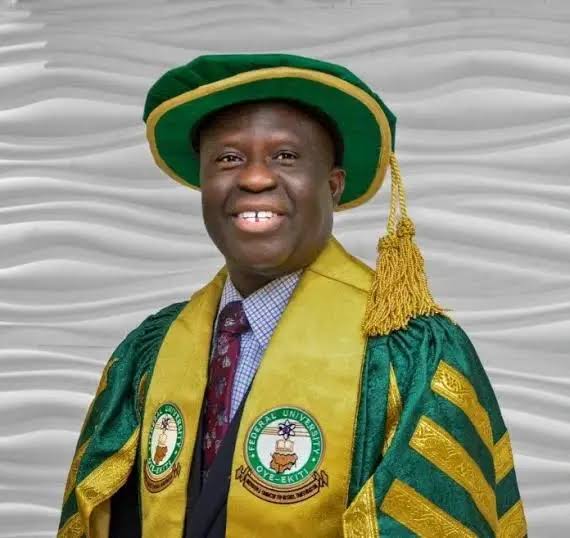
A broad coalition of more than 300 women’s rights organisations, civil society groups, professional associations and prominent public figures has urged President Bola Tinubu to halt the appointment of former Federal University Oye-Ekiti (FUOYE) Vice-Chancellor, Professor Abayomi Sunday Fasina, as Nigeria’s ambassador-designate, arguing that the Senate ignored pending court proceedings and failed to exercise adequate diligence before confirming his nomination.
ABUJA — One of the largest coordinated interventions by civil society in recent years has emerged against the Senate’s confirmation of former Federal University Oye-Ekiti (FUOYE) Vice-Chancellor, Professor Abayomi Sunday Fasina, as an Ambassador of the Federal Republic of Nigeria, with more than 300 organisations asking President Bola Tinubu to withdraw the appointment over what they describe as serious unresolved legal and ethical concerns.
In a petition released under the platform of WOMANIFESTO, the coalition accused the Senate of confirming the nomination despite petitions, documentary evidence and pending proceedings before the National Industrial Court relating to allegations of workplace sexual harassment and victimisation involving the former university administrator. The coalition argues that ambassadorial appointments demand not only professional competence but also the highest standards of public integrity and public confidence.
The organisations further contend that the confirmation process fell short of the diligence expected of a constitutional institution charged with scrutinising nominees for high public office. According to the petition, the Senate relied heavily on representations made during the screening exercise without hearing from complainants or considering the full body of documentary materials earlier submitted by civil society groups.
Among the issues raised by the coalition is its contention that the Senate was mistaken in stating that no petition had been submitted against Professor Fasina. The petition alleges that detailed memoranda, accompanied by supporting documents relating to ongoing civil proceedings before the National Industrial Court in Abuja and Lagos, had previously been acknowledged by both the Office of the Senate President and the Senate Committee on Foreign Affairs.
The coalition also disputes the Senate’s reliance on what it described as the nominee’s clearance by the Police and the Governing Council of FUOYE. It argues that neither institution possesses the constitutional authority to make a final determination on allegations of workplace sexual harassment, insisting that such questions ultimately fall within the jurisdiction of the courts.
The petition further challenges statements reportedly made during the Senate proceedings suggesting that alleged complainants failed to appear before lawmakers. According to the coalition, no invitation was ever extended to the complainants or to the civil society organisations that submitted petitions, making it impossible to conclude that they deliberately declined to participate in the screening process.
The organisations also argue that ambassadorial appointments should command unquestionable public confidence, particularly where Nigeria’s representatives are expected to project the country’s commitment to integrity, accountability and respect for the rule of law before the international community.
Beyond Professor Fasina’s nomination, the coalition describes the development as a broader test of institutional accountability, warning that confirming nominees while judicial proceedings remain pending could discourage victims of workplace misconduct from seeking legal redress and erode public confidence in constitutional oversight mechanisms.
The petition concludes by calling on President Tinubu to review the appointment in the wider public interest, arguing that constitutional responsibility requires public appointments to be judged not only by the absence of criminal conviction but also by the credibility, transparency and integrity of the appointment process itself.
The full text of the statement reads:
Confirmation of Professor Abayomi Sunday Fasina as ambassador of the Federal Republic of Nigeria: Acharade of shame
- INTRODUCTION
In the Senate/Upper House of the National Assembly, in what appears to be a charade of shame, travesty of justice and in total oblivion of existing petitions, the Senate proceeded to confirm Prof. Sunday Abayomi Fasina as an Ambassador of the Federal Republic of Nigeria. Despite objections by notable senators, the Senate President, Godswill Akpabio, proceeded to confirm him, anchoring his confirmation on four points.
First, that Prof Sunday Abayomi Fasina’s state of origin and constituency is Lagos State and given that there is no opposition from Lagos State, the confirmation was solidified. Secondly, no petition was submitted that substantiated allegations of sexual harassment against Professor Sunday Abayomi Fasina. Thirdly, there is a presumption of innocence in his favour. Finally, they claim that the Police and the FUOYE Governing Council have cleared Prof Sunday Abayomi Fasina.
We, the undersigned CSOs, respond that the appointment of Professor Sunday Abayomi Fasina and the basis of his confirmation is erroneous, constitute an affront to the tenets of democracy and the protection of the dignity of women.
First, Prof Sunday Abayomi Fasina, although educated in Lagos State, is from Abeokuta South, Ogun State. Secondly, a plethora of petitions were submitted to the Senate with substantial evidence of the cases against Prof Sunday Abayomi Fasina at the National Industrial Court, Abuja and Ikoyi, respectively. Thirdly, presumption of innocence does not cancel the prima facie case of sexual misconduct against Prof Sunday Abayomi Fasina. Neither the Police nor the FUOYE Governing Council has the constitutional power to clear Prof Sunday Abayomi Fasina of allegations of misconduct; only the court has such power.
The purpose of this Petition is to bring to the attention of the Nigerian government and the entire Nigerian population these material facts and public-interest considerations arising from the confirmation of Professor Abayomi Sunday Fasina, former Vice-Chancellor of the Federal University Oye-Ekiti (FUOYE), as an ambassador. We humbly urge the Nigerian government and the entire Nigerian Community to jettison his appointment as an Ambassador of the Federal Republic of Nigeria based on the following points as detailed in the subsequent paragraphs.
- MISREPRESENTATION OF THE STATE OF ORIGIN OF PROF ABAYOMI SUNDAY FASINA
Undoubtedly, Prof Sunday Abayomi Fasina is from Abeokuta, Abeokuta South Local Government Area of Ogun State. While he may have schooled extensively in Lagos State, his state of origin remains Ogun State. Thus, the argument projected forward by Senator Godswill Akpabio is unfounded and erroneous.
- EVIDENCE OF SUBMISSION OF MATERIAL FACTS ABOUT THE CIVIL CASES IN THE NATIONAL INDUSTRIAL COURT, ABUJA AND IKOYI, TO THE SENATE
Regardless of the material facts/evidence that we presented against Prof Fasina, the acknowledged copy by the Office of the Senate President, Godswill Akpabio and the Chairman Senate Committee on Foreign Affairs, Abubakar Sani Bello, which is attached to this petition, shows that the Senate was totally oblivious to the existence of any pending suit against Prof Fasina. In a petition dated 25th June 2026 and 29th June 2026, we presented material evidence about the cases currently before the National Industrial Court, Abuja and Ikoyi, respectively, against Professor Sunday Abayomi Fasina which included the 37 minutes recording. For the avoidance of doubt, the facts of these cases are detailed:
SUIT NO NICN/ABJ/201/2025- A female staffer under Fasina’s institution, FUOYE, filed the case of sexual harassment against Fasina for sexual harassment at the National Industrial Court, Abuja. Her case is substantiated by a 37-minute recording of Prof Abayomi Fasina pressing her for sex/ sexual relations.
Some of the excerpts from their conversation in the 37-minute tape read that Fasina told her thus, ‘You know that you and Adenigba Adele and a few people; we were in Ikole together. I did not pass my boundary; we have come too far, we have come a long way. But let me tell you, I’m dying for you, I’m dying for you inside, I’m really dying inside. I don’t do this kind of thing, but if someone is in love with someone, as you can see me, I’m thinking about you, I can’t even sleep,”.
SUIT NO NICN/LA/61/2025 – Another female staffer filed a case of harassment and victimisation against Fasina for failing to promote her simply because she declined what she thought was his immoral conduct and advances towards her. She alleged that she complained to the past Pro-Chancellor of FUOYE about this conduct. Prof Fasina initially informed the then Pro-Chancellor that she had passed all her assessments, but later changed her assessment outcomes, claiming she had self-plagiarised. This claim is irrespective of the judgement against Fasina in AKINGBE V FUOYE, which held that self-plagiarism is alien to Nigerian law.
While her case was ongoing and in violation of a court order requiring the parties to maintain the peace, Prof Fasina, as the Vice Chancellor of FUOYE, in flagrant disobedience to the court order, secured the termination of her appointment by FUOYE.
- AMBASSADORIAL APPOINTMENT DEMANDS THE HIGHEST LEVEL OF INTEGRITY WHICH PROF SUNDAY ABAYOMI FASINA DOES NOT POSSESS
Ambassadorial Appointments are public trust appointments requiring the highest standards of integrity and public confidence. An Ambassador acts as the official representative of the Federal Republic of Nigeria before foreign governments, international organisations, and the global community. Such appointments necessarily require technical competence, as well as unquestionable public credibility, ethical standing, and the confidence of both domestic and international stakeholders.
Prof Sunday Abayomi Fasina has two sexual harassment cases pending against him at the National Industrial Court, Ikoyi and Abuja. The existence of two sexual harassment cases against him is a prima facie indictment of his questionable public credibility and lack of ethical standing.
- THE POLICE DOES NOT HAVE THE CONSTITUTIONAL POWERS TO CLEAR A PERSON FOR AN ALLEGATION OF SEXUAL HARRASSMENT
Even though the police don’t have the constitutional right to decide, with finality, the rights and liabilities of an individual, Senator Godswill Akpabio claims that the Police have cleared Prof Fasina and, as such, he is now fit and proper for the position of Ambassador. In rebuttal, the police report did not explicitly clear Fasina of workplace sexual harassment in its entirety. Still, it dismissed any claim of physical sexual assault, which is distinguishable from workplace sexual harassment. Moreso, the court and not the police have the constitutional right to clear a citizen of sexual harassment allegations. Only the court has the power to do so with finality.
Another vital point is that the other sexual harassment claim against Fasina has not been subject to any police investigation.
- CLEARANCE BY FUOYE PANEL BASED ON TECHNICALITY RATHER THAN MERIT AND A PANEL COMPOSED OF FRIENDS, EMPLOYEES AND ALLIES OF PROF FASINA
The claim of the Senate that Prof Fasina was cleared of sexual harassment is defeated by the unconstitutional composition of that panel and the basis upon which he was cleared. The purported panel was largely composed of FUOYE employees (4 out of 8, with the secretary, a FUOYE employee). All of them were under the control of Prof Fasina. By section 9(2) of the FUOYE Establishment Act 2015, Professor Fasina, as the Chief Executive Officer of FUOYE, had control over all the affairs of the University.
Even the purported external members of the committee from the University Council were alleged to be allies of Prof Fasina because he controlled their remuneration and allowances. As such, it is not surprising that the verdict was against the female staffer (Engr Folasade Adebayo). The basis for the verdict is that the woman did not petition the Council herself and that she recorded Prof Fasina without his permission. The case that Prof Fasina made unwanted sexual advances at her and victimised her as a result was never rebutted.
Their position is that the allegation of sexual harassment was unfounded. Note that the second case by the female staffer of victimisation and harassment against Fasina at the National Industrial Court was not determined by any panel or investigated by any law enforcement agency.
- THE CLAIM BY THE SENATE THAT THE ALLEGED VICTIMS FAILED TO APPEAR BEFORE THE SENATE IS FALSE
One of the principal justifications advanced during the Senate proceedings was that the alleged victim failed to appear before the Senate Committee when Professor Abayomi Fasina was screened. This assertion is demonstrably false. At no point did the Senate Committee invite Engr. Folasade Adebayo or any of the other victims, complainants or civil society organisations that submitted petitions and documentary evidence against Professor Fasina. Having never been invited, it is legally and factually impossible to conclude that the victims “failed to appear.”
This narrative creates the false impression that the victims deliberately refused to participate in the legislative process, whereas the truth is that they were denied any opportunity to be heard. Such a conclusion offends the constitutional principle of fair hearing and undermines the credibility of the Senate’s fact-finding process. Rather than hearing from both parties before reaching a decision, the Senate relied exclusively on representations made by Professor Fasina while excluding those who possessed first-hand evidence of the allegations.
The principle of Audi Alteram Partem is enshrined in section 36 of the 1999 Constitution. It entails that both sides must be heard. Despite the material facts presented before the Senate by the undersigned NGOs, the Senate President did not at any point deem it fit to hear from Prof Fasina’s Victims. The Senate had ample opportunity to invite the victims for a plenary hearing to enable them to determine the suitability of Prof Fasina from an informed rather than a one-sided narrative from the point of view of an alleged aggressor.
- OF THE RECORD OF THE HOUSE OF REPRESENTATIVES DEMONSTRATES THAT ONE PROF. ABAYOMI FASINA’S VICTIMS HAS CONSISTENTLY SOUGHT ACCOUNTABILITY
The claim that the complainant failed to pursue accountability is equally inconsistent with the documentary record. Following the decision of the Federal University Oye-Ekiti Governing Council in 2025 which dismissed the allegations, victim-blamed Engr. Folasade Adebayo and directed her to apologise to the University, she formally petitioned the House of Representatives Committee on University Education requesting legislative intervention.
The Committee acknowledged her petition, requested that both parties submit all documentary evidence and fixed 15 May 2025 for a formal hearing. In compliance with the Committee’s directive, Engr. Adebayo submitted over one hundred pages of documentary evidence and travelled from Ekiti State to Abuja on 14 May 2025, a day before the scheduled hearing, in readiness to appear before the Committee. However, after her arrival in Abuja, the Committee officially communicated that the hearing had been postponed indefinitely because Professor Abayomi Fasina had failed to respond to the Committee’s invitation. These official correspondences formed part of the materials submitted to the Nigerian Senate prior to Professor Fasina’s confirmation.
It is therefore inaccurate and misleading to suggest that the complainant has ever refused to appear before a legislative body. The documentary evidence demonstrates precisely the opposite: she honoured every invitation extended to her, whereas Professor Fasina failed to cooperate with the investigative process before the House of Representatives.
- THE SENATE FAILED TO EXERCISE THE MINIMUM STANDARD OF DUE DILIGENCE EXPECTED OF A CONSTITUTIONAL INSTITUTION
Beyond the petitions submitted by civil society organisations, the Senate had before it sufficient information indicating that serious judicial and investigative proceedings concerning Professor Fasina remain pending. In 2025, following petitions submitted by civil society organisations, the Independent Corrupt Practices and Other Related Offences Commission (ICPC) commenced a criminal investigation into allegations relating to abuse of office and sexual harassment involving Professor Fasina. Rather than honouring the Commission’s invitation and cooperating with the investigation, Professor Fasina approached the court and obtained an order restraining the ICPC from proceeding with its investigation.
That matter remains pending before the court. The Senate was informed of these facts through the petitions and supporting documents submitted before the confirmation process. As the constitutional body responsible for scrutinising presidential nominees for some of the highest public offices in the country, the Senate owed Nigerians a duty to undertake reasonable due diligence. At the very least, it could have formally requested information from the ICPC regarding the status of its investigation or sought clarification from the House of Representatives Committee on University Education regarding its pending proceedings. No evidence has been presented that the Senate undertook either step before confirming Professor Fasina.
The failure to verify readily available information from two public institutions the ICPC and the House of Representatives and the Civil Society Organizations, raises serious concerns about whether the confirmation process met the standard of diligence, fairness and accountability expected of the Nigerian Senate. Conclusion This Petition is a call for constitutional responsibility, institutional integrity and public accountability. Public appointments, particularly ambassadorial appointments, demand more than the absence of a criminal conviction. They require public confidence, ethical credibility and demonstrable respect for accountability processes. Confirming a nominee while multiple judicial proceedings remain pending, while an anticorruption agency’s investigation is stalled before the courts, and without hearing from those who submitted detailed evidence undermines public confidence in the Senate’s oversight function and sends a dangerous signal to survivors of workplace sexual harassment.
Signed: Wumi Asubiaro-Dada, Co-Convener, Womanifesto on behalf of listed groups.
Among the organisations endorsing the petition are WOMANIFESTO, ActionAid Nigeria, Baobab for Women’s Human Rights, Bring Back Our Girls, International Federation of Women Lawyers (FIDA), Women Advocates Research and Documentation Centre (WARDC), Women Aid Collective (WACOL), Women’s Rights Advancement and Protection Alternative (WRAPA), Women Consortium of Nigeria (WOCON), Women at Risk International Foundation (WARIF), Education as a Vaccine (EVA), Enough is Enough Nigeria (EiE), Yiaga Africa, National Council of Women Societies (NCWS), Federation of Muslim Women’s Associations in Nigeria (FOMWAN), Nigeria Association of Women Journalists (NAWOJ), WIMBIZ, WISCAR, The Guardian Newspapers, Dr. Obiageli Ezekwesili, and hundreds of other civil society organisations, professional associations, women’s groups and development partners.