Students of History know that it has a habit of whispering before it screams.
In the winter of 1170, an exasperated King Henry II is said to have uttered one of history’s most expensive sentences: “Will no one rid me of this turbulent priest?” Whether those were his exact words is almost beside the point. History remembers not the grammar of power but its consequences.
Henry had elevated his trusted friend, Thomas Becket, to the exalted office of Archbishop of Canterbury. His calculation was straightforward, a loyal friend would surely become a loyal Archbishop, his policies would be aided and supported, and Church and Crown would march in elegant lockstep, each blessing the ambitions of the other.
Something deeply inconvenient happened instead.
Becket met God.
In short, the man became born again and began to give away his worldy possessions.
Wahala!
The courtier had become a cleric in more than vestment. He had become God’s servant! When Henry reportedly reminded him, “I made you Archbishop,” Becket’s reply still echoes across the centuries: “God used you to make me Archbishop.”
That single sentence marked the end of their friendship.
Henry expected fealty, Becket offered fidelity to a higher authority. The King insisted that the Archbishop existed to serve the Crown, the Archbishop obdurately insisted that he could only first serve God and the Church.
Then came that fatal lament. Four knights, hearing in the King’s frustration what they chose to interpret as royal intent, saddled and rode to Canterbury Cathedral and ensured that an impatient monarch’s complaint became an immortal crime.
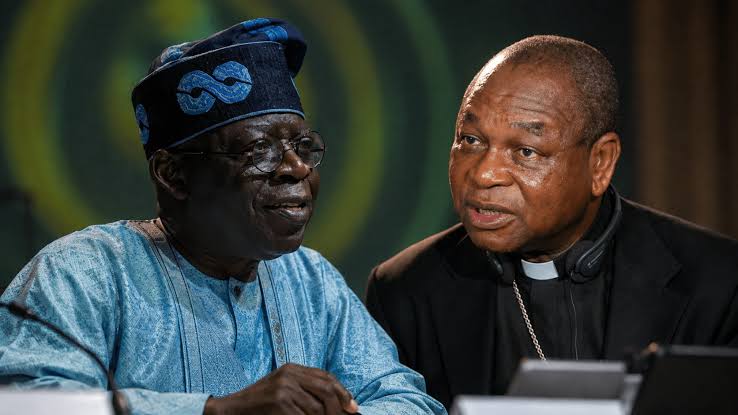
Centuries later, TS Eliot transformed that moment into enduring literature. Eliot understood that the real danger was not merely the King’s anger; it was the eagerness of those who rush to convert irritation into action, those who mistake sycophancy for duty and excess for loyalty. This brings us, rather closely and uncomfortably to our own moment, our own time, and to those presently attacking the verbal Cardinal.
Cardinal John Olorunfemi Onaiyekan has, by speaking according to his understanding of the obligations of his office, drawn the displeasure of President Bola Ahmed Tinubu and his supporters The Cardinal has spoken as a prince of the Church, courtiers would rather he spoke as a courtier.
There is, of course, no medieval England here. No cathedral awaits a band of armed horsemen. Nigeria is a constitutional democracy, not a feudal kingdom.
Yet history’s warnings are rarely literal. They are moral auguries for the prescient.
Every age produces its own versions of the four knights. They do not always carry swords. Sometimes, they carry microphones. Sometimes hashtags. Sometimes television studios. Sometimes, they simply carry an unshakable conviction that defending power requires attacking every independent voice.
No one, thankfully, has called for the Cardinal’s head. May no one ever do so. But societies do not descend into intolerance in a single dramatic leap. They arrive there one denunciation at a time, one orchestrated outrage at a time, one act of performative loyalty after another.
The truly loyal adviser is not the one who silences every dissenting voice. It is the one who prevents a leader from confusing criticism with betrayal.
Henry II eventually performed public penance for the consequences of his anger. History granted him remorse but denied him innocence. Thomas Becket became a saint. The four knights became footnotes to infamy.
There is wisdom in remembering that story before passions outrun prudence.
There is wisdom, also in remembering that power is transient, that institutions endure longer, and conscience longer still.
The presidency loses nothing by allowing a Cardinal to be a Cardinal. The Church, and the rest of us,
lose everything if a Cardinal becomes merely another applauding official.
The tragedy at Canterbury began not with murder but with the belief that every influential voice must ultimately bend before the throne.
That belief was wrong in 1170.
That belief remains wrong today.
[email protected]
The views expressed by contributors are strictly personal and not of Law & Society Magazine.