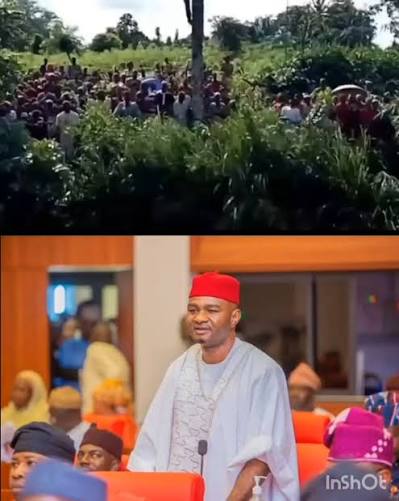
Peter Onyekachi Nwebonyi went to Izzi seeking support for the APC, but an unbridged river left him on one bank while the voters he came to court stood on the other.
There is a familiar ritual in Nigerian politics: the politician disappears after the election and returns when the next one is approaching, suddenly remembering the roads, the villages and the voters whose lives may have changed little since the last campaign.
In Izzi, Ebonyi State, that ritual produced an image almost too perfect to require a political speech.
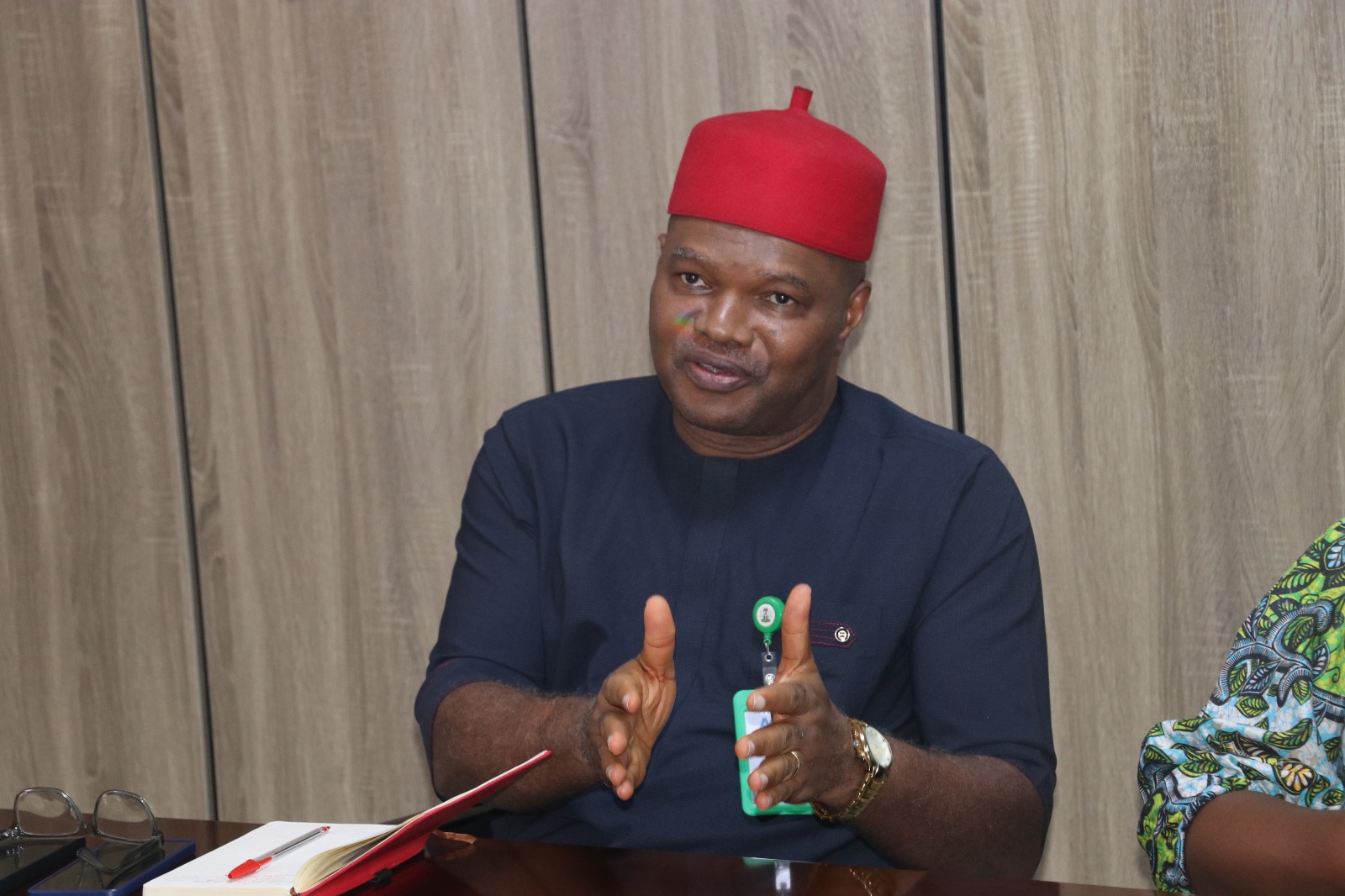
Senator Peter Onyekachi Nwebonyi, the Deputy Chief Whip of the Senate and representative of Ebonyi North, went into the area to campaign for the All Progressives Congress, only to find a river standing between him and the people whose votes he was seeking.
There was no bridge.
So Nwebonyi stood on one bank with his supporters while residents gathered on the other. Speaking in Igbo, he urged them not to listen to politicians from rival parties who might come asking for their votes.
The scene was striking not because a politician had encountered an inconvenient river, but because of what the river represented.
For years, Nigerians in communities like this have learned to live with the absence of infrastructure that connects them to the rest of the country. Then election season arrives and politicians somehow find their way back to those same communities, asking residents to remember them at the ballot box.
In Izzi, the senator could not even cross the water to meet the voters.
Yet he had come to ask them to cross a political bridge and give his party another chance.
That is the contradiction captured by the video now circulating online: The Nigerian political class can be remarkably good at finding voters when it needs their votes, even when it has spent years struggling to find the problems that keep those voters trapped.
The river is not the real story
It would be easy to make the episode entirely about the missing bridge. But that would reduce a revealing political image to a joke about an awkward campaign stop.
The more important question is what the absence of the bridge means to the people who live there.
A bridge can determine whether a farmer gets produce to market before it spoils, whether a child can get to school without taking a dangerous or much longer route, or whether someone who falls seriously ill can reach a hospital in time.
For communities separated from major roads and markets by rivers and difficult terrain, connectivity is not an amenity. It is part of the basic infrastructure of economic life.
The World Bank has estimated that about 80 per cent of Nigeria’s road network is in poor condition and has invested in programmes designed to improve rural roads and access routes. Its Rural Access Agricultural Marketing Project-Scale Up is expected to rehabilitate or upgrade 6,500 kilometres of rural roads and improve access for about four million people.
The logic behind such projects is straightforward: a road or bridge does not merely shorten a journey. It connects farmers to markets, children to schools, patients to healthcare and communities to economic opportunities.
That is precisely why the scene in Izzi resonates.
For the people standing across the river, the absence of a bridge is not a campaign-season metaphor. It is part of their everyday life.
The politician arrives when the votes are due
Nigeria’s election seasons have developed their own choreography.
Politicians who may have spent years in Abuja suddenly return to villages they rarely visit. Convoys appear on roads that have received little attention from government. Campaign banners go up. Promises are made. Traditional rulers are visited. Community leaders are consulted. Supporters are mobilised.
The voter, who may have struggled with bad roads, unreliable electricity, inadequate healthcare or poor access to water throughout the previous electoral cycle, is once again the most important person in the country.
Until the votes are counted.
This is one of the enduring weaknesses of Nigerian democracy: the relationship between elected officials and citizens is too often reduced to the election itself.
The citizen is courted before voting and forgotten afterwards.
That does not mean nothing is ever achieved. Across Nigeria, elected representatives can point to roads, schools, health centres, boreholes, electricity projects and other interventions delivered during their terms. Some have made a genuine difference.
The problem is that voters are too often expected to judge political performance by what a politician says he has done rather than by what exists on the ground and whether it works.
That is where the river in Izzi becomes significant.
What constituency representation is supposed to mean
Nwebonyi’s record is itself part of the debate.
The senator has highlighted roads, bridges, schools, water projects and other interventions in Ebonyi North as evidence of his work in the constituency. In February, he was reported to have linked six rural communities with a 12-kilometre road project that included bridges and culverts. He has also said he personally financed some projects while awaiting government funding.
Those projects should be assessed individually, and there is no evidence that the particular bridge absent from the Izzi crossing was a project personally promised or funded by Nwebonyi.
A senator cannot reasonably be held personally responsible for every piece of infrastructure missing from a senatorial district.
But representation also means knowing what continues to make life difficult for the people one represents.
If a community remains physically cut off, it is reasonable for residents to ask their elected representatives whether the problem has been identified, whether a solution has been proposed and whether anyone is pursuing the funding needed to make it happen.
Those are not partisan questions.
They are the ordinary questions of accountability.
The constituency-project problem
The episode also brings back a much larger argument about Nigeria’s constituency-project system.
Federal lawmakers have long been able to influence the allocation of projects to their constituencies. The arrangement was intended to ensure that local needs found their way into the national budget, particularly in communities that might otherwise struggle to attract federal attention.
But the system has generated persistent criticism over abandoned projects, duplication, weak oversight and projects that do not correspond adequately with local needs.
The Independent Corrupt Practices and Other Related Offences Commission (ICPC) has repeatedly raised concerns about poorly executed and abandoned constituency and executive projects.
BudgIT’s analysis of the 2025 federal budget identified 11,122 projects worth about ₦6.93 trillion inserted by lawmakers, prompting renewed debate over the scale and purpose of legislative interventions in the national budget.
The numbers are enormous, but voters encounter none of them directly.
They encounter the road.
They encounter the school.
They encounter the health centre.
They encounter the borehole that works—or does not.
And, in Izzi, they encounter the river.
That is why constituency projects should ultimately be judged by a simple test: Did the project solve the problem it was supposed to solve?
The politics of gratitude
There is another feature of Nigerian political culture that deserves scrutiny: the expectation that voters should be grateful to politicians for public projects.
A legislator commissions a road and supporters applaud.
A politician distributes equipment and photographs are taken.
A scholarship is awarded and the beneficiaries are reminded of who provided it.
An empowerment programme is launched and the recipients are encouraged to remember the benefactor when elections arrive.
Yet much of the money behind these interventions ultimately comes from public funds.
The politician may deserve credit for identifying a need, securing funding or pushing a project through government machinery. But the citizen remains a citizen, not a beneficiary of the politician’s personal generosity.
A functioning road is not a favour.
A bridge is not a gift.
A hospital that can be reached when someone is sick is not an act of personal kindness.
They are part of what citizens should expect from a government funded by their taxes and entrusted with public resources.
The voters are entitled to ask questions
There is also a danger in turning the Izzi video into a purely partisan story.
The issue is bigger than Nwebonyi and bigger than the APC.
The same questions should follow every politician who arrives in a community during an election campaign.
What has changed since the last election?
Which promises were kept?
Which projects were funded?
Which were completed?
Which have failed?
What remains to be done?
And, perhaps most importantly, what is the timetable for doing it?
These are the questions that can turn elections from contests of personality into contests of performance.
They also change the balance of power.
A politician who knows that voters will ask for evidence has less room to rely on slogans, party loyalty or the occasional campaign gift.
The bridge voters really need
The image from Izzi will probably have a short life on social media. Another video will soon replace it, another campaign speech will generate another argument and another political controversy will push it down the news cycle.
The river, however, will remain.
So will the community on the other side.
That is why the photograph—or video—should not simply be laughed at. It should prompt a more serious conversation about what Nigerian voters should demand from those who come looking for their support.
The politician’s job is not merely to find the electorate when an election approaches.
It is to know where the electorate lives, understand the problems it faces and use public office to help solve them long before the next campaign convoy arrives.
The people of Izzi may eventually get their bridge. If they do, it should not be because an election made them visible for a few weeks.
It should be because somebody in government finally treated their isolation as a problem worth solving.
Until then, the image remains difficult to ignore: a senator standing on one side of a river, calling across to voters on the other.
For the politician, it was a campaign stop.
For the people across the water, the river is still there tomorrow.
Watch the video here.