- Blames political failures for Nigeria’s economic crisis
Lagos, Nigeria — The Governor of Abia State, Alex Chioma Otti has issued a stark warning ahead of Nigeria’s next election cycle, declaring that the country’s economic future hinges not on rhetoric or quick fixes, but on hard political choices that will determine whether millions face prosperity—or deeper hardship.
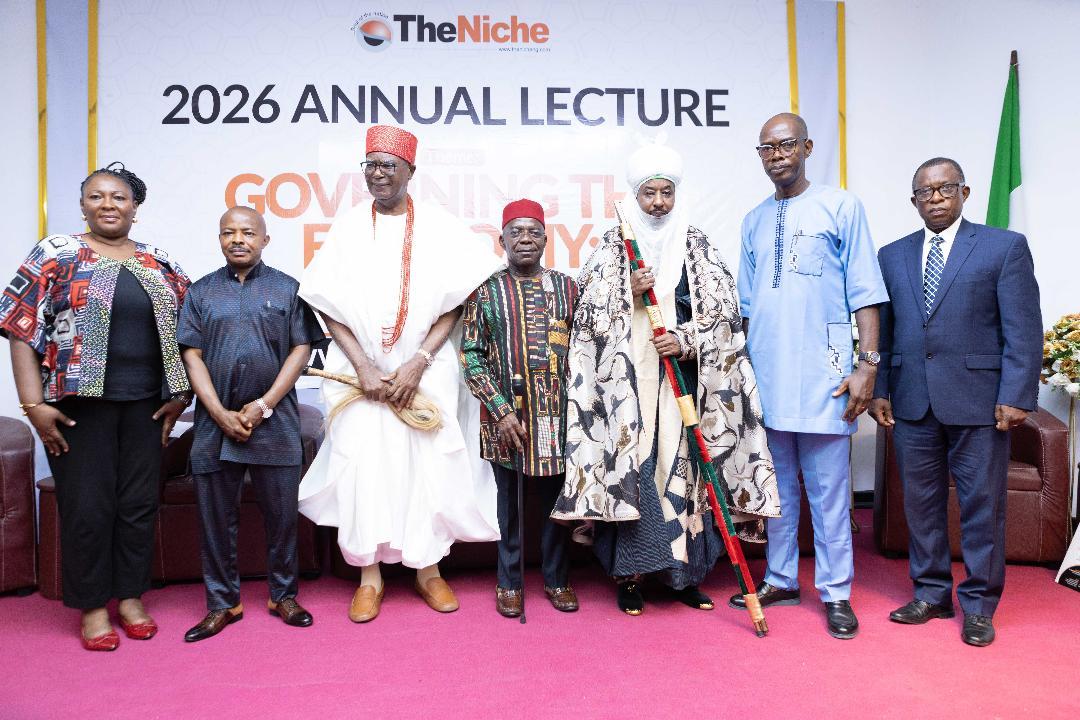
Delivering the 2026 TheNiche Annual Lecture at the Nigerian Institute of International Affairs, Otti drew a direct line between political behavior and economic outcomes, arguing that corruption, vote-buying, and opportunistic leadership have become structural barriers to growth.
“There is no silver bullet,” Otti said, dismissing any expectation of rapid turnaround in an economy grappling with unemployment, poverty, and declining investor confidence. Instead, he called for “tough decisions” and a break from what he described as a culture of political expediency and institutional decay.
In unusually blunt terms, the governor warned that Nigeria’s elections have increasingly been reduced to transactional exercises, where votes are treated as commodities and public office as an investment to be recouped.
“If we treat elections as bazaars,” he said, “those who win will not serve—they will recover their investments and prepare for the next cycle.”
Otti’s remarks come at a pivotal moment, with political momentum already building toward the 2027 general elections. He framed the coming vote as a defining national crossroads.
“Poverty and prosperity, employment and joblessness, security and anxiety will all be on the ballot,” he said, adding that the implications of voters’ choices would extend far beyond politics into the everyday economic realities of Nigerians.
The governor also took aim at what he described as a dangerous disconnect between leadership and economic governance, arguing that incompetent or self-serving political actors inevitably trigger economic decline—from shrinking GDP to rising poverty and weakened institutions.
Nigeria’s persistent economic struggles, he suggested, are not inevitable but self-inflicted.
“Economics does not respond to sentiment,” Otti said. “It responds to decisions—and the quality of those decisions depends on who is in power.”
Citing his administration’s experience in Abia State, Otti argued that reform begins with changing leadership behaviour rather than relying solely on policy shifts. He pointed to increased investor confidence, improved infrastructure, and revenue growth as evidence that governance reforms can yield rapid, tangible results.
But he cautioned that progress requires difficult trade-offs, including reducing wasteful public spending, prioritizing infrastructure over short-term welfare handouts, and investing in sectors like power and transportation to unlock productivity.
He also warned against populist policies that prioritize immediate consumption over long-term economic sustainability, arguing that such approaches undermine both growth and human dignity.
“Teaching people to produce is more sustainable than handing out temporary relief,” he said.
Beyond policy, Otti emphasized civic responsibility, criticizing declining voter turnout and political apathy as key drivers of Nigeria’s governance crisis. Participation, he argued, must go beyond voting to include active engagement and accountability.
“Things will continue to deteriorate if citizens stay away from the process,” he warned.
On security, the governor described insecurity as a major economic drain, stressing that instability not only consumes public resources but also deters investment and stifles growth.
Despite the grim diagnosis, Otti struck a cautiously optimistic tone, insisting that Nigeria’s trajectory can still be reversed—if both leaders and citizens make the right choices.
“The nation will go in whatever direction we choose,” he said. “It is as simple as that.”
With less than a year before critical political decisions begin to crystallize, Otti’s message was clear: Nigeria’s economic fate will not be decided by chance—but by the ballot.