At World Medical Law Congress, Nigerian lawyer says legal protection has not translated into access on the ground
ANTWERP, Belgium — Nigeria has developed a legal framework intended to protect the rights of persons with disabilities, but access to healthcare on the ground remains severely constrained by communication barriers, inaccessible facilities, inadequate institutional support and weak implementation of existing laws, Nigerian lawyer Joyce Nnenna Eseni has said.
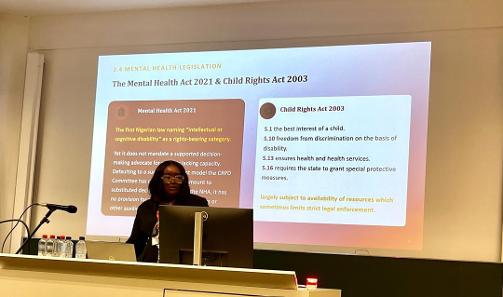
Eseni made the submission on the opening day of the 30th World Congress on Medical Law, which held from August 5 to 7, 2026, in Antwerp, Belgium, where she presented a paper titled “The Human Rights to Healthcare: Evaluating Legal Frameworks and Barriers for Persons with Disabilities in Nigeria.”
Her central argument was stark: Nigeria’s legal architecture has not been matched by equal access in practice.
Eseni, a member of the Nigerian Bar Association’s Abakaliki Branch and pioneer Head of Legal Services at Alex Ekwueme Federal University Teaching Hospital, Abakaliki, Ebonyi State, said the gap between legal protection and lived experience remains particularly evident for people with sensory, physical, intellectual and learning disabilities.
The challenge, she argued, is not simply that some facilities lack ramps or that some hospitals do not have interpreters. Communication, physical and institutional barriers frequently operate together, making healthcare technically available while leaving patients unable to access it on equal terms.
For a deaf patient, for example, the absence of a sign-language interpreter can affect far more than communication. It can prevent the patient from understanding a diagnosis, discussing treatment options, giving informed consent and participating meaningfully in decisions concerning their own health.
The same principle applies to other forms of disability, although the barriers may take different forms.
Eseni said several human rights are inseparable in the delivery of healthcare. The right to health cannot be meaningfully realised where a patient cannot communicate with a healthcare provider, understand information about treatment, give informed consent or receive care with dignity.
Nigeria already has important legal protections, including the Discrimination Against Persons with Disabilities (Prohibition) Act 2018, which provides for the protection of persons with disabilities and established the National Commission for Persons with Disabilities.
Yet legislation alone, she argued, cannot remove barriers that persist within healthcare institutions.
Discriminatory attitudes, the shortage of sign-language interpreters and Augmentative and Alternative Communication support, inaccessible infrastructure, inadequate funding and insufficient training of healthcare professionals continue to affect the ability of persons with disabilities to obtain appropriate care.
The consequence is a system in which the existence of a hospital or a statutory right does not necessarily mean that a person with a disability can exercise that right effectively.
Eseni illustrated the problem with a simple example that went to the heart of her argument.
“A hospital that admits a deaf patient but provides no interpreter has not actually delivered on the right to healthcare, consent, or dignity,” she said. “It has delivered only the appearance of care.”
She called for a coordinated response involving the legislature, judiciary, executive authorities and civil society, arguing that the problem cannot be solved by placing responsibility on one institution alone.
The legislature, she said, has a role in strengthening the legal framework and oversight mechanisms; the executive must provide funding, infrastructure and effective implementation; the judiciary must provide appropriate remedies where rights are violated; while civil society has an important role in advocacy, monitoring and accountability.
The division of responsibility is important, she noted, because each institution has different constitutional and legal powers. A court cannot provide hospital infrastructure, just as a ministry cannot determine the justiciability of a socioeconomic right simply by administrative action.
She also called for healthcare-worker training that recognises the different and sometimes overlapping needs of people with different disabilities, rather than treating disability as a single category requiring a single response.
For Eseni, the objective should be to move beyond formal compliance towards healthcare systems in which persons with disabilities can actually exercise their rights.
That means being able to enter healthcare facilities, communicate with providers, understand medical information, give or withhold informed consent, receive appropriate treatment and leave without having their dignity compromised.
Her presentation at an international medical-law forum therefore placed a distinctly Nigerian problem within a broader question confronting rights-based healthcare: What does it mean for a State to guarantee a right if the institutions through which that right is supposed to be enjoyed remain inaccessible to the people it protects?