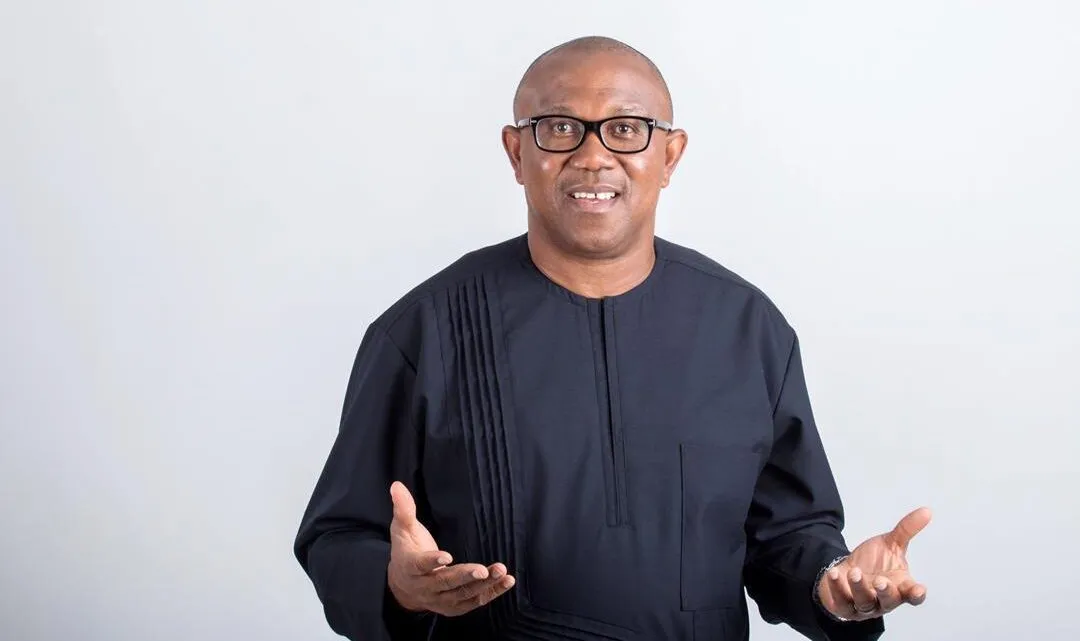
Before thousands of lawyers, Peter Obi turned a grain shipment from a war zone into a devastating question about how a country blessed with land, labour and oil became too unproductive to feed itself.
Former Anambra State Governor Peter Obi delivered one of the most pointed interventions at the 66th Nigerian Bar Association Annual General Conference in Port Harcourt, arguing that Nigeria’s deepening food insecurity and economic distress are the cumulative result of years of political choices that rewarded consumption over production and elite privilege over national development.
Addressing thousands of lawyers, Senior Advocates of Nigeria, jurists and policymakers during the conference’s presidential candidates’ dialogue at the Yakubu Gowon Stadium, Obi painted a bleak picture of a country blessed with abundant natural resources yet unable to feed its citizens. He said the country’s worsening hunger, insecurity and economic stagnation reflected a collapse of governance rather than a shortage of potential.
The former Labour Party presidential candidate anchored his argument on what he described as one of the greatest contradictions confronting Africa’s largest economy.
“Nigeria is poor today because it is not a productive country. Nigeria is one of the hungriest countries in the world. We got worse in the past three years. Some of you might not know that in the past two years, Ukraine, a country at war, gave us grain to fight hunger. We are hungry because Nigeria is not a productive country.”
The comparison with Ukraine carried particular force. While the Eastern European nation continues to defend itself against a prolonged military invasion, it has remained one of the world’s largest grain exporters and has contributed food assistance to countries battling hunger, including Nigeria. For Obi, that reality exposed the depth of Nigeria’s economic decline. A nation endowed with millions of hectares of fertile land, favourable weather and one of Africa’s largest labour forces, he argued, has become increasingly dependent on food imports and international relief because successive governments failed to build a productive economy.
He contended that Nigeria’s slide on global hunger rankings was not inevitable but the consequence of leadership that consistently diverted public resources toward consumption instead of investment, leaving agriculture, manufacturing and rural infrastructure underfunded.
The discussion soon broadened into a wider debate over economic policy, governance and the direction of the country ahead of the 2027 general election.
On fuel subsidy removal, Obi maintained that ending the subsidy was economically unavoidable but insisted that the policy could only succeed if the savings were transparently invested in programmes capable of cushioning citizens from the resulting hardship. He questioned the management of the more than ₦16 trillion reportedly saved from subsidy removal, arguing that Nigerians had seen little evidence of corresponding investments in agriculture, transportation, healthcare or social protection.
His position drew a sharp response from human rights activist and presidential aspirant Omoyele Sowore, who argued that successive administrations, regardless of political affiliation, had merely shifted public subsidies from fuel to the political establishment itself. According to Sowore, the real beneficiaries of government spending have remained members of the ruling elite rather than ordinary Nigerians struggling with inflation and declining purchasing power.
Obi also linked the country’s worsening security situation to its economic decline, arguing that insecurity has driven farmers away from their land, reduced food production and accelerated inflation. Restoring security in farming communities, he said, would unlock agricultural productivity on a scale capable of generating revenues that rival, and potentially exceed, earnings from crude oil.
He urged government to guarantee safety in agrarian communities, expand access to financing for smallholder farmers and redirect public expenditure toward sectors that generate long-term economic value instead of sustaining an expensive political bureaucracy.
The former governor further accused Nigeria’s political elite of exploiting ethnic and religious differences to divert public attention from failures of governance.
Rather than confronting unemployment, poverty, insecurity and declining productivity, he argued, political actors routinely inflame identity divisions to mobilise electoral support while avoiding accountability for deteriorating living conditions.
The exchanges underscored the NBA conference’s growing role as a national policy forum where legal practitioners engage political leaders on issues extending beyond the courtroom. With the 2027 elections drawing closer, the presidential dialogue provided another opportunity for aspirants to defend competing visions for reviving an economy weighed down by inflation, food insecurity, fiscal pressures and widespread public discontent.
Key Policy Positions Highlighted During the Debate
| Policy Area | Obi’s Position |
|---|---|
| Economic Productivity | Redirect public spending from recurrent expenditure to productive sectors, particularly agriculture and manufacturing. |
| Fuel Subsidy Savings | Subject the reported ₦16 trillion savings to public accountability and channel the funds into programmes that ease economic hardship. |
| Security | Secure farming communities to restore agricultural production and strengthen food security. |
| Economic Diversification | Reduce dependence on oil by building an export-driven economy anchored on agriculture, industry and value addition. |
| National Cohesion | End the political exploitation of ethnic and religious divisions and refocus governance on measurable development outcomes. |