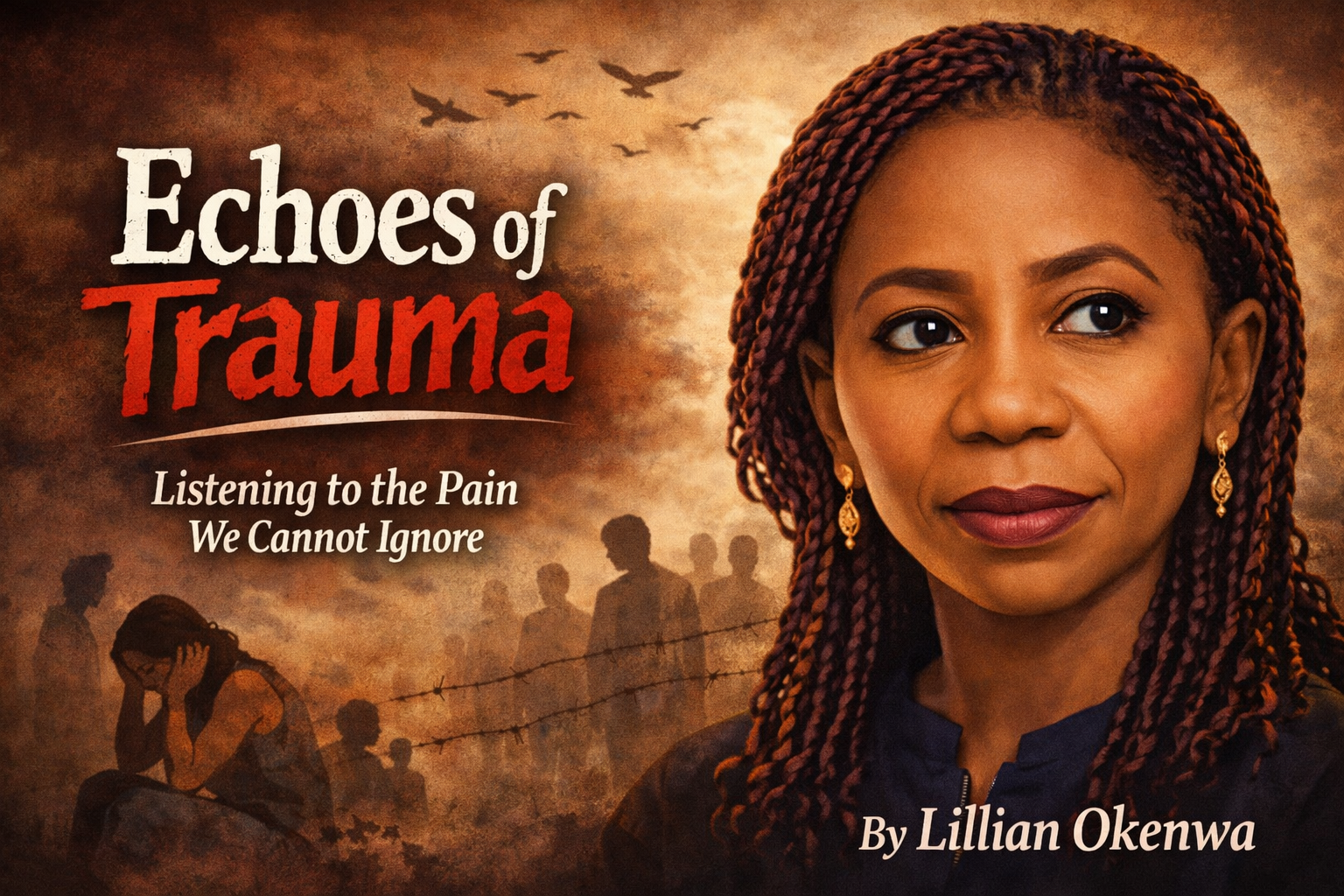
By Lillian Okenwa
Some people are not tired of hoping. They are tired of having to hope for so long.
They have watched opportunities come close and disappear, started again after things fell apart, celebrated small victories only to discover another obstacle waiting ahead. They have lived through circumstances that have tested their patience, their finances, their relationships, their bodies and their ability to imagine anything beyond the life they are living. Yet they keep making plans. They keep looking for another possibility. They keep asking what else they can try.
Read Also: Echoes of Trauma: When nobody is listening
The trauma weighs heavily. The exhaustion is real. The uncertainty can be frightening. Yet somehow, hope remains.
I have been thinking about the strange company hope keeps in some people’s lives. It can sit beside disappointment without erasing it. It can exist in the same heart as fear, frustration and grief. A person can be deeply unhappy with the life they are living and still believe another life is possible. They can be tired of the journey and still look for another road.
I will call her Tina, though that is not her real name.
Tina was a woman people loved. She was warm, generous and extraordinarily hospitable, the kind of person whose presence made people feel welcome. Then came the diagnosis that changed everything.
Chemotherapy began, and with every session came the hope that perhaps this would be the treatment that finally brought the disease under control. There was fear, and there was the physical and emotional toll of watching her body go through treatment, but hope travelled alongside all of it.
Then came radiotherapy.
Perhaps this would be the final answer. Perhaps after this, life could begin to resemble itself again.
Then one breast was lost.
Later, the other.
There was more chemotherapy. More radiotherapy. More difficult days. More waiting for results. At some point, there was relief. She was doing better. Perhaps this was finally behind her.
Then the cancer metastasised.
Her body began to surrender the things she had once taken for granted. Eventually, she became immobile. The illness kept taking pieces of ordinary life, while the people who loved her kept hoping for another turn in the story.
Eventually, Tina died.
What stays with me is that hope remained through almost every stage of it. Tina hoped. Her family hoped. Her friends hoped. They hoped after the chemotherapy, after the radiotherapy, after the surgeries, after the moments when it seemed the worst might finally be over.
Hope did not prevent the outcome. But neither did the progression of the disease immediately extinguish it.
We are accustomed to stories in which hope is rewarded. Someone persists through years of difficulty, eventually succeeds, and the ending seems to justify everything that came before.
But some of the most important parts of a person’s story happen long before anyone knows how it will end.
Before Jibrin Okutepa became a Senior Advocate of Nigeria, he was a teenager beginning Primary 2 at more than 17, in a classroom with children many years younger than himself. His father did not want him to go to school. He eventually left and became a motorcycle-mechanic apprentice, later finding his way back into education, passing his GCE as an external candidate, studying law and eventually rising to the rank of Senior Advocate.
Before Ogwu James Onoja became a Senior Advocate of Nigeria, there was a boy born in Idah on a day when the town was bombed during the Nigerian Civil War. His parents divorced when he was seven. Then came a succession of losses: his father died, six months later his mother died, and he subsequently lost his siblings. By his early thirties, he had experienced a depth of grief few people could imagine. Yet he continued building a life, working, studying and practising law, eventually rising to the very top of his profession and going on to build FortLugard University in Abuja, where the campus is now taking shape.
Before Ebun-Olu Adegboruwa became a Senior Advocate, he was a boy from rural Ilaje who lost his mother during his childhood, experienced severe hardship at home, dropped out of secondary school and became a cart pusher for more than a year. He eventually returned to education, studied law and endured further setbacks before rising to become one of Nigeria’s most prominent lawyers.
We usually encounter these men from the other end of their stories.
We see the Senior Advocate, not the teenager sitting among much younger children. We see the accomplished lawyer, not the young man carrying the grief of losing almost everyone closest to him. We see the legal luminary, not the boy pushing a wooden cart to survive.
The achievement is visible. The years before it are not.
None of them knew the ending while they were living through those years. They knew only the lives they were living.
And they continued.
There are women whose lives carry the same uncertainty.
By the time Olushola Olonade married for the first time at 48, she had already lived through years in which marriage and motherhood had remained possibilities rather than realities. Then life surprised her. On March 6, 2026, at 50, she gave birth to quadruplets, two boys and two girls, three weeks before her 50th birthday.
Think about the years before that.
Not simply the waiting, but the living. The work, the relationships, the ordinary days, the hopes carried alongside everything else. Think about reaching an age at which society has already begun to assume that certain chapters of your life are closed, only for life to open one of them in a way nobody could have scripted.
Society has a remarkable talent for putting expiry dates on people’s dreams.
By a certain age, you should be married. By another, you should have children. There are ages at which you are expected to have found your career, built your finances, bought a house, established yourself and generally demonstrated that you have figured life out.
When those milestones do not arrive on schedule, delay can begin to look like failure.
But life does not always consult the timetable we create for one another.
Another woman, Fummi Akinade, married in 1992 and became a mother 31 years later. After three unsuccessful IVF attempts, her fourth attempt succeeded. At 62, she gave birth to a baby boy in Lagos.
The birth is what makes the news.
The 31 years before it are harder to capture.
Thirty-one years is a long time to carry an unanswered hope. Long enough to watch other people’s children grow up. Long enough to attend naming ceremonies and birthdays. Long enough to answer questions you wish people would stop asking. Long enough to wonder whether hope is sustaining you or keeping an old wound open.
Yet hope remained.
Some years ago, I met another person whose story has stayed with me. I needed the seats of my car reupholstered, and someone introduced me to a young man who did upholstery.
In the course of our conversation, he told me that he had recently been released from prison. While there, he had learnt upholstery, bag making and other forms of leatherwork.
His journey to prison was nothing like the life he had been building before it was abruptly taken away.
He had started a business in Makurdi and, by his account, it was doing very well. An uncle who also lived in the city eventually asked for a share of the business. He refused, saying it was a business he had started and built himself. The disagreement became bitter. He said his uncle had connections within the police and that he was subsequently framed and arrested.
He was charged with armed robbery.
He was arraigned alongside two other men he said he had never met. Eventually, he was sentenced to death.
His family was in the East and, for a long time, did not know what had happened to him. As the years passed without word, they eventually gave him up for dead.
He, however, was still alive. Somewhere inside that prison, while the outside world had moved on without him, he kept hoping.
His death sentence was eventually commuted to life imprisonment. Later, he was released under the exercise of the prerogative of mercy.
When he finally made his way back to his village, people ran away from him. He looked so different from the person they remembered that some believed they were seeing the ghost of the man they had long assumed was dead.
Imagine surviving years in prison only to return home and discover that even your own people had already mourned you.
Yet he had something to return with.
He had learnt a trade. He had learnt how to make bags and other leather products. During those years when he could not know whether freedom would ever come, he continued acquiring skills that might be useful if it did.
When freedom came, he was not returning empty-handed. He carried with him the skills he had acquired while waiting for a future he could not see.
Sometimes hope looks like that: learning something today that may be useful if tomorrow comes.
But this is also where we have to be careful with the stories we tell.
We cannot take the case of the woman who went back to JAMB at 37 and became a doctor and tell another person who has failed repeatedly that their breakthrough is guaranteed. We cannot take Olushola’s story of marrying at 48 and becoming a mother of quadruplets at 50 and tell a woman who has waited for years that her own waiting will necessarily end in the same way. We cannot take the stories of people who survived extraordinary hardship and imply that everyone who perseveres will eventually receive a spectacular reward.
Life does not make that promise.
Hope should not become another burden placed on people who are already carrying enough.
The person who has sent hundreds of job applications and remains unemployed is not less deserving of hope because the job has not arrived. The student who has failed another examination is not lazy simply because the result is disappointing. The entrepreneur who has rebuilt three times and is still struggling is not necessarily lacking resilience. The woman whose treatment has failed is not someone who simply did not believe enough.
Sometimes people are already doing everything they can. They are simply living through a chapter whose ending has not revealed itself.
Perhaps that is why I hesitate when we tell people simply to “keep hoping.” It sounds encouraging until you meet someone who has been hoping for years and is exhausted from carrying the weight of uncertainty.
Maybe we do not always have to tell people to keep hoping. Sometimes we need to help them carry the hope they already have.
For someone who has hoped for too long, perhaps what is needed is not another instruction to keep hoping, but someone willing to sit with them in the uncertainty and help them find the strength for the next day. Sometimes that may mean listening without trying to fix the story, helping with something practical, reminding them of what they have already survived, or simply refusing to let them feel that they are carrying everything alone.
Hope is not always confidence. It is not always optimism. It does not necessarily mean believing that everything will work out.
Sometimes hope is much smaller.
It is filling out another examination form. Sending another application. Starting another business after the last one collapsed. Going for another medical appointment. Trying another treatment. Opening another book. Making another plan. Getting out of bed and asking what can still be done today.
Sometimes hope is simply refusing to close the door completely.
There is also a cost to carrying hope for too long. Repeated disappointment can make people afraid to expect too much. They may stop celebrating early. They may become cautious about making plans. They may learn to protect themselves by pretending not to care too much about what they deeply want.
They may still hope, but more carefully.
A person can be traumatised and hopeful at the same time. They can be frightened and hopeful, exhausted and hopeful, disappointed and hopeful. They can be deeply unhappy with today and still believe tomorrow might be different.
Perhaps we have misunderstood hope by expecting it to look like certainty. Hope is not necessarily the conviction that a particular outcome will happen. It can simply be the refusal to declare the future closed while we are still living in the present.
Tina’s story brings us back to the hardest part of that truth.
Her hope did not save her life.
But it was not meaningless because she died.
She and the people who loved her had something to hold while the outcome remained uncertain. They hoped because they loved her. They hoped because there was still another appointment, another treatment, another result, another morning.
When the ending came, it did not erase the hope that had existed along the way.
Trauma can make the future feel dangerous because we have learned how badly the present can hurt. It can teach us to expect disappointment before we allow ourselves to expect joy.
Yet people continue to imagine.
Another career.
Another relationship.
Another examination.
Another business.
Another chance.
Another year.
Another treatment.
Another life.
Not because they know it will work, but because they cannot quite bring themselves to believe it never will.
Maybe that is why some people keep striving long after observers think they should have stopped. They are not necessarily certain that success is waiting around the corner. They simply cannot accept that failure must be the final definition of their lives.
We often want to know how a story ends.
Perhaps it is more useful to ask what it takes to keep living while the ending is still unknown.
Sometimes hope changes the story. Sometimes hope leads us towards change. Sometimes hope sits beside us through something that cannot be changed.
It is not a contract with life. It is not a guarantee. It is not proof that everything will eventually make sense.
Sometimes it is simply the small space in the heart that suffering has not yet managed to occupy.
The trauma may weigh heavily. The disappointment may be deep. The waiting may have gone much longer than anyone imagined. The future may still be uncertain.
And somehow, hope remains capable of asking one more question.
What if?
Maybe that is why hope refuses to leave.
A lawyer and equity advocate, Lillian can be reached at [email protected]. Follow on X: @OkenwaLillian. Lin