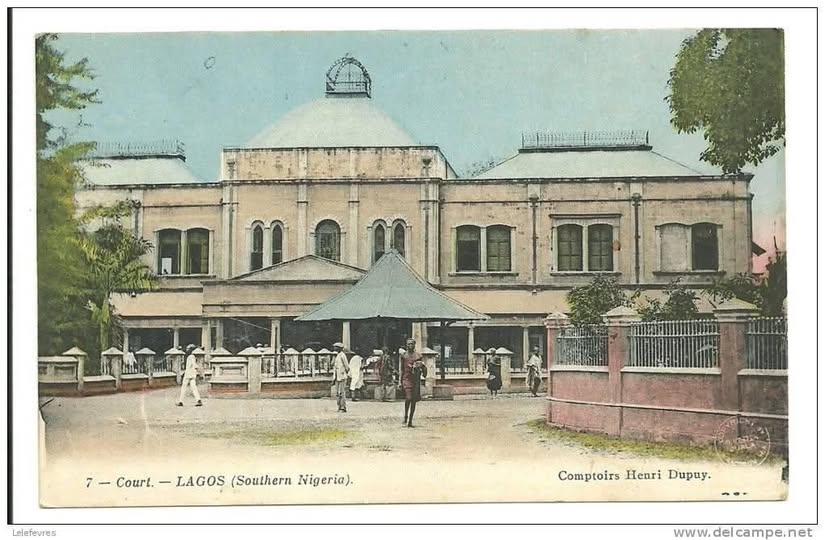
Law Reports: A Selection of Cases Decided in the Supreme Court of Nigeria · Volume 1 · 1915
Judgment delivered on September 28, 1900
Asiata (by her next friend, Asatu Onikepe) v. Cessario Goncallo
Many years ago, Alli Elese, a Yoruba man, was taken to Brazil as a slave. While there, he married Selia, an African freedwoman. Their union was solemnized first under Mohammedan rites and later in a Christian church. Selia adopted her husband’s Brazilian surname, Marques, and the marriage produced two daughters, who remained in Brazil.
Subsequently, Alli Elese returned to Lagos with Selia. During her lifetime, and after the enactment of the Marriage Ordinance of 1884, he contracted another marriage, this time with Asatu, in accordance with Mohammedan rites. That union produced a daughter, Asiata, the plaintiff in this case.
The central issue before the court was whether this second marriage to Asatu was legally valid.
In the lower court, reliance was placed on Cole v. Cole, leading to the conclusion that the second marriage was invalid. However, the court clarified that Cole v. Cole addressed the distribution of property following Christian marriage, not the validity of subsequent marriages under different legal systems.
There was no dispute that the Christian marriage between Alli and Selia was valid under Brazilian law, and that it carried with it the legal expectation of monogamy. Under such a system, Alli could not have taken another wife while Selia remained alive. This restriction would also apply in other Christian jurisdictions.
However, the court emphasized a crucial distinction: Lagos, at the time, operated under native law and custom, including Mohammedan law, which permitted polygamy. Such unions, while unrecognized in Christian countries, were valid and widely accepted locally.
The court found that Alli Elese was a bona fide Mohammedan and therefore legally entitled, under Mohammedan law, to marry multiple wives.
In considering whether his prior Christian marriage invalidated his later Mohammedan marriage, the court reasoned that it did not. Drawing a comparative example, the judge questioned whether a marriage conducted under Christian rites in one jurisdiction would invalidate a lawful polygamous marriage in another where such unions are permitted. The answer, he suggested, was no.
The circumstances of the case were also significant: Alli and Selia had been taken as slaves to a Christian country against their will, and their initial observance of Mohammedan rites suggested they did not wholly abandon their original customs.
For the purposes of this case, the court held that Lagos should be treated as a Mohammedan jurisdiction. Applying Mohammedan law, the court concluded that the marriage to Asatu was valid, and that Asiata, as the child of that union, was legitimate and entitled to inheritance rights.
A further argument was raised: that Selia, having entered a Christian marriage implying monogamy, and her children should not suffer from Alli’s subsequent marriages. However, the court found that Selia’s conduct undermined this claim. She had participated in a Mohammedan marriage ceremony before the Christian one, raised no objection to subsequent marriages, and, after Alli’s death, acknowledged the legitimacy of his other children by involving them in property transactions.
This, the court held, demonstrated that she did not regard her marriage as strictly monogamous.
It was therefore accepted that, under Mohammedan law, all children were entitled to inherit equally. Asiata was thus deemed a co-heir alongside her half-sisters.
A procedural issue remained: whether Asiata could pursue the claim without joining her sisters. To resolve this, the court allowed an amendment to the claim, enabling her to sue in a representative capacity on behalf of all lawful children of Alli Elese.
With that amendment, the court reversed the earlier judgment and ruled in Favour of the plaintiff in her representative capacity. However, it ordered that she bear the costs both in the appellate court and the court below.
— Speed, Acting Chief Justice
Editor’s Note
Sir Edwin Arney Speed was a British colonial official who served as the first Chief Justice of Nigeria from 1914 to 1918. Following the amalgamation of the Northern and Southern Nigeria Protectorates in 1914, Sir Edwin Speed was appointed to lead the newly combined judiciary.