The country’s strongest earthquake this century has plunged Colombia into a humanitarian crisis, testing a new president and exposing entire cities to devastation.
BOGOTÁ, Colombia — Colombia has declared a national state of emergency after the country’s strongest earthquake in more than a century left at least 254 people dead, more than 2,500 injured and thousands still missing beneath collapsed buildings in what officials fear could become one of the worst natural disasters in the nation’s modern history.
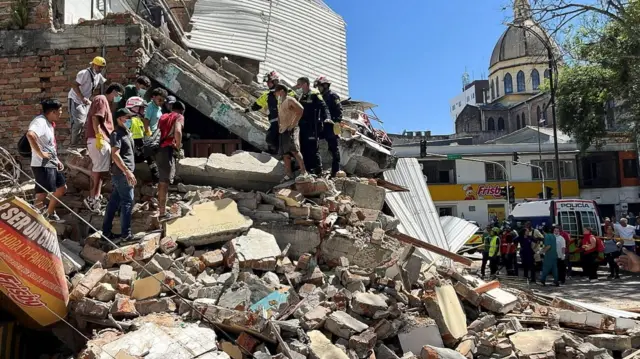
With rescue workers racing against time through mountains of concrete and twisted steel, the humanitarian situation has become increasingly desperate. Entire neighbourhoods remain without electricity, clean water and communications. Hospitals have been damaged, thousands of families have been displaced, and more than 100 aftershocks have repeatedly forced rescuers to suspend operations amid fears of further building collapses.
The magnitude 7.4 earthquake struck western Colombia on Monday, flattening homes, apartment blocks, schools and public buildings across Cali, Pereira, Manizales, Quibdó and surrounding communities. More than 1,600 buildings have either collapsed or suffered severe structural damage, leaving thousands homeless. Authorities warn the death toll is expected to rise as emergency crews continue to search the rubble.
President Abelardo De La Espriella, sworn into office only days before the disaster, declared the state of emergency and mobilised the military, emergency agencies and government ministries in what has instantly become the defining crisis of his young administration. Additional troops have been deployed to maintain security, protect abandoned neighbourhoods from looting and support rescue operations in the worst-hit areas.
For emergency workers, every passing hour reduces the chances of finding survivors. Rescue teams, assisted by volunteers, continue to work around the clock, listening for voices beneath collapsed buildings, cutting through reinforced concrete and removing debris by hand where heavy equipment cannot reach. The operation has become a race against the clock as the critical 72-hour survival window narrows.
There have been moments of hope amid the devastation. Rescue workers have pulled children, elderly residents and entire families alive from the rubble, drawing cheers from exhausted volunteers and relatives who have maintained anxious vigils outside collapsed buildings. Yet those rescues have been overshadowed by the growing number of bodies recovered from destroyed homes and public facilities.
The disaster has also paralysed critical infrastructure. Airports across western Colombia were temporarily shut for structural inspections, roads have been damaged by landslides and debris, while power and telecommunications outages have complicated relief efforts in remote communities. Humanitarian agencies warn that some isolated areas remain difficult to reach, raising concerns that the full scale of the tragedy is still unknown.
International assistance has begun flowing into Colombia. The United States has pledged emergency aid, while neighbouring countries and humanitarian organisations have dispatched rescue personnel, medical supplies and relief materials to support overwhelmed local authorities.
Colombia sits along the Pacific Ring of Fire, one of the world’s most active seismic zones, but seismologists say this was the country’s most powerful earthquake of the 21st century. Although the epicentre was more than 100 kilometres below the surface, the earthquake generated violent shaking across densely populated valleys, causing catastrophic structural failures over a vast area.
As night falls once again over western Colombia, thousands of families remain gathered outside flattened homes, hospitals and emergency shelters, waiting for news of loved ones still unaccounted for.
For a nation already grappling with economic pressures and internal security challenges, the earthquake has become more than a natural disaster. It is now a national emergency demanding an enormous humanitarian response—and the first great test of a new presidency.