By Sylvester Udemezue
MEMORY VERSE:
“No oppression is so heavy or lasting as that which is inflicted by the perversion and exorbitance of legal authority” (-Joseph Addison)
- INTRODUCTION
For the avoidance of doubts, mine is strictly a legal opinion, having nothing to do with the politics (politics is for only politicians) of who is or becomes Nigeria’s next leader, but indeed, everything to do with the right things being done right and at the right time according to the laws of the land, towards installing, promoting and sustaining transparency, integrity, credibility and the rule of law which is the foundation of every constitutional democracy. I had therefore composed a commentary which got published on 28 February 2023, under the title, *”Direct E-Transmission Of Election Results From The Polling Units Is Mandatory, Not Directory, Under Nigeria’s Election Laws; Non-Compliance May Be Considered Fundamental, Fatal”.* But, having, since then, been researching further and reflecting deeper, albeit disinterestedly, on all circumstances surrounding INEC’s benumbing outing on 25 February 2023 for purposes of the just-concluded presidential elections, and generally on our country Nigeria, I have come to the irresistible conclusion that the *Electoral Act 2022, and the subsidiary laws made thereunder, are beautiful, and had/have given the Independent National Electoral Commission (INEC) and the Nigerian Federal Government, all the legal tools, structures and opportunities necessary or needed to deliver to Nigeria and Nigerians, on 25 February 2023, the type of credible, free and fair election that could effectively measure up to, or even beat, all 21st-century standards, international benchmarks and prevailing global best practices. But, you see, in any country where religious or ethnic considerations still have the upper hand in politics, leadership actions or manner of coexistence, there are always bound to be huge problems, no matter what the laws say, and no matter how beautiful the laws are. This is because retrogressive concepts of ethnic jingoism, religious bigotry and exclusionism, when they find their way into leadership, and they appear to be the reigning kings in Nigeria, are no respecter of civilized laws, and, indeed usually require, in order to have their way, that progressive laws be shoved aside. Else, how does one explain the conduct or behaviour of the Independent National Electoral Commission (INEC) on 25 February 2023 when it (INEC) threw law, caution, civility, sanity and modernity to the trash-can, and went straight on a frolic of its own, while thereafter unashamedly blaming what many see as a broad-daylight subversion and unpretentious exorbitanceof law, reason and the electoral process, on some feeble factors that only add(ed) up to deepen the belief in all discerning minds, that we’re in a huge mess as country.
Also, I have just seen someone brandishing some media reports of a judgement said to have been delivered by Hon Justice Nwite to the effect that _*”2023 Elections: Only INEC Can Determine Mode Of Collating, Transmitting Results – Court”* [published on MARCH 11, 2023; BarristerNG]_ and I asked, and so what? What has it changed? Did the judgement in any way change the law, which is that E-TRANSMISSION OF ELECTION RESULTS DIRECT FROM THE POLLING UNITS by INEC is mandatory and not directory? BarristerNG has the following reports, of the judgement, whose suit number and date of delivery were not given:
“Justice Nwite stated that only INEC has the prerogative to direct how the Polling Unit Presiding Officer should transfer election results, including the total number of accredited persons and results of the ballot.Justice Nwite further held that the collating and transferring of election results manually in the 2023 general elections cannot be said to be contrary to the relevant provisions of the Electoral Act, 2022. The judgement was on a suit filed by the Labour Party with INEC as the sole defendant”.
With due respect, the report is misleading, because it purports to give the impression that electronic transmission may not be mandatory after all. Hence, the present commentary by me, is necessary to explain the extant law, this time, step by step and in the simplest of terms, to buttress my position that electronic transmission of election results direct from the polling units, is a sine-qua-non for a valid election under the Electoral Act 2022..
To start with, I do not think there is any Court in Nigeria that has decided that electronic transmission of results from the polling units is not mandatory. And even judging by the reports flying around, Hon Justice Nwite did NOT say so either. Please note that saying that “It is for the INEC to determine the manner/mode of result collation” is not the same as saying that *”e-transmission is not mandatory”.* Thus, interpreting the reported pronouncement of Hon Justice Nwite as if it gave INEC any discretionary power on the issue of e-transmission of election results direct from the polling units, appears misleading, with due respect. Assuming it is true, as reported, that the Court actually said *it’s for the INEC to determine or prescribe MANNER OF COLLATION,* the following questions appear to immediately arise: (1) Did INEC prescribe/ determine, before the election, the manner or mode of collation of election results? (2). Is INEC entitled to disregard the prescription in paragraph 38 of the Regulations and Guidelines for Conduct of Elections, 2022? (3). Is electronic transmission mandatory or directory? (4) If answer to question (3) if yes, then, what is the effect/consequences of non-compliance with the legal provisions on mandatory e-transmission of results, collation and declaration and return? Now, let’s take them step-by-step.
- BOTH DIRECT E-TRANSMISSION OF RESULTS FROM THE POLLING UNITS, AND MANUAL COLLATION OF THE RESULTS, ARE MANDATORY UNDER THE ACT*
Section 60(5) or the Electoral Act 2022* provides that “The presiding officer shall transfer the results including total number of accredited voters and the results of the ballot in a manner as prescribed by the Commission”. See also Sections 50(2) and 62(1) of the Electoral Act. Meanwhile, *section 148 of the Electoral Act 2022,* provides “The Commission may, subject to the provisions of this Act, issue regulations, guidelines, or manuals for the purpose of giving effect to the provisions of this Act and for its administration”. In pursuance of the provisions of sections 50(2), 60(5), 62(1) and 148 the Act, INEC had in June 2022, issued *The Regulations and Guidelines for Conduct of Elections 2022* which then became, still is, a subsidiary legislation under the Electoral Act 2022, binding and enforceable. *Clause/Paragraph 38 of the Regulations and Guidelines* makes Electronic Transmission of Results and Upload of Results to IReV from *the polling units,* and manual collation mandatory. According to the paragraph, when voting and announcement of results have been completed at a polling unit, the Presiding Officer: “(1) must Electronically transmit the result of the polling unit to INEC’s collation system; (2) Must use the BVAS to upload a scanned copy of the EC8A result sheet to the INEC Result Viewing Portal (IReV); and (3) [must thereafter] take the BVAS and the original copies of all forms in a tamper evident envelope to the RA/Ward Collation officer in the company of security agents. Polling Agents may accompany the PO to the RA/Ward Collation Centre”. [See: PLAC Publication: Simplified Electoral Act 2022, and INEC Guidelines. FEBRUARY 22, 2023 <https://placng.org/Legist/plac-publication-simplified-electoral-act-2022-and-inec-guidelines/>]. However, the discussion below shows that, even aside from the Regulations and Guidelines, direct electronic transmission of ALL election results from the polling units remain mandatory, by virtue of the provisions of the Electoral Act 2022.
- E-TRANSMITTED RESULTS ARE NECESSARY FOR EFFECTIVE COLLATION AND VALID DECLARATION OF RESULTS*
Now, when one looks at *section 64(5),(6),&(7) of the Electoral Act,* one would see that INEC is strictly mandated to electronically transmit all election results direct from the polling units on the election day. *Section 64(4)&(5) of the Electoral Act 2022* provides:
“(4) A collation officer or returning officer at an election shall collate and announce the result of an election, subject to his or her verification and confirmation that the— (a) number of accredited voters stated on the collated result are correct and consistent with the number of accredited voters recorded and transmitted directly from polling units under section 47 (2) of this Act ; and (b) the votes stated on the collated result are correct and consistent with the votes or results recorded and transmitted directly from polling units under section 60 (4) of this Act. (5) Subject to subsection (1), a collation officer or returning officer shall use the number of accredited voters recorded and transmitted directly from polling units under section 47 (2) of this Act and the votes or results recorded and transmitted directly from polling units under section 60 (4)of this Act to collate and announce the result of an election if a collated result at his or a lower level of collation is not correct”.
From these provisions, it appears the work of the Collation Officer might be seriously jeopardized, especially where the manually-collated results are disputed, in the absence of results electronically transmitted DIRECT from the polling units. This is because, as it appears from the aforesaid provisions, that the Collation Officer or Returning Officer is NOT ENTITLED to announce the result of the election unless and until he has satisfied the following conditions:
(I). Must confirm that the number of accredited voters as stated on the manually-collated result is correct and CONSISTENT with the number of accredited voters recorded and transmitted directly from polling units;
(II). Must confirm that the votes or results as stated on the manually-collated result is correct and CONSISTENT with the votes or results recorded and transmitted directly from polling units;
(III). Where the election is disputed, the Collation/Returning Officer shall use number of accredited voters and the results/votes recorded and transmitted directly from polling units to collate and announce the result of the election.
From the above, it could be seen that where the manually-collated records (whether of the accredited voters or of the results) conflict with the e-transmitted version, the e-transmitted version must be preferred by the Collation or Returning Officer. Thus, for the Collation or Returning Officer to have the opportunity of making a decision where there’s a dispute, or to be able to confirm that/whether the manually-collated results are correct, the E-transmitted version must necessarily be present during collation. E-transmission of results direct from the polling units, is therefore, an indispensable condition precedent for collation and announcement of election results under the Act; it appears there is nothing that can validly or lawfully done in the absence of results electronically transmitted direct from the polling units. This raises serious questions as to the legality or validity of any results declared by the Collation or Returning Officer without following this procedure and without complying with this mandatory conditions.
- *DIRECT ELECTRONICALLY TRANSMITTED RESULTS ARE NECESSARY FOR THE PURPOSE OF RESOLVING DISPUTES DURING RESULT-COLLATION*
Now, one other reason why e-transmission of election results direct from the polling units is MANDATORY is because where the manually-collated results are disputed during collation, the version of results on the IReV which were e-transmitted direct from the polling units, must be produced/present (is necessary) for the purpose of resolution of such election disputes at that stage, before declaration of results and return could be made. In other words, it may be legally impossible for a Returning Officer to effectively resolve a case of DISPUTED ELECTION RESULTS in the absence of the results e-transmitted direct from the polling units. See *section 64(6) or the Electoral Act* which provides:_
_“(6) Where during collation of results, there is a dispute regarding a collated result or the result of an election from any polling unit, the collation officer or returning officer shall use the following to determine the correctness of the disputed result—(a) the original of the disputed collated result for each polling unit where the election is disputed; (b) the smart card reader or other technology device used for accreditation of voters in each polling unit where the election is disputed for the purpose of obtaining accreditation data directly from the smart card reader or technology device ; (c) data of accreditation recorded and transmitted directly from each polling unit where the election is disputed as prescribed under section 47 (2) of this Act ; AND (d) the votes and result of the election recorded and transmitted directly from each polling unit where the election is disputed, as prescribed under section 60 (4) of this Act.”_
- *DUTY OF THE RETURNING OFFICER WHERE THE ELECTION IS DISPUTED AT THE LEVEL OF COLLATION*
As one can see, *section 64 (6)(d) of the Act* makes it mandatory that WHERE ELECTION RESULTS ARE DISPUTED, there must be produced, among others, for the purpose of resolving the disputes, “the votes and result of the election recorded and TRANSMITTED DIRECTLY FROM EACH POLLING UNIT where the election is disputed, as prescribed under section 60 (4) of this Act.” It would appear that it is only after the disputes as to results have been resolved using the mandatory items/information mentioned in section 64 (6)(a),(b),(c),&(d) of the Electoral Act, that INEC could now go ahead and declare the winner of the election. The mandatory items are: (a). The original of the disputed results; (b). The Smart Card Reader, the BVAS and other technology device used for accreditation of voters in each polling units where the election is disputed; (c). Data of the accreditation recorded and TRANSMITTED directly from each polling unit where the election is disputed; AND (d). The votes and result of the election recorded and transmitted directly from each polling unit where the election is disputed. Where, after applying the mandatory procedure in section 64(6), the Collation Officer or Returning Officer finds that the disputed result is not correct, the Collation Officer or Returning Officer shall re-collate and announce a new result using the information in s 64(6)(a)-(d). Section 64 (7) provides that “If the disputed result under subsection (6) were otherwise found not to be correct, the collation officer or returning officer shall re-collate and announce a new result using the information in subsection (6)(a)-(d)”. Note that where there is any conflict between the version of the results e-transmitted direct from the polling units and the manually-collated version, the e-transmission version must be preferred.
The implication of the aforesaid is, it appears, that where election/result is disputed at the level of collation, the Collation/Returning Officer is not supposed, indeed not entitled, to declare the result or declare a winner until the disputes have been resolved, following the procedure in section 64 (6)&(7). Hence, *Section 64(8) of the Act,* provides that “(8) Where the dispute under subsection (6) arose at the level of collation and the returning officer has satisfied the provision of subsection (6) (a)-(d), the returning officer shall accordingly declare the winner of the election”. It is, therefore, respectfully submitted that where such a dispute arises during collation, any declaration of results made by the Collation or Returning Officer in the disputed areas without following the aforesaid procedure may be considered illegal and consequently invalid. This means, in the case of presidential election, by extension, that where the election is disputed during collation, it may be impossible for the Returning officer to resolve such disputes in the absence of results e-transmitted direct from the polling units. Under such circumstances (where the election is disputed), if it’s discovered that the version of the results e-transmitted direct from the polling units is not available, it may be considered illegal for the Collation or Returning Officer to proceed to make a declaration and return. Ans, by virtue of Section 64 (9) of the Act, it is a criminal offence for the Returning Officer to declare a wrong or false result. Meanwhile, it appears that the most reasonable solution under such circumstances is to adopt a procedure similar to what is prescribed in *section 47(3) of the Act* in respect of failure-to-function, of the Smart Card Reader or any other technological device deployed for the accreditation of voters. Section 47(3) provides:
_”Where a smart card reader or any other technological device deployed for accreditation of voters fails to function in any unit and a fresh card reader or technological device is not deployed, the election in that unit shall be cancelled and another election shall be scheduled within 24 hours if the Commission is satisfied that the result of the election in that polling unit will substantially affect the final result of the whole election and declaration of a winner in the constituency concerned”.
It’s respectfully submitted at this juncture that there appears to be some lacuna in the Law. The Electoral Act makes very elaborate provisions on the simple but mandatory procedure for resolving disputes during collation of election results. A look at the procedure shows that existence in the IReV, of results electronically transmitted directly from the polling units is an indispensable part of collation of results and resolution of disputes during results collation, meaning that any declaration made in the absence of the version of results e-transmitted direct from the polling units, is most likely to be regarded as illegal and invalid. However, the following gaps are observed in the law:
(A) The Electoral Act fails to provide any guide as to how to go about collation of election results in the absence of the version of results e-transmitted direct from the polling units; and
(B). Neither the Act nor the Regulations and Guidelines provides any guide as to how to go about resolution of disputes arising during collation, in the absence of results e-transmitted direct from the polling units.
In the case of the 2023 presidential election, it appears obvious/evident that during the collation period, the version the the results e-transmitted direct from the polling units was hardly available since, according to reports, only results from only about 137,776 polling units out of the 176, 846 polling units in Nigeria were uploaded/e-transmitted direct from the polling units as required by law, on 25 February 2023. Thus, only results from only 37,776 polling units were available in the IReV as of the time of result-collation and up until the time the results were declared on 01 March 2023. See: *”INEC OFFICIALS HAVE SUCCESSFULLY UPLOADED 37,776 OUT OF 176, 846 EXPECTED RESULTS.”* [Source: https://www.inecelectionresults.ng]. Reports had it that by the end of 25 February 2023, INEC officials from the Polling Units across the country had only successfully directly transmitted and uploaded only 37,776, of out of 176, 846 results from the 176,846 polling units in Nigeria. [<http://opr.news/s62e66661230226en_ng?link=1&client=news>]. If this account is anything to go by, it means that INEC did not upload results from about 139,070 polling units — 139,070 represents about 78 percent of the total number of polling units in Nigeria. Also, the Guardian Newspapers’ report of 26 February 2023 had it that “As of 6 pm on Sunday, The Guardian checks revealed that the commission has uploaded less than 30 percent of presidential election results to its IREV”._ [see: *”INEC says technical hitches responsible for delay in uploading results”* (<https://guardian.ng/news/inec-says-technical-hitches-responsible-for-delay-in-uploading-results/>].
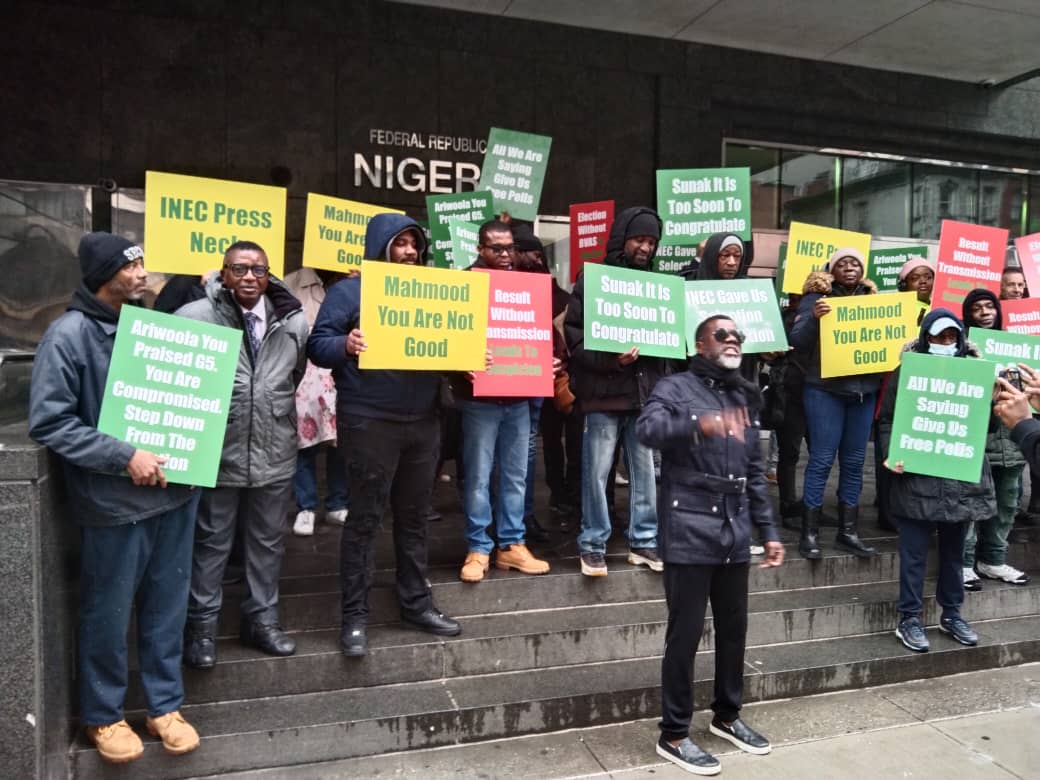
This means that the level of non-compliance by INEC with the mandatory requirement of direct e-transmission of election results from the polling units stood at about 78 percent. Meanwhile, while one may not be too conclusive or categorical about the exact number of polling units adversely affected by the non-compliance on direct e-transmission, it is not in dispute that INEC itself failed in this respect, leading to widespread allegations and complaints of plans to manipulate the results of the election. Most of the fundamental issues raised in attacking the credibility and integrity of the polls bordered on report of substantial failure of presiding officers to transmit the presidential elections to the INEC Result Viewing Portal (IReV) from the polling unit, long after voting had closed, as required by law including non-use of Bi-Modal Voter Accreditation System (BVAS), for accreditation in some states. Besides, the reported refusal of most Polling Units officials to upload result sheets to the INEC portal raised suspicions of result manipulations towards achieving a co-ordinated substitution and replacement of results from the polling units, with allegedly manufactured outcomes that bore no relationship to what occurred during voting. Although, in a Press Release issued the following day (26 February 2023), INEC itself had admitted that the IReV had been (shut) down due to “technical hitches”, it assured that the election results were intact, untampered with. See: _*”#NigeriaElections2023: INEC Speaks On Why Result Viewing Portal (IReV) Is Not Working, Blames Technical Hitches For Challenges”*_ and assuring “These results cannot be tampered with and any discrepancy between them and the physical results used in collation will be thoroughly investigated and remediated, in line with Section 65 of the Electoral Act 2022″_ [ThenigeriaLawyer; 26 February 2023]. At this juncture, and for the purpose of the submissions I make in this piece, I deem it necessary to reproduce verbatim, INEC’S PRESS RELEASE of 26 February 2023, titled *”CHALLENGES EXPERIENCED WITH THE INEC RESULTS VIEWING PORTAL (IReV)”*
_”The Commission is aware of challenges with the INEC Results Viewing Portal (IReV). Unlike in off-season elections where the portal was used, it has been relatively slow and unsteady. The Commission regrets this setback, especially because of the importance of IReV in our results management process. The problem is totally due to technical hitches related to scaling up the IReV from a platform for managing off-season State elections, to one for managing nationwide general elections. It is indeed not unusual for glitches to occur and be corrected in such situations. Consequently, the Commission wishes to assure Nigerians that the challenges are not due to any intrusion or sabotage of our systems, and that the IReV remains well-secured.Our technical team is working assiduously to solve all the outstanding problems, and users of the IReV would have noticed improvements since last night. We also wish to assure Nigerians that results from the Polling Units, copies of which were issued to political parties, are safe on both the BVAS and the IReV portal. These results cannot be tampered with and any discrepancy between them and the physical results used in collation will be thoroughly investigated and remediated, in line with Section 65 of the Electoral Act 2022.While we fully appreciate the concerns of the public on this situation and welcome various suggestions that we have received from concerned Nigerians, it is important to avoid statements and actions that can heat up the polity at this time or promote disaffection towards the Commission. We take full responsibility for the problems and regret the distress that they have caused the candidates, political parties and the electorate. Festus Okoye Esq, National Commissioner and Chairman, Information and Voter Education Committee. Sunday 26th February 2023″. [See: _*“INEC speaks on slow update on IReV election result portal, allays fears”;*_ 26 February 2023; <https://www.premiumtimesng.com/news/headlines/584674-inec-speaks-on-slow-update-on-irev-election-result-portal-allays-fears.html>].
From the Statement by INEC ON 26 FEBRUARY 2023, the following conclusions could be made:
(1). INEC failed to upload a substantial portion of the results to the iReV on 25 February 2023.
(2). The failure to e-transmit the results as required by law was entirely the fault of INEC. According to INEC, _”We take full responsibility for the problems and regret the distress that they have caused the candidates, political parties and the electorate”._
(3). INEC’s failure to e-transmit election results direct from the polling units was not due to any (external) intrusion or sabotage of our systems. INEC said: “The problem is totally due to technical hitches… the Commission wishes to assure Nigerians that the challenges are not due to any intrusion or sabotage of our systems, and that the IReV remains well-secured.Our technical team is working assiduously to solve all the outstanding problems, and users of the IReV would have noticed improvements since last night”.
(4). INEC had promised on 26 February 2023 that _”We also wish to assure Nigerians that results from the Polling Units, copies of which were issued to political parties, are safe on both the BVAS and the IReV portal. These results cannot be tampered with and any discrepancy between them and the physical results used in collation will be thoroughly investigated and remediated, in line with Section 65 of the Electoral Act 2022″._ The following questions arise from INEC’S PRESS RELEASE and promise to”remedy” resulting discrepancies:
(a). Section 65 of the Act provides for Review of the results by INEC. Is there any evidence that INEC had waited to conduct the promised “review”, towards remedying noticed discrepancies between results in the IReV and the manually-collated results, before rushing to make a declaration and return on the presidential election? Why did INEC fail or neglect to conduct the review, especially considering that there were serious complaints and allegations of malpractices and manipulation of the manually-collated results in-between the time of conclusion of voting and counting on 26 February and the time preceding the declaration of the results? Since (I) the failure of direct e-transmission was entirely the fault of INEC, (ii) the principal reason for the Provisions on mandatory e-transmission was to forestall allegations of result manipulation, and (III) there were now allegations of result manipulation arising from failure of INEC to comply with the law on mandatory e-transmission of election results, was it not suspicious that INEC waved aside the complaints, allegations and disputes and proceeded to make a declaration and return on the basis on only the version of the manually-collated results in its possession?
- *WHAT SHOULD INEC HAVE DONE AT THAT POINT?*
It’s submitted that at point (i.e., the period after 25 February 2023 but before the time of declaration of results and return on 01 March 2023), none of the following options appears to apply:
(A). For the affected areas (over 78 percent of the polling units were affected, from reports), and the disputed areas, it was not practicable at that point to deploy the procedure under section 64(4)&(5) of the Act, since the direct e-transmitted results were unavailable on the IReV as required by the section.
(B). For the affected areas, and the disputed areas, it was not practicable at that point to deploy the procedure under section 64(6),(7)&(8) of the Act, since the direct e-transmitted results were unavailable on the IReV as required by the section.
(C). For the affected areas, and the disputed areas, it was not practicable and lawful at that point to deploy the procedure under section 65(1) of the Act, because the procedure under the proviso to section 65(1)(c) of the Act may only be resorted to *”within seven days”* after _*”declaration and return”* already made, pursuant to section 66 of the Act. In other words, the power of INEC *”TO REVIEW”* may only be resorted to after a declaration and return have been made. The declaration and return on the presidential results, was made on 01 March 2023. Hence, it was not legally possible for INEC to have resorted to this procedure BEFORE 01 March 2023.
In view of the discussion above, it is most respectfully submitted that the only reasonable and practicable option available to the Presidential Returning Officer and to INEC at that particular point in time (since there appears to be a lacuna as I already pointed out above), was OUTRIGHT CANCELLATION of the results/election in all the areas where the provisions on mandatory direct e-transmission was not COMPLIED WITH, or at least, in the areas where the election was disputed (if the Commission is satisfied that the result of the election in the affected areas will substantially affect the final result of the whole election and declaration of a winner), and rescheduling of the elections to hold the next day (or so soon thereafter), similar to what is prescribed/mandated by section 47(3) of the Act, which provides:
“Where a smart card reader or *any other technological device deployed* for accreditation of voters fails to function in any unit and a fresh card reader or technological device is not deployed, *the election in that unit shall be cancelled and another election shall be scheduled within 24 hours if the Commission is satisfied that the result of the election in that polling unit will substantially affect the final result of the whole election and declaration of a winner in the constituency concerned”*.
- *POWERS OF INEC WHERE THE RESULTS ARE DISPUTED AFTER THE DECLARATION AND RETURN OF A WINNER?*
The result of the 2023 presidential election was declared and a return made on 01 March 2023, pursuant to section 66 of the Act which provides: _”In an election to the office of the President or Governor whether or not contested and in any contested election to any other elective office, the result shall be ascertained by counting the votes cast for each candidate and subjected to the provisions of sections 133, 134 and 179 of the Constitution, the candidate that receives the highest number of votes shall be declared elected by the appropriate returning officer”._
However, *the proviso to section 65(1)(c) of the Electoral Act* gives INEC the power to REVIEW THE results after a winner has been declared, but the REVIEW (which includes, it is submitted, re-collation, modification or even outright cancellation of the results or some and fresh elections) must be done within 7 days. *Section 65(1) of the Electoral Act 2022* provides: “(1) The decision of the returning officer shall be final on any question arising from or relating to—(a) unmarked ballot paper; (b) rejected ballot paper ; and (c) declaration of scores of candidates and the return of a candidate: Provided that the Commission shall have the power within seven days to review the declaration and return where the Commission determines that the said declaration and return was not made voluntarily or was made contrary to the provisions of the law, regulations and guidelines, and manual for the election”.
- *GROUNDS FOR INEC REVIEW OF DECLARATION OR RETURN:*
(1). That the declaration and return was not made voluntarily;
(2) That the declaration and return was made contrary to the Electoral Act 2022;
(3). That the declaration and return was made contrary to the Regulations and Guidelines for Conduct of Elections 2022;
(3). That the declaration and return was made contrary to the Manual for the elections;
Accordingly, INEC had the power to have reviewed the declaration and return, within 7 days of the declaration and return. Unfortunately, the 7-day period has now passed. The winner was declared on 01 March 2023. Thus, INEC has at this point (12 March 2023) lost the power to do anything about the declaration and return.
- *WAY OUT OF DISPUTES AFTER EXPIRATION OF THE SEVEN DAYS*
What is the way out of the current crises and complaints everywhere, in view of the fact that although (a) INEC has declared Asiwaju Bola Ahmed Tunubu the winner and accordingly the President-elect (congratulations, sir), yet (b) each of Peter Obi (of the Labour Party) and Atiku Abubakar (of the Peoples Democratic Party) claims to be the winner? *Section 65 (2) of the Act* provides that “A decision of the returning officer under subsection (1) may be reviewed by an election tribunal or court of competent jurisdiction in an election petition proceedings under this Act”. Now, assuming (I mean, just in case) the Tribunal ignores all these gross infractions of the law and allows the election to stand, but then elects to go into resolving the disputes as to who really secured the highest number of lawful votes cast in the election as well as satisfied the constitutional requirements as to geographical spread, one wonders how legally possible or practicable it would be for the Tribunal to effectively exercise its power of review under section 65(2) of the Act in the absence of results e-transmitted direct from the polling units on the election day, especially in the disputed areas. See also *section 130(1)&(2) of the Act* which provides: “No election and return at an election under this Act shall be questioned in any manner other than by a petition complaining of an undue election or undue return (in this Act referred to as an “election petition”) presented to the competent tribunal or court in accordance with the provisions of the Constitution or of this Act, and in which the person elected or returned is joined as a party.(2) In this Part “tribunal or court” means—(a) in the case of Presidential election, the Court of Appeal”. *Section 139(1)(a) of the Constitution of the Federal Republic of Nigeria, 1999* provides that “Subject to the provisions of this Constitution, the Court of Appeal shall, to the exclusion of any other court of Law in Nigeria, have original jurisdiction to hear and determine any question as to whether – (a) any person has been validity elected to the office of President or Vice-President under this Constitution.” From available reports, Peter Obi (of Labour Party) and Atiku Abubakar (Peoples Democratic Party) have each approached the Election Petition Tribunal; this is the only lawful mode of challenging the election/results, after the expiration of the seven-day window for INEC-review. Under *Section 133(1) of the Act*, any Candidate or a Political party is entitled to challenge the results of an election under the Act, by filing a PETITION at the relevant Election Tribunal. However, as required by each of Section 285(5) of the Constitution of the Federal Republic of Nigeria,1999 and section 132(7) of the Act, any election petition challenging the results must be filed at the Tribunal “within 21 days from the date of the declaration of the results of the election”. The Court of Appeal which sits as the Presidential Election Petition Tribunal, has within 180 days from the date of the filing or the petition” to hear, determine and deliver its judgement (see: Section 285(6) of the Constitution and section 132(8) of the Act). After the judgment of the Election Tribunal (court of appeal), an appeal may lie to the Supreme Court which is the final court of appeal in presidential election petition [see Sections 285(7) and 233(2)(e)(i) of the Constitution, and section 132(9) of the Act].
- *GROUNDS FOR CHALLENGING AN ELECTION IN NIGERIA UNDER THE ELECTORAL ACT 2022?*
*Section 134(1) of the Act* sets out FOUR GROUNDS for election petitions. The section provides that an election may be questioned on any of the following grounds:
(1) That the person declared the winner was not qualified to contest (Section 134(1)(a)).
(2). That the election was invalid by reason of corrupt practices (Section 134(1)(b)).
(3). That the election was invalid by reason of non-compliance with the provisions of the Electoral Act 2022. (Section 134(1)(b).
(4). That the person declared the winner was not elected by the majority of lawful votes cast (Section 134(1)(c)).
For the avoidance of doubts, Section 134(1)&(2) of the Act provides that “An election may be questioned on any of the following grounds—(a) a person whose election is questioned was, at the time of the election, not qualified to contest the election; (b) the election was invalid by reason of corrupt practices or non-compliance with the provisions of this Act ; or (c) the respondent was not duly elected by majority of lawful votes cast at the election”.
Please, note the following with respect to ground (3) [election is invalid by reason of non-compliance with the Electoral Act]:
(A). Section 134(2)* provides that “An act or omission which may be contrary to an instruction or directive of the Commission or of an officer appointed for the purpose of the election but which is not contrary to the provisions of this Act shall not of itself be a ground for questioning the election”. Thus, allegations bothering on non-compliance with the Electoral Act is a valid ground for questioning the election.
(B). However, it appears that for any election to be held to be invalid by reason of non-compliance, the alleged non-compliance must be so substantial as to be capable of or likely to adversely affecting the result of the election. Thus, *Section 135 (1) of the Act.* provides that _”An election shall not be liable to be invalidated by reason of non-compliance with the provisions of this Act if it appears to the Election Tribunal or Court that the election was conducted substantially in accordance with the principles of this Act and that the non-compliance did not affect substantially the result of the election”._
*(C). Finally, *Section 137 of the Act* provides that it is “not necessary for a party who alleges non-compliance with the provisions of this Act for the conduct of the elections to call oral evidence of the originals or certified true copies manifestly disclose the con-compliance”.
- *RELIEFS THAT MAY BE GRANTED BY THE ELECTION TRIBUNAL:*
(1). Dismiss the petition for lacking merit where the petitioner failed to prove his case; or
(2). Strike out the petition where the petition is shown to be incompetent by reason of non-compliance with mandatory provisions of the law; or
(3). Where it’s proved that the person declared winner was not not qualified to contest, the Tribunal shall NOT nullify the election but shall instead declare the person with the second highest votes and who has met the geographical spread, winner (see: section 136(2)).
(4) Where it is proved that the election is invalid by reason of corrupt practices, the Tribunal shall nullify the election and order fresh elections to be held within 90 days (Section. 136(1).
(5). Where it is proved that the election is invalid by reason of SUBSTANTIAL non-compliance with the Electoral Act, the tribunal shall nullify the election and order fresh elections to be held within 90 days (Section 136(1).
(6). Where it is proved that the respondent (the person declared winner) was not elected by the majority of lawful votes, the tribunal shall declare the person with the highest votes who has satisfied the requirements of the Constitution on geographical spread, the winner (section. 136(3)).
- *CAN THE 25 FEBRUARY 2023 PRESIDENTIAL ELECTION IN NIGERIA BE SAID TO HAVE SUBSTANTIALLY COMPLIED WITH THE ELECTORAL ACT 2022?*
From the discussion above, one could be safe to reasonably conclude that the manner of Conduct of the 25 February 2023 presidential election in Nigeria was in SUBSTANTIAL NON-COMPLIANCE with (that’s, gross violation of) relevant mandatory provisions of the Electoral Act and of the Regulations and Guidelines for Conduct of Elections 2022. Let me make the following further observations, in addition to the discussion above:
(A). From available reports, already cited above, only results from about 37,776, out of 176, 846 polling units in Nigeria had been e-transmitted direct from the polling units to the iReV on 25 February 2023, as required by law. If this is anything to go by, then the level/rate of non-compliance could be said to be at about 78 percent. Unfortunately, this was despite the numerous promises and declarations made by INEC prior to the election date, that all results would be e-transmitted realtime, direct from the polling units. See the Public Release titled “ELECTRONIC TRANSMISSION & COLLATION OF RESULTS” which comes under the general heading “2023 General Election Updates” and published by INEC, prior to the election, on its own website (<https://main.inecnigeria.org/?page_id=11312> wherein INEC gave a step-by-step explanation of the procedure for conduct of the then upcoming elections, especially the procedure for collation of the election results, and stating EXPRESSLY that e-transmission of all election results was a mandatory/necessary part of the process in line with the provisions of both the Electoral Act and the Regulations and Guidelines for Conduct of Elections 2022. Besides, INEC’s duly authorized officials, including the Chairman himself, made several radio and TV appearances on each of which occasions INEC gave firm assurances to Nigerians on e-transmission of election results direct from the polling units. There were also several public statements issued by INEC to the same effect. Furthermore, on February 07, 2023, on its verified Twitter handle, INEC was found to have written as follows:
“The Chairman of the Commission… expressed satisfaction with the optimal performance of the BVAS in all the States of the Federation. The use of the BVAS for voter verification and authentication is mandatory provision of section 47(2) of the Electoral Act and every registered voter must undergo the process of accreditation. The Commission will also upload polling unit level results (Form EC8A) and the accreditation data to the INEC Result Viewing Portal. This is also a mandatory provision of section 50, 60, and 64 of the Electoral Act 2022. For the 2023 general elections, the Commission will recruit 707,384 Presiding Officers and Assistant Presiding Officers, about 17,685 Supervisory Presiding Officers, 9,620 Collation/Returning Officers as well as 530,538 PU Security Officials, making a total of 1,265,227” [See: <https://twitter.com/inecnigeria/status/1622829482540146688?lang=en>]. Moreover, there were/are several other instances and pieces of evidence that INEC was confessedly/demonstrably ready for the election with all personnel, materials and equipment.
What is more? There was an allegation in early November 2022, made publicly, that INEC was conspiring with some people to jettison e-transmission of election results real-time. INEC had immediately come out to publicly debunk the allegation, assuring Nigerians that all results of the 25 February 2023 elections, must be e-transmitted direct from the polling units to the iReV, on the election day. See: *”2023: INEC Denies Plan To Jettison Electronic Results Transmission”* The statement issued by its spokesman, Festus Okoye, on 11 November 2022, read:
“Our attention has been drawn to reports in a section of the media of alleged plans by the Commission to rig the 2023 General Election by abandoning the direct and real-time electronic upload of polling unit results to the INEC Result Viewing (IReV) portal by the Registration Area Technical Support Staff (RATECHSS). The claim is patently false. The Commission has repeatedly reassured Nigerians that it will transmit results directly from the polling units as we witnessed in Ekiti and Osun State Governorship elections and 103 more constituencies where off-cycle Governorship/FCT Area Council elections and bye-elections were held since August 2020. The results can still be viewed on the portal. The IReV is one of the innovations introduced by the Commission to ensure the integrity and credibility of election results in Nigeria. It is therefore inconceivable that the Commission will turn around and undermine its own innovations.” [See: <https://thewillnews.com/2023-inec-denies-plan-to-jettison-electronic-results-transmission/>]
(2). Beside the above, some opposition political parties/candidates had during collation of the results, vigorously disputed the manually-collated results, each alleging that there were manipulations of the results as a result of the substantial failure of e-transmission of the results. At that particular point, one had reasonably expected the INEC Chairman (who happened to be the the returning officer for the Presidential Election) to have deployed the mandatory procedure provided in *Section 64 (6),(7),&(8) of the Electoral Act 2022* for resolving such disputes, before proceeding to declare the result and make a return. From reports, there appears to be no evidence that INEC complied with this mandatory condition precedent before proceeding to declare the result on 01 March 2023.
(3). Even after the declaration and return of a winner, and following repeated complaints and disputes by the other candidates, INEC still had an opportunity to have utilized the option provided in *the proviso to section 65(1)(c) of the Electoral Act 2022.*. There is no evidence that INEC did this, despite INEC’s own promise on 26 February 2023, that “We also wish to assure Nigerians that results from the Polling Units, copies of which were issued to political parties, are safe on both the BVAS and the IReV portal. These results cannot be tampered with and any discrepancy between them and the physical results used in collation will be thoroughly investigated and remediated, in line with Section 65 of the Electoral Act 2022″_ (<https://www.premiumtimesng.com/news/headlines/584674-inec-speaks-on-slow-update-on-irev-election-result-portal-allays-fears.html>).
- *MY IMPRESSION ABOUT INEC IN RE THE 2023 PRESIDENTIAL ELECTION IN NIGERIA:*
A disinterested analysis of all the above and especially INEC’s serial violation of the extant law and gross breach of own words, undertakings and promises, would show that, contrary to the laws of the land and in total disregard and contempt for the high hopes and confidence placed on INEC by a vast majority of right-thinking Nigerians, INEC had either (a) deliberately and willfully jettisoned the use of the BVAS and the IReV for mandatory electronic transmission of all election results direct from the 176,846 polling units in Nigeria, or (b). Perhaps, INEC had actually conspired with some people (yet unknown) to desecrate Nigeria’s electoral process and subvert the rule of law and the will of the majority of the Nigerian electorate. It is therefore possible that the allegation in early November 2022 (that INEC had perfected plans to jettison the use of the BVAS and the IReV as required by law) was true, while INEC’s denial was both insincere and dishonest. Else, how could anyone explain that INEC, after collecting about N350,000,000,000 (three hundred and fifty billion Naira) from the Federation Account to enable it conduct an election whose most crucial, important, fundamental and essential feature was direct electronic transmission of all results from the polling units, could turn around to suddenly, right in the middle of the game, jettison e-transmission of election results, without any prior notice to Nigerians and without previously applying to get the Electoral Act 2022 amended to render e-transmission DIRECTORY instead of MANDATORY? All available piece of evidence point to one direction, namely — that INEC just surreptitiously overruled the National Assembly on the mandatory e-transmission of election results, by suddenly unilaterally jettisoning its duty on mandatory e-transmission. Something is fishy; there appears to be much more to this than meets the ordinary eye. Perhaps, judging from the above, one could reasonably now say that it should not be much of a surprise that there were widespread calls for outright cancellation or review of the election, even before a winner was announced on 01 March 2023, on the grounds that the election was riddled with malpractices and substantial non compliance with the provisions of the Electoral Act, 2022, the INEC Regulations and Guidelines for the conduct of the election. On his part, Mr Femi FALANA, SAN, had this to say, during an exclusive interview with Channels Television:
“I’ve not been impressed by the very disappointing outing on the part of the Independent National Electoral Commission. Nigerians had been assured they were going to have a credible election – a peaceful election – whereby votes would count. Regrettably, there was a free rein of thuggery; thugs took over in many places.There was a compromise on the part of the security forces. There was a compromise on the part of some INEC chiefs. There was impunity on the part of some governors.” [See: *”Nigerians Were Promised a Credible Election — Falana”* 28 February 2023; <https://youtu.be/DlT4mnM4QOM>
Now, could it not be said that with their dance-naked-on-street outing on 25 February 2023, INEC, its chairman and his masters have shown that power doesn’t corrupt people, it’s people that corrupt power. Thus, as William Gaddis once wrote, it’s as if “Cruel leaders are replaced only to have the new leaders turn cruel”. I my opinion, corruption of the rule of law, as INEC and its cohorts have done, is much worse than any other form of corruption and crime. Indeed, until strict observance of rule of law is elevated above all else, we’re going nowhere as a people. But, as a way out this continual corruption of our laws by a select few, why not we consider adopting Leo Tolstoy’s survival formula: _“Since corrupt people unite among themselves to constitute a force, then honest people must do the same.”_ In the meantime, I just hope INEC’s unexplained, unexplainable, unjustified and (it’s respectfully submitted) legally unjustifiable subversion of the rule of law, as I believe I’ve shown above, would not move the Tribunal/Court to declare the entire election of 25 February 2023 *a wasted or “wasteful exercise”, as was the case in the earlier case of *PETER OBI v. INEC* (SC No:2) [2007] Vol. 9 M.J.S.C 1 where the Supreme Court of Nigeria (while nullifying THE ENTIRE governorship election in Anambra State on grounds that the election was conducted in breach of the rule of law) had declared as follows:
“The 1st respondent (INEC) was aware at that time that the appellant was in court pursuing his legal rights. A body that has respect for the rule of law, which the Independent National Electoral Commission ought to be, would have waited for the outcome of the court proceedings; particularly when it was aware of it…. As at 14th April 2007 when the 1st respondent (Independent National Electoral Commission) was conducting gubernatorial election in Anambra State, the seat of the governor of that State was not vacant. That election was a wasteful and unnecessary exercise. The 1st respondent (INEC) was aware at that time that the appellant was in court pursuing his legal rights. A body that has respect for the rule of law, which the Independent National Electoral Commission ought to be, would have waited for the outcome of the court proceedings; particularly when it was aware of it.”
Meanwhile, it was in *AMAECHI V. INEC* (2008) 1 SCNJ 1; (2008) 5 NWLR (Pt. 1080) 227 that the Supreme Court (per PIUS OLAYIWOLA ADEREMI, JSC) had to warn and remind, that _”in all countries of the world which operate under the rule of law, politics [is] always adapted to the laws of the land and not the laws to politics. Let our political operators allow this time-honoured principle to sink well into their heads and hearts”. However, with the rampant manner extant laws are now being desecrated with impunity, and treated with contempt in Nigeria, in favour of the arbitrary will, whims and caprices of people in authority, one has begun to ask the exact same question as was once asked by Sol Luckman in his literary work, The Angel’s Dictionary, namely: Has Nigeria become a _”Banana Republic: lawless society where the monkeys rule”?_ As Tiffany Madison said, “When the Rule of Law disappears, we are ruled by the whims of men”. So, one may ask, Have we not arrived in such a scenario in Nigeria? Anyway, in the book titled, You Can’t Be Neutral on a Moving Train: A Personal History of Our Times, the author Howard Zinn wrote: “Perhaps the most important thing I learned about democracy [is] that democracy is not our government, our constitution, our legal structure. Too often they are enemies of democracy”. So, applying this to our current scenario, would one not be making sense if one said that the entire government, governance and legal structure in Nigeria have gone into perpetual conspiracy against the masses of the Nigerian people, as the enemies of the people? Or, could it be, that there exists in Nigeria, some distinct set of unwritten laws (say, those founded upon ethnicism, bigotry and exclusionism) which now takes precedence over the known laws of the land, and which forms the ultimate guiding formula and doctrinal foundation of actions and decisions of Nigerian leaders? Seriously speaking, please which law rules over Nigeria? Is Nigeria still being governed at all by the known laws of the? Well, I humbly submit to the power and authority of the Court of law; at this point/stage, only the Court may show us the way, pursuant to Sections 65(2) and 136 of the Electoral Act. You see, after centuries of informal methods of dispute resolution in Nigeria, the judiciary as the third arm of government became the formal institution for settling disputes with the advent of the colonial masters. This has led to high public expectation that the courts would always dispense justice with utmost effectiveness and impartiality; the court is thus seen as the temple of justice, the impartial arbiter, the last hope of the common man, and a bastion of hope for the promotion of true democracy and sustenance of the rule of law. Hence, I trust the Court of law to do its job right according to law; we’re bound by the Court’s decision. In the meantime, I humbly urge peace, order and responsibility on the part of all the political parties, candidates and their supporters, sympathizers and fans, and indeed all citizens, even while the available legal grievance-remedial processes and procedures are being explored by relevant aggrieved parties and candidates.
May God help Nigeria; Nigeria needs an help and urgently too!
Respectfully:
*Sylvester Udemezue (Udems)*
08109024556.
[email protected].
(12 march 2023)