Home Blog Page 407

Nasir el-Rufai: The Bloodlust of a Presidential Wannabe

By Chidi Anselm Odinkalu

In the week in which former Kaduna State Governor, Nasir el-Rufai abandoned the ruling All Progressives Congress (APC) to chart a different political trajectory with the Social Democratic Party (SDP), his son, Bashir, characteristically made it known that “Southern Kaduna residents will keep seeing sheghe if they continue to attack indigenous Fulani herdsmen.”

Three things about this, among many, were chilling. One is the absence of any interest in addressing the underlying problem of coexistence between communities. The second is the enthusiastic investment in violence. The third is the indiscriminate nature of the promised violence. This was not the first time that an outburst of candour from the el-rufai clan was laced with unconcealed thirst for human blood.

In January 2019, as the country prepared to go to the polls in a presidential election the following month, the administration of Nasir el-Rufai’s political benefactor, Muhammadu Buhari, guillotined then Chief Justice of Nigeria, Walter Onnoghen. The manner and timing of the decision drew very sharp international rebuke. In response, Governor el-Rufai went on national television to warn that any foreign observers perceived as meddling in the elections “will go back in body bags.” As influential continental news magazine, Africa Report, delicately put it, these were the words of a man who had “previous on the ‘anti-meddling’ approach to diplomacy.”

This “‘anti-meddling’ approach to diplomacy” appears to be a family investment. Abubakar Idris was a committed supporter of former Kano State Governor, Rabiu Musa Kwankwaso, who lived in Barnawa, in Kaduna South Local Government Area of Kaduna State. From there Mr. Idris, who was better known as “Dadiyata”, engaged in vigorous criticism of the ruling APC, one of whose founders happened to be Nasir el-Rufai.

On or about 2 August 2019, Dadiyata vanished. He has not been seen since then. A digital visibility campaign to help locate his whereabouts continues under the hashtag #WhereIsDadiyata. Four and a half months after Dadiyata disappeared, on 23 December 2019, Bashir el-Rufai ominously tweeted: “The same clowns who encouraged him when he was creating false stories and capitalizing on lies that could endanger lives solely for political ends are the same individuals trending hashtags asking #WhereisDadiyata. Dangerous lies in the public space have consequences.”

Less than three months later, on 11 March 2020, Bashir’s brother, Bello, currently a member of the House of Representatives, went one better with an even more chilling gloat in poor verse: “The things that we’ve done to protect the name are unsettling. But no regrets though, the name’ll echo. Years later, none greater. Death to a coward and a traitor, that’s just in my nature!”

At his inauguration as Kaduna State governor in May 2015, Nasir el-Rufai identified insecurity as “an obstacle to progress” and promised to “work with law enforcement officials to drastically reduce violent crime” and  “insure safety of life and limb.” By the time he left office eight years later, he had achieved the exact opposite.

Forgetting this promise, Nasir el-Rufai as Governor brooked no criticism or opposition. No cruelty was considered beyond the pale for them. For daring to disagree with him, el-Rufai demolished the homes of the Zonal vice-chair of his party, Inuwa Abdulkadir; and of his Senator for Kaduna North, Suleiman Hunkuyi.

He was only just beginning. His regime compiled a jaw-dropping list of body bags. Some, like Dadiyata, disappeared, never to be seen again. Others, like Maiwada Raphael Galadima, Agwam Adara III, paramount ruler in Kajuru, turned up dead or decapitated. The Agwam Adara was ostensibly returning home from a consultation with the state government on a crisis in his domain when he was abducted. Abducted with him, his wife was released after the abductors murdered her husband. The Governor was missing from his funeral. After his burial, Nasir el-Rufai swiftly abolished his kingdom and purported to divide it up into emirates.

Under Nasir el-Rufai and by appointment of the Nigerian Union of Journalists (NUJ), Kaduna State attained “notoriety as the deadliest state for Journalists in Nigeria to operate.” They were not the only endangered species. The strategic research group, SBM Intelligence, concluded also that “Kaduna was the most dangerous state for priests, who were often kidnapped during services.”

His signal accomplishment was to displace Boko Haram from the top of the league of atrocities. This was no easy feat. In May 2014, the United Nations Security Council listed the Jama’atu Ahlis-Sunna Lidda’Awati Wal-Jihad, (the Islamist insurgency better known as Boko Haram) as a terrorist organization. Three years earlier, the Gaji Galtimari Presidential Committee on the Security Challenges in the North-East Zone of Nigeria had reported that the group “started as an innocuous non-violent group” around 2003.

Since then, Borno State, the epicentre of Boko Haram’s atrocities habitually topped the national league table of mass-casualty killings in Nigeria. The monitoring coalition, Nigeria Mourns, reported a peak of 6,138 atrocity casualties in Borno State in 2015. Over the next five years, casualty count in Borno State appeared to drop off quite significantly.

Over 760 kilometres away from the Borno State capital, Maiduguri, in Kaduna, the historical capital of northern Nigeria, it almost appeared as if the State government led by Nasir el-Rufai was envious of Borno’s position. In 2015, when Borno State hit the peak in atrocity killings, Nigeria Mourns recorded 411 casualties in Kaduna State. By 2020, this had risen to 628. In Borno State in the same year, the count was 1,176 killed.

In 2021, el-Rufai’s Kaduna State overhauled Borno to take over the top position in the national body-count of mass-casualty atrocities. That year, Nigeria Mourns recorded 587 killed and 119 abducted in Borno State. In Kaduna State, it counted 1,114 killed and 1,225 abducted. In 2022, at least 1,346 were abducted in Kaduna State. The comparable figure for Borno State was 77.

To be sure, Kaduna State had a well-advertised history of chronic violence dating back to the 1980s and accounting for tens of thousands killed over the period. Under Nasir el-Rufai however, virulent executive bigotry drove the state beyond the edge through methodical segregation. Leena Hoffman captured the depth of Kaduna’s crisis of sectarian segregation under him: “the river that runs through the city of Kaduna, the state capital, highlights the starkness of the divide: the northern half is unofficially called Mecca; the south, Jerusalem.”

The most intense site of chronic mass-casualty atrocities in Kaduna State was Southern Kaduna, which is characterised by linguistic and ethnic diversity coexisting with a high concentration of the State’s non-Muslim populations. For many people, there was only one explanation for the exponential spike in mass-casualty atrocities in Kaduna State – the State governor, Nasir el-Rufai. His administration was widely “accused of a conspiracy of silence” in support of the murderous campaign of extermination in Southern Kaduna.

In one of his earliest acts as governor, Nasir el-Rufai sought exculpation for bandit pastoralists from the chronic massacre in Southern Kaduna, claiming that he had already “spent government money to pay Fulani herdsmen to stop violence in southern Kaduna.” About the armed “bandits” who were to emerge as the fall guys for the violence, Governor el-Rufai later described them as “just collections of independent criminals. It is a business for them.”

When Mr. el-Rufai stepped down from office in 2023, mass-casualty atrocities in Kaduna crashed spectacularly. Nigeria Mourns recorded 413 atrocity killings in Kaduna and 393 abductions. The only thing that appears to have occurred to bring about this transformation was a change in the occupant of the office of Governor.

In January 2017, an audio emerged in which he gloated over the untimely death in 2010 of former President, Umaru Musa Yar’Adua, his high school contemporary at Barewa College, Zaria on whom he had also visited unrestrained bile in his memoirs. Columnist, Farooq Kperogi, observes that Nasir-El-Rufai “embodies one of the most morbidly toxic strains of political intolerance in Nigeria. He exteriorises his discomfort with opposition by literally wishing death upon his opponents or claiming credit for their death.”

Bloodlust such as this can never be slaked. Out of power today, el-Rufai seeks to re-brand himself as an ecumenical politician invested in pluralism. Those who make the mistake of jumping into political bed with him will have themselves to blame.

A lawyer and a teacher, Odinkalu can be reached at [email protected]

Before Rivers State fire consumes Abuja…

By Martins Oloja

‘There is fire on the mountain
And nobody seems to be on the run
Oh, there is fire on the mountaintop
And no one is a-running

I wake up in the morning
Tell you what I see on my TV screen
I see the blood of an innocent child and everybody’s watching
Now I’m looking out my window
And what do I see?
I see an army of a soldier man marching across the street, hey
Hey, Mr. Soldier man
Tomorrow is the day you go to war
But you are fighting for another man’s cause and you don’t even know him
Oooh, what did he say to make you so blind to your conscience and reason?
Could it be love for your country? Or for the gun you use in killing?

So, there is fire on the mountain
And nobody seems to be on the run
Oh, there is fire on the mountain top and no one is a running…’
(Asa on ‘Fire on the mountain’ (2007)

Everyone can see clearly now that there is fire on the mountain in Rivers state and nobody in authority in the state and national capitals seems to be on the run. Oooh, we can wake up in the morning and can see on television live stream how a governor can be locked out of the parliament in the state he governs. And the hit-man in the power struggle in the federal capital can be seen at the same time on the same television screens, vibrating that if the humiliated governor is impeached, heavens will not fall. Indeed we now have a country of anything is possible. That is why it is important to appeal to our leaders in Abuja and Port Harcourt to borrow from the brilliance and light of the ancient word that the bush is still burning with fire, but behold the bush isn’t consumed yet.

Yes, it isn’t a time to beat chests – to damn consequences of fire because we have the power and cruise control over violence. It is a time to build the peace in the interest of our country of complex diversity. It is a time to recall the warnings through the ancient words that our tongue is the most sensitive part of our body and so can trigger the wildest of fire that can reach the mountain top that Asa’s allegory teaches today.

There is power in the words our leaders in Port Harcourt and Abuja use at this time. What is more, our leaders in Abuja should note too that this is a time to invoke the power of this phenomenon called attitude, yes attitude! That is the weapon needed at this time to quench the fire on the mountain in Rivers state, not to become ‘Rivers of Blood’. We don’t want Asa to see an army of a soldier man marching across the street, hey
Hey, Mr. Soldier man, Tomorrow is the day you go to war…’

We should heed the warning of our daughter, Asa and ask our careless leaders everywhere Oooh, what did he say to make you so blind to your conscience and reason? Could it be love for your country? Or for the gun you use in killing?

We have seen the fire on the mountain. Let’ us with a gladsome mind, denounce our leaders who say we should not be on the run. Let’s not wait for the fire to consume us, as it did in 1966, when the same fire in the form of ‘operation wetie”, consequentially diminished our independence, took away our federalism after consuming some of our founding fathers. There is already a great deal of crisis of coherence between Abuja and Port Harcourt where our great son, Chinua Achebe would have recast W. B Yeat’s poem: “The second coming” he used in ‘Things Fall Apart’ to our leaders: “Excuse me Sirs, behold, things are falling apart in the Garden City; the centre cannot hold; mere anarchy is loosed upon the world…”

Even observers who are not part of the crisis would want the powers in Abuja to note that the reason they are in office and in power is to settle conflicts arising from our development strides. They should not be part of the problem in the interest of next elections. The optics isn’t quite good for our leaders at this time because we the people are seeing the way they place politics over governance.

The President has appealed that the law should rule in Rivers State where there is a political crisis that involves a member of his cabinet and the governor of the state. But let’s review what happened on the day the Governor reportedly appeared to begin implementation of the president’s appeal. Minister of the Federal Capital Territory (FCT), Nyesom Wike, via a live media chat, scoffed at threats of consequences over purported plans to impeach Rivers State Governor Siminalayi Fubara, saying the sky isn’t going to fall if he is impeached.

The minister’s comments came after the Rivers State House of Assembly, led by Martins Amaewhule denied Fubara access to the Assembly premises for a re-presentation of the 2025 appropriation bill, which was ordered by the Supreme Court. The governor said he was prevented from entering the compound, despite the fact that he had notified the Assembly of his intention to visit in view of their request that he re-presented the 2025 appropriation bill. In response to the Governor’s claim, the Rivers State Assembly officials said the Governor didn’t inform them as claimed. While this drama was taking place in Rivers state capital, former Governor of the State now FCT Minister who is associated with the crisis in the state was on television blasting the same governor, Fubura and his cohorts in the state.

The relationship between the governor and the legislature, peopled mainly by Wike’s loyalists, soured early in his tenure following political disagreements with his predecessor, Wike. Things seemed worsening for the governor recently after the Supreme Court reinstated the Amaewhule-led legislators. But foremost group of elders from the oil-producing region, the Pan Niger Delta Forum (PANDEF), asked President Bola Tinubu not to consider any party to the crisis superior. PANDEF urged Tinubu to take decisive steps to resolve the escalating crisis, contending that a win-win outcome must be sought outside the courts. The group urged the president to prevail on Wike and Fubara to prioritise peace and seek a lasting solution.

Similarly, Ijaw National Congress (INC) reiterated its position that if Fubara was impeached for any reason, the consequences would be too heavy for the Nigerian state to bear economically. Urging the president to prevail on Wike and Fubara to seek an amicable resolution for the sake of peace and stability, INC said it was concerned by the prolonged political impasse in the state.

However, addressing some of the latest concerns on the Rivers crisis, Wike described PANDEF, whose members met Tinubu to try to proffer solution to the festering political crisis in the state, as an unreliable organisation made up of political merchants, only motivated by money.

Wike, who spoke on a live television interview, said if Fubara had, indeed, breached the tenets of the constitution and the House of Assembly deemed the infraction an impeachable offence, then the governor should be impeached. He stated, “If you have committed an offence to be impeached, what’s wrong? Is it a criminal offence? It’s provided in the constitution. And let me tell you, and I have heard people say, ‘oh, if they impeach him, there’ll be breakdown’ and all that. “Rubbish. Nonsense. Who is he? Nonsense! “Who is not a militant? Who cannot blow up the pipeline? Why do you arrogate this power to a certain group of people? The Ijaw people are the only people who can blow a pipeline? What nonsense is that…?

Now in the complex logistics of everyday life, perceptions have gone far into shaping decisions. Most people have noticed that only the powers in Nigeria could have allowed the enigmatic Wike to be talking the way he talks about the crisis in the state he has governed. The president keeps putting everything at the doorstep of the governor when there are two parties to the dispute. Insiders and observers, still believe that the last agreement the president asked the two parties to sign when he first intervened last year was skewed in favour of the other party and the governor’s people can thus perceive that the agreement was not drafted by neutral men. This may not represent the truth but that is what perception does when conflict resolution mechanisms are mismanaged. Besides, after the PANDEF’s meeting with the President at the Villa, officials of the socio-cultural organisation have claimed that there were various issues tabled before the president who picked only the Rivers matter and ignored the rest socio-economic and infrastructure challenges in the south-south region. They have alleged that the President kept emphasising to the governor to obey the Supreme Court’s controversial judgment as the only panacea to peace there. But critics on the other side would be quick to remind the same president that his government too hasn’t implemented the judgment of the same Supreme Court regarding local government autonomy, delivered six months ago. Critics have also quickly added that the same government has also refused to obey the judgment and order of the court of appeal against the National chairmanship of NURTW, which was against his staunch supporter, MC Oluomo who is illegally occupying the seat, against the judgment won by one Baruwa.

So, the president’s position in condoning Wike, the minister of FCT, to be insulting Niger Delta elders and even governors in the middle of strategy to resolve a dangerous crisis is what a literature in English teacher would easily call a tragic error. There can be only one consequence: emergence of a tragic hero in the denouement. From the body language of the Nigeria’s leader, the opposition leaders in this regard are bound to perceive that the president sees the governor as the problem and Wike as the victim. Would you blame the governor’s men therefore if they shout that Wike is provoking them to play into the hands of hit-men in Abuja who are in a hurry to trigger causes for a state of emergency as things get out of hands?

It is hoped that all the stakeholders and crisis merchants, in this regard, understand the dynamics of Nigeria Delta politics, particularly Rivers state that is historically crisis-prone. We need to speak this inconvenient truth to the Nigeria’s leader to take responsibility and call the hardworking and passionate Wike to order immediately. Reference to him (Wike) as a coordinator and factional leader of the now victorious legislators and the strange media chat he was allowed to address on the day and the time the Governor of Rivers state attempted to address the State Assembly according to the president’s counsel, diminished our humanity and the public space.

Our leaders in Abuja may not believe this, whatever is happening to the Governor of Rivers state who Senator Shehu Sani believes may be impeached soon despite suspicious interventions in Abuja, further diminishes the majesty of democracy and the rule of law. Security and welfare of the people of River state, is part of the remit of the Chief Executive of the Federation who cares so much about the sanctity of that responsibility. He can’t delegate his power (as president) to a clear leader of a faction in the conflict in Rivers state. The fire on the mountain in Port Harcourt requires that the President should be on the run – this time to put out the fire- before it is too late.

ALDRAP drags Amaewhule, Rivers Assembly to Court, seeks order of mandamus compelling them to fix ‘reasonable’ date for presentation of appropriation bill

The Registered Trustees of Association of Legislative Drafting And Advocacy Practitioners (ALDRAP) has filed an action at the Federal High Court seeking an Oder of Mandamus directing and compelling the Martin Amaewhule-led Rivers State House of Assembly to fix a reasonable time and date within which Governor Siminalayi Fubara would present the appropriation bill and finance bill for the year 2025.

Part of the Motion Exparte filed on Friday, 14 March 2025 reads:

“AN ORDER of this Honourable Court granting the Applicant leave to apply for Order of Mandamus directing and compelling the Respondents to fix a reasonable time and date (A reasonable a time and date, being such time and  date  before  salaries  and  allowances  of  all  persons  under  the employment and service of the Rivers State Government is due from the date of this application); and to provide such reasonable avenue and courtesy to the Governor of Rivers State, in a manner devoid of rancour and intimidation for the presentation of the appropriation bill and finance bill for the year 2025 and/or any such bill necessary for the due administration, receipt and expenditure of funds/money due or standing to the credit of the Government of Rivers State.”

Grounds for the application are:

A. Subject to the judgment of the  Supreme Court of Nigeria in suit No. …………………………, the Central Bank of Nigeria and the Accountant General of the Federation will not release to the Government of Rivers State statutory federal allocations due and standing to the credit of Rivers State to the Government of Rivers State except an appropriation law is duly presented by the Governor of Rivers State and passed by the Rivers State House of Assembly.

B. The  Governor in compliance with the judgement of the  Supreme  Court mandating it to present the said appropriation bill before the Respondents for passage into law, has communicated his readiness to do so to the Respondents, but the Respondents have refused to create the necessary avenue and courtesy for the Governor to perform such duty.

C. Our members are persons who may be directly affected and will suffer untold hardship and irreparable damage should the federal allocation due Rivers State be withheld.

D. Therefore, it has become imperative that this honourable grant us leave to seek order(s) of this court mandating the Respondents to provide the necessary avenue and courtesy required for the presentation of the appropriation bill for 2025 by the Governor, and order mandating the Respondent to pass the bill into law within a reasonable time.

Below is a filed copy of the process.

Federal-High-Court-Of-Nigeria-filed-copy

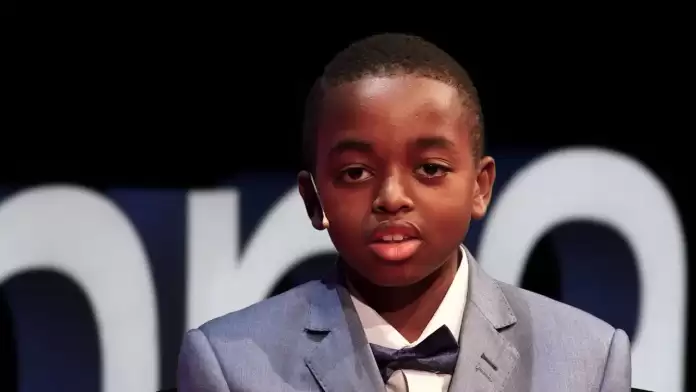
Nigeria’s Joshua Beckford is the youngest person to attend Oxford University

Joshua Beckford gained worldwide recognition as the youngest person ever to study at Oxford University.

The youngster was admitted at age six (taking part in courses which were part of an online learning platform for gifted children) and gained distinctions in both Philosophy and History.

When Beckford’s father, Knox Daniel, wrote to Oxford University advocating for his son’s admission, it was a bold move to challenge the conventional age limits for a programme aimed at children aged eight to 13.

His record remains unmatched, with the next youngest Oxford student being at least two years older at the time of admission.

Read Also: Meet Nigerian-British Florence Eshalomi, new UK trade envoy to Nigeria

By 10 months old, Beckford could already identify letters and numbers. At age two and a half, he could read fluently using phonics and had begun learning Japanese and some Mandarin.

Aspiring to become a neurosurgeon, Beckford has already demonstrated remarkable medical knowledge. Using the Microsoft Surgery Simulator, he has mastered complex surgical procedures, including cataract removal, hernia repair and leg fracture correction. His proficiency with surgical instruments showcases his extraordinary abilities beyond his years.

Beyond medicine, Beckford is multi-talented, excelling in art, Information Technology (IT), sports and foreign languages.

In 2017, Beckford was named Positive Role Model of the Year at the UK’s National Diversity Awards.

The Illumination Foundation of North Carolina also listed him among the Top 30 Most Extraordinary People worldwide who have made societal impact.

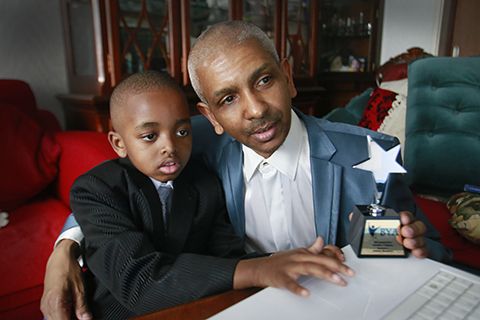
Joshua Beckford and his father
Joshua Beckford and his father. Photo: Pinterest

Beckford serves as an ambassador for the Boys Mentoring Advocacy Network (BMAN), a non-governmental organisation dedicated to mentoring young boys and adolescents in Africa. Within BMAN, he holds the role of Low-Income Families Education (L.I.F.E) Support Ambassador across six countries: Nigeria, Ghana, Kenya, Uganda, South Africa and the United Kingdom where he was born.

Joshua Beckford also serves as the face of the National Autistic Society’s Black and Minority (BME) campaign. Diagnosed with high-functioning autism himself, he helps to spread the campaign’s mission.

In 2019, Beckford and his father travelled to Nigeria to launch a live mentoring session, delivering a keynote speech at the University of Lagos before an audience of nearly 5,000 people. Their visit was to raise funds for building a secondary school in Kaduna State, providing education to children from economically disadvantaged backgrounds.

According to a statement on UNILAG’s website, the proposed school was to include classrooms, an administrative block, a laboratory, an ICT Centre and an agriculture green garden and was to be named Joshua Beckford Community School.

Vanguard

Kano State gov’t says Appeal Court ruling didn’t nullify Emir Sanusi’s reinstatement

  • Odinkalu describes verdict as ‘most extraordinary’, hints at outside interference

The Government of Kano State has dismissed claims that Friday’s judgment of the Court of Appeal, Abuja Division nullified the reinstatement of Muhammadu Sanusi II as the 16th Emir of Kano.

Addressing journalists in Kano, Commissioner for Justice and Attorney General, Barrister Haruna Isa Dederi emphasised that the appellate court’s judgment on January 10, 2025, reaffirmed the state government’s authority to reinstate Sanusi.

He clarified that only the Supreme Court has the power to overturn that decision.

LEADERSHIP reports that the remarks followed the Court of Appeal’s ruling on a stay of execution application filed by Aminu Baba DanAgundi, a kingmaker loyal to the 15th Emir, Aminu Ado Bayero, on Friday.

The court ruled that the status quo should be maintained until the Supreme Court delivers its final verdict.

Dederi reiterated that the appellate court had not overturned its own judgment but merely placed a hold on its execution pending the Supreme Court’s ruling.

He further explained that the January 10 judgment had set aside an earlier Federal High Court decision that nullified Sanusi’s reinstatement, affirming that the lower court lacked jurisdiction over the emirate matter.

“It doesn’t mean that the judgment delivered on January 10, 2025, has been quashed. That judgment is still standing and subsisting. The Court of Appeal cannot reverse its own decision; only the Supreme Court has the power to set it aside,” Dederi stated.

However, Prof. Chidi Odinkalu, law teacher and ex-chair of the National Human Rights Commission (NHRC) in a post on X (formerly Twitter) raises some questions about outside interference with the verdict.

Hinting that the panel, consisting of Justices Okon Efret Abang, Eberechi Suzanne Nyesom-Wike, and Oyejoju Oyebiola Oyewumi might have given some colouration to the judgment, Odinkalu added that the presiding justice of the trio, and the controversial Justice Okon Abang, only got to the Court in the 4th quarter of 2023.

Read his tweet below.

Nasir El-Rufai’s Scorched-Earth One-Man Opposition, By Farooq A. Kperogi

This week’s column examines Nasir El-Rufai’s transformation from an internally displaced “accidental public servant” to a troubled, accidental, one-band opposition squad who is railing against exactly the same things he did when he was in power.

Like a stranded mariner gasping on the shores of irrelevance, former Kaduna State governor Nasir Ahmad El-Rufai writhes in the uneasy throes of power’s withdrawal. His disquiet, however, is less the quiet lament of a fallen statesman and more the tempestuous fury of a Shakespearean woman scorned.

He has become fiery, irascible, indignant, and unrelenting in his public expressions of rage towards his former friends in power who have isolated him. He is throwing the kitchen sink at the power structures in Kaduna and Abuja in an all-out effort to extract vengeance and to ward off potential ensnarement.

The former cushy, self-satisfied, and illiberal denizen of power who was the scourge of dissenters railing against tyranny, now finds himself wielding the very defiance he once crushed with arrogance and malevolent glee. He has become an accidental insurgent (a la “accidental public servant”) forged in the crucible of his own contradictions.

There is a part of me that loves this new insurrectionary, rebellious, activist, and intensely irate one-man band opposition that El-Rufai has opportunistically transmogrified into.

For one, he is providing the first real opposition to the Bola Ahmed Tinubu administration. Every democracy needs the well-aimed slings and well-informed counsel of a sharp-witted opposition to keep its leaders from sinking into the depths of self-satisfaction and insouciance.

Say what you will about El-Rufai, but his intellect, erudition, and rhetorical dexterity are top-notch and undeniable. Imagine if figures of his political stature, institutional access, and strategic acumen had chosen to be thorns in the current corridors of power. Perhaps, the Tinubu administration would have thought twice before treating Nigerians with the cavalier disregard that has become its trademark in the last two years.

For another, he has an opportunity to experience what his critics went through when he was a governor for eight years. He abducted critics, caused opponents to be tortured, bragged about reducing politicians he has displaced to mere “bloggers,” instrumentalized the courts to squelch dissent, etc.

Now, he posts social media updates about his former commissioners being “abducted,” about the judiciary being weaponized against his supporters and his past administration, about the “misuse of federal security agencies in the persecution of opposition leaders,” etc.

Not only has El-Rufai become a “blogger,” once his favorite pejorative for social-media-active politicians he has dislocated in Kaduna, he has now plunged deeper into a lowly “content creator.” With the launch of a TikTok account, he’s gone from being a mere “blogger” to a digital hustler, complete with the undignified ritual of soliciting Nigerians to subscribe to his channel.

Yet, I am delighted that El-Rufai has joined our ranks. Professional “wailing wailers” like me (to use former presidential spokesman Femi Adesina’s agonizingly asinine and illiterate insult for government critics) welcome him to the club.

Nonetheless, my joy that he is inadvertently rendering a democratic service by the constancy and stridency of his strictures against the government has not blunted the acuteness of my awareness that he is an unbearably devious, self-seeking, hateful scoundrel who is only on a mission to avenge what he perceives as a personal affront to him.

As most people have already observed, had El-Rufai secured the minister of power position he was promised, his current antagonism toward the government would be as unimaginable as a cat lobbying for the rights of rats.

Not only would he have been a staunch defender of every government action, but he would have also directed his trademark vitriol at ordinary Nigerians suffocating under economic hardship. He would dismiss their grievances with characteristic scorn and cruelty.

Indeed, the same northern establishment he now courts and seeks to mobilize as a political cudgel would have been his favorite punching bag—just as it was in 2023, when he enthusiastically championed Bola Tinubu’s candidacy.

It takes an unnatural degree of slow-wittedness not to see that El-Rufai’s newfound disillusionment with the governments in Kaduna and Abuja reeks less of principle and more of a bruised ego nursing its wounds.

In my July 27, 2019, column titled, “How Political Power Damages the Brain—and How to Reverse it,” I called attention to (temporarily) politically displaced whores of power like El-Rufai who pretend to identify with ordinary people in their moments of political trauma.

“Also look at previously arrogant, narcissistic, power-drunk prigs who have been kicked out of the orbit of power for any number of reasons. You’ll discover that they are suddenly normal again.

“They share our pains, make pious noises, condemn abuse of power, and identify with popular causes. The legendary amnesia of Nigerians causes the past misdeeds of these previous monsters of power to be explained away, lessened, forgiven, and ultimately forgotten. But when they get back to power again, they become the same insensitive beasts of power that they once were.”

Get El-Rufai back into power now or in 2017, he would be the same villainous backstabber he has always been. He would be the same annihilator of the homes of poor people. He would be the same horrid tormentor and abductor of critics.

He would be the same inciter and instigator of genocide in the name of defending his people. Recall his 2012 tweet, “We will write this for all to read. Anyone, soldier or not that kills the Fulani takes a loan payable one day no matter how long it takes” and his admission that he paid bandits to stop attacking southern Kaduna?

In a September 20, 2019, article, I described him as “straight-up Nigeria’s most bigoted and most dangerous public official alive.”

I said he “detains and torments people who criticize him. Abu Hanifa Dadiyata, a critic of his, just disappeared in Kaduna without a trace. Several other critics are in detention. And he recently threatened: ‘If you want to tweet anything about Kaduna be very careful because I’m watching…’”

He has a deep, visceral hatred for the people of southern Kaduna, leading to write this August 18, 2020, social media status update: “Why does El-Rufai hate and despise the people of Southern Kaduna with such unnaturally infernal intensity? He strains hard, often too hard, to be seen as ‘cosmopolitan’ when he relates with southern Christians. Why can’t he even pretend to be prepared to get along with the people of Southern Kaduna? I don’t get it.”

He is also a rhetorically violent man. In October 2015, he told his critics to “climb Kufena Hill and fall.” At a Kaduna APC stakeholders’ meeting in September 2017, El-Rufai told political opponents that death is a possible outcome for fighting him. “I had fought with two presidents,” he said. “Umaru Yar’Adua ended in his grave, while President Goodluck Jonathan ended in Otueke.”

He repeated this a few days ago. In my September 23, 2017, column titled “El-Rufai’s Morbid Fixation with Death of His Political Opponents,” I pointed out that El-Rufai betrays a disturbingly shallow humanity and a murderous inner disposition. In addition to many examples of his embrace of the rhetoric of violence, he endorsed, defended, and even celebrated the brutal, cold-blooded, and unjustified mass slaughter of hundreds of Shiite Muslims in his state.

El-Rufai’s latest political metamorphosis is less a transformation than a temporary realignment born of personal grievance rather than ideological conviction. His brand-new zeal for opposition, while inadvertently serving the democratic process, is unmistakably fueled by wounded pride and thwarted ambition.

The same man who once ruled with an iron fist, silencing critics with impunity, now fashions himself as the voice of the oppressed, railing against the very structures of power he once upheld with ruthless enthusiasm. His current posture as an anti-establishment crusader is not the product of principle but of exclusion, making his activism less an act of courage than an elaborate act of self-preservation.

Yet, even as he momentarily aligns with the forces of resistance, history warns against mistaking his opportunistic dissent for genuine reform. Should fortune return him to the corridors of power, El-Rufai would waste no time reverting to the autocratic instincts that have long defined him. He would crush opposition, weaponize state institutions, and wield power with the same reckless abandon that now makes him a pariah.

Today’s dissenter is often tomorrow’s despot. To embrace him uncritically is to risk aiding yet another cycle of tyranny dressed in the fleeting garb of rebellion.

CJ Niger State orders Magistrates and Sharia Judges not to entertain actions brought by police prosecutors who are not lawyers

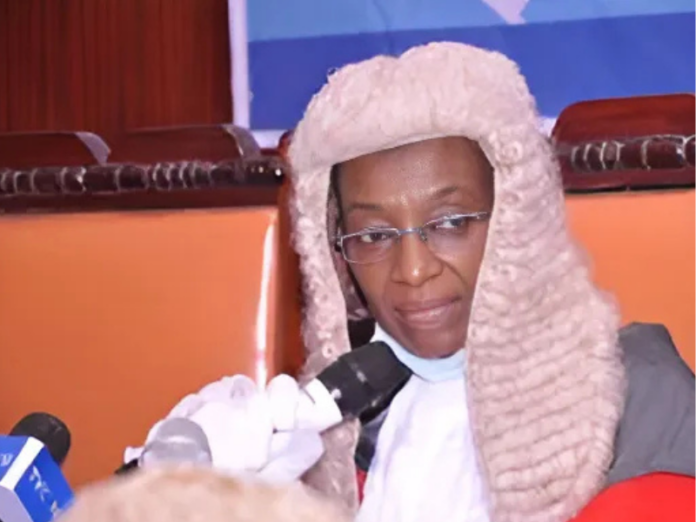
With the Administration of Criminal Justice Act (ACJA) and the Police Act 2020 emphasizing the need for legal expertise in prosecution, the Chief Judge of Niger State, Hon. Justice Halima I. Abdulmalik has given a directive for full compliance with the statutes in the state.

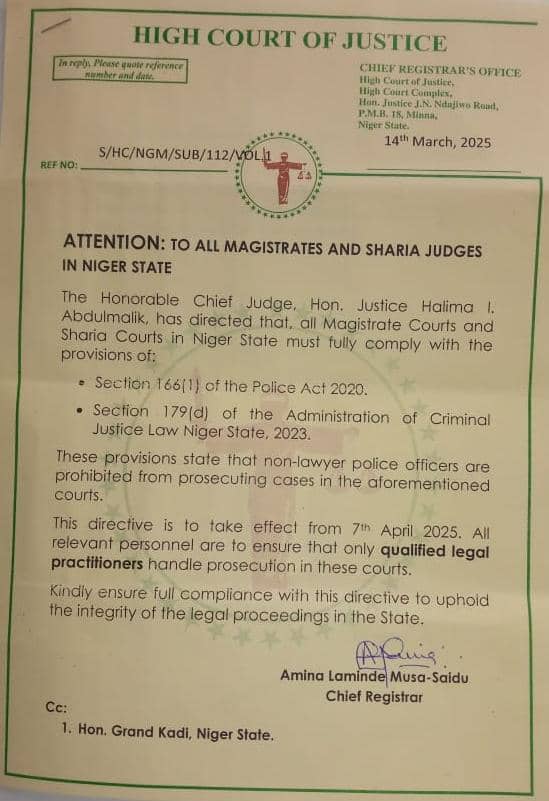
Her Lordship in a circular signed by the Chief Registrar of the High Court of Justice, Niger State, Amina Laminde Musa-Saidu, instructed that all Magistrate Courts and Sharia Courts in Niger State must fully comply with the provisions of section 166(1) of the Police Act 2020 and Section 179(d) of the Administration of Criminal Justice Law Niger State. 2023, by declining to entertain cases brought before their Courts by non-lawyer police prosecutors.

Part of the circular dated 14th March 2025, reads:

“These provisions state that non-lawyer police officers are prohibited from prosecuting cases in the aforementioned courts.

This directive is to take effect from 7th April 2025. All relevant personnel are to ensure that only qualified legal practitioners handle prosecution in these courts.

Kindly ensure full compliance with this directive to uphold the integrity of the legal proceedings in the State.”

Police holds suspect for over six weeks without bail or remand order —SARS all over again

By Bayo Akinlade Esq

When a senior police officer tells you, “I don’t care if the suspect dies in my custody.” I begin to worry about our safety and security; or when he says, “This criminal will not leave my cell, I won’t charge him, I won’t take him to court, I will keep him as long as I want to .. ” Then I wonder who the real criminal is!

This is my story from the Police Tactical Squad at 2nd Rainbow at Oshodi Apapa Express Way

The case of Mr Nosiru Owolabi (suspect in detention)

  1. Arrested and Detained on the 25th of January 2025 – the police 2IC denies the accuracy of the date of arrest while the Commander claims they have a remand order which has expired but promises to have it renewed. (No remand order was shown to me neither was any document presented to show date of arrest from the police)
  2. Police did not grant suspect access to his family and Lawyer for the more than six weeks – police denies this. Observations
  3. Police considers the suspect a dangerous cult member who terrorizes his community, who has access to local guns and even police rifles, he is said to be the 2nd in command to a prominent gang/cult individual called Eleshin and they are involved in killings and unlawful activities.
  4. The police seem to have a personal beef with the suspect and his gang
  5. The police intends to hold the suspect in their custody for as long as possible. Other observations:
    It appears that suspects taken to the Tactical Squad at 2nd Rainbow have their rights constantly violated as they are detained and tortured for as long as it pleases the commander. Are we in a police state? When did the police become the prosecutor and judge who determines the fate of suspects It was the police (SARS) that pushed citizens to the brink of public disobedience in the #Endsars protest….The Police seem to be at it again

There is no justifying breaking the law…THE POLICE IS NOT ABOVE THE LAW! The Constitution is the LAW not the wimps and caprices of a police man!

The commander of Tactical Squad at 2nd Rainbow claims the Lagos State Commissioner of Police is aware of this situation… Is this true?

The Police are doing a great job and are trying their best but some elements within its ranks are sabotaging these efforts.

We will not allow our society to fall apart again because of bad policemen!

All persons detained by the police must be arraigned before a court of law within 48 hours or released! This is the law and any policeman who goes contrary to the law does not deserve the respect the uniform grants him!

It is my hope that people like Nosiru will get Justice! If he is the criminal they say he is then let the court decide this.

The IGP should ensure that no single citizen is oppressed by the Police. It is a disgrace to be free from Military oppression just to be under the bondage of police oppression under a democracy.

Judge says doctrine of judicial precedent should apply only conditionally in customary adjudication

The fluidity of customary law, its dynamism, its evolution to meet societal needs, and why judicial precedent should apply only conditionally in its adjudication formed part of the discourse at a refresher course for judges of the lower courts held in Abuja recently.

In a paper titled “Inheritance and Succession: Customary Law Practice and Procedure” presented at the National Judicial Institute, a judge of the Upper Customary Court, Kafanchan, Kaduna State, His Worship Emmanuel J. Samaila, Esq. submitted that given the nature of customary law, the doctrine of judicial precedent should only apply conditionally in customary arbitration.

“A discourse on the applicability of case law in customary adjudication necessarily includes the question of the applicability of the doctrine of judicial precedent. By its nature, customary law is not codified and is distinct from ‘common law principles with their characteristic certainty and ossification.’

From practical experience, there are customary issues to which the doctrine of judicial precedent should apply and customary disputes where it ought not to apply.”

Click here to download the full presentation.

Inheritance-and-Succession-Customary-Law-Practice-and-Procedure

Recently wed couple dies in Otedola Bridge gas fire explosion

A newlywed couple, Dozie and Joan Okoye, died in the gas explosion on the Otedola Bridge along the Lagos-Ibadan Expressway. 

It was gathered that the couple got married on February 22, 2025. 

According to reports, Dozie and Joan were on the way home when their phone lines suddenly became unreachable. 

After searching for them at the Burns Center in Gbagada and Yaba Mortuary, their charred remains were finally found on Wednesday evening.

The only identification was their car’s registration number, which was found among the burnt vehicles. 

The explosion, which occurred at 8:08 pm on Tuesday, March 11, 2025, was caused by a 30-tonne tanker carrying gas products, said to be owned by a nearby gas station. 

The blast severely affected De-Twist Dental Clinic, while the generator house and security post of a nearby church building also sustained significant damage. 

Responders recovered four charred bodies, including that of an auto mechanic identified as Rotimi Adeleye.

Newlywed couple d!es in Otedola Bridge gas tanker explosion

TIPS