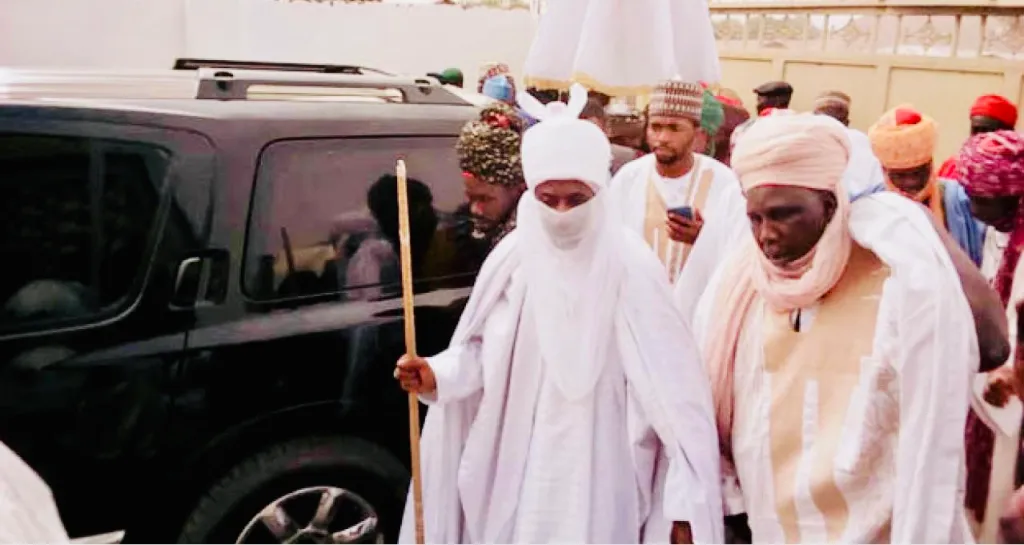
The Court of Appeal in Abuja on Friday stopped the reinstatement of Alhaji Muhammadu Sanusi II’s as the Emir of Kano.
A three-member panel of justices led by Justice Okon Abang unanimously halted the implementation of the January 10 judgment, which vacated the nullification of Sanusi II’s appointment by a Kano State High Court, which it held was done without jurisdiction.
The judgement, which was delivered by Justice Gabriel Kolawole, held that the nullification of Sanusi II’s appointment was done without the required jurisdiction and ordered the transfer of the suit to the Kano State High Court.
However, ruling on the fresh applications with numbers CA/KN/27M/2025 and CA/KN/28M/2025, the appellate court agreed that the applications seeking to halt the enforcement of the earlier judgment pending the appeal before the Supreme Court were competent and meritorious.
“The law is settled. The court is enjoined to exercise its discretion judiciously and in the interest of justice,” he said.
Justice Abang also noted that the subject matter before the court needs to be preserved because the applicant had served as emir for five years before his removal, adding that he deserved the right to protection.
On January 10, Justice Kolawole, in vacating the order against Sanusi II’s appointment, held that the matter, being a chieftaincy dispute, ought to have been determined by the high court of Kano State rather than the Federal High Court, which he described as “a grave error”.
The Federal High Court in Kano, presided by Justice Abubakar Liman, had on June 20, 2024, nullified the Kano State Government’s Kano Emirates Council (Repeal) Law 2024, which reinstated Muhammadu Sanusi II as the 16th Emir.
In the fundamental rights enforcement suit by Aminu Baba-Dan’Agundi, the presiding judge further directed parties, including the Kano State House of Assembly, to maintain the status quo during the reign of Emir Ado Bayero.
However, the appellate court in its ruling, cited Section 251 of the Nigerian Constitution and Section 22(2) of the Federal High Court Act to hold that the matter was a chieftaincy and state legislative dispute and not a fundamental rights matter, and such ought to have been taken before the Kano State High Court or the FCT High Court.
“The proper order to make is to order the 1st respondent (Baba-Dan’Agundi) to transfer the pending suit before the Federal High Court to the high court of Kano State where the chief judge shall assign it to a judge who has not been previously involved in the hearing of the suit,” he said.
The judge awarded the cost of N500,000 against Dan’Agundi and in favour of the Kano State House of Assembly.
However, following the opinions of the presiding justice, Justice Mohammed Mustapha and Justice Abdul Dogo that the right order was to strike out Dan’Agundi’s suit filed at the Federal High Court and not to transfer same, the matter was struck out.
The five appeals — CA/KN/126/2024 between the state assembly and Dan’Agundi; CA/ABJ/140/2023 state assembly and Dan’Agundi; CA/ABJ/142/2024 Kano State Government and Dan’Agundi; CA/KN/200/2024 Alhaji Aminu Ado Bayero and Attorney General of Kano State; and CA/KN/161/2020 Kano Government and Dan’Agundi emanated from the same issue before the Federal High Court
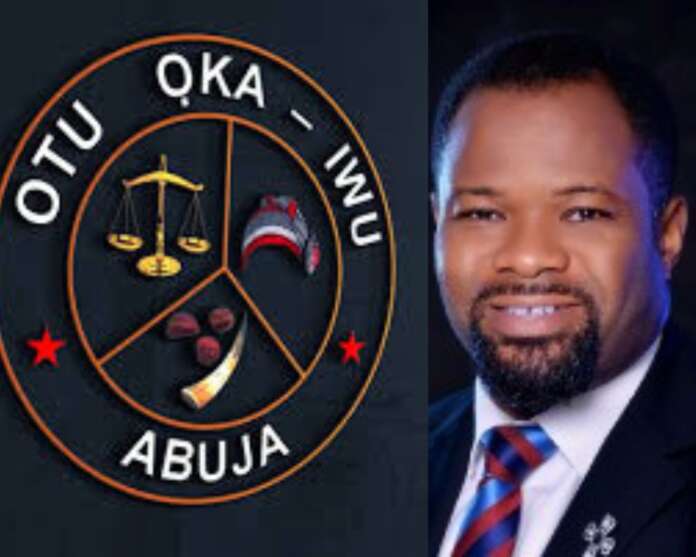
Otu Oka-Iwu Abuja, an association of Igbo lawyers in Abuja and its environs acknowledge and fully endorses the press statement issued by the Association of Igbo Town Unions (ASITU) on March 11, 2025.
The press statement articulates a critical stance against the Federal Government’s proposed establishment of ranches in Imo State, funded under the 2025 budget of the newly created Ministry of Livestock Development. This initiative, which permits the government to acquire land for private cattle ranching, raises profound questions about fairness, legality, and the long-term implications for the people of Imo State and the broader Igbo nation.
ASITU has rightly asserted that cattle rearing should be treated as a private enterprise, and it is unjustifiable for the government to use taxpayer resources to support this specific industry for the private benefit of select groups. Rather than prioritizing the interests of cattle ranchers, the government must ensure that all businesses—including those operated by Igbo traders—have equitable access to land and resources while adhering to the established processes of land acquisition.
The concerns raised by ASITU regarding the already severe land scarcity in Imo State and across the South East can not be overstated. The pressure on our communities to allocate land for agricultural, urban, and infrastructural developments is palpable. The further appropriation of these scarce land resources for private cattle ranching exacerbates an already precarious situation and poses an injustice that the Igbo people will not tolerate.
Moreover, ASITU’s observations about the alarming trend of state governments appropriating land from Igbo businessmen who have invested time and resources into their own ventures add another layer of injustice to this situation. It is unacceptable that in some instances, lands privately acquired and developed by our people are forcibly taken away under various pretexts. The implication that state powers can be wielded to dispossess indigenous populations in favour of external business interests highlights an intolerable dimension to the ongoing struggle against systemic injustices faced by the Igbo people.
Otu Oka-iwu Abuja unequivocally supports ASITU’s assertion that all individuals interested in cattle rearing in the South East should pursue private land acquisition through proper legal channels. The attempt to leverage state authority and apparatus to expropriate our ancestral lands for the benefit of specific business interests only compounds the grievances that have historically marginalized the Igbo people within Nigeria.
This proposed ranching scheme serves to rekindle critical concerns about the broader issue of marginalization that has long afflicted the Igbo community. As articulated by ASITU, it starkly epitomizes the troubling reality that governmental policies favour particular ethnic groups at the expense of indigenous populations and their rights. Such policies are not merely an administrative oversight; they are a reinforcement of systemic exclusion, creating an atmosphere of division where unity is essential.
In light of these considerations, Otu Oka-iwu Abuja, alongside ASITU, categorically rejects this initiative in its entirety. This plan undermines the principles of fairness, equity, and respect for the indigenous communities of our region. The demand for an immediate cessation of this ill-conceived plan to establish cattle ranches in Imo State is both necessary and urgent. We call upon the Federal Government to respect the rights of our people and to allow businesspeople, irrespective of their ethnicity, to acquire land through due legal processes.
Furthermore, Otu Oka-iwu Abuja urge the Federal Government to shift its focus from promoting the business interests of one ethnic group to addressing the underlying economic challenges faced by the vast majority of Nigerians. An inclusive approach is vital; policies must foster equitable growth, create an enabling environment for diverse businesses, and promote national unity rather than division.
Otu Oka-iwu Abuja firmly believes that no part of Igbo land should be appropriated for the private gain of any group without due consideration for the interests and welfare of the residents. The South East deserves better, and we will steadfastly oppose any actions that seek to marginalize our people further. Our collective resilience and determination towards achieving justice and equity for the Igbo nation will remain unwavering.
Chidiebere Nwabueze Udekwe ESQ President Otu Oka-iwu Abuja
An Abuja-based lawyer, Alexander Oketa, has instituted an action against the Chairman of, the Economic and Financial Crimes Commission (EFCC), Ola Olukoyede at a High Court of the Federal Capital Territory FCT over land ownership tussle between Jona Brothers Construction Limited and one Chief Michael Adeojo (Chairman of Elizade Motors),
Acting on behalf of his clients, Jona Brothers, the suit has the Inspector-General of Police, IGP Kayode Egbetokun, the Attorney-General of the Federation, Prince Lateef Fagbemi (SAN), and some EFCC officials as Respondents.
He is asking the court to order the respondents to pay the plaintiffs, the sum of N500M as general damages.
Barrister Oketa had petitioned the EFCC Chairman last week, urging him to call his personnel who were allegedly involved in land grabbing in Abuja to order.
The piece of land situated at Plot 680-689, Cadastral Zone, B06 Mabushi, Abuja; has been a subject of dispute, with several Court judgements and Police Investigation Report, giving the authentic ownership of the said land to Jona Brothers, while the EFCC, in a twist, dabbled into it thereafter, and insisted the land belongs to Chief Adeojo.
Subsequently, the EFCC operatives stormed the premises last week Thursday, sealing off the property, while threatening to arrest anyone who goes close to it; relying on an ex-perte order of interim forfeiture.
In a Fundamental Rights Enforcement suit filed at the High Court of the FCT, on behalf of Jona Brothers Construction Limited, Bullion Properties Limited, Oyenbueke Uche Vincent and John Oyih; Barrister Oketa is seeking an Order, directing the EFCC to immediately unseal the property and allow his clients unrestrained access to it.
The suit is also seeking an Order to declare the invasion and threats to arrest and detain the Owners of the land by the EFCC, as “ultra vires; arbitrary; prejudicial; without precedent; unprocedural; unconstitutional; subversion of the rule of law and due administration of justice; subversion of the independence, authority and integrity of the judiciary; and a violation of the Applicants fundamental rights to personal liberty, fair hearing, freedom to own movable and immovable property guaranteed under sections 35, 36, 43 & 44 of the Constitution of the Federal Republic of Nigeria, 1999 (as amended)”.
The suit, which also has the Inspector-General of Police, IGP Kayode Egbetokun, the Attorney-General of the Federation, Chief Lateef Fagbemi (SAN), and some EFCC officials as Respondents; is also seeking the sum of N500M as general damages against the Respondents.
“The facts of this suit as it relates to the Applicants is a simple land dispute and attempts by the EFCC officials to retake possession of the land and hand same to the Applicants’ defeated opponent, Chief Michael Adeojo (Owner of Elizade Motors), whom the EFCC gave verdict as the owner of the land, contrary to the verdicts of three (3) judgements and rulings of three (3) Justices of the FCT High Court Abuja, having exclusive jurisdiction over land matters”, Barr. Oketa posited.
He gave the breakdown of the judgements and rulings of the Courts to include, “Judgement of His Lordship, Justice Ibrahim Mohammed, in Suit No. FCT/HC/CV/42/2023, prohibiting the EFCC and entity acting on its behalf, from Plot 680-689…
“Judgement of Hon. Justice S.U. Bature, Suit No. FCT/HC/CV/05/2020, declaring the Applicants Owners of the land. Ruling of Hon. Justice Binta Mohamed, in Suit No. FCT/HC/CV/806/2022, dismissing Chief Michael Adeojo’s quest to set aside the judgement; and Oder of Hon. Justice Olajuwon of the Federal High Court, Abuja, in Suit No. FCT/ABJ/CS/779/2023, Ordering the EFCC to maintain status quo”.
The Lawyer contended that, “the Respondents took laws into their hands and recklessly carried out the aforementioned illegal acts, without the approval of the enforcement unit of the Federal High Court, Abuja, where they covertly obtained the exparte Order.
“The Respondents violated the sanctity of the Courts and the Applicants’ rights to liberty, fair hearing, acquire and own properties, as enshrined in the Sections 35, 43, and 44 of the 1999 Constitution and Articles 6 and 14 of the African Charter on Human and Peoples’ Right, hence this suit”.
The Lawyer is also seeking an Order directing the 8th Respondent (the IGP), to accord the Applicants all necessary protection and security needed to for their peaceful possession of the said property.
Hon. Justice Emeka Nwite of the Federal High Court in Abuja has dismissed the bail applications filed by four terrorism suspects linked to wanted notorious bandit kingpin, Bello Turji.
The Judge on Friday turned down the bail request of the suspects on the ground that the charges against them were severe.
Ruling on the bail applications, Justice Nwite held that the Attorney General of the Federation and Minister of Justice AGF has established that the characters of the offences allegedly committed by the four suspects are so strong.
The Judge also held that the likelihood of tampering with evidence, witnesses and further committing more offences were carefully established against them.
The suspects denied bail are Musa Kamarawa; Abubakar Hashimu, a.k.a. Doctor; Samuel Chinedu and Lucky Chukwuma who were alleged to have aided and abetted the bandit group being led by Bello Turjil.
The federal government had slammed 11 counts terrorism charges against them and which they denied.
Justice Nwite had on December 23, 2024, ordered remanded them in Kuje prison pending the completion of their trial.
In count one, Musa Kamarawa; Abubakar Hashimu, aka Doctor; Bashir Abdullahi; Samuel Chinedu; Lucky Chukwuma; Bello Turji (at large); Aminu Muhammad (at large) and Sani Lawal (at large) were alleged to have sometime between 2018 and 2022 in Sokoto State conspired among themselves to commit the terror act.
They were alleged to have provided material services to terrorists groups led by Turji, Kachalla Halilu, Danbokolo, Lawali, Atarwatse, Buderi and others, by procuring and supplying illicit drugs, including penta injections and cannabis plants (aka indian hemp); food items; military and police uniforms, camouflage.
They were also alleged to have supplied , boots, caps and building materials, including bags of cement, cover zinc, bags of nails, M.M. iron rod, etc., to terrorist camps in the forests located in Zamfara, Sokoto and Kaduna States.
The offence is said to be contrary to Section 17 of the Terrorism (Prevention) (Amendment) Act 2013 and punishable under the same section of the Act.
In count four, Kamarawa, Muhammad (at large) and Lawal (at large), sometime in 2021 in Sokoto State, allegedly aided and abetted the commission of acts of terrorism by acquiring a military gun truck from Libya and supplying same to a terrorist, Kachalla Halilu, at a cost of approximately N28.5 million (28,500,000).
They were alleged to have paid for the gun truck partly in cash and partly via electronic transfer.
The offence, the federal government said, is contrary to Section 18 (a) of the Terrorism (Prevention) (Amendment) Act 2013 and punishable under the same section of the Act,” the count read in part.
The offence, the prosecution also said is contrary to Section 8 (1) (b) of the Terrorism (Prevention) (Amendment) Act 2013 and punishable under the same section of the Act.
The federal government through the AGF office had filed the 11-count charge marked: FHC/ABJ/CR/633/2024 against eight defendants, four of who were said to be at large.
In the charge filed on December 16 by Mohammed Abubakar, Director, Department of Public Prosecutions of the Federation, Musa Muhammad Kamarawa; Abubakar Hashimu, a.k.a. Doctor; Samuel Chinedu and Lucky Chukwuma were charged as 1st, 2nd, 4th and 5th defendants.
The Nigerian Correctional Service(NCoS) has said that a total of 3,688 inmates are currently on death row across various correctional facilities in the country.
The Acting Comptroller-General of the NCoS, Sylvester Nwakuche, disclosed this during his screening before members of the Senate Committee on Interior on Wednesday.
He was nominated earlier in the week as substantive comptroller-general by President Bola Tinubu.
Mr Nwakuche said the number of inmates on death row increased from 3,590 in September 2024 to 3,688 in March 2025, a situation that shows the challenges of congestion within Nigeria’s prison system.
“Inmates on death row are now 3,688 from 3,590 in September 2024,” he said.
Nigeria is one of the countries yet to abolish the death penalty despite pressure from groups such as Amnesty International. However, state governors, who have the final power to approve the killing of death sentence inmates after judicial rulings, are reluctant to do so.
Governors’ inactions worsening prison congestion
The acting comptroller-general explained that the reluctance of state governors to either execute death row inmates or commute their sentences to life imprisonment is a major reason for prison congestion.
“State governors are part of our challenges. They refuse to execute inmates on the death row; neither do they commute their death sentence to life imprisonment,” he said.
Mr Nwakuche explained that if these sentences were commuted to life imprisonment, the NCoS could redistribute the affected inmates to rural correctional facilities, which are less congested compared to those in urban areas.
“This is because the issue of congestion is a major urban phenomenon. Our correctional facilities in urban centres are more congested than those in rural areas. If we commute them to life sentencing, we will be able to distribute them equitably,” he added.
Push for collaboration with security agencies
Beyond the issue of death row inmates, Mr Nwakuche emphasised the urgent need for collaboration with security and justice institutions to tackle the challenges of awaiting-trial inmates, which also contributes significantly to prison congestion.
He noted that many inmates have been held in correctional facilities for years without trial, some even beyond the sentences they would have served if convicted.
“This is very important for any establishment to forge ahead. An establishment like correctional centres cannot do anything without collaboration. We are the ones at the recipient of the products of all the prosecuting agencies.
“When I met with the Inspector-General of Police, I said some of your inmates are in our facilities. They have stayed up to five or six years. Some of them are not needed to be in our facilities any longer.
“If they had been sentenced, some of them would not spend up to two to three years in prison. But they have stayed in our facilities for six years. For me, such persons should be discharged and acquitted. That is one area we must collaborate to decongest our facilities,” he said.
To address these issues, Mr Nwakuche noted that he had initiated discussions with key security and legal institutions, including the Nigeria Police, Economic and Financial Crimes Commission (EFCC), State Security Services and the Attorney-General of the Federation.
He stressed that without proper collaboration among these agencies, prison congestion would persist.
“I also met the Director-General of DSS (SSS) on the need for collaboration. I met the Attorney-General of the Federation for the same reason. Some of the inmates are waiting for the advice of the Director of Public Prosecution. If we do not reach out to these agencies, our people will continue to be in prisons unnecessarily,” he said.
Committee’s response
The Chairman of the Senate Committee on Interior, Adams Oshiomhole, assured Mr Nwakuche that the committee would evaluate his performance and submit a report to the Senate.
Mr Nwakuche was accompanied to the screening by top NCoS officials, including his Principal Staff Officer, Godwin Okosun, a Deputy Controller of Corrections, Babatunde Ogundare, and Assistant Controller General Ahmed Adagiri.
If you ask someone to name the Supreme Court’s single greatest moment, many will cite the 1954 Brown v. Board of Education decision. That landmark ruling, which unanimously found that the racial segregation of students in public schools was unconstitutional, is considered a turning point in American history.
But 70 years after the Court ordered public schools to desegregate at “all deliberate speed,” many public schools in America remain racially separate and unequal. And this racial isolation is deepening. Racial segregation has increased 64% since 1988 in the nation’s 100 largest school districts, according to a 2024 study from Stanford University and the University of Southern California.
How did this happen? The reasons are complex, but according to a provocative new book, much of the blame can be placed on another Supreme Court ruling that few like to talk about: The 1974 Milliken v. Bradleydecision.
In “The Containment: Detroit, the Supreme Court, and the Battle for Racial Justice in the North,” author Michelle Adams argues that contemporary American schools are shaped more by Milliken than by Brown. What one Supreme Court gave in Brown, another took away in Milliken, leaving us with the separate but unequal public school system that we have today, she says. Four of the five justices in the Milliken majority were appointed by President Richard Nixon,a Republican, reflecting the court’s shift to the right since its Brown decision.
“Milliken v. Bradley is where the promise of Brown v. Board of Education ended,” Adams writes in her book.
The Milliken decision limited the reach of Brown and made it meaningless in many Northern cities, Adams says. In the South, it was easier for the courts to order the desegregation of schools because segregation was “state sponsored” or codified into law. Racial segregation in Northern schools was not as overt, she says.
Many Northern cities had laws that banned school segregation, but racist housing practices and “White flight” — White parents fleeing cities for the suburbs to enroll their children in heavily White public schools — led to the spread of underfunded city school districts that were virtually all-Black or Latino.
The High Court’s 5-4 decision overturned a ruling by a federal judge who had ordered the desegregation of Detroit’s public schools several years earlier. In 1972 US District Judge Stephen J. Roth ordered students in Detroit’s largely White suburban schools to participate in a sweeping “metropolitan plan” to integrate the city’s mostly Black public schools — in part through a busing plan that required that Black and white students equally share the burden of desegregation. Roth’s plan removed the “White flight” escape hatch for White parents.
Many White parents objected, previewing arguments that would later be used in other anti-integration school campaigns. They said they were against “busing”kids to public schools in other neighborhoods.
“Labeling the issue ‘busing’ rather than desegregation was a key move, one the national media now adopted and amplified,” Adams writes. “It allowed Whites to oppose integration without appearing to be openly racist.”
In “Containment,” Adams recounts how a crack team of NAACP lawyers convinced Roth during 41 days of testimony that racial segregation in Detroit was not accidental. It was caused by state and federal policy to “contain” Detroit’s Black students as if they and their families “were viewed not just as harm-causing agents, but as contagions to be quarantined and avoided at all costs.”
In the Supreme Court opinion that struck down Roth’s decision, the majority concluded that desegregation, “in the sense of dismantling a dual school system,” did not require “any particular racial balance in each ‘school, grade or classroom.’ ”
And Justice Thurgood Marshall, who as a lawyer had successfully argued the Brown case, was left to lament in his dissent, “for unless our children begin to learn together, there is little hope that our people will ever learn to live together and understand each other.”
The impact of the Milliken decision was almost immediate. By the mid-1970s, Detroit had lost at least 51,000 White students. And by 2021, a study found that Detroit was the most segregated city in America. In recent decades the nation’s public schools have been steadily resegregating.
At times, Adams’ book reads like a legal thriller, with striking characters and dramatic courtroom moments. One of the book’s most intriguing characters is Roth, a judge who used racial slurs in private and initially viewed NAACP lawyers as outside agitators. Yet he ignored the hatred he received from parts of Detroit’s White community — one bumper sticker from that era declared, “Roth is a four-letter word” — to devise a plan to live up to the promise of the Brown decision. Roth died of a heart attack just weeks before the high court struck down his ruling.
The Milliken case and its aftermath are also personal for Adams. She is a native of Detroit. Her father was one of only two Black men to graduate from the Detroit College of Law in 1957, and although they lived in the city her parents enrolled her in a small, private White school in the Detroit suburbs because they thought it would provide her with additional educational resources.
Adams talked to CNN about her book. Her comments were edited for brevity and clarity.
You say in your book that Milliken is where the promise of Brown versus Board of Education ended. Some may say that sounds like hyperbole. Why write that?
Imagine it’s 1970, and we’ve got Brown, and we’ve got Brown II, which came in 1955, which basically says, (desegregate) “at all deliberate speed.” And so people are trying to figure out what that means. But in 1970, right around when this case (Milliken) gets going, the Supreme Court hadn’t spoken to desegregation in the North at all. And the question was, is Brown going to be a nationwide rule, or was it just going to be of regional significance?
And the promise of Brown wasn’t just that Black children were going to be able to go to White schools. It was that we were going to have an opportunity to move forward as a nation, because children would be educated together.
And so we would be dealing with both the fact that Black children hadn’t had equal educational opportunity, but also hopefully we’d start breaking down some of the kinds of thought processes that cause White supremacy. One of the things we know is that when you separate people and keep them apart, it tends to increase stereotypes and hostilities. And when people get to know each other, it tends to decrease that.
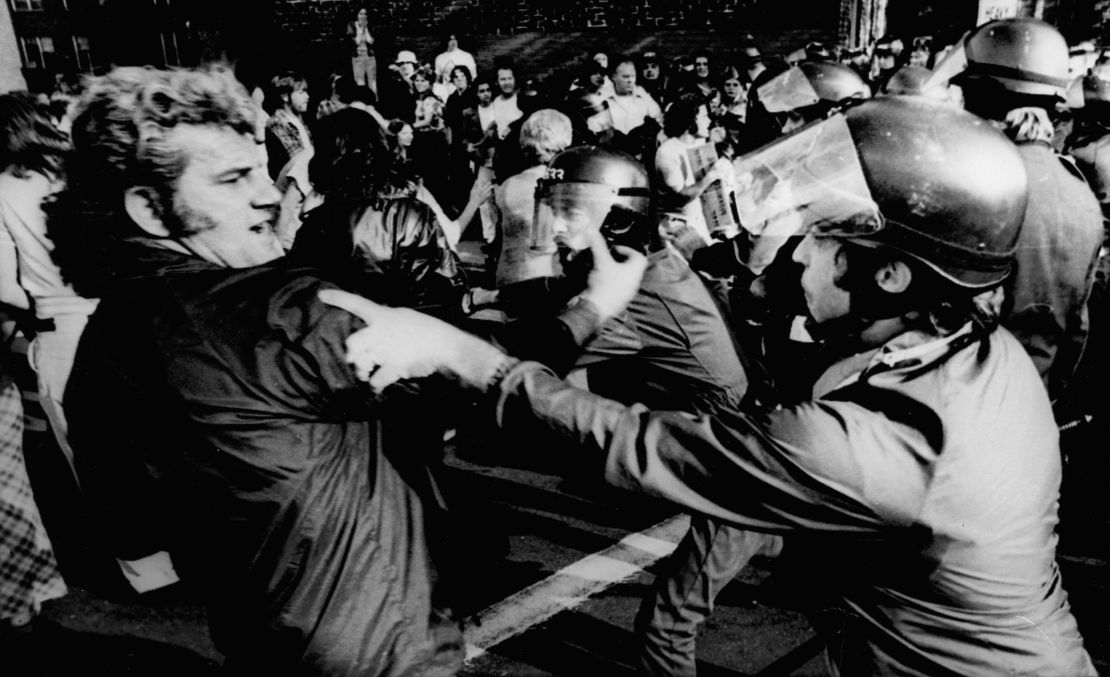
Helmeted police move in to break up a crowd of nearly 800 people at an anti-school busing demonstration in Boston on October 7, 1974. AP
The promise of Brown was the possibility that when you start integration in the earliest ages, our children as a nation would grow up together. And so the big question in 1970, when the case in Detroit starts, is Brown going to go North? And ultimately, the Supreme Court says, no. Milliken really is a nationwide rule, and it really does end the promise of Brown, because Brown promised an opportunity for us to put Jim Crow back in the bottle.
You quoted that dissent from Thurgood Marshall, where he said unless our children learn to go to school together, there is little hope that our nation will learn how to live together. Why did you highlight that quote?
Thurgood Marshall’s name is basically synonymous with school desegregation. He’s on the Supreme Court, and he’s in the minority of this 5-4 decision. When people hear Thurgood Marshall, they think this guy knows what he’s talking about. And so when he says something like that, it carries a lot of weight. The other reason is because his dissent in that case (Milliken) was really prescient.
You quote President Nixon, who opposed busing to create integrated schools by saying — and I’m paraphrasing — you can’t stop discrimination against one group by starting discrimination against another. I heard that rationale repeated by Chief Justice John Roberts in a 2007 decision when the Court’s conservative majority ruled that a public school district in Seattle couldn’t consider race, even for the purpose of integration. This prompted Roberts to write, “The way to stop discrimination on the basis of race is to stop discriminating on the basis of race.”
What I think about that (Roberts) line is that it’s intuitively so common-sensical. But that statement suggests that anything that we do to try to make up for what happened in the past … is a form of discrimination in of itself.
Motorcycle police escort school buses as they leave South Boston High School on the second day of court-ordered busing, September 14, 1974. Some buses were stoned by protesters, and police made several arrests. AP
Instead of saying that, maybe what we should say is that the way for us to be a functioning, multiracial democracy is to have our children learn together from the earliest grades. The way to stop discriminating on the basis of race is to start bringing our children together across class and across race. That’s the way I would phrase that. We need to look back to help us look forward.
You wrote about the anger of White parents in Detroit who used threats of violence and vandalism to prevent their kids from attending school with Black children. It made me think of the photos from the South that showed enraged parents reacting to school integration. Why did the prospect of having their children sit next to Black kids in classrooms provoke such fury?
One of the things that we need to get away from is the idea that what was happening in North and the South was different, and that people’s mindsets were different. When you stigmatize a group, and when you associate a group (Black people) with being Other, being dirty, being contaminated, being poor and being oversexualized — when you put all of those things on a group, then the question becomes: Well, do want your kids to go to school with those kids?
How would you tell White parents that sending their children to racially segregated schools hurts their kids? What would you say?
What I would say is, what do we mean when we say, “a good school?” All parents want their children to go to good schools. All parents want their children to be educated to the highest level that their children’s talent will take them.
If we are living in a multiracial society, is it possible for students to be adequately prepared in a mono-racial environment to compete economically and interpersonally in a workplace? I think that in order to prepare our children to not just be your best self, but to be able to compete, move and max out their talents, they need to be able to be effective in a multiracial workplace, because that’s the world that we live in. So, I would say to a parent that I wonder if a good school is all one race — in a society that’s not.
What do you say to Black parents who say I am tired of chasing White people? We move into their neighborhoods and send their children to their schools and then they leave. The best thing we can do is to make sure our schools have equal resources and that we have teachers who see our kids as human beings.
What I would say is, I hear you. The first thing I’d say is, I’m not going to lecture or second-guess choices that Black parents make. But because of racial economic segregation, Black students in many situations don’t just need equal money, they need more. And so the question becomes: Is it true that we’re going to get all the benefits we need to compete if our children are raised solely in Black-only schools?
Judge Roth is a fascinating character in the book. What enabled him to change his views?
There are a ton of interesting characters in the book, but he probably changes the most. He does start out at the beginning of the lawsuit being very hostile to the plaintiff’s (NAACP) claims. Roth is a Hungarian immigrant, grows up in Flint, Michigan, puts himself through college and law school. He’s a man of his time. He thinks that the reason why Blacks live in Black neighborhoods and Polish people live in Polish neighborhoods is just because they want to live with people who are like themselves.
What changes him is that he has an open mind. He’s open to being persuaded by something called facts. And day after day after day, he listens, and he learns, and he comes to certain kinds of realizations.
What I’m trying to suggest is not that Black people need White people next to them to be able to learn. What am I trying to suggest is that there were a cohort of Black folks in the 1960s and early 70s who were passionate about school desegregation. What I want to know is why? Part of what they thought is that green followed White (the belief that the only chance Black students get to share the equal resources allotted to White students is to attend the same schools).
This is not about chastising Black parents. It’s about stepping back and asking what kind of social polices might benefit all American children, and going back to a moment when many Black parents were passionate about school desegregation.
What impact did it have on you to attend this private integrated school outside of Detroit as a girl?
I had two feet in different places. One of my feet was firmly in the Black community. Everybody I knew went to an HBCU (historically Black college or university). Both of my parents attended Howard (University) for a time, so I grew up around a lot of Black professionals: doctors, lawyers, school administrators. It was a very strong, incredibly positive, idyllic Black community.
And then during the school days, I took a long bus ride, and I was in a suburban area that was predominately White. It affected the person that I have become. All of it (the Milliken case) was happening while I’m a kid. But I didn’t know it, because I wasn’t going to Detroit public schools.
Was it difficult for you to be one of the few Black kids in this White school? Did you get abuse from students and teachers? A lot of Black parents who opposed integration said they didn’t want their kids to go through anything like that.
I was not bullied. I was not called names. I was not belittled. I was not made to feel like Other, and I think a lot of it had to do with the fact that the school was founded by folks who were fleeing Nazi tyranny in Germany and so the whole vibe of the school — they were progressive schools in Germany that the Hitler regime closed down — was very much against authoritarianism. They were progressive, and so that worldview permeated the school and came from the top.
It also attracted parents who also shared some of those same values. I was less likely to be exposed to children who had been raised in households where it was viewed as okay to treat a Black child differently. I only went to that school, so I kind of thought that’s the way (all) schools were. And then, of course, I got older and realized that that was a unique experience.
You’re still passionate about integration, a term that people don’t even really use anymore (Adams wrote a 2006 paper on something she calls “radical integration”). How do you not give into despair when you look at where the country is today, and why is integration so important to you?
If I give into despair now, then I would not be honoring my ancestors. I think about my parents and what they went through. I also think about historical figures like Frederick Douglass and Martin Luther King Jr. I think about all the people who made sacrifices to make it possible for me to be sitting here talking to you today.
And on one level or another, all these people agreed about one thing—that this country could change. I still believe that within our country and within our Constitution are the seeds of the possibility of a true democracy. And at the end of the day, whether you want to call it integration or some other word, what we’re really talking about is democracy.
Signatures attached to the report were allegedly taken from the attendance register
The controversy surrounding the suspension of the Kogi Central Senator, Natasha Akpoti-Uduaghan, has deepened, with allegations that the signatures attached to the Senate Committee on Ethics, Privileges, and Public Petitions’ report were not for the endorsement of the suspension but rather attendance records.
This led to confusion at a closed-door Senate meeting as some senators reportedly claimed their signatures were misrepresented to give the impression of unanimous support for the suspension.
Attendance or endorsement?
On 5 March, members of the Senate Committee on Ethics convened to investigate the seat rearrangement dispute between Mrs Akpoti-Uduaghan and the Senate President, Godswill Akpabio. On that day, senators who attended the committee’s sitting signed the attendance register, while others abstained.
Based on the Senate’s rules, all senators can attend committee meetings, whether or not they are members of such a committee. Also, all the senators who attend a committee meeting can sign the attendance register.
On 6 March, when the ethics committee chairman, Neda Imasuen, presented its report on the floor of the Senate, the attendance sheet’s signatures were included, creating the impression that all signatories endorsed the committee’s recommendations.
One of the key recommendations in the report was to prohibit Senator Akpoti-Uduaghan from identifying herself as a senator, both locally and internationally, for the six months she would be on suspension.
Some senators who signed the attendance register have now reportedly distanced themselves from the report with the argument that they were not allowed to review the final draft before it was presented on the floor of the Senate. A senator who attended the meeting where the matter was discussed but requested not to be named told PREMIUM TIMES that the proper process should have been for the committee members to examine and approve the report before its presentation. However, members were unaware of its content until it was publicly read on the Senate floor.
Natasha Akpoti-Uduaghan
The suspension
On 6 March, the Senate voted to suspend Senator Akpoti-Uduaghan for six months following the ethics committee’s recommendations.
The decision was based on the ethics committee’s report which indicted her for alleged misconduct during a plenary session on 20 February and her refusal to adhere to the chamber’s sitting arrangement.
The Senate also imposed several penalties on her, including the withdrawal of all her security aides and the closure of her office within the National Assembly.
All Senate properties in her possession would be handed over to the Clerk to the National Assembly. At the same time, she was also prohibited from entering the National Assembly premises during the suspension period.
Her salary and allowances were also suspended for the duration of the suspension, just as she was banned from representing herself as a senator, both locally and internationally
However, the Senate left a door open for the suspension to be lifted if Akpoti-Uduaghan submits a written apology, which the leadership may consider before the full six-month period expires.
On Tuesday, Senator Akpoti-Uduaghan took her case to the Inter-Parliamentary Union (IPU), seeking international intervention in her suspension from the Senate.
She addressed delegates at an IPU meeting held at the United Nations headquarters in New York, during which she also raised allegations of sexual harassment against Senator Akpabio.
The Kogi senator described her suspension from the Senate as unlawful and a deliberate attempt to silence her for speaking out against alleged misconduct in the Nigerian upper legislative chamber.
Senators push back against signature use
Our source also confirmed that some of Imasuen’s colleagues in the committee expressed concern about the improper use of their signatures during a closed-door meeting on Wednesday, which lasted about two hours.
According to the lawmaker, those who objected to using their signatures were two senators from the North-west geopolitical zone, one from the North-east and another from the North-central.
They reportedly argued that their signatures were misused because they did not explicitly consent to the report’s recommendations.
Their position is based on the principle that signing an attendance register does not equate to endorsing a resolution. They insisted that their signatures should not have been attached to a report they neither reviewed nor approved.
The senators also emphasised that the report should have been circulated among all committee members before being presented to ensure transparency and due process.
Despite these senators raising their concerns at the closed-door meeting, none of them has done so publicly and PREMIUM TIMES’ efforts to reach out to them individually were unsuccessful.
Argument on endorsement
On the opposing side at the closed-door meeting, some senators argued that attendance at a meeting implies participation in any decisions made during that session. They contended that once a decision is reached within a committee, there is no need for additional signatures.
The opposing argument implies that a senator’s presence at a meeting means they acknowledged the decision, whether they explicitly signed the recommendation or not.
This controversy around signatures further fuels concerns that the suspension of Akpoti-Uduaghan was decided without due process.
Imasuen could not be reached for comment. He did not pick up PREMIUM TIMES’ calls to his mobile telephone or respond to a text message.
A 13-year-old Nigerian voice actress, Simisola Gbadamosi, has made history as the youngest Nigerian to receive an Emmy nomination.
She has been nominated for a prestigious Children’s and Family Emmy Award in the category of Outstanding Younger Voice Performer in a Preschool, Children’s, or Young Teen Program for her role as Tola in Iwájú, an animated miniseries created through a groundbreaking partnership between Disney and Kugali Media.
Set in a futuristic Lagos, Nigeria, Iwájú debuted on February 28, 2024, and quickly garnered critical acclaim and widespread audience appreciation.
The series is celebrated for its compelling storytelling, deep themes, and vibrant depiction of African culture.
Simisola’s nomination is one of three for Iwájú at the upcoming Children’s and Family Emmy Awards, scheduled to take place on March 15 in Los Angeles, California.
The show has also been nominated for Outstanding Children’s or Young Teen Animated Series and Outstanding Directing for an Animated Series.
Simisola’s recognition marks a historic first for Nigeria, making Iwájú the first-ever Nigerian television production to receive a nomination at the Children’s and Family Emmy Awards.
The show delves into themes of socioeconomic disparity, technology, and family bonds, offering a unique perspective on life in a futuristic African metropolis.
“Bringing Tola to life in Iwájú has been an incredible experience. This project is special, and I’m honored to be part of a story that celebrates innovation, culture, and African storytelling.”
For Simisola Gbadamosi, this nomination is beyond anything she could have imagined.
“Being nominated for this Emmy is truly an honor. I’m so grateful to be recognized alongside such incredible talent—many of whom I have watched and admired. This moment is a dream come true!” she shared.
As court bars him from publishing defamatory materials against Mercy Chinwo
Controversial social media critic Martins Vincent Otse, popularly called VeryDarkMan (VDM) has released and shared snippets of his new song, “Court Case,” from his album ‘Body Of Christ.’
VDM, who shared parts of the music video on social media, urged his followers to stream his song so that he could make enough money to pay the charges the court slammed against him.
Justice Aliyu Yunusa Shafa of a High Court of the Federal Capital Territory in Nyanya, Abuja has granted an order restraining a blogger, Martins Vincent Otse (aka VeryDarkman) from making defamatory publication against a Gospel Artist, Mercy Chinwo Blessed.
The Judge granted the order following a motion exparte by the Artist in the Suit with No. GWD/CV/39/2025 with motion No. FCT/HC/NY/M/137/2025.
He also revealed that he hoped to collaborate with notable Nigerian artists such as 2Baba, Vector, MI Abaga, Magnito, and Mode Nine.
However, he admitted that financial constraints prevent him from featuring all the artists he admires, noting that gospel artist Mercy Chinwo inspired him.
“So, this is the second song off my album titled Court Case, so I just want to give a shout-out to Mercy Chinwo for being an inspiration behind this second hit.
“I’d like to feature some big rappers in Nigeria, talking about the incredible MI Abaga, talking about one of the most underrated rappers in Nigeria, Magnito fresh out, i’ll also like to feature VEC GOAT, VECTOR, talking about Mode Nine, Talking about Neto C, ill like to also feature Tuface Idibia in my song but I can’t afford it right now but I believe that if I sell this song if you people stream my song, I will have more money to feature them and also pay for my court case,” he said.
VDM had previously faced criticism for referencing the ‘Body of Christ’ in his first recordings; however, this has not deterred him from continuing his musical pursuits.
Justice Aliyu Yunusa Shafa of a High Court of the Federal Capital Territory in Nyanya, Abuja has granted an order restraining a blogger, Martins Vincent Otse (aka VeryDarkman) from making defamatory publication against a Gospel Artist, Mercy Chinwo Blessed.
The Judge granted the order following a motion exparte by the Artist in the Suit with No. GWD/CV/39/2025 with motion No. FCT/HC/NY/M/137/2025.
Justice Shafa restrained him from “further posting, publishing, sharing, circulating, disseminating or broadcasting through any social media platform or any electronic means, any information, statement or comment whatsoever, in respect of or against the Mercy Chinwo or on any issue relating to the subject matter of this suit, pending the hearing and determination of the motion on notice.”
On Thursday, a Chief Magistrates’ Court in Wuse Zone 6, Abuja, issued a bench warrant for the arrest of VeryDarkMan for “criminal defamation” of a Gospel Artist, Mercy Chinwo.
The magistrate ordered the Nigeria Police Force, together with other law enforcement agencies, to arrest VeryDarkMan and produce him to court to answer to the criminal allegations levelled against him.
Chief Magistrate Emmanuel Iyanna issued the bench warrant following the failure of VeryDarkMan to failed to appear before the Magistrate, despite a court summon on March 5, 2025.
Although counsel to VeryDarkMan, Deji Adeyanju, appealed to the Magistrate to rethink the bench warrant and that he would personally produce his client in court, the Magistrate rejected the appeal and insisted that VeryDarkMan be produced in court by security agencies.
The bench warrant stemmed from alleged defamatory statements made by VDM on social media, accusing Chinwo of involvement in a contractual dispute and the purported diversion of $345,000 linked to her former record label boss, Ezekiel Onyedikachukwu, also known as Eezee Tee.
In support of her claims, Chinwo furnished the court with documentary evidence, including emails and payment receipts, to substantiate that VDM’s allegations were not only entirely false but damning and injurious to her public image and reputation.
The complainant’s lawyers led by Pelumi Olajengbesi of Abuja-based law firm, Law Corridor, Chinwo said the alleged actions of the defendant are contrary to Sections 391 of the Penal Code and Section 24 (1)(B) of the Cybercrime (Prohibition, Prevention etc) Act 2015.
Chinwo’s counsel had also dragged VDM before a High Court of the Federal Capital Territory, Abuja, seeking N1.1bn damages against the blogger.
The lawyer sought an order compelling VDM to delete, retract, and issue a public apology for all allegedly false and defamatory statements made against Chinwo and her brand.
The prolonged political upheaval in Rivers State took another turn on Thursday with the Association of Legislative Drafting and Advocacy Practitioners, (ALDRAP) requesting the Supreme Court to review its February 28, 2025, judgment which restored 27 members of the State Assembly, led by Speaker Martin Amaewhule.
The topmost court, in its judgment delivered by Justice Emmanuel Akomaye Agim, equally ordered Governor Sim Fubara to re-present the state’s 2025 budget to the Amaewhule-led Assembly.
Also, the Court halted the payment of allocations from the Federation Account to the Rivers State Government. It ruled that funds would be released to Fubara’s government only when a lawful Appropriation Law is enacted by the Assembly led by Amaewhule.
The budget had earlier been passed into law after Fubara presented it to the Victor Oko-Jumbo-led three-man faction of the Assembly.
ALDRAP, an association of professional legislative lawyers, in a letter dated March 13, 2025, and addressed to the Chief Justice of Nigeria, CJN has asked the Supreme Court to review the judgment, which was seen by many as a final resolution of key issues involved in the Rivers political crisis.
According to the letter sent to Law & Society and signed by ALDRAP’s lawyer, Kenneth Amadi, the request is based on the provisions of Order 8 Rule 16 of the Supreme Court Rules, 2024. Among other contentions, the lawyers argued that the February 28 Supreme Court judgment did not comply with previous apex court verdicts on similar cases.
The letter is titled “Application for Review by a Full Panel of Seven Justices of the Supreme Court of Nigeria of the Judgment of the Supreme Court of Nigeria Dated February 28, 2025, Delivered by Hon. Justice Emmanuel Agim, JSC, and a Panel of Five Justices, Pursuant to Order 8 Rule 16, Supreme Court Rules, 2024, and Other Relevant Laws as the Supreme Court Deems Appropriate.”
Parts of the letter read: “By way of introduction, my name is Kenneth A. Amadi, Esq. I am a legal practitioner and lawyer to the Association of Legislative Drafting and Advocacy Practitioners (ALDRAP), which is a professional association of lawyers in Nigeria with its national secretariat inside the National Assembly complex, Abuja.
“We write to request permission to submit an application on the above-named subject matter. This application for a review of the Supreme Court judgment of February 28, 2025, is made in accordance with the Supreme Court of Nigeria Rules, 2024, on the following grounds:
“A full panel of seven judges instead of the five judges that sat on the Rivers State House of Assembly case.
” Failure of the panel of judges to follow and comply with the former judgments of the Supreme Court of Nigeria, such as the case of Attorney-General of Bendel State v. Attorney-General of the Federation (1981).”
In an analysis of the verdict, the Executive Secretary of ALDRAP, Dr. Tonye Clinton Jaja, faulted the Supreme Court judgment for failing to take note of the record of proceedings of the Rivers State House of Assembly concerning the defection of the 27 lawmakers.
Citing a court case, Hon. J. I. Ekpenkhio v. Hon. Matthew Egbadon (1962-2001)1 Legislative Law Reports of Nigeria (LLRN) pages 307 to 336, Jaja said: “The Supreme Court of Nigeria held that the Court has a duty to take judicial notice of the record of proceedings of the House of Assembly as stipulated under Section 73 of the Evidence Act.
“In accordance with the above-named judgment, it is reasonable to expect that the Supreme Court of Nigeria would consider the words and actions of Amaewhule and the 26 others on the floor of the Rivers State House of Assembly during the plenary session in December 2023.
“Ironically, the evidence of the defection of the said 27 lawmakers is contained in the Hansard of the Rivers State House of Assembly of December 11, 2023, when the Deputy Speaker of the Rivers State House of Assembly read a letter of defection on behalf of the 27 lawmakers, including the Speaker. The Speaker then put it to a voice vote, and it was approved by all 27 lawmakers. This was then approved as a resolution of the Rivers State House of Assembly as passed on the 11th day of December 2023.”
Further faulting the judgment, Jaja argued: “There are so many absurdities that Hon. Justice Agim’s interpretation has created, such as the absurdity in his statement that only the offending legislature can declare that a defection has occurred.
“Additionally, Hon. Justice Agim’s interpretation has defeated the very purpose of Section 109(1)(g) of the Nigerian Constitution, considering that, going by his interpretation, it is next to impossible for any lawmaker who is in violation of the said Section to be declared as having vacated his seat if such a declaration is to be made by the Speaker of such a legislature—when the Speaker himself is also one of the lawmakers that has defected, as was the case with the 27 lawmakers of the Rivers State House of Assembly.
“How on earth would any offender readily agree that he or she has committed the crime of defection, which would result in the automatic forfeiture of his or her seat in the legislature, along with the humongous sums of money that are paid as both salaries and allowances to such lawmakers?
“The judicial powers of the Federal Republic of Nigeria are vested in the judiciary for the sole purpose that the judiciary would perform the tasks of undertaking judicial review of the actions of the other two arms of government, namely the Executive and the Legislature. The purpose is to create checks and balances to avoid tyranny by one arm of government.
“Therefore, in the event that an application is made to the judiciary to determine whether the actions of some members of the legislature (in this case, the defection of the 27 members of the Rivers State House of Assembly) are in violation of any section of the Nigerian Constitution, it is the judiciary alone that can adjudicate and make such a determination.
“The judiciary cannot shirk its responsibility to the legislature as Hon. Agim’s judgment has done in this case. It violates the very cardinal principle of justice and fair hearing to ask the legislature to sit as a judge in its own case to determine and declare whether a defection has occurred in violation of the said Section 109(1)(g) of the Nigerian Constitution.”
Our site uses cookies. By clicking “Accept All Cookies”, you direct Law and Society Magazine to store cookies on your device and disclose information in accordance with our Cookie Statement: cookie policyACCEPTREJECT
Privacy & Cookies Policy
Privacy Overview
This website uses cookies to improve your experience while you navigate through the website. Out of these cookies, the cookies that are categorized as necessary are stored on your browser as they are essential for the working of basic functionalities of the website. We also use third-party cookies that help us analyze and understand how you use this website. These cookies will be stored in your browser only with your consent. You also have the option to opt-out of these cookies. But opting out of some of these cookies may have an effect on your browsing experience.
Necessary cookies are absolutely essential for the website to function properly. This category only includes cookies that ensures basic functionalities and security features of the website. These cookies do not store any personal information.
Any cookies that may not be particularly necessary for the website to function and is used specifically to collect user personal data via analytics, ads, other embedded contents are termed as non-necessary cookies. It is mandatory to procure user consent prior to running these cookies on your website.