Home Blog Page 406

The Role of Lawyers in Providing Steadiness and Stability in The Senate of the Federal Republic of Nigeria: Lessons the Top 10 Lawyers of the 10th Senate can Learn from Senator Pius Anyim

By Tonye Clinton Jaja.

Ideally, lawyers are supposed to be exceptional leaders by virtue of their professional training.

The curriculum of legal training of lawyers includes courses such as professional ethics, solicitors accounts and other rules of both civil and criminal procedures.

Ideally, such training ought to translate into effective management of the relationship between any lawyer and others (whether clients or non-clients).

There is still an opportunity for the top ten lawyers that are currently members of the 10th Assembly of the Senate of the Federal Republic of Nigeria to deploy their lawyering skills to de-escalate and manage the challenge arising from the current Senate Natasha issue.

For the records the tops ten lawyers, in no particular order of hierarchy are as follows:

  1. Senate President, His Excellency, Godswill Obot Akpabio-GOA;
  2. Senator Adeniyi Ayodele Adegbonmire, SAN;
  3. Senator Kaka Shehu Lawan, SAN;
  4. Senator Simon Lalong;
  5. Senator Ned Nwoko;
  6. Senator Neda Imasuen (lawyer in Nigeria, not USA);
  7. Senator Seriake Dickson;
  8. Senator Agom Jarigbe;
  9. Senator Natasha Akpoti-Uduaghan;
  10. Senator Michael Opeyemi Bamidele (MOB).

The foregoing can learn something from the tenure of another Senator and lawyer who led the Senate from the year 2000 to May 2003.

He managed to provide stability and cohesion with the 109 members of the Senate of the Federal Republic of Nigeria.

As culled from his website, below are details of Senator Pius Anyim’s tenure as President of the Senate, it is as follows:

“Sen. Anyim’s experiences shaped him into the man he is today; a man of deep faith in God; a vigorous problem solver, crisis manager, and consensus builder. He was first elected Senator at age 37 to represent Ebonyi South Senatorial District, on the platform of the United Nigeria Congress Party (UNCP) In 1998. He was again elected Senator on the platform of the Peoples Democratic Party (PDP) in 1999. On the 10th of August, 2000, Sen. Anyim, at the age of 39 years, was unanimously, elected President of the 4th Senate of the Federal Republic of Nigeria.

As President of the Senate, Senator Anyim inherited a crisis-ridden and factionalised Senate. But with the solid support and cooperation of his fellow Senators, he was able to stabilise the Senate, shored up public confidence in the Senate and indeed the National Assembly; and enhance the integrity and dignity of the legislature as the bastion of democracy. The Senate under the watch of Sen. Anyim was focused, cohesive, confident, and productive.

The 4th Senate, a greater part of when Sen. Anyim presided over, passed sixty-five bills and seventy-two resolutions, among which are:

  1. The Niger Delta Development Commission (NDDC) Establishment Act;
  2. The Onshore/Offshore Dichotomy Act;
  3. The Independent Corrupt Practices and Other Related Offences Commission Establishment Act;
  4. The Police Service Commission Establishment Act;
  5. The National Examination Council (NECO) Establishment Act;
  6. The Small and Medium Scale Industries Development Agency Establishment Act;
  7. The National Roads Maintenance Agency Establishment Act;
  8. The Economic and Financial Crime Commission (EFCC) Establishment Act.

By the end of Sen. Anyim’s tenure as President of the Senate, the Senate was re-established as a stable and respected institution, a fierce defender of democracy and a catalyst for good governance.

Prior to his election as a Senator, he held several executive positions in the Directorate for Social Mobilisation, with extensive experience in drawing up mobilization programmes, strategies and manuals for the Directorate’s operations. From 1989 through to 1992, he served as the Social Justice Co-ordinator, and later as Legal Adviser to the Directorate for Social Mobilisation (MAMSER) Headquarters, Abuja.”

NBA says DSS has no role in probe of Chief Judge, As Fubara seeks emergency budget session

The Nigerian Bar Association (NBA) has sternly spoken against enmeshing the judiciary in Rivers State in the ongoing political conflict, cautioning that such actions could erode public confidence in the legal system.

The admonition is sequel to the Rivers State House of Assembly’s demand for the Department of State Services (DSS) to investigate the State Chief Judge, Justice Simeon Amadi, over alleged age falsification.

Chairperson of the NBA Port Harcourt branch, Cordelia Eke, stressed that such matters should be directed to the National Judicial Council (NJC), not the DSS. Eke expressed disappointment that despite the Supreme Court’s ruling, tensions in the state continue to rise.

She urged political leaders to respect the separation of powers and explore alternative dispute resolution methods rather than inflaming the situation. Eke also warned that ongoing instability in Rivers State could discourage investors and disrupt governance.

The political standoff has intensified as the Rivers State House of Assembly accused Governor Siminalayi Fubara of ignoring the Supreme Court ruling, which instructed him to present the 2025 budget anew. Lawmakers loyal to former Governor Nyesom Wike challenged Fubara’s claim that he had sent an official letter to the Assembly, insisting that no such communication had been received.

Assembly spokesperson Enemi George demanded that the governor provide an acknowledged copy of the letter, dismissing the use of a WhatsApp message as unprofessional. He also accused Fubara of obstructing efforts to resolve the crisis.

In response, Rivers State Commissioner for Information Joseph Johnson insisted that Fubara had formally written to the Assembly and urged lawmakers to schedule an emergency session to present the budget. “We propose Wednesday, March 19, for the budget presentation and expect the Assembly to facilitate this,” Johnson said.

As the conflict continues, calls for dialogue and peaceful resolution are growing, with many hoping to avoid further disruption to governance in the state.

How Ugandan High Court Judge and a UN Criminal Tribunal Judge was convicted of immigration and modern slavery offences

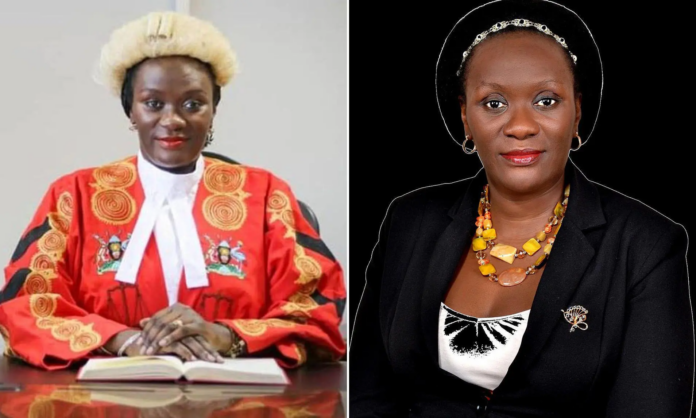
Sequel to an investigation by Thames Valley Police, a Ugandan High Court Judge and a UN Criminal Tribunal Judge was convicted of immigration and modern slavery offences in Oxfordshire, South East England.

The 49-year-old judge, Lydia Mugambe, of Lyne Road, Kidlington, was on 13 March 2025 found guilty by a unanimous Oxford Crown Court jury of:

  • One count of conspiring to do an act to facilitate the commission of a breach of UK immigration law by a non-UK national;
  • One count of requiring a person to perform forced or compulsory labour;
  • One count of conspiracy to intimidate a witness.

Mugambe was found guilty by a majority verdict of:

  • One count of arranging or facilitating travel of another person with a view to exploitation.

On 10 February 2023, Thames Valley Police received a report that the victim in this case, a woman, was being held as a slave by Mugambe at her then address in Brasenose Drive, Kidlington.

A protracted and complex investigation involving several partners then ensued, during which Thames Valley Police established that Mugambe had obtained a visa for the victim to work in the UK.

However, the terms of this visa were that the victim would be paid to work for the then Deputy High Commissioner at the Ugandan Embassy in London, John Mugerwa.

Mugambe paid for the victim’s plane ticket to the UK, picked her up from the airport, and thereafter the victim became Mugambe’s slave, carrying out unpaid work as a domestic maid and nanny.

It was the prosecution’s case that Mugerwa sponsored the victim’s entry into the UK as a domestic worker in his personal household but under the auspices of the Ugandan High Commission, which in his diplomatic role, he was entitled to do, whereas Mugambe could not sponsor a visa as she was a student in the UK at that time.

The prosecution argued that communications between Mugambe and Mugerwa demonstrated that Mugerwa facilitated the victim’s visa in the knowledge she would actually work in servitude for Mugambe, and in return that Mugambe would provide him assistance relation in a separate court case in Uganda.

Thames Valley Police investigated Mugerwa’s involvement in its case, but he had diplomatic immunity, which the Ugandan Government did not waive, meaning he could not be charged with any offences.

Commander for Oxfordshire, Chief Superintendent Ben Clark said: “Lydia Mugambe is an extremely qualified lawyer, a Ugandan High Court Judge and a UN Criminal Tribunal Judge.

“As such, there is no doubt that she knew she was committing offences by bringing the victim to the UK under the pretence that she was going to work for the then Deputy High Commissioner at the Ugandan Embassy in London, thus providing her a legal route of entry, but knowing all along that she intended to make the victim work in servitude.

“Mugambe used her position of power as well as her knowledge of the law to take advantage of the victim, ensuring that she would become her unpaid domestic servant.

“After the offences had been reported to the police, Mugambe tried to evade justice by repeatedly claiming she had diplomatic immunity due to her status as a Ugandan High Court Judge and, after her appointment as a United Nations Judge. Any immunity Mugambe may have enjoyed as a UN Judge has been waived by the Office of the United Nations Secretary-General.

“I want to commend the victim for her bravery in coming forward to report the offences. I, and the whole investigation team, wish her all the best for her future now she is out of servitude and justice has been served.

“I would also like to thank Justice and Care as well as the National Crime Agency Specialist Witness Team, both of who have provided additional support to the victim throughout this process.

“I want to appeal to anyone who is a victim of modern slavery or suspects that modern slavery is being committed to contact Thames Valley Police. We will listen and we will help you.”

Mugambe will be sentenced at the same court on 2 May.

Despite court order, U.S. deports Brown University Professor

By Dana Goldstein

Dr. Rasha Alawieh, a kidney transplant specialist and Brown University professor who had a valid visa, was expelled in apparent defiance of a court order.

A kidney transplant specialist and professor at Brown University’s medical school has been deported from the United States, even though she had a valid visa and a court order temporarily blocking her expulsion, according to her lawyer and court papers.

Dr. Rasha Alawieh, 34, is a Lebanese citizen who had travelled to her home country last month to visit relatives. She was detained on Thursday when she returned from that trip to the United States, according to a court complaint filed by her cousin Yara Chehab.

Judge Leo T. Sorokin of the Federal District Court in Massachusetts ordered the government on Friday evening to provide the court with 48 hours’ notice before deporting Dr. Alawieh. But she was put on a flight to Paris, presumably on her way to Lebanon.

In a second order filed Sunday morning, the judge said there was reason to believe U.S. Customs and Border Protection had willfully disobeyed his previous order to give the court notice before expelling the doctor. He said he had followed “common practice in this district as it has been for years,” and ordered the federal agency to respond to what he called “serious allegations.”

Customs and Border Protection did not respond on Sunday to questions from The New York Times about why Dr. Alawieh had been detained and deported. Lebanon is not included on a draft list of nations from which the Trump administration is considering banning entry to the United States.

A hearing in Dr. Alawieh’s case is scheduled for Monday.

Court documents related to the case were provided to The New York Times by Clare Saunders, a member of the legal team representing Ms. Chehab, who filed petitions to prevent her cousin’s deportation, and then to request that her cousin be allowed to return to the United States.

Ms. Chehab’s petitions name several members of the Trump administration as defendants, including Homeland Security Secretary Kristi Noem, Secretary of State Marco Rubio and the acting commissioner of Customs and Border Protection, Peter Flores.

Thomas Brown, a lawyer representing Dr. Alawieh and her employer, Brown Medicine, said that while the doctor was in Lebanon, the U.S. Consulate issued her an H-1B visa, which allows highly skilled foreign citizens to live and work in the United States. Brown Medicine, a nonprofit medical practice, had sponsored her application for the visa.

According to Ms. Chehab’s complaint, when Dr. Alawieh landed at Boston Logan International Airport on Thursday, she was detained by Customs and Border Protection officers and held at the airport for 36 hours, for reasons that are unclear.

Ms. Saunders, the lawyer, said in an affidavit that she went to the airport Friday and notified Customs and Border Protection officials there — before the flight to Paris was scheduled to depart — that there was a court order barring the doctor’s expulsion. She said that the officers took no action and gave her no information until after the plane had taken off.

Dr. Alawieh graduated from the American University of Beirut in 2015. Three years later, she came to the United States, where she held medical fellowships at the Ohio State University and the University of Washington, and then worked as a resident at Yale.

Before the new visa was issued, she held a J-1 visa, a type commonly used by foreign students.

There is a shortage of American doctors working in Dr. Alawieh’s area of speciality, transplant nephrology. Foreign-born physicians play an important role in the field, according to experts.

Fear over immigration status could “harm the pipeline even more,” said Dr. George Bayliss, who works in the Brown Medicine kidney transplant program with Dr. Alawieh.

Her patients included individuals awaiting transplants and those dealing with the complex conditions that can occur after a transplant, Dr. Bayliss said. He called Dr. Alawieh “a very talented, very thoughtful physician.”

“We are all outraged,” he added, “and none of us know why this happened.”

In a Sunday letter to members of the university community, Brown’s administration advised foreign students, ahead of spring break, to “consider postponing or delaying personal travel outside the United States until more information is available from the U.S. Department of State.”

Culled from the New York Times

2027: They will write the results

By Lasisi Olagunju

President Nnamdi Azikiwe was certain that the 1964 federal elections were a farce and should not produce a legitimate government. By hook and by crook, Abubakar Tafawa Balewa’s Nigerian National Alliance (NNA) party got 200 of its candidates elected into a parliament of 313 members. The winners wrote the election results.

The law empowered the ceremonial president to appoint as the prime minister “the person most likely to command a majority in the lower House.” But President Azikiwe, who led a counter alliance of parties (UPGA), knew Balewa’s ‘majority’ was a product of fraud. He was determined not to allow Balewa and his people to profit from their larceny. He quietly vowed that Balewa would not come back as prime minister.

Now, if Balewa wouldn’t be called to form the government, who and what would fill the void? Zik’s think tank asked him to appoint a caretaker federal government with him assuming executive powers. He liked that. He thought the constitution gave him the power to do it, and he would do it, and he was about doing it.

But, to successfully do that he realized that he needed the backing of the security forces. President Azikiwe invited the heads of the Army, the Navy and the Police to a meeting. He reminded them that he was their Commander-in-Chief and that their allegiance should be with him. The officers exchanged glances. The head of the police pointed at the constitution: the prime minister was his boss. That of the navy told the president that under the relevant Acts, he took orders from the parliament which had enacted Acts that created the army and the navy councils. Those councils, he told Zik, were the bosses. The head of the army, Major-General Sir Welby-Everard, a Briton, had no time for the inanities of that moment. He knew operational orders could only get to him from the Prime Minister but did not bother to tell Zik. He just saluted the president and left Azikiwe with his plans in tatters. What else was left for the president to do? He turned to the labour movement which promised to back him with street protests.

As Zik was plotting, Balewa’s party was plotting too. It was a North versus South Game of Thrones. The cast wore those colours. Balewa’s advisers said with his party having officially won a majority of the seats, he automatically remained prime minister with or without the president’s endorsement. And who said Azikiwe himself was not vulnerable? They called his attention to a clause in the 1963 constitution which empowered him to sack Zik as president. The clause stated that the office of the President became vacant if “the President is absent from Nigeria or is, in the opinion of the Prime Minister, unable to perform the functions of his office by reason of his illness.” But was Zik ill? Someone asked, and someone responded that he was. Did Azikiwe not recently announce that he stayed back longer than usual in Nsukka, his hometown, where he went for Christmas because he wasn’t feeling fine? That was all that was needed by Balewa’s kitchen cabinet to prove that the president was ill and incapable of performing the functions of his office.

So, late on the night of 3 January 1965, it was decided by Balewa’s people that the clause be activated in full. “But, it remains one leg: the president is not absent from the country, and must be absent.” One of the plotters reminded the others. They needed to get him outside the country first. How would they do that? That should not be difficult to do. A genius among them whispered a solution: Anyone who strayed beyond the nation’s land and sea borders had left the country. They had the police and the armed forces on their side. There is a “Nigerian Navy frigate anchored just opposite State House (in Marina, Lagos);” put ‘sick’ Zik in that boat and get him “removed outside the three-mile limit so that he would be both ill and ‘absent from Nigeria.’” Audacious!

\Did the Balewa people carry out the plot? They didn’t have to. The plotters themselves deliberately leaked the plot to Zik, and with that leak, they got him sufficiently frightened so much that “shortly after 1 a.m. on Monday morning (January 4), the State House issued a bulletin that “the President had benefitted from his rest, following the strain of the Yuletide season, and that he was fit to resume his normal engagements.” Zik surrendered. He announced the end to the stalemate, asked Balewa to form the government, and Nigeria began its journey of fate to January 15, 1966. You can read all the above in J. P. Mackintosh’s ‘The Struggle for Power in Nigeria’ published in 1965. There are six pages of the intrigues there.

We do not learn, and we should learn – at least from our own history and experiences. The First Republic took off in turbulence, cruised and crashed in turbulence. But it didn’t just crash without some cockpit drama like the above. Note the extent both sides planned to go in their determination to rule Nigeria. That was 60 years ago. Today, the tap root of demons has reached the crust of the earth. Nothing scares or frightens anyone again. The next election is two clear years away, yet it suffocates as if it is holding this moment. The name for what we feel is desperation.

In 2027, they will seek to write the results. When you marry a man bigger than you can carry, you endure him. We hear that very often now – in universities, in newsrooms and at motor parks. People speak the language of surrender; they lament the futility of contesting against the president in 2027. They point at the mock exam in Lagos, the dress rehearsal in Osun, the warning shots in Rivers, the emirate injunction in Kano, the strategic posting of police chiefs to states of interest. The noise in town is no longer of wars and rumours of wars. The song is of tomorrow as the day of battle, the next is the victor’s dance. “They will write their victory.” And you wonder who the ‘they’ that would “write the results” are. INEC, or who? Foot soldiers of the president are not hiding matters. They boast of his reelection two clear years before the polls. They may be right. What can his enemies and all the unhappy do? The old man has all the ingredients needed to cook what he wants cooked.

Last week, Nasir el-Rufai, man of small chassis, very big engine, ported out of the president’s party. Regime supporters laughed at his folly. Was that a dummy he sold to Tinubu’s party? If it was, that is a familiar terrain to the president, master of subterfuge. Or could it be that the tempestuous Kaduna man just walked into an ambush? If I were him, I would ask if the new haven was actually not one of Tinubu’s other rooms. But the former governor is angry, and bitter. And if you combine anger with ‘beef’, you won’t see what is clearly visible. The ex-Gov has been active, doing Mark Anthony, rousing the rabble. Regime people say he deserves this Yoruba drum called bàtá, and they would give him. When a Tinubu voter heard what El Rufai did, he laughed and sneered: “Òjò á pa bàtá, á pa janwon janwon etí è.» When an enemy is seen fretting and kicking and threatening as El-Rufai is doing, my people would simply sing for him Majek Fashek. They would send down the rain and get his bàtá drum and all its small, noisy gongs thoroughly drenched.

Whatever El Rufai is doing, he is not a lone wolf. The whole country knows that the North is not smiling at all. The Muhammadu Buhari people, complete with their Mallams and marabouts, even with their sermons, are said to have moved their cattle to new pastures. The General himself has abandoned sleep in provincial Daura; he recently relocated to Kaduna, the capital of the North. Watch the skies over Bayajidda II›s North-West and North-East. The former president may not be a darling of the elites of the North, but he is the commander of the over 20 million street kids there. A simple, innocent walk to the mosque one critical Friday afternoon will rekindle their candle – father and children.

What does it mean to write the results of an election years before they are held? In December 2017, Muhammadu Buhari paid a two-day official visit to Kano. He was just two and a half years in power. At the end of that visit, Buhari promised to overwhelm whoever opposed his reelection in 2019. “I will win,” he vowed. Again, in August 2018, Buhari repeated the vow in Daura, his hometown. He said he would win no matter what anyone did: “For those who are discerning, those who have ears and eyes they will see, hear and understand. Those who don’t understand are entitled to their assumptions.” The Election Day eventually came on 23 February, 2019 and the man voted for himself in Daura. He was thereafter asked by a reporter if he would congratulate the winner if he lost the election. The General looked at the audacity (and possible idiocy) of the reporter and responded: “I will congratulate myself; I am going to be the winner.” And super-efficient INEC said he won, although the voting and the votes were very inelegant.

If he is asked the same question today, I am sure Tinubu›s answer to the Buhari question above will be exactly what Buhari said: “I will congratulate myself; I am going to be the winner.” And he is working hard at it, meeting this group today, moving against that group tomorrow.

Two years to 2027 elections, we read of plots and counter-plots; movements and coalitions against Bola Tinubu. Watch him; the law respects him at all times. I recommend his model to those plotting his defeat.

The man is consistent and deliberate. At a book launch in Lagos in 2018, he launched his philosophy of politics with a declaration that: “power is not served a la carte. You have to struggle for power.”

He is consistent. In December 2022, Tinubu in London told his supporters that “political power is not going to be served in a restaurant. It is not served a la carte. At all costs, fight for it, grab it, snatch it and run with it.”

On Wednesday 25 January, 2023, Tinubu was in Abeokuta where he fed our politics with a potent brew of poisonous proverbs and incantations; imprecations and curses. Listen to him: “If you want to eat palm kernel, put a stone on the ground; put a palm nut on it, take another stone and smash it on the palm nut. The nut will be cracked and the kernel will come out. You can see that it is not easy to get palm kernel to eat.” The man spoke with so much courage. He staked his all for what he wanted. I have not heard any of his would-be challengers coming out half this forcefully.

If you plan to do heist in elections, work to have some popularity in your constituency. Rigging won›t work where more than 70 percent loathe you. But, can›t somebody win without stealing? I do not think it is too late for Tinubu to be born again and win clean and clear. Someone, however, said he is too powerful to see how naked he is. Everyone around him holds his magical hem which makes them become wealthy and powerful. It is therefore suicidal to tell the king that he is unclad. They are not showing him the narrowing (narrowed) pathway to a happy 2027. And it is there in plain sight: His APC is shrinking and wearing the sunken eyes of his closet Action Congress. The North appears off; the South-East and the South-South are aloof. His South-West thinks he has been using the bread of Lagos to lap up the Yoruba stew. In his geography book, Lagos is Yorubaland. And that is costly.

Is it too late for him? Two years have enough months to kill the pain of poverty in the land, to be fair to all, to contest and win a reelection. But does that not appear too tortuous and expensive a route to take, especially if you are the custodian of all monies and powers in the land? Only the unwise get hungry and thirsty in seasons of fasting. Why plant crops when you can simply conjure cash, get rich and buy the throne? We saw all these not once, not twice before. It is cheaper, faster and safer. The consequences? People without power are the ones who bother about consequences. There will be none.

An Open Letter to Nasir El-Rufai: Tell me, Nasir, is this about the people or another ego-driven exercise, fueled by personal ambition?

By Senator Babafemi Ojudu

Dear Nasir,

This is a letter from a friend. I take the liberty of calling you a friend because, for nearly 12 years, we walked the same political path, sharing dreams of a better Nigeria within the same party. I also recall your 50th birthday when I persuaded two wealthy friends to accompany me to Dubai, where you were in exile, to celebrate with you. I made two other visits to Dubai with different delegations to meet with you and another of your friends from Canada. We also held another meeting in Accra, Ghana, for the same purpose.

I also traveled to Rwanda and Liberia to meet with Nuhu Ribadu, your friend and now your rival. These trips were in search of the right candidate to bear our presidential flag under the ACN at the time. Later, I arranged another meeting in Dubai between our leaders and Ribadu. Present at that meeting were Bola Ahmed Tinubu, Segun Osoba, Bisi Akande, Niyi Adebayo, Rauf Aregbesola, and several others.

But Ribadu, our chosen candidate, would not show up until the third day, prompting Osoba to joke that if he failed to come from his base in the U.S., I should forget about my senatorial ambition. Eventually, Ribadu arrived, and we settled for him. In anger, you defected to Goodluck Jonathan’s camp, but were soon sidelined.

I briefly managed Ribadu’s bid, mobilizing brilliant and enthusiastic young men and women for the campaign, but that effort was short-lived. That ACN bid for the presidency ended in disaster, a victim of our penchant for expediency. In an earlier “transfer season” Atiku Abubakar picked up our AC ticket, and that, too, failed woefully.

You were involved in all of this, as well as in the 2015 merger that produced Muhammadu Buhari. From a distance, I watched as a select group hurriedly cobbled together a semblance of a manifesto, which was soon discarded because it was not a product of collective reasoning.

Looking back, every effort since then—including the grand merger of CPC and ACN to form APC—has not led to any remarkable outcome. Individuals we once believed to be upright have grown richer, while the people they were meant to serve have grown poorer. Friendships long nurtured have been destroyed by unhealthy competition, leaving bitterness in their wake. And after all the battles fought, alliances made and broken, betrayals and reconciliations, our country remains in a state of coma.

I have also heard—though I have yet to confirm from you—that you led the committee set up by General Abdulsalami Abubakar to locate me when I was left in solitary confinement after the deaths of Abacha and Abiola, while others had been freed.

During my eight years working in the Presidency, our paths crossed often, whether in Abuja or Kaduna, where you served as governor.

But this letter is not about nostalgia or friendship. It is about your recent political moves and what they symbolize. I am not one of those criticizing you for leaving our so-called party. Far from it. My concern is about the endless merry-go-round of Nigerian politicians, the constant movement without direction—what Fela, the musician, once called “perambulation.”

The Question That Must Be Answered: What Is This Move Really About?

I am aware of your transition from APC to SDP, as well as the frenetic cross-carpeting of politicians across the country. But I sincerely hope this is not just another barber’s chair movement—spinning round and round but going nowhere.

They say only a madman does the same thing over and over again and expects a different result.

So, tell me, Nasir, is this about the people? Or is it another ego-driven exercise, fueled by personal ambition and the present discontent in the country?

Is this yet another hastily assembled political project, crafted to serve a few individuals who, having been sidelined from the feasting table of the current overlords, are now seeking a new platform to reposition themselves for the next political cycle?

I have always known you to be intelligent, hardworking, and sometimes strategic. But I must say, you have not always been consistent.

You take a position today, only to negate it tomorrow. And in politics, that kind of inconsistency is fatal. It does not make for the kind of leadership Nigeria needs at this critical juncture. If we are to truly liberate our people from the cesspool into which the country has sunk, we need leaders who stand firm on principle, not those who sway with the wind.

Forgive me if I seem to be getting personal. This letter is not really about you, Nasir. It is about the broader failure of Nigeria’s political culture—the shallowness of our party structures, the absence of real political organization, and the failure of governance.

But since individuals shape institutions, one cannot entirely separate the nature of our politics from the temperament of those who occupy the political space.

What We Lack Are Political Parties, Not Just Political Figures

Let me be blunt: Nigeria has no real political parties.

None of the current players—APC, PDP, or SDP—qualify as proper political institutions.

These are mere vehicles for power, hastily assembled contraptions used by those with means, guile, and bravado to seize office and, once there, engage in a contest to outspend Aliko Dangote.

This absence of well-structured, purpose-driven political organizations is why politicians in Nigeria keep defecting from one party to another, treating politics like European footballers switching clubs every transfer season.

Until we, the so-called political elite, understand what a real political party is—its structures, goals, and responsibilities—we will remain unprincipled, selfish, self-centered, and insincere actors who lack vision and patriotism.

Nasir, This Is Not About Owning a Party—It’s About Building One

For posterity’s sake, do not aim to own a party. Instead, mobilize like-minded people to build a truly national political institution, strong enough to withstand Nigeria’s turbulent political climate.

And when I say like-minded people, I wonder how principled individuals can sit at the same table with Major Al-Mustapha—the Chief Security Officer to General Sani Abacha, whose hands are stained with the blood of many innocent citizens, including Alhaja Kudirat Abiola.

I was riled and overwhelmed by indignation when I recently read of the elation with which you received him into your new party.

Why do we always forget so soon?

What is the definition of a party? What are its fundamental attributes? What goals must it pursue to qualify as a true political movement?

A party built on the primacy of personal ambition will not last. If you embark on this course without deep reflection and principled action, you will be back in four years, looking for another party to join or returning to the one you just left.

Take a cue from Chief Awolowo. When he and other patriots established the Action Group, they did not build it on personal ambition. They structured it around three core objectives:

  1. The absence of ignorance – Free education for all.
  2. The absence of disease – Accessible healthcare.
  3. The absence of want – Economic empowerment and prosperity.

From these goals, they crafted policies that transformed the Western Region.

Final Thoughts

Nasir, if this latest movement is just another barber’s chair—spinning but going nowhere—then you are wasting your time.

But if it is truly about the people, about genuine change, about building something enduring, then do it right.

History will judge.

Your friend,

Senator Babafemi Ojudu, CON

Akpoti-Uduaghan: Suspension by Senate threat to democracy gender inclusion —FixPolitics

A political think tank, FixPolitics has kicked against the suspension of Senator Natasha Akpoti-Uduaghan by the Nigerian Senate, describing it as a threat to democracy, gender inclusion, and the rule of law.

The organisation said that by imposing the suspension under the pretext of rule violations, the Senate had not only silenced Senator Akpoti-Uduaghan but also disenfranchised the people of Kogi Central senatorial zone, depriving them of their constitutional right to representation.

“This action blatantly disregards judicial precedents, including Senator Ali Ndume v. Senate of Nigeria (2018) and Senator Dino Melaye v. Senate of Nigeria (2016), which affirm that lawmakers cannot be suspended in ways that strip their constituents of representation”, FixPolitics said in a statement by its Executive Director, Dr Anthony Ubani.

He said, “The Senate’s repeated defiance of these rulings raises serious concerns about its commitment to democracy, the rule of law, and the integrity of Nigeria’s legislative processes.
Beyond undermining democratic principles, this punitive measure also calls into question the institution’s willingness to address misconduct within its ranks.”

According to the FixPolitics, the suspension highlights the systemic barriers and entrenched misogyny that Nigerian women face in politics and society at large.

“Female representation in the Senate has plummeted by nearly 50 per cent – from seven women in the 9th Assembly to just four in the 10th Assembly. This decision sets a dangerous precedent that could further discourage women from political participation and silence victims of harassment.

“As a signatory to CEDAW, the Maputo Protocol, and SDG 5, Nigeria has an obligation to foster gender inclusion in governance. Actions like these reinforce exclusion, rather than progress. Moreover, public officials must always remember that they hold office in trust for the people and have a duty to model behaviour that promotes civility, decorum, and respect for all Nigerians, regardless of gender.

“Their actions should inspire confidence in the nation’s institutions and reflect the highest ethical standards.
“In today’s interconnected world, where events unfold in real-time through the Internet of Things (IoT), the conduct of public officials is scrutinised globally.”

The organisation said the “unconstitutional” suspension of a duly elected legislator denied constituents their fundamental right to representation in the National Assembly.

Ubani said, “In this case, an entire senatorial district in Kogi State is being disenfranchised – an outcome that contradicts both the spirit and letter of the 1999 Constitution (as amended). The Senate, as Nigeria’s highest lawmaking body, must uphold the rule of law rather than continuously flout court rulings that protect the rights of elected representatives and their constituents.

“We stand in solidarity with Senator Akpoti-Uduaghan and commend her courage in speaking out on this matter. The Senate’s response sets a troubling precedent that may discourage other victims from speaking out for fear of retaliation or dismissal.
The FixPolitics unequivocally condemns the Senate’s actions and demands the immediate reinstatement of Senator Akpoti-Uduaghan.

“We call on the Senate to uphold justice, transparency, and accountability by ensuring that allegations of this nature are investigated thoroughly and impartially – free from internal biases and procedural technicalities.”

FixPolitics called on the civil society organisations, human rights advocates, and the Nigerian public to join it in demanding a legislative environment where all members could perform their duties without fear of harassment or unjust reprisal.

“The integrity of our democracy depends on institutions that serve all Nigerians without bias or discrimination. The FixPolitics is a research-driven, citizen-led initiative committed to addressing the deep-rooted challenges of poor governance by recognising the central role of politics in building effective states and shaping Africa’s development, beginning with Nigeria,” the statement noted.

It added, “We remain steadfast in our commitment to advocating an inclusive, transparent, and accountable political system. We will continue to monitor this situation closely and support all efforts that promote justice, equity, and the protection of democratic values in Nigeria.”

Senator Jimoh Ibrahim Got it Wrong: The Inter-Parliamentary Union (IPU) would consider Natasha’s petition on the basis of its IPU statutes and rules, 2024

By Tonye Clinton Jaja

On Friday 14th March 2025, an online newspaper reported that:

“Senator Jimoh Ibrahim, representing Ondo South Senatorial District, has declared that the petition filed by suspended Senator Natasha Akpoti-Uduaghan regarding her suspension from the Senate cannot be considered by the Interparliamentary Union (IPU).”

He alleged that: “Ibrahim clarified the workings of the IPU, emphasizing that it is Nigeria, not individual members, that is a member of the union. According to him, only another member State can file a petition against Nigeria, not an individual.”

However, Senator Jimoh Ibrahim’s claims are not true or accurate.

Contrary to his allegations, Senator Natasha Akpoti-Uduaghan’s petition which she submitted on 11th March 2025 to the IPU is going to be considered by the IPU in accordance with the Statutes and Rules of the IPU, 2024.

This is because Senator Natasha’s petition was submitted to the Women In Parliament session of the IPU, which in turn would submit Senator Natasha’s petition on her behalf to the IPU.

According to the Statutes of the IPU, 2024, there are Rules of the Forum of Women Parliamentarians (page 52) this set of Rules permits the said Forum of Women Parliamentarians to submit petitions to the IPU on behalf of Women Parliamentarians such as Senator Natasha.

This is a newly created special set of Rules that creates an exception to the general Rule that only Member States can submit Petitions to the IPU.

Further evidence that the new IPU Statues that was introduced in the year 2024 introduced new Rules that were previously non-existent is the Special Rules and Procedure to Regulate Conduct of Virtual Sessions of the Governing Council (page 12) of the Statutes of the IPU, 2024.

So from the foregoing it is evident that Senator Jimoh Ibrahim (who coincidentally is the Chairman of the Senate Committee on Inter-Parliamentary Relations) did not take his time to study the relevant and most updated laws and Statutes of the IPU, 2024.

Just as the Senate Committee on Ethics, Privileges and Public Petitions that was in an incredible hurry to violate its own Rules regarding Quorum in its hurry to find Senator Natasha guilty of misconduct, Senator Jimoh Ibrahim has committed the same blunder!!!

This is a sad, very sad public display of a pre-meditated and prejudicial disposition by both Senator Jimoh Ibrahim and the Senate Committee on Ethics, Privileges and Public Petitions.

Whereas the more professional approach would be to say “let us allow both parties (Senator Natasha and the Senate President) to present their case before the panel of the IPU and then the panel of the IPU would reach a decision based on the submissions of both parties!!!

Senator Jimoh Ibrahim has revealed himself as someone who is not interested in taking time to study the relevant Rules of the IPU, which is the very institution that the Committee which he chairs is focused on!!!

He appears more interested in making headlines in the newspaper and estacodes accruing from embarking on international trips to IPU conventions.

In the year 2018, I was appointed as an Adjunct Faculty/lecturer at the Institute for Legislative Studies, University of Abuja. Eventually, I was assigned by the Director of the said institute to write the curriculum and lecture notes for a course entitled: “Parliamentary Diplomacy”. It is a course that teaches the inner workings, the laws and procedures of the IPU and other Parliamentary institutions.

I would recommend that Senator Jimoh Ibrahim and indeed all the members of the Senate of the Federal Republic of Nigeria should undergo the said course!!!

It will hopefully improve and refine their skills in the fine art of Parliamentary Diplomacy both within Nigeria and on the international scene instead of the current “comedy of errors” that some members of the Senate are currently acting out in the full glare of the public!!!

The electronic copy of the 2024
Statutes of the Inter-Parliamentary Union are available online and below is a reproduction of its table of contents:

……………………………………………………….
1
Rules of the Assembly …………………………………………………………………………………
12
Special Rules of Procedure to regulate the conduct
of virtual sessions of the Assembly
21
Rules of the Governing Council …………………………………………………………………….
24
Special Rules of Procedure to regulate the conduct
of virtual sessions of the Governing Council ……………………………………………
31
Rules of the Executive Committee …………………………………………………………………
35
Rules of the Standing Committees ………………………………………………………………..
40
Special Rules of Procedure to regulate the conduct
of virtual sessions of the Standing Committees ………………………………………..
50
Rules of the Forum of Women Parliamentarians ……………………………………………..
52
Rules of the Bureau of Women Parliamentarians …………………………………………….
61
Rules of the Forum of Young Parliamentarians ……………………………………………….
65
Rules and practices of the Committee on the Human Rights of Parliamentarians”

Dr. Tonye Clinton Jaja,
Executive Director,
Nigerian Law Society (NLS).

A tale of two central bank governors

By Worgu Boms

A Tale of Two Central Bank Governors reveals that one, upon being the apex Bank governor, developed a desire to join politics and be head of the Government of his country. At the end of his tenure, it turned out that mass corruption and mindless illicit acquisition characterised his activities at the apex bank. Today, he is having his day in many courts!
I am talking of Nigeria’s Emefiele.

The other is the first and so far the only one to be the Governor of two separate countries’ Central Banks.

He was Governor of the Bank of Canada and after that, Governor of the Bank of England even though he is a Canadian. No such history of any individual heading such exists.
He did well on both.

After his separate tenures, not even whispers of malfeasance were heard. Today, he is the Prime Minister of Canada.

Someone said Britain should colonise us again. Now, we are concluding we cannot govern.
I have been here long and I am enjoying the boldness and the advocacy.

Recap:
One Central Bank Governor who wanted to join politics and be president of his country, is in all the Courts, forfeiting properties and standing criminal trials. Another was Governor of not one central Bank, but two great countries’ central Banks and nothing of the Emefiele-type is associated with him.

Let’s amend the Law to ensure only an Angel will be a CBN Governor so that he can be like Mark Carney since Mark Carney is not a human being but an angel; or how do we explain his running Bank of Canada and Bank of England without blemish (enough or at all) as to transit to Prime Ministership while ours transit to Prison precincts.

” We Are Where We Are Because of Whom We Are.”

My name’s WorguBoms.

If you do not like what I think and write, please, think and write what you like!

Human trafficking is an abhorrent phenomenon that shames humanity —Ezeilo, SAN

Ex-United Nations Special Rapporteur on Trafficking Persons in Africa and Professor of Law, Joy Ngozi Ezeilo, SAN has again raised her voice against human trafficking describing the morbit trade as an “abhorrent phenomenon that shames humanity.”

In post made on her X handle (formerly Twitter), the Senior Advocate of Nigeria who charged Nigerians to be observant and report any case of human trafficking said:

“Stop the trafficking: We must educate ourselves and others about the signs of trafficking and exploitation. Knowledge serves as our first line of defence. 

“If you observe any signs of human trafficking, please report them immediately. Let us work together to prevent and combat this abhorrent phenomenon that shames humanity,’ she said.

Human trafficking has been referred to as not only being morally repugnant but also a security threat.

The Punch Editorial Board in an editorial titled “Bring human traffickers to justice“, cautioined that the “festering rights abuse, killings, exploitation, rape, and horror associated with human trafficking over the years have made it compelling for the government to devise a comprehensive strategy to check this ‘modern slavery.'”

The editorial observed that: “Human trafficking thrives partly due to the harsh economy that fosters hardship, hunger, and unemployment; the ignorance of unsuspecting Nigerians; and the fact that traffickers often operate without being apprehended, as the masterminds behind the illicit trade evade justice while only their foot soldiers are caught.

“According to the UNODC, 896 offences of trafficking in persons occurred in Nigeria in 2019; 934 in 2020; 1,112 in 2021; and 1,462 in 2022. Of the 1,462 recorded in 2022, 1,011 were brought to police attention, 120 were prosecuted, and 79 resulted in convictions.

“Human trafficking is a massive global economy. While the UN estimates the smuggling route from East, North, and West Africa to Europe generates $150 million in annual profits or $35 billion globally, Pathfinders Justice Initiative describes human trafficking as a $150 billion global industry. An ILO report states that forced labour generates $236 billion annually in illegal profits.

“The US 2022 Global Slavery Report states that Nigeria remains a source, transit, and destination country for human trafficking.

“The 2023 Global Slavery Index ranks Nigeria 38th out of 160 countries with the highest number of slaves, with an estimated 1.6 million people affected.

“NAPTIP reports that between 2019 and 2022, 61 per cent of human trafficking in Nigeria occurred internally, while 39 per cent resulted from cross-border trafficking.

“It is the third most common crime in Nigeria after drug trafficking and economic fraud.

“Human trafficking operates as a network of cartels. Individuals known as “agents” recruit victims for their firms or clients across the globe. Traffickers often keep victims in hostels before selling them to clients who exploit them for coercive labour and sexual purposes.

“Traffickers lure, trick, and deceive vulnerable Nigerians, particularly those from rural areas who are semi-educated, impoverished, and desperate to escape the hardship in Nigeria, often seeing overseas work as a life-changing opportunity.

“The dynamics of human trafficking vary across regions. In Asia, it is characterised by ignorance, deceit, forced labour, and sexual coercion. In Europe and other regions, trafficking often involves a “binding pact,” where most victims are aware of their mission abroad.

“Thousands of desperate youths engage in self-imposed slavery, attempting dangerous crossings over the Mediterranean Sea to Europe, with many perishing in the process.

“Al Jazeera provides a graphic illustration of human trafficking:

“In Nigeria, women are recruited by a network of local ‘agents’ who sell them dreams of good pay and working conditions abroad. They persuade the women, process their visas, and send them to recruitment firms in Iraq for a commission of about $500 per woman, according to activists familiar with the system.

“Once in Iraq, the firms require the women, called ‘shagalas’ (meaning ‘house worker’ in Arabic), to sign two-year contracts and assign them to families or labour-intensive institutions like spas, where they often work more than 20 hours a day for a monthly pay of $200 to $250. In many homes, the women face inhumane treatment: they go days without food, are beaten, and are denied proper living quarters.”

“The International Organisation for Migration describes human trafficking dynamics in Europe:

“Most of the women …incur debts of anywhere between $40,000 and $100,000 to traffickers in their bid to reach Europe.”

“The dynamics of Nigerian trafficking are also characterised by the creation of a binding pact which both sides have to honour – the victim must pay off the debt regardless of the suffering endured along the way, and the trafficker must allow the victim to earn money for herself after the debt has been cleared. If the Nigerian victim is uncooperative, however, she may be subjected to a mixture of violence and coercive rituals.” This is horrendous.

“No country is spared from harsh economic realities and high unemployment. Only jobs in healthcare, multinational companies, and technology-related fields guarantee decent pay. People without relevant skills who travel abroad are often subjected to coercive labour exploitation, sexual assault, and menial jobs that strip them of their dignity. Agnes’ case demonstrates that friendship or blood relations should never be a reason to trust someone with securing a job abroad.

“Since human trafficking thrives on ignorance, poverty, and hardship, the government must implement robust economic policies, create an economy that works for all, and provide jobs to encourage youths to remain in the country while sensitising the public about the dangers of modern slavery.

“Nigeria should fully implement the Transnational Organised Crime Convention and the Trafficking in Persons Protocol 2000 as a signatory. Arresting traffickers alone is not enough—the big sponsors behind trafficking must be brought to justice to serve as a deterrent to others.

“Governments and community leaders must take deliberate steps to educate and guide their youths against this menace. In 2017, Edo State launched the Task Force Against Human Trafficking to combat the scourge—other states should adopt similar initiatives.

“Security forces should collaborate to combat this crisis effectively. They must work with international security agencies, local communities, and promote whistleblowing to help curb the illicit trade.”

TIPS