By Law & Society Magazine Investigations
History has a habit of preserving only the moment of triumph.
It remembers the embraces at the end of an ordeal, the relieved smiles, the official commendations and the photographs that reassure a weary nation that hope has not entirely abandoned it. The quieter, more complicated stories that follow rarely command the same attention. They unfold after the television cameras have departed, after the congratulatory statements have been issued and after the country has turned to the next crisis.
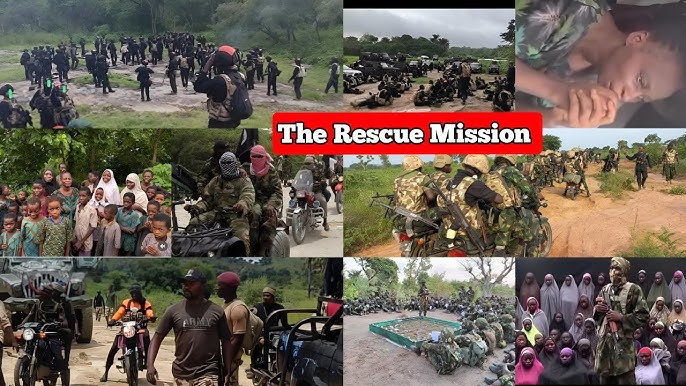
The rescue of the pupils and teachers abducted from three schools in Oriire Local Government Area has already secured its place among Nigeria’s most remarkable security operations in recent years. Fifty-six days after heavily armed terrorists invaded schools in the community and marched dozens of children and their teachers into the forest, the victims were brought home alive through a coordinated operation involving the Armed Forces, intelligence agencies and other security institutions.
For parents who had lived through almost two months of uncertainty, the reunion was nothing short of extraordinary. The operation restored children to their families, revived hope in communities that had feared the worst and demonstrated that determined intelligence gathering, sustained operational planning and inter-agency cooperation could still produce results against criminal groups that many Nigerians had begun to regard as almost untouchable.
The rescue deserved every expression of gratitude it received.
Yet no serious investigation into an event of this magnitude should end where the celebration begins.
Oriire is more than the story of children who came home. It is also the story of teachers who never did, of security personnel whose families exchanged anxious waiting for irreversible loss, of survivors attempting to rebuild lives interrupted by terror and of institutions now confronted with responsibilities extending well beyond the success of a single operation.
These are not separate stories. Together, they reveal what organised kidnapping leaves behind long after the hostages have regained their freedom.
The return of the abducted pupils marked the conclusion of one phase of the crisis. The more demanding work begins afterwards: prosecuting those responsible, supporting survivors, honouring those who died, strengthening vulnerable schools and ensuring that the conditions which allowed such an attack to occur are not simply left in place until another community faces the same nightmare.
That broader perspective matters because Oriire did not occur in isolation.
Mass abductions have become one of the defining features of Nigeria’s security crisis. Independent conflict monitors have documented hundreds of incidents involving schools, highways, farming communities and rural settlements, illustrating how kidnapping has evolved into an organised enterprise capable of disrupting education, economic activity and public confidence across large parts of the country.
Against that national backdrop, the Oriire operation stands out for what it achieved. It also presents an opportunity to examine what effective rescue operations can—and cannot—accomplish.
Military operations recover hostages.
They cannot, on their own, erase trauma. They cannot prosecute offenders. They cannot compensate bereaved families. They cannot restore public confidence in schools without sustained institutional action. Nor can they prevent future attacks unless the lessons drawn from one operation shape the response to the next.
Those responsibilities belong to the wider machinery of constitutional government.
They belong to investigators who must prepare criminal cases capable of securing convictions in court. They belong to prosecutors who must demonstrate that terrorism and kidnapping carry real legal consequences. They belong to policymakers responsible for improving school security and intelligence gathering. They belong to governments whose constitutional obligation to protect life does not end when rescued victims step out of the forest.
The human cost of Oriire illustrates why those obligations matter.
While families across Oyo State celebrated the return of their children, other families were preparing for burials.
Two teachers abducted during the attack did not survive captivity. Mr. Michael Oyedokun, a Mathematics teacher, was killed in the kidnappers’ camp. Mr. Esiyan Adegboye also lost his life before the rescue operation reached its conclusion. Their deaths transformed what had begun as a mass kidnapping into a tragedy from which some families would never fully recover.
The rescue itself claimed further lives.
Lieutenant Felix Ademe Isaac of the Nigerian Army, Private Silas Musa of the 81 Battalion and Sergeant Abena John Jerome of the Nigeria Police Force died during the operation. Lance Corporal Adamu Hussain sustained injuries while participating in the mission.
Their sacrifice received national recognition. The Senate observed a moment of tribute and urged the Federal Government to ensure the prompt payment of statutory death benefits, pensions, insurance claims and every entitlement due to their families. Those resolutions acknowledged an essential principle that is sometimes overlooked in public discussions of national security: the State’s duty to those who defend it extends beyond ceremonial honours.
The death of Lieutenant Isaac has since drawn particular public attention after members of his family disclosed that they were still seeking a clearer official account of the circumstances surrounding the young officer’s final mission. Reports have differed on whether the fatal incident involved explosives encountered by a military convoy or a landmine allegedly planted by the terrorists. Operational details may legitimately remain confidential where national security requires it, but communication with bereaved families, prompt fulfilment of statutory obligations and institutional accountability remain integral to the covenant between the nation and those it asks to serve in dangerous circumstances.
The constitutional promise of security is measured not only by the protection afforded citizens but also by the manner in which the Republic remembers those who pay the highest price in defending them.
That promise extends equally to the children whose education was interrupted, the teachers whose lives were permanently altered, the communities left to recover from collective trauma and the families of those who never returned from the operation.
The photographs celebrating the rescue captured an important national achievement.
They did not, and could not, tell the whole story.
To understand what Oriire means for Nigeria, it is necessary to look beyond the images of reunion and examine what the survivors themselves revealed about life inside the forest, what the conduct of the kidnappers says about the changing character of organised violence and why the events of those fifty-six days continue to raise difficult questions about justice, accountability and the future of school safety in Nigeria.
Those accounts begin where the celebrations ended.
Watch out for Part IV B