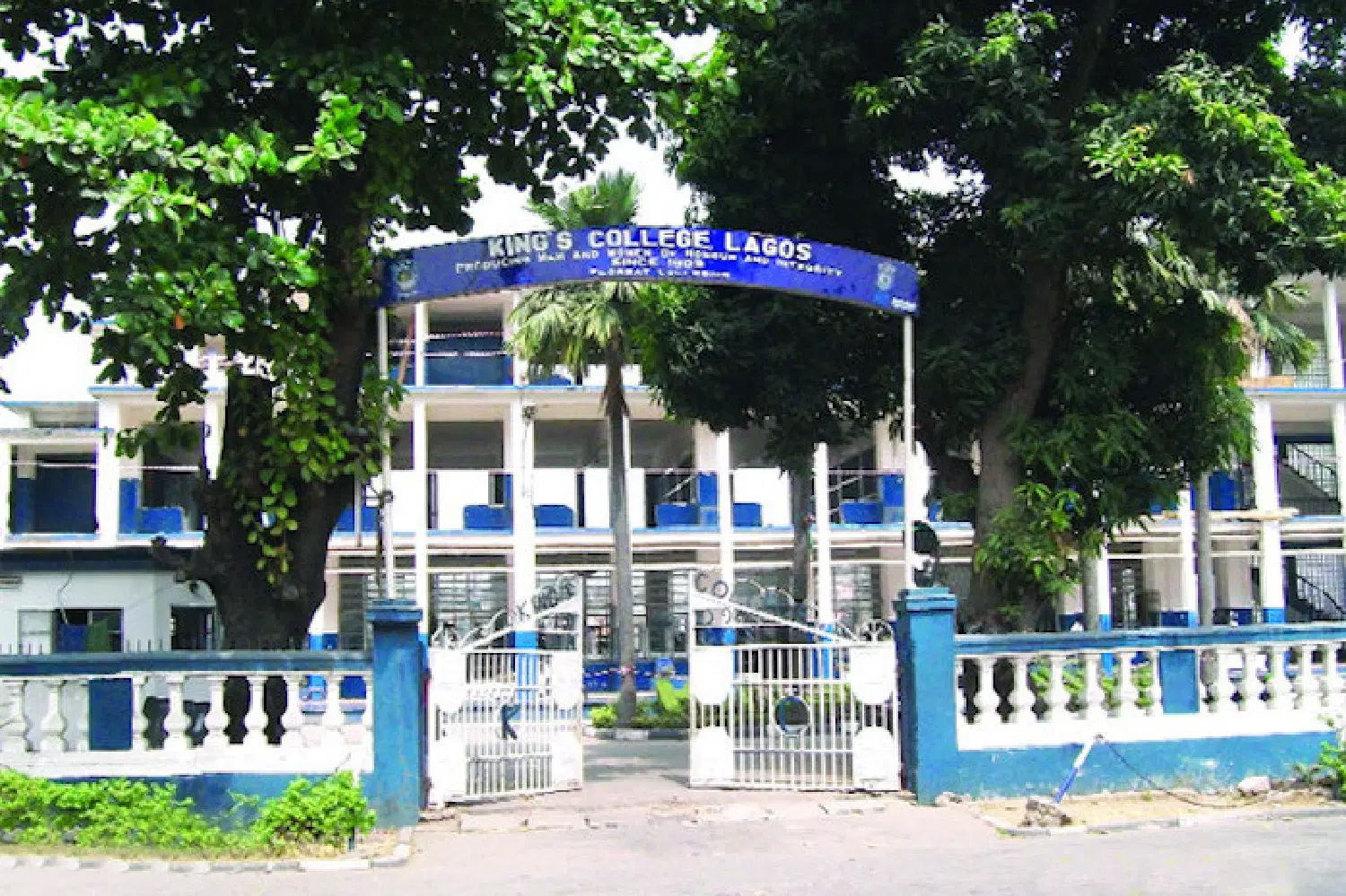
With a ₦100 billion alumni rescue fund, the Federal Government says one of Nigeria’s oldest schools is getting a second chance. Parents see something else entirely: The beginning of a quiet retreat from public education.
By Law & Society Investigations
For generations of Nigerians, King’s College, Lagos has represented something larger than a secondary school.
Founded in 1909, it has produced presidents, governors, judges, diplomats, captains of industry and some of the country’s most influential public servants. Admission has long been regarded as a ticket into one of Nigeria’s finest publicly funded schools—a place where talent, rather than wealth alone, could open doors.
That understanding is now being tested.
This week, the Federal Government formally handed over the management of the 116-year-old institution to the King’s College Old Boys’ Association (KCOBA) under what officials describe as a strategic concession designed to rescue the school from years of physical decay and administrative decline.
The arrangement leaves ownership of the school with the government, but transfers day-to-day management to the alumni association. Within six months, direct federal funding will cease, while KCOBA assumes responsibility for running the institution with support from a planned ₦100 billion transformation fund backed by prominent alumni, including the Emir of Kano, Muhammadu Sanusi II, and businessman Atedo Peterside.
To government officials and alumni leaders, the agreement marks an ambitious effort to revive one of Nigeria’s most prestigious schools.
To many parents, labour unions and education advocates, it raises a more unsettling question.
Is King’s College being rescued—or is Nigeria witnessing the first major step towards the privatisation of its federal unity colleges?
A school carrying the weight of history
Few schools occupy the place King’s College does in Nigeria’s educational history.
Established during the colonial era, it became a model for academic excellence and national integration. Students from across the country competed fiercely for admission, while successive governments invested in maintaining its reputation as one of the country’s flagship public institutions.
Like many federal colleges, however, King’s College has struggled in recent decades.
Investigations, inspection reports and media accounts have repeatedly documented deteriorating hostels, ageing classrooms, inadequate sanitation, overcrowding and infrastructure that often bears little resemblance to the school’s celebrated past.
The deterioration has unfolded despite years of federal budgetary allocations.
It is against that backdrop that the government argues the concession became necessary.
Rather than continue managing a school requiring enormous capital investment, officials say they are leveraging the financial strength, professional expertise and emotional commitment of alumni willing to restore what the state has been unable to sustain.
KCOBA insists the agreement is neither a sale nor a permanent transfer of ownership. Government retains the land and assets. The association, it says, is simply assuming operational responsibility while mobilising private resources to rebuild the institution.
The ₦100 billion question
The headline figure has dominated public discussion.
A proposed ₦100 billion intervention fund would finance extensive rehabilitation of classrooms, laboratories, hostels, sporting facilities and digital infrastructure, while supporting broader reforms aimed at restoring King’s College to international standards.
It is difficult to dismiss the ambition.
For years, education experts have argued that public funding alone has been insufficient to maintain Nigeria’s ageing educational infrastructure. Many federal schools carry maintenance backlogs stretching over decades.
If successfully implemented, King’s College could become a model demonstrating how alumni philanthropy can transform public education.
Yet the size of the investment also raises an uncomfortable question.
If alumni can mobilise ₦100 billion for one school, what happens to the dozens of federal unity colleges whose former students lack comparable financial networks?
The answer could determine whether this becomes a blueprint for educational renewal—or another source of inequality within the public school system.
Parents fear a different future
While government officials celebrated the concession, many parents responded with protest.
Their concerns extend beyond legal ownership.
The central fear is affordability.
Parents worry that once government funding ends, management will inevitably turn to higher school fees and expanded private financing to sustain operations and justify major capital investments.
That, they argue, risks changing the character of King’s College itself.
A school originally created to provide high-quality public education could gradually become accessible only to families able to bear significantly higher costs.
Those anxieties explain why the Parent-Teacher Association has resisted the arrangement, insisting that preserving public ownership means little if ordinary Nigerians are eventually priced out of admission.
Labour unions have voiced similar concerns.
The Association of Senior Civil Servants of Nigeria argues that the concession threatens staff welfare while signalling a broader policy shift towards commercialising public education.
Their warning extends beyond King’s College.
If the model succeeds, could it be replicated across the federal unity college system?
Beyond King’s College
That question may prove more important than the controversy surrounding the school itself.
Nigeria operates more than 100 federal unity colleges established to promote national integration by bringing together students from every region of the country.
For decades, these schools have represented a social compact between the state and its citizens.
The government would provide affordable, high-quality education.
In return, the schools would help build a shared national identity.
The King’s College concession invites a fresh conversation about whether that compact is changing.
Successive governments have struggled under the financial burden of maintaining extensive public infrastructure across education, healthcare and transportation. Increasingly, policymakers have looked to public-private partnerships, concessions and private capital to bridge widening funding gaps.
The logic is difficult to ignore.
The controversy is equally difficult to dismiss.
When does partnership become privatisation?
Where should government draw the line between encouraging private participation and relinquishing core public responsibilities?
Those questions have no easy answers.
A test case for public education
The significance of King’s College lies not only in its history but in what happens next.
If alumni management restores infrastructure, improves academic standards, protects access for students from diverse economic backgrounds and preserves public accountability, the concession could become one of the most successful educational reforms in recent years.
If, however, fees rise sharply, access narrows and transparency weakens, critics will argue that the experiment merely transferred a public institution into the hands of private interests under a different name.
Either outcome will reverberate far beyond Lagos.
Other elite federal schools—including Government College Umuahia, Federal Government Colleges and the wider unity school network—will inevitably become part of the same national conversation.
More than a management change
The debate surrounding King’s College is not really about one school.
It is about the future of public institutions in Nigeria.
For decades, the country’s greatest schools were built on the idea that excellence should not be reserved for those who could afford it. That principle helped produce generations of leaders from families of vastly different means.
Whether the King’s College concession strengthens that legacy or gradually reshapes it into something else will become clear only with time.
The buildings may soon look different.
The management structure certainly will.
The real test, however, is one that no concession agreement can answer.
When the next generation of brilliant but disadvantaged Nigerian children competes for admission, will King’s College still belong to them—or will it have become a different institution altogether?