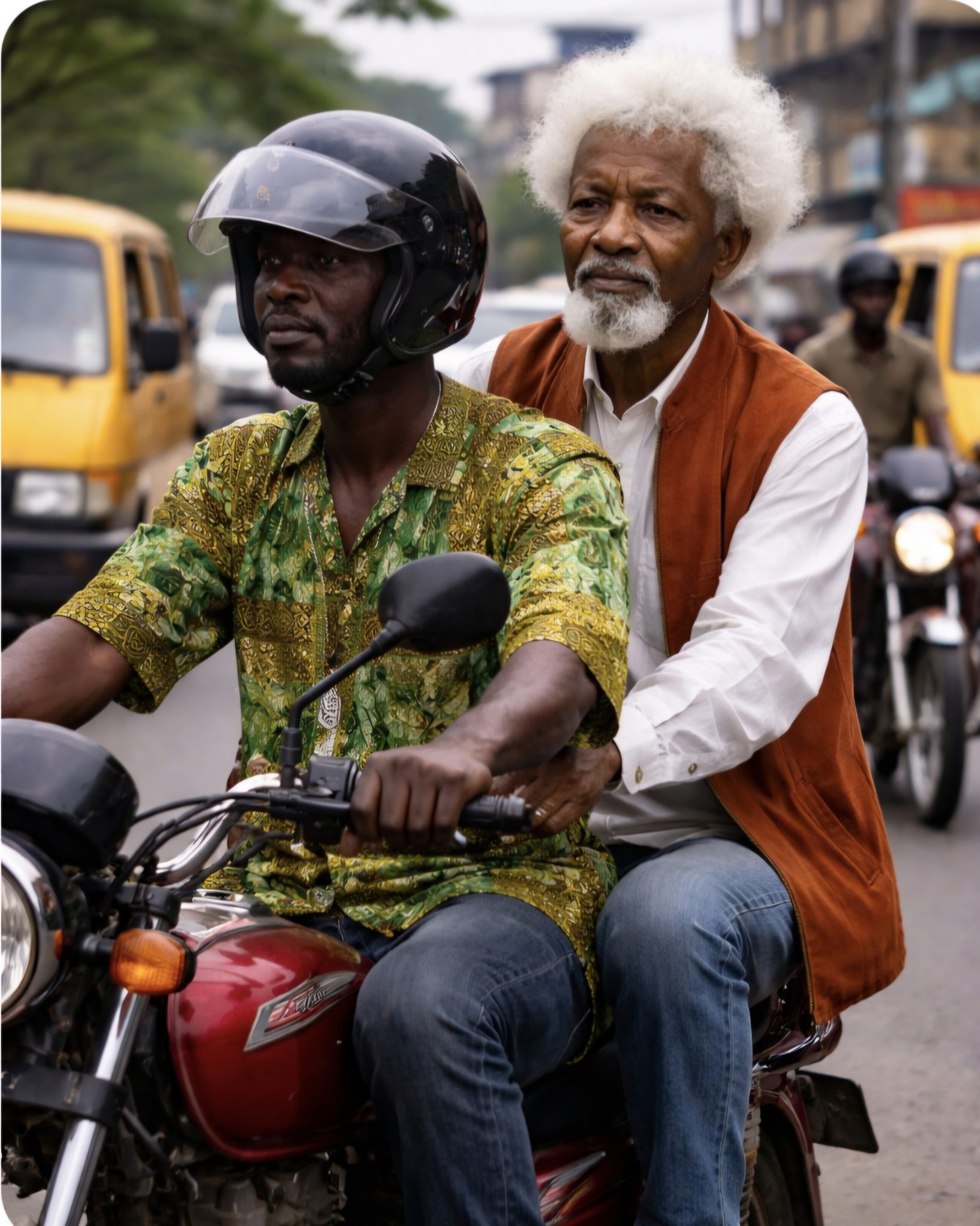
In a country where survival increasingly demands improvisation, the image was as jarring as it was symbolic: Wole Soyinka, global literary icon, moral voice, and one of Nigeria’s most enduring public intellectuals—perched on the back of a commercial motorbike (okada), cutting through traffic like millions of ordinary Nigerians.
It lasted only a moment. But in that moment, a nation saw itself.
The sight of Soyinka on a commercial motorcycle has ignited a wave of reactions across Nigeria, not merely because of its novelty, but because of what it appears to say about a deepening economic crisis that is reshaping daily life under President Bola Ahmed Tinubu.
A Symbol in Motion
In a country battling soaring fuel prices and transportation costs, the okada has become more than a mode of transport—it is a last resort.
For Soyinka, long regarded as a conscience of the nation, the choice to ride one is being widely interpreted as more than convenience. It is being read as commentary.
Nigeria’s ongoing fuel crisis—triggered in part by subsidy removal and broader economic reforms—has pushed petrol prices beyond the reach of many citizens. Commuters now navigate a harsh reality of inflated fares, long queues, and shrinking mobility.
Soyinka’s ride distilled that reality into a single, arresting image.
A Voice, Once Loud—Now Measured
The moment has also revived scrutiny of Soyinka’s evolving relationship with power.
During the administration of former President Goodluck Jonathan, Soyinka was an unrelenting critic—famously branding the government “Nebuchadnezzar” during the 2012 fuel subsidy protests linked to the #OccupyNigeria movement.
By contrast, his posture under Tinubu has appeared more restrained, prompting debate about whether the Nobel laureate’s voice has softened—or simply changed tempo.
Soyinka himself has rejected that framing. He has argued that his approach is deliberate, not diminished.
In late 2023, he said he prefers to give new administrations time before passing sweeping judgment. But he has not been silent.
Selective Criticism in a Volatile Climate
Over the past year, Soyinka has issued pointed criticisms of specific government actions.
He condemned the handling of protests tied to the #EndBadGovernance protests, describing the state’s response as “colonial-style repression.” He has also questioned excessive security around the president’s family, warned against regional military entanglements, and criticized the declaration of emergency rule in Rivers State as an overreach.
Yet for critics—including supporters of Peter Obi—these interventions fall short of the sweeping condemnation Soyinka once directed at past governments.
His acceptance of a national honour under Tinubu—an award he previously declined under Jonathan—has further fuelled perceptions of a shifting stance.
The Politics of Perception
Whether fair or not, perception in Nigeria’s political space often carries as much weight as action.
And in that context, Soyinka’s okada ride has been interpreted as a subtle recalibration—a form of protest not in words, but in imagery.
Analysts suggest the message is simple, if unsettling: hardship has become universal.
“This is not just about Soyinka,” one political observer noted. “It’s about what happens when even the symbolic elite begin to mirror the survival strategies of the masses.”
A Nation Running Out of Options
Across Nigeria, the consequences of fuel scarcity are cascading.
Transport costs have surged. Small businesses are struggling to stay afloat. Workers are being priced out of their daily commute. For many households, mobility itself has become a luxury.
In that context, the okada is no longer just a workaround—it is a reflection of a system under strain.
Soyinka’s ride, then, becomes metaphor.
It captures a country where dignity is increasingly negotiated, where resilience is stretched thin, and where adaptation often masks desperation.
Public Reaction: Between Solidarity and Alarm
The response has been swift and deeply emotional.
On social media, many Nigerians have embraced the image as a moment of solidarity—a reminder that the crisis spares no one. Others see it as something more urgent: a warning signal.
If a figure like Soyinka must resort to an okada, they argue, then the scale of the crisis is no longer debatable. It is visible.
Beyond the Image
Fuel scarcity is not new in Nigeria. But the current wave of hardship has been described by many as unprecedented in both scale and impact.
It is disrupting education, crippling commerce, and redefining daily existence.
Against that backdrop, Soyinka’s ride stands as more than a fleeting viral moment. It is a cultural signal, part protest, part adaptation, part indictment.
And perhaps most powerfully, it raises a question that lingers long after the image fades:
If this is how even the most prominent Nigerians now move, what does it say about where the country is headed?