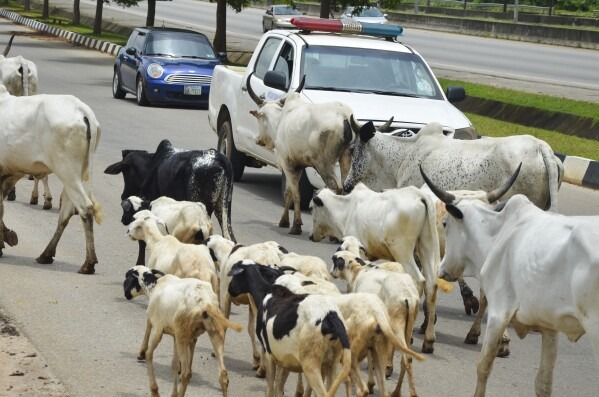
A viral confrontation between an Abuja commuter and a Fulani herdsman moving cattle along a major expressway has reignited debate over open grazing, insecurity, and what many residents describe as selective law enforcement in Nigeria’s capital city.
The now-trending video, widely circulated across social media platforms, captured the moment a visibly frustrated driver stopped to record a herd of cows obstructing traffic on a busy Abuja road.
But the situation escalated when the herdsman approached the motorist and demanded that he stop filming the cattle.
“You can video me, but don’t ever video my cows,” the visibly irritated herder said in the clip.
The commuter, stunned by the response, questioned why cattle were being herded along major roads instead of grazing in rural areas or designated reserves.
In response, the herdsman argued that worsening insecurity had made forests and grazing routes unsafe, claiming armed bandits had effectively taken over large parts of the bush.
According to him, the government’s failure to secure rural grazing areas had forced herders into urban corridors and city outskirts.
“Nothing can be done to me because the government has failed to make the bush safe,” he said.
While the explanation resonated with some Nigerians familiar with the growing insecurity across rural communities, the video has also revived longstanding frustrations over the persistent presence of cattle in urban centres — particularly in Abuja — years before banditry escalated into a nationwide crisis.
Residents and civil society groups have repeatedly complained about cows obstructing traffic, roaming through residential districts, and grazing near major roads in the Federal Capital Territory despite official claims of urban regulation and environmental enforcement.
Critics argue that the controversy exposes a deeper contradiction in the Federal Capital Territory Administration’s enforcement priorities.
For years, authorities in Abuja have aggressively cracked down on commercial motorcyclists, roadside traders, and street hawkers in the name of sanitation, traffic control, and protecting the capital’s image.
Joint task force operations involving the Abuja Environmental Protection Board (AEPB), police units, and transport officials routinely target petty traders and informal workers operating around major corridors such as Airport Road, Berger Junction, and the Central Business District.
Many arrested hawkers and commercial motorcycle (okada) riders are arraigned before mobile courts, fined, or sentenced to short jail terms. In some operations, authorities have confiscated goods and impounded or destroyed motorcycles belonging to low-income operators struggling to survive amid Nigeria’s economic crisis.
Yet critics say authorities appear far less aggressive when it comes to enforcing restrictions against cattle roaming through major city roads and highways.
The latest viral video has intensified questions over why vulnerable informal workers often face swift enforcement actions while cattle continue to compete with motorists in Nigeria’s capital territory in 2026 with little visible consequence.
The issue of open grazing has remained politically and socially sensitive for years in Nigeria, especially amid deadly farmer-herder clashes across the Middle Belt and southern states.
Several states have enacted anti-open grazing laws, while successive federal administrations have promoted ranching as a long-term solution. However, implementation has remained uneven, and enforcement within urban centres continues to draw criticism.
Security experts note that worsening rural insecurity — including banditry, kidnapping, and violent land conflicts — has disrupted traditional grazing routes used by pastoralist communities across northern Nigeria.
But urban residents increasingly argue that insecurity alone cannot explain why cattle movement persists in heavily policed city centres long after authorities imposed strict controls on other forms of informal activity.
For many Nigerians reacting to the video online, the confrontation was about more than cows on a highway. It became a symbol of uneven governance, economic desperation, and growing public frustration over who gets punished — and who gets ignored — under Nigeria’s urban enforcement system.
Watch the video here.