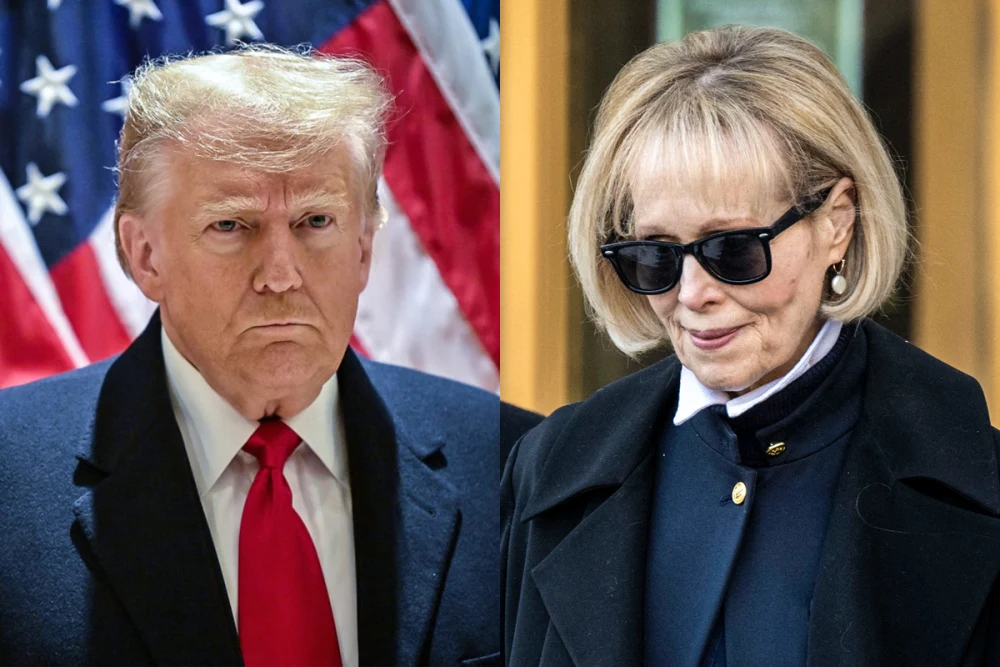
President Donald Trump has exhausted his legal challenge to the $5 million civil judgment awarded to writer E. Jean Carroll, after the Supreme Court of the United States declined to hear his appeal, leaving a jury’s 2023 verdict intact.
In a brief order issued without explanation—as is customary when the court declines to hear a case—the justices refused to review Trump’s challenge to a New York jury’s finding that he sexually abused Carroll in a Manhattan department store dressing room in the mid-1990s and later defamed her after she publicly disclosed the allegation. No justice publicly noted a dissent.
The decision effectively ends Trump’s appeal in the $5 million case, leaving in place both the jury verdict and the ruling of the federal appeals court, which had previously upheld the judgment.
In asking the Supreme Court to intervene, Trump’s lawyers argued that the trial had been fundamentally unfair. They challenged the admission of the 2005 “Access Hollywood” recording, in which Trump was heard making vulgar remarks about women, and objected to testimony from two other women—Jessica Leeds and Natasha Stoynoff—who accused him of sexual misconduct. The U.S. Court of Appeals for the Second Circuit rejected those arguments, concluding that the evidence was properly admitted and that the verdict should stand.
Trump’s legal team also argued that forcing a sitting president to continue litigating decades-old allegations was harmful to the presidency itself, describing the litigation as “deeply damaging to the fabric of our Republic.” The Supreme Court declined to take up those arguments.
The $5 million judgment is only one part of Trump’s legal battle with Carroll. In a separate defamation case arising from statements he made after she first accused him publicly, another federal jury awarded Carroll $83.3 million in damages. Trump continues to challenge that judgment through the courts.
Following the Supreme Court’s decision, Carroll’s legal team moved to have the nearly $5.8 million—reflecting the original award plus accrued interest—released to her, arguing that Trump has exhausted his legal options in this case and should no longer be permitted to delay payment.
For Carroll, the Supreme Court’s refusal to hear the appeal marks the end of one of the most closely watched civil cases involving a sitting U.S. president. For Trump, it closes the door on any further effort to overturn the jury’s finding in the $5 million case, even as his fight over the separate $83.3 million defamation award continues.