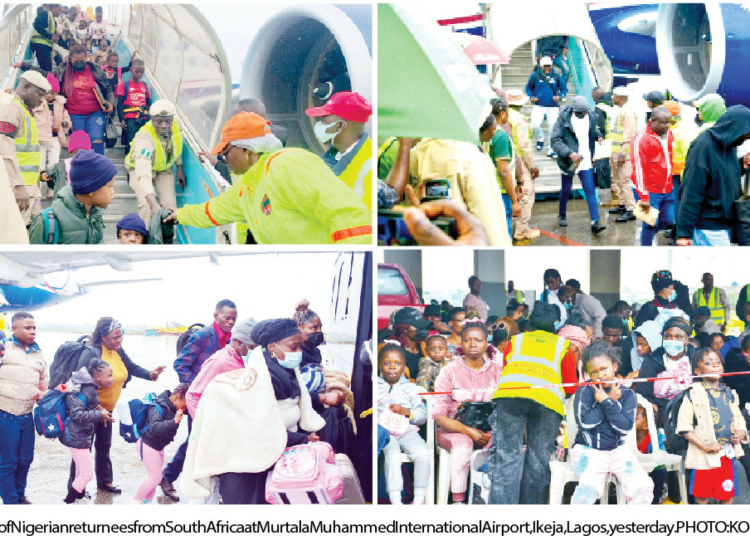
The 271 Nigerians evacuated from South Africa by the federal government over renewed xenophobic attacks have recounted harrowing experiences in the Southern African country, lamenting that they returned home with nothing after abandoning businesses, investments and personal belongings to save their lives.
The returnees, who arrived at the Murtala Muhammed International Airport (MMIA), Lagos, aboard an Air Peace flight at about 10:35 a.m., urged Nigerians contemplating relocation to South Africa to reconsider, describing the country as unsafe for foreigners.
Speaking with LEADERSHIP shortly after arrival, one of the returnees, Emmanuela Akagosu, said she fled South Africa after years of living in fear and intimidation.
“My experience in South Africa is not good at all. They are not accommodating. They are so jealous because Nigerians are hardworking and enterprising, so they feel threatened,” she said.
Akagosu, who had lived in South Africa since 2017, said she was forced to abandon all her possessions while escaping.
“South Africa is not a safe place to go. It’s not safe at all because all the time they tell us to leave or be killed. They constantly threaten us and say that if we don’t leave their country, they will kill us.
“The last time they came to the complex where I was staying, I was not at home, but I was told what happened. My life was no longer safe, so I had to leave,” she said.
According to her, she returned to Nigeria with only two boxes.
“I didn’t come back with anything apart from my two boxes. I left everything behind in South Africa,” she lamented.
Akagosu also alleged that many Nigerians found it difficult to obtain legal residency documents in South Africa.
“It’s not everybody that has permits because they don’t easily issue them. Even when you apply, you keep waiting without any result,” she added.
Advising Nigerians against relocating to South Africa, she said: “I will tell Nigerians who want to go to South Africa not even to try it because South Africa is not safe.”
Another returnee, Sandy Oris, an indigene of Anambra State, described his decision to relocate to South Africa 14 years ago as the biggest mistake of his life.
According to him, his shop and property were looted, leaving him with nothing to rebuild his life.
“When the attacks started again, and the federal government initiated the evacuation process, I decided to return home and start afresh.
“Recently, they destroyed my shop and took all my goods. I came back to Nigeria with nothing,” he said.
Oris appealed to the federal government to provide support for the returnees, many of whom, he said, were stranded.
“We are pleading with the Federal Government to assist us, no matter how little. We are stranded and have nothing.
“Some people became so frustrated that they contemplated taking their own lives, but I kept telling them not to lose hope because life is more important,” he said.
Expressing regret over his relocation, Oris said he would never leave Nigeria again.
“It was a very big regret. If I had the money to return home years ago, I would have done so because Nigeria is safer for me.
“I thought I would do better in South Africa, but I never knew I was trying to destroy my future. I will never move out of this country again. Nigeria is a beautiful country, and I believe I can still succeed here,” he stated.
He further alleged that many accusations levelled against Nigerians in South Africa were driven by prejudice.
“Most of the allegations against Nigerians are false. Once they discover that you are a foreigner and your business is doing well, they begin to make allegations against you. I suffered a lot despite never committing any crime,” he said.
Meanwhile, the Edo State Government has commenced arrangements to receive and reintegrate indigenes among the returnees.
Director-General of the Edo State Migration Agency, Lucky Agazuma, said the state government was prepared to support them in rebuilding their lives.
“We have food packs and transportation arrangements to convey them back to Edo State. Governor Monday Okpebholo is waiting to receive them and ensure their reintegration into society,” he said.
A representative of the Nigerians in Diaspora Commission (NiDCOM), Dipo Odebowale, disclosed that individuals and organisations had donated financial support to the returnees.
“A church donated N100,000 to each returnee. Pastor Bolaji Idowu also gave N100,000 to each returnee, while MTN provided N100,000 and recharge cards worth N50,000 to each returnee,” Odebowale said.
Thousands march in SA, tell illegal migrants to leave
Meanwhile, thousands of people marched on Tuesday in cities across South Africa to demand the departure of undocumented foreign nationals after a weeks-long campaign that has sent thousands fleeing and claimed four lives.
Police were out in force for the nationwide protests, which capped a campaign of demonstrations led by citizen-led vigilante groups that set an unofficial June 30 deadline for foreigners without papers to leave.
There were isolated reports of looting, stone-throwing and confrontations, including near Johannesburg, where security forces escorted a handful of foreign nationals away from a mob brandishing large sticks.
Crowds of demonstrators moved through the centre of the city, South Africa’s financial capital, where most shops were shuttered, workers stayed home, and transport hubs were quiet.
They waved flags and placards, watched by police in bulletproof jackets and riot helmets.
In the southeastern city of Durban, the Zulu heartland, protesters turned out in traditional warrior attire, carrying spears, whips and shields, with some draped in leopard skins.
Demonstrator Brightness Gumbi, 48, said she was frustrated at not being able to afford to rent premises for her business while foreign nationals were able to run shops.
“The illegal foreigners manage to pay it because they sell drugs to our people,” she told AFP. “I hope through these demonstrations our president will hear our cries and enforce stricter laws.”
In the tourist magnet, Cape Town, only about 100 people joined a march through the city centre, passing a counter-protest against Afrophobia and xenophobia.
‘Mass deportation’
One of the continent’s wealthiest countries, South Africa is a magnet for migrant labour while grappling with an unemployment rate above 30 per cent, high crime and a breakdown in services in many areas.
Groups mobilising against illegal immigrants say they take jobs and services from locals, claims that analysts say unfairly scapegoat foreign nationals for government failures.
“South Africans have been replaced by illegal foreigners, increasing unemployment,” the leader of the anti-immigrant march group, Jacinta Ngobese-Zuma, told a crowd in Durban.
“We want mass deportation,” she said. “For the next six months, we want the government to get rid of the people who have not left.”
At least two Mozambicans, an Ethiopian and a Malawian have been killed in the latest outburst of anti-immigrant violence, according to police.
Several African governments — including Nigeria, Malawi, Ghana, Zimbabwe and Mozambique — have organised voluntary repatriation flights and buses for their citizens.
South Africa has seen previous flare-ups of violence targeting undocumented foreign nationals, but this is the first time governments have simultaneously organised repatriations.
More than 25,000 people had been processed for departure in recent weeks, authorities said on Monday.
Nigerians In South Africa Must Stay Alert, Connected – Presidency
The Presidency has urged Nigerians living in South Africa to remain vigilant, stay connected with Nigerian diplomatic authorities, and ensure they are fully aware of their rights amid renewed anti-immigrant protests in parts of the country.
Presidential adviser on Foreign Affairs, Demola Oshodi, said the government was closely monitoring developments and had already taken steps to safeguard Nigerians affected by the unrest.
Speaking on Channels Television’s Politics Today yesterday, Oshodi said the administration of President Bola Tinubu is actively engaging with South African authorities and other international partners to prevent escalation while prioritising the safety of Nigerians abroad.
He noted that the government had already begun evacuation efforts for vulnerable citizens, stressing that diplomatic engagement remains ongoing at multiple levels.
‘I’m scared’
As the protests unfolded in several cities, hundreds of migrants — mostly Malawians and Zimbabweans — gathered in Cape Town, Johannesburg and other centres, waiting for assistance to go home.
Some said their landlords had evicted them or their employers had fired them, fearing fines from officials or attacks by vigilante groups.
“The people in South Africa don’t want us here. I’m scared,” said a 23-year-old Zimbabwean woman, who asked to remain anonymous, as she stood among around 2,000 people waiting for buses.
Only a few dozen Malawians remained at a site in Durban, from which several thousand had been bused out in recent days, either returned to their country or sent to a processing site near the border with Zimbabwe.
“I thought I could stay on, but neighbours warned us last night,” 32-year-old Adam John told AFP.
“I felt that it was better to try and get home while I still can.”
‘Weaponised’
Concerned about a repeat of unrest five years ago, when around 350 people were killed in days of looting and riots, the government put in place a massive security deployment for Tuesday’s mobilisation.
President Cyril Ramaphosa announced the stepping up of government plans to combat illegal immigration and called on traditional leaders to use their “standing to calm tensions.”
Coming ahead of local government elections in November, the anti-migrant push has been “politically weaponised,” labour analyst Dale McKinley said.
Previous anti-foreigner riots in South Africa proved deadly. In 2008, violence left 62 people dead.
Nigerians In South Africa Must Stay Alert, Connected – Presidency
The Presidency has urged Nigerians living in South Africa to remain vigilant, stay connected with Nigerian diplomatic authorities, and ensure they are fully aware of their rights amid renewed anti-immigrant protests in parts of the country.
Presidential adviser on Foreign Affairs, Demola Oshodi, said the government was closely monitoring developments and had already taken steps to safeguard Nigerians affected by the unrest.
Speaking on Channels Television’s Politics Today yesterday, Oshodi said the administration of President Bola Tinubu is actively engaging with South African authorities and other international partners to prevent escalation while prioritising the safety of Nigerians abroad.
He noted that the government had already begun evacuation efforts for vulnerable citizens, stressing that diplomatic engagement remains ongoing at multiple levels.
“The government is really, really on top of things. We have moved hundreds of the most vulnerable Nigerians out of South Africa. We’ve escalated this to the South African government, and we are taking steps to do more.”
He stated that while tensions remain, Nigeria is deliberately pursuing a cautious diplomatic approach rather than drastic action.
“We cannot, and we should not, move to extreme measures at this moment. The African Union is there, and other international bodies are involved. We have to do things incrementally.”
According to him, both countries share deep economic and historical ties that must be considered in handling the situation.
“There is a lot of vested interest in both countries. There’s a lot of investment in both countries, and we also have a history together. We are the two largest economies in Africa, so it is important to take things incrementally. We don’t want to throw the baby out with the bathwater,” he added.
Oshodi said the government is closely watching developments around the expiry of a deadline reportedly issued in relation to the protest actions, expressing hope that the South African authorities will take stronger steps to protect foreign nationals.
“Today is the 30th deadline they’ve given, and we are watching to see how much the South African government is doing to protect our nationals,” he noted.
He also stressed the importance of Nigerians in South Africa maintaining a low profile while tensions persist and ensuring they remain in constant contact with Nigerian diplomatic missions.
“We need to ensure Nigerians there are fully aware of their rights, that they know how to get in touch and have been in touch with the Nigerian diplomatic community in case of any emergency or evacuation. They’ve also been advised to keep a low profile while things are resolved,” he added.