By Lillian Okenwa
Every major corruption investigation presents two separate stories.
One unfolds in press conferences, political statements and social media debates. The other is built in investigators’ case files, court filings and documentary evidence. The first often shapes public opinion. The second determines legal outcomes.
The investigation involving former Kaduna State Governor Nasir El-Rufai now sits at the intersection of those two narratives.
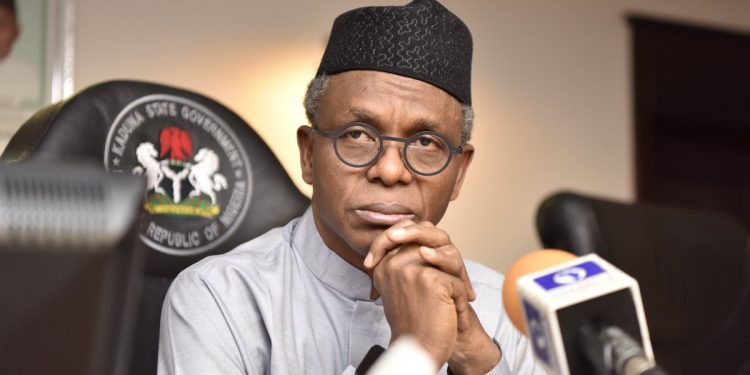
Since leaving office in May 2023, El-Rufai has remained one of Nigeria’s most influential political figures. His supporters describe the investigation into his administration as a calculated attempt to weaken a prominent voice ahead of the next political cycle. Those urging accountability insist that no public official should be insulated from scrutiny because of political stature or past service.
Neither position answers the central legal question.
Can the allegations be proved before a court of law?
That is the question investigators, prosecutors and, eventually, the judiciary will have to answer.
From a Legislative Inquiry to a Criminal Investigation
The present controversy grew out of an investigation by the Kaduna State House of Assembly into the finances of the immediate past administration.
The Assembly’s ad hoc committee raised concerns over government borrowing, contract awards, procurement practices and public expenditure during El-Rufai’s eight years in office. Its report alleged widespread financial irregularities involving hundreds of billions of naira and recommended that anti-corruption agencies examine several transactions more closely.
The report immediately generated political controversy.
Supporters of the former governor dismissed the findings as politically motivated, while critics argued that the allegations deserved a full criminal investigation.
The law, however, draws a clear line between a legislative inquiry and a criminal prosecution.
A House of Assembly may investigate the management of public funds and recommend further action. It cannot determine criminal guilt. That responsibility belongs exclusively to the courts after evidence has been tested according to the rules of criminal procedure.
Read Also: THE EL-RUFAI FILES (Part I): Where allegation ends and evidence begins
For investigators, the Assembly’s report was not the conclusion of the matter. It became the starting point.
How Financial Investigations Are Built
Complex financial investigations are rarely driven by dramatic arrests or public announcements.
They begin with documents.
Budget approvals.
Loan agreements.
Contract files.
Bank records.
Payment schedules.
Corporate registrations.
Land records.
Auditors and investigators attempt to reconstruct years of financial decisions, tracing how public money moved from appropriation to expenditure and identifying those who authorised, received or benefited from particular transactions.
Where funds are alleged to have been diverted, suspicion alone is insufficient.
Investigators must establish a chain of evidence capable of identifying the source of the money, the route it followed and the individuals who exercised control over it. Each document must withstand forensic examination. Each transaction must fit into a coherent evidential picture.
The task becomes even more demanding when allegations extend beyond Nigeria’s borders.
Reports linking the investigation to alleged overseas property acquisitions attracted widespread public attention. Yet claims involving foreign assets require considerably more than public speculation. Property records, beneficial ownership documents, banking records, international transfers and cooperation from foreign authorities would ordinarily be required before such allegations could be proved in court.
Until those links are established through admissible evidence, allegations remain exactly that—allegations.
The Burden of Proof Never Changes
Nigeria has witnessed numerous high-profile corruption investigations over the past two decades.
Some resulted in convictions.
Others ended in acquittals.
Still others never reached trial.
The reasons varied. In some cases, investigators could not assemble sufficient evidence. In others, prosecutors failed to establish every element of the offences charged. Occasionally, procedural defects weakened otherwise substantial investigations.
Those experiences underline an important feature of criminal justice.
Public suspicion cannot replace legal proof.
Neither media attention nor political pressure relieves prosecutors of their obligation to prove every allegation beyond reasonable doubt.
The same standard applies whether the accused is a former governor, a serving official or an ordinary citizen.
The Courtroom Takes Over
Public debate has gradually given way to litigation, with the courtroom now serving as the principal arena in which the dispute is unfolding.
El-Rufai’s legal team has challenged aspects of the investigation, arguing that his constitutional rights were violated during the process. Among other reliefs, his lawyers are seeking substantial damages, contending that the investigation crossed the boundary between lawful inquiry and unlawful treatment.
Such proceedings are not unusual in complex criminal investigations.
Defence lawyers frequently test the legality of arrests, detention, searches and investigative powers while the substantive allegations remain under investigation.
These constitutional challenges address the conduct of investigators rather than the truth or otherwise of the allegations themselves.
The outcome may influence the admissibility of evidence or determine whether particular investigative steps complied with the Constitution.
Why Procedure Matters
Many members of the public understandably focus on the allegations.
Lawyers often begin somewhere else.
Procedure.
Was a search authorised by law?
Were statutory powers properly exercised?
Were constitutional safeguards observed?
Was evidence obtained in a manner recognised by law?
Questions such as these sometimes determine whether evidence can be relied upon during trial.
A successful procedural challenge does not establish innocence.
Nor does procedural compliance establish guilt.
The law treats those issues separately.
One concerns the conduct of investigators.
The other concerns the conduct of the accused.
Politics and Criminal Justice
No investigation involving a politician of El-Rufai’s profile exists in complete isolation from the country’s political climate.
Since leaving office, the former governor has remained an influential figure within Nigeria’s evolving political landscape. His well-publicised disagreements with the Federal Government and continuing relevance in national politics have encouraged competing interpretations of the investigation.
Supporters describe the case as selective enforcement.
Critics respond that accountability cannot depend on political convenience.
Those competing narratives may influence public debate.
They do not determine the outcome of legal proceedings.
Courts decide criminal liability by examining evidence, not political alliances, public sentiment or media campaigns.
The Institutions on Trial
The litigation reaches beyond the individuals involved and touches institutions that shape public confidence in the administration of justice.
Can anti-corruption agencies investigate politically exposed persons without creating the perception of political interference?
Can constitutional safeguards be respected without weakening legitimate law enforcement?
Can legislative oversight, criminal investigation and judicial adjudication each remain within their constitutional boundaries?
These questions are likely to outlast the present controversy because they speak directly to public confidence in Nigeria’s anti-corruption framework.
What Lies Ahead
Whether criminal charges are eventually filed or not, every decision taken from this point will attract close examination.
If prosecutions commence, investigators will be expected to produce documentary and forensic evidence capable of supporting each allegation beyond reasonable doubt.
The defence will continue examining both the factual basis of the allegations and the legality of the investigative process.
The courts will decide the issues according to the evidence placed before them and the applicable law.
No political speech, legislative report or television interview can substitute for that judicial process.
Conclusion
Public opinion remains sharply divided over the investigation involving Nasir El-Rufai. That division is unlikely to disappear soon.
What will endure long after today’s political arguments have faded is the quality of the investigation itself. If the evidence satisfies the law, the courts will say so. If it does not, the legal process provides its own remedy.
The issues now extend beyond one former governor. They touch the credibility of anti-corruption institutions, the protection of constitutional rights and the ability of Nigeria’s justice system to command public confidence irrespective of whose name appears on the case file.
The remaining questions belong to the courts.