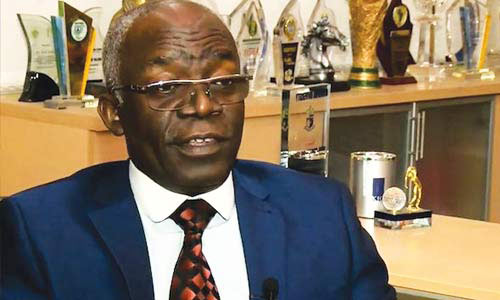
Days after the former Liberian president warned Nigeria’s lawyers against elected leaders who bend the courts to their will, Femi Falana, SAN, challenged the NBA over his invitation — citing Liberia’s defiance of an ECOWAS Court judgment
PORT HARCOURT — George Weah arrived at the Nigerian Bar Association’s Annual General Conference as a former president with a message about the dangers of democratic backsliding. He left the opening ceremony to applause after warning African leaders that an electoral mandate was no licence to bend the judiciary, weaken the legislature or turn constitutional institutions into instruments of personal power.
Forty-eight hours later, one of Nigeria’s most prominent human-rights lawyers turned that message back on him.
Femi Falana, SAN, has challenged the Nigerian Bar Association (NBA) over its decision to give Weah the keynote platform, accusing the former Liberian leader of presiding over a government that refused to comply with judgments of the ECOWAS Community Court of Justice.
Falana’s intervention, delivered on Monday in a video introduced an uncomfortable question into an AGC that has placed the rule of law and institutional independence at the heart of its programme: How should a Bar that demands obedience to judicial decisions at home treat a former head of state whose administration was accused of disregarding a regional court’s judgment?
Falana was blunt.
He criticised the NBA for inviting Weah and urged the Association to stop giving former African leaders whom he described as dictators a platform at its conferences. He specifically pointed to the former Liberian government’s handling of an ECOWAS Court judgment involving Kabineh Muhammad Ja’neh, a former Associate Justice of Liberia’s Supreme Court.
The irony was difficult to miss.
Only a day earlier, Weah had stood before Nigerian lawyers and delivered a forceful defence of the very principles Falana said his administration had failed to respect.
The Weah warning
Speaking at Sunday’s opening ceremony of the NBA’s 66th Annual General Conference in Port Harcourt, Weah warned that democracy is endangered not only by soldiers overthrowing elected governments or defeated politicians refusing to accept election results.
The greater danger, he argued, can emerge after an elected leader takes office.
A government elected through a legitimate ballot, he warned, can gradually acquire authoritarian habits — weakening the legislature, pressuring the judiciary and converting constitutional checks into political conveniences. His most striking formulation was uncompromising:
“A tyrant with a certificate of return is still a tyrant.”
Weah urged the legal profession to stand between political power and the erosion of constitutional government, insisting that democracy ultimately depends on institutions capable of restraining those who control the state. His address placed the independence of the judiciary at the centre of the conference theme, “Beyond Limits.”
The former Liberian president also pointed to his own decision to concede the 2023 presidential election to Joseph Boakai before the final count had been completed, presenting it as evidence that political ambition must remain subordinate to the will of voters.
Then came Falana’s intervention.
The judgment that refuses to disappear
At the heart of the criticism is the case of Justice Kabineh Muhammad Ja’neh, whose removal from Liberia’s Supreme Court became one of the most significant tests of the country’s relationship with the ECOWAS Court during Weah’s presidency.
Ja’neh was impeached and removed from the Liberian Supreme Court in 2019 following proceedings that he challenged before the ECOWAS Community Court of Justice.
In November 2020, the regional court ruled in his favour. It ordered the Liberian government to restore, calculate and pay his withheld salaries, allowances and pension benefits, and ordered his reinstatement as an Associate Justice or, alternatively, his retirement with full pension benefits. The court also ordered Liberia to pay him US$200,000 in compensation for moral prejudice resulting from the violation of his rights.
The Weah government did not comply with the judgment.
The U.S. State Department’s human-rights reporting subsequently recorded that Liberia had not implemented the ECOWAS Court’s ruling against the government.
The issue was not simply financial.
It went to the question of whether a member state could accept the jurisdiction of a regional court and then disregard its judgments when the outcome became politically inconvenient.
That is precisely why the episode has resonance in a conference devoted to the legal profession.
The ECOWAS Court is not an informal mediation forum. It is a regional judicial institution whose jurisdiction Liberia had accepted. The United Nations has also recorded that Liberia is bound by the jurisprudence of the ECOWAS Community Court of Justice.
Falana’s argument, therefore, goes beyond whether Weah’s keynote was politically appropriate.
It raises a question of institutional consistency.
A contradiction the Bar cannot easily ignore
The NBA’s decision to invite Weah was clearly intended to bring an international voice and the experience of a former African head of state into its discussion of democracy. The conference programme has deliberately assembled figures from politics, law, business, government and civil society around the theme of institutional renewal. The NBA itself has emphasised that the AGC should be a forum for confronting the limits holding Nigeria back.
Weah fitted that programme in one obvious respect: his political career offered a powerful story about electoral transition. He peacefully conceded the 2023 election and handed power to Boakai, an episode that has been widely cited as an example of democratic restraint in a region where electoral defeat has too often produced instability.
But Falana has introduced the other side of the record.
A former president can be praised for conceding an election while still being questioned over how his administration treated judicial authority. Those two propositions are not mutually exclusive.
Indeed, that tension is precisely what makes the controversy worth reporting.
The Ja’neh case does not erase Weah’s decision to concede the 2023 election. Nor does his concession answer the questions surrounding the ECOWAS judgment.
Both belong to the record.
And for a legal profession that places obedience to court orders at the centre of constitutional government, the second part cannot simply be left outside the conference hall.
The larger question for the NBA
Falana’s criticism puts the NBA in an awkward but important position.
The Association is entitled to invite speakers whose experiences and views it believes will enrich debate. A keynote invitation is not an endorsement of everything a former president did while in office.
But the Bar also occupies a peculiar moral position in public life. It routinely demands accountability from governments, challenges executive interference with courts and defends the authority of judicial decisions. Its conferences are therefore more than social gatherings; they are among the most visible platforms through which the Nigerian legal profession speaks about constitutional government.
That makes the choice of speakers consequential.
The NBA could argue that Weah was invited precisely because his record provides material for serious debate: the peaceful transfer of power in Liberia on one side, and the controversy surrounding judicial authority during his presidency on the other.
Falana’s intervention effectively asks whether that debate should have been acknowledged rather than left for someone else to raise after the applause had died down.
There is also a wider African question.
Regional courts derive much of their authority from the willingness of states to obey their decisions. When governments accept jurisdiction when convenient and resist judgments when politically costly, the credibility of the entire regional justice architecture suffers.
That problem is hardly confined to Liberia.
For the Nigerian Bar, which has repeatedly championed the rule of law and judicial independence, the debate over Weah’s invitation therefore presents an opportunity to ask a difficult question about its own standards:
Is the rule of law a principle to be defended only when the government being challenged is someone else’s?
Falana has put that question squarely before the Association.
And he did so barely 24 hours after the man at the centre of the controversy told Nigerian lawyers that democracy cannot survive when political power bends the institutions designed to restrain it.
That coincidence may be the most disturbing part of the story.