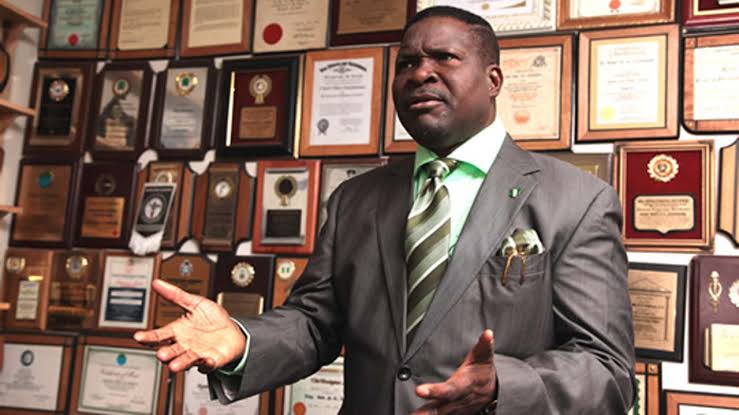
By Ike Augustine, Esq.
The exposure by VeryDarkMan concerning the alleged organ-harvesting operation in Abuja is mind-blowing and should compel Nigerians to ask much deeper questions than simply whether a kidney was removed or how much the donor was paid.
Even assuming, for the sake of argument, that some of the donors voluntarily consented and were paid ₦7 million, there is a fundamental question: can ₦7 million reasonably compensate a person for surrendering one of his kidneys?
A kidney is not a commodity that can simply be replaced when the money is exhausted. Once a healthy person donates a kidney, he is left with one functioning kidney for the rest of his life. The vast majority of living kidney donors can live healthy lives with one kidney, but donation is nevertheless a major surgical procedure with potential short- and long-term risks. The donor therefore deserves far more than a conversation about the immediate cash payment.
What happens when the ₦7 million is spent?
What happens if the remaining kidney subsequently develops serious disease?
Who bears the cost of future medical monitoring and treatment?
Can the ₦7 million buy another kidney if the donor eventually develops kidney failure?
Obviously not.
And this is where the issue of exploitation and undue influence becomes extremely important.
If a desperately poor young man is offered ₦7 million to surrender an organ while the intermediary who brought him into the arrangement allegedly makes substantially more money, we must ask whether the donor’s consent was truly free and informed or whether his poverty was effectively used as leverage.
There is also a disturbing economic imbalance in the alleged arrangement.
Reports surrounding the Abuja case contain allegations that organs obtained from vulnerable persons could subsequently be sold for tens of millions of naira, while the alleged donors received only a fraction of that amount.
That raises the obvious question:
Who is actually profiting from the human organ?
If the person who permanently loses an organ receives a relatively small fraction of the eventual economic value generated from that organ, while intermediaries and other actors make enormous profits, then what we may be looking at is not merely an organ donation arrangement but a potential commercial exploitation of vulnerable human beings.
More importantly, Nigerian law does not treat the human body as an ordinary commercial marketplace.
The National Health Act prohibits the commercialisation of human organs. Financial reward to a donor is generally prohibited, subject to reimbursement of reasonable costs incurred in connection with the donation.
The Federal Government’s 2025 transplantation guidelines similarly emphasise voluntary and informed consent and prohibit organ trafficking and commercial dealings in human organs.
So the legal question is not simply:
“Did the donor agree?”
The more important questions are:
How was that consent obtained?
Was the donor properly informed of the medical risks and lifelong consequences?
Was the donor economically or psychologically coerced?
Was there an intermediary?
How much did the intermediary receive?
How much did the recipient pay?
Who negotiated the transaction?
Was the donor independently represented or advised?
Was the donor given adequate time and opportunity to withdraw?
Was the procedure conducted in an authorised facility under the applicable regulatory framework?
And perhaps most importantly:
Was this genuinely a voluntary donation, or was it a commercial transaction disguised as a donation?
The allegation that some victims are now complaining that they were paid “peanuts” because the money they received has been exhausted is particularly revealing.
It exposes the fundamental problem with commodifying human organs: the money is temporary; the loss of the organ is permanent.
A person can finish ₦7 million in months or years. He cannot grow another kidney when the money is gone.
That is why the investigation should go beyond the individual doctors.
The alleged middlemen, recruiters, financiers, hospitals, recipients, brokers and beneficiaries of the proceeds should all be investigated.
If the allegations are established, this should not be treated merely as a case of questionable medical practice. It could potentially involve a network of organ trafficking, exploitation of vulnerable persons, undue influence, fraudulent recruitment and financial racketeering.
At the same time, we must be careful not to pronounce anyone guilty before the investigation and judicial process establish the facts.
But one thing is already clear:
A poor person’s desperation must never become the marketplace in which his body is bought and sold.
The real test of a lawful organ-donation system is not merely whether a signature was obtained or money changed hands.
It is whether the donor’s consent was free, informed, voluntary and protected from exploitation.
That is the conversation Nigeria should now be having.
Ike Augustine, Esq.
The views expressed by contributors are strictly personal and not of Law & Society Magazine.