By Sylvester Udemezue
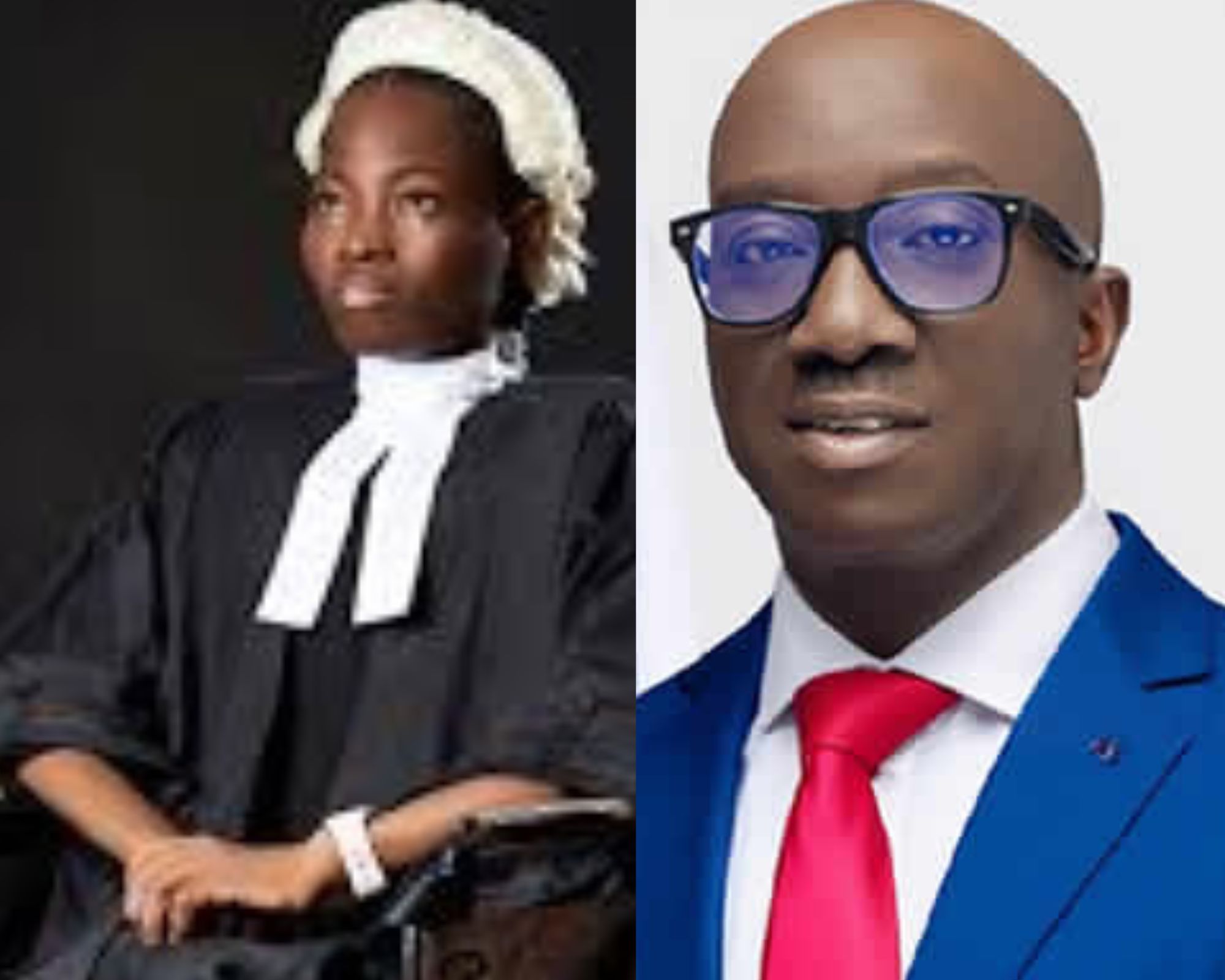
The recent news report under the title, “Governor Okpebholo Approves Appointment of Physically-Challenged Lawyer, Ms. Kindness Ikponmwosa Idahosa” (12 December 2025) has generated conversation across the public space, not because the employment itself is inappropriate, but because of the manner and framing of the communication.
Ms. Idahosa is a brilliant and accomplished young lawyer: a Second Class Upper Law graduate of the University of Benin (2023), a successful alumna of the Nigerian Law School (2024), and a lawyer duly called to the Bar in September 2025. She earned her place in the legal profession through hard work, discipline, and intelligence. Like every other qualified lawyer in Edo State (or anywhere else in Nigeria) she is fully entitled to apply for and secure employment in the Ministry of Justice.
MY INITIAL REACTION WAS SIMPLE AND DIRECT:
“Employed as a law officer in the Ministry of Justice? Why, then, is the government publicising it as though it were a political appointment? Is she not entitled to apply for (and secure) employment just like any other qualified lawyer? Must routine civil-service recruitment be elevated into “breaking news”?
These questions were not raised to diminish Ms. Idahosa, whose achievements deserve respect. Rather, they were raised to interrogate the governance rationale behind the personalised and sensationalised nature of the announcement.
PUBLIC COMMUNICATION vs. POLITICISATION: A NECESSARY DISTINCTION
It is important to distinguish between ordinary transparency in recruitment and the politicisation of a routine administrative process. There is a clear and meaningful difference between:
- “The Governor approves the employment of additional legal officers in the Edo State Ministry of Justice.” (This is proper public communication: normal, neutral, administrative, transparent).
and
- “The Governor approves the employment of a physically-challenged lawyer, Ms. Kindness Ikponmwosa Idahosa, as a legal officer.” (This is a personalised, selectively amplified announcement that raises important governance questions).
If the goal were transparency, the announcement would focus on the recruitment exercise, not on one individual applicant. Thus, several legitimate questions arise:
- Was Ms. Idahosa the only lawyer employed under this administration?
- If others were also recruited, why were their names not publicised?
- If only her name was highlighted, is it because of her physical condition?
- If so, does this not risk treating her employment as a spectacle rather than a normal exercise of merit?
- Does the announcement imply that employing a physically-challenged lawyer is an accomplishment for the Governor?
- If the government considers her employment a special privilege, does that not amount to indirect discrimination contrary to constitutional principles?
- Is the messaging unintentionally suggesting that she was hired as an act of sympathy rather than competence?
- Has the Governor publicised the names of all civil servants employed since assuming office? If not, why single out this one case?
These are not trivial concerns. They go to the heart of governance ethics, public perception, inclusion, and dignity.
THE DANGER OF TOKENISM IN GOVERNANCE
True inclusivity demands that persons with disabilities be treated equally, not exceptionally, except where special assistance is required for accessibility, not publicity. To single out Ms. Idahosa’s employment for public spectacle, when she earned her qualifications through the same rigorous path as her peers, risks turning her into a symbol rather than a professional. It unintentionally reinforces the stereotype that persons with disabilities must be celebrated simply for participating, rather than for excelling, as she unquestionably has. Inclusivity is not tokenism.
And equality is not charity. If recruitment is to be publicised, let it be institutional, not personalised.
If transparency is the goal, let it be comprehensive, not selective.
GOVERNANCE SHOULD RISE ABOVE PETTINESS
Edo State (and indeed Nigeria) deserves leadership that prioritises substantive governance over cosmetic announcements. A government earns respect not by headline-chasing but by confronting the structural challenges facing the state. Governor Okpebholo’s attention would be far better applied to:
- Revitalising education through funding, teacher development, digitisation and infrastructure renewal.
- Upgrading public infrastructure, including roads, power, water, transportation systems, etc.
- Modernising healthcare, ensuring humane, reliable, and technologically improved service delivery.
- Strengthening agriculture as the backbone of food security and rural development.
- Genuine youth empowerment, through education, skills acquisition, ICT, science, and innovation, not through patronage, stipends, or political recruitment.
- Building strong, reliable, depersonalised institutions that deliver governance beyond the lifecycle of any administration.
- Reforming the justice sector through digitisation, improved facilities, increased funding, and recruitment of essential personnel
- Maintenance of peace, order and security.
- Promotion of the rule of law and separation of powers
A governor’s legacy is not built through personalised announcements about routine employment matters. Legacies are built through policies, institutions, infrastructural development, and transformative governance.
CONCLUSION
Nothing in this debate diminishes Ms. Idahosa. She is a shining example of resilience, brilliance, and professional worthiness. The concern lies not with her, but with a style of governance that turns routine administrative acts into political theatre. If inclusivity is the goal, let equality (not spectacle) be the method. If transparency is the objective, let consistency (not selective publicity) be the standard.
If dignity is the intention, let merit (not condition) be the focus.Governance must mature beyond symbolism. Edo State deserves leadership grounded in substance, discipline, and a commitment to building enduring institutions. A great leader is remembered not for momentary applause but for lasting impact.
Respectfully,
Sylvester Udemezue (udems)
Lawyer, Law Teacher and Proctor, The Reality Ministry of Truth Law and Justice (TRM).
08021365545.
[email protected], [email protected].
(12 December 2025)
The views expressed by contributors are strictly personal and not of Law & Society Magazine.