
Amid mounting tax controversies—and as household budgets are already stretched to breaking point—Nigerians will begin paying a 7.5 percent Value Added Tax (VAT) on selected banking services, including mobile transfers and USSD transactions, from January 19, 2026, following a new government-backed regulatory directive. The move expands Nigeria’s tax net deeper into everyday financial activity, hitting millions who rely on low-cost digital banking to survive rising living costs.
The new charge comes at a time when Nigerians are grappling with soaring inflation, higher fuel prices, stagnant wages and multiple levies across essential services, intensifying what many describe as a relentless squeeze on disposable income. For low-income earners, artisans and small traders—many of whom depend on USSD and mobile banking due to limited access to smartphones or stable internet—the tax effectively raises the cost of basic economic participation.
A notice sent to customers on Wednesday afternoon by Moniepoint informed users of the impending implementation of the VAT regime on certain electronic banking charges.
According to the notice, the development is tied to a directive from tax authorities mandating financial institutions to begin VAT collection and remittance.
“We would like to inform you of an upcoming government-endorsed regulatory change regarding Value Added Tax (VAT),” the notice stated.
It added, “From Monday, 19 January 2026, we are required to collect a 7.5% VAT, to be remitted to the Nigerian Revenue Service (NRS) (formerly known as the Federal Inland Revenue Service).”
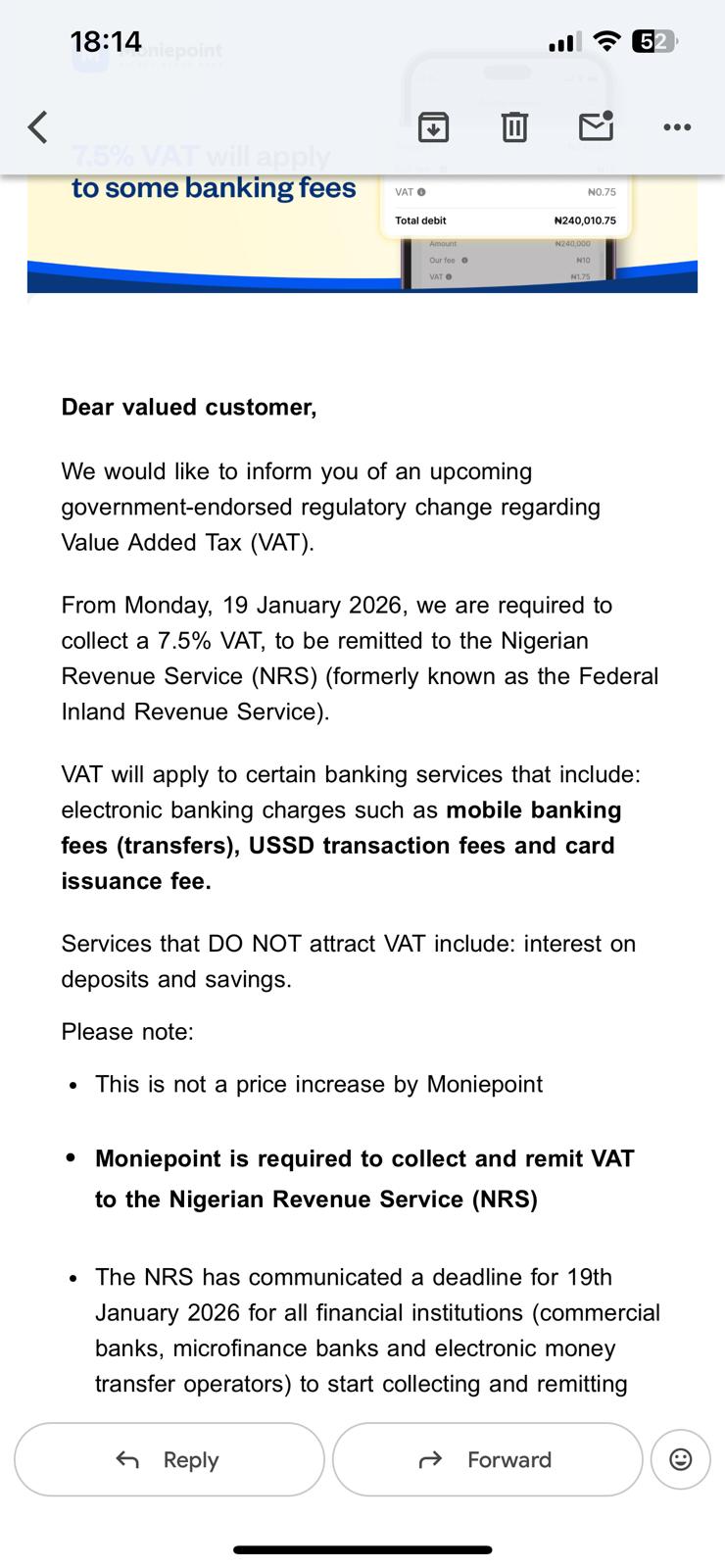
The company disclosed that the tax will apply to “certain banking services,” including “electronic banking charges such as mobile banking fees (transfers), USSD transaction fees and card issuance fee.”
However, Moniepoint clarified that not all banking-related transactions would attract the tax, noting that “services that DO NOT attract VAT include: interest on deposits and savings.”
The firm also distanced itself from responsibility for the new charges, stressing that “this is not a price increase by Moniepoint.”
“Moniepoint is required to collect and remit VAT to the Nigerian Revenue Service (NRS),” the notice read.
It further explained that the tax authority had issued a clear timeline for compliance across the financial sector.
“The NRS has communicated a deadline for 19th January 2026 for all financial institutions (commercial banks, microfinance banks and electronic money transfer operators) to start collecting and remitting VAT,” the statement said.
Moniepoint also emphasised that the VAT would be limited strictly to service charges, stating that “VAT applies only to banking or service fees, not interest.”
Customers were also informed that the deductions would be clearly itemised, as “VAT charge will appear separately on your transaction reports and statements.”
The new VAT enforcement is expected to affect millions of Nigerians who rely daily on mobile banking platforms and USSD services for financial transactions.
Critics argue that the policy underscores a growing disconnect between fiscal policy and social reality. While the government frames the VAT expansion as a revenue-boosting measure, citizens see it as yet another burden shifted onto the most financially vulnerable, reinforcing concerns that economic reforms are being financed from the bottom up—without visible efforts to cut waste or ease elite spending at the top.