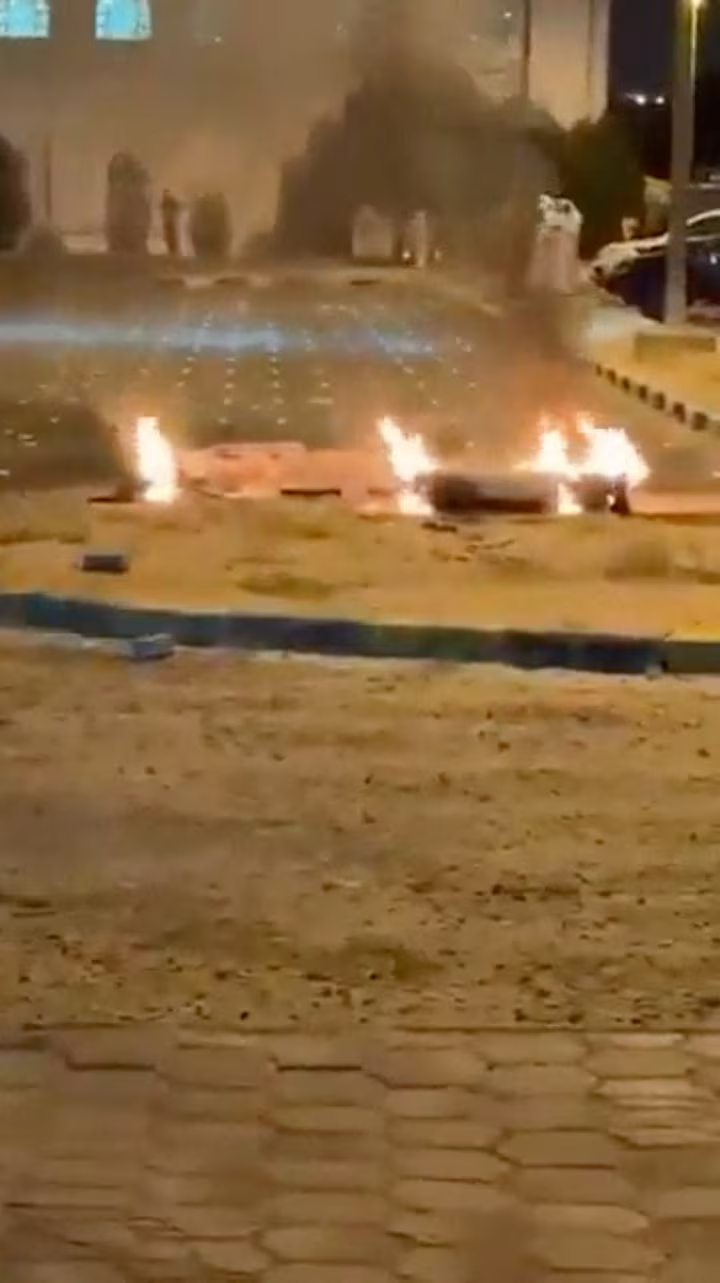
Hostilities flared again in the Gulf on Wednesday, June 3, 2026, with an Iranian missile attack severely damaging Kuwait’s international airport and the U.S. military carrying out retaliatory strikes near the Strait of Hormuz.
The sudden military escalation sent global oil prices climbing more than 1%, coming at a time when the broader conflict remains deeply stalemated under a shaky, nominal ceasefire.
Early Wednesday morning, an Iranian drone and missile attack struck the T1 passenger terminal building at Kuwait International Airport.
According to reports from Kuwait’s state news agency, citing civil aviation authorities, the assault caused significant structural damage to the facility and left several individuals injured.
In the immediate aftermath, Kuwait Airways suspended its operations, and aviation officials halted all incoming and outgoing flights, diverting airborne traffic to alternative regional hubs until further notice.
The airport strike was part of a larger, coordinated volley aimed at regional targets, though U.S. Central Command (CENTCOM) reported that the majority of the offensive operations ultimately failed:
Apart from the drones that successfully breached the airport, two Iranian missiles fired toward Kuwait fell short or broke apart mid-flight. American forces also downed several additional drones attempting to target U.S. troops stationed in the country.
Meanwhile, Bahrain’s military reported that its air defence systems successfully intercepted and destroyed three incoming missiles and a swarm of drones.
In regional waters, CENTCOM forces successfully shot down a number of Iranian drones that were actively targeting civilian merchant vessels.
Iran’s state media and the elite Islamic Revolutionary Guard Corps (IRGC) claimed they had successfully targeted and struck the high-profile headquarters of the U.S. Navy’s Fifth Fleet in Bahrain, alongside an unspecified regional airbase and helicopters. However, CENTCOM explicitly rejected these claims, stating that all attacks against American installations were entirely thwated.
The U.S. military responded swiftly to the barrage, launching targeted strikes on Qeshm Island, a heavily fortified Iranian military outpost and critical oil transit point situated directly inside the Strait of Hormuz. CENTCOM confirmed American forces destroyed an IRGC communications tower and a military station on the island, which had been utilized to coordinate the attempted drone and missile operations.
The military friction spilled over into the naval arena as well.
The IRGC’s navy claimed it launched a targeted missile strike against a vessel identified as the Panaya. Tehran stated this was direct retaliation for an American attack on an Iranian tanker near Hormuz, warning that “disrupting the security of the Strait of Hormuz will carry a heavy price for the U.S. military.”