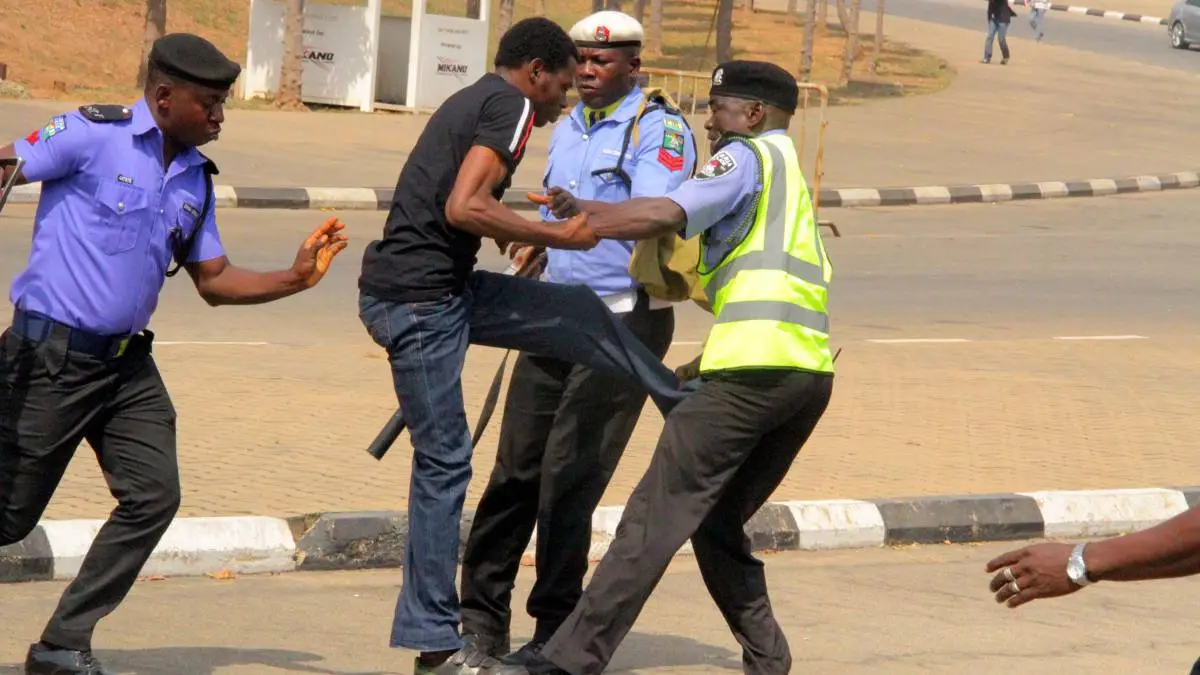
In recent weeks, reports of arrests and imprisonment of poor and homeless people in Lagos State, alongside the brutal assault of homeless children in Cross River State, have surfaced yet again. The justification is familiar: they are a nuisance, they constitute a threat to public order, they disturb the peace. But we must pause and ask a simple, piercing question—whose peace?
There is something profoundly unsettling about a nation that begins to fear the visible evidence of its own failure. Because what is being criminalised in Nigeria today is not nuisance, it is poverty, displacement, abandonment and perhaps most disturbingly, it is the audacity of the poor to exist in public view and in spaces they are reserved for the rich.
This incessant hunting of the poor and homeless has continued unabated despite the President’s famous speech, “Let the poor breathe, don’t suffocate them” during his inauguration in 2023.
Read Also: When citizens stop expecting govt.
Read Also: 3-year-old girl has intestines ripped out in freak pool drain accident and miraculously survives
When Poverty Becomes A Crime
Across parts of Nigeria, the machinery of the state is increasingly deployed not to protect the vulnerable, but to remove them from sight. Street sweeps, arbitrary arrests, detention of homeless persons—these actions are often framed as urban management or security measures. But beneath that language lies a dangerous shift: the reframing of poverty as deviance.
To be poor and homeless in Nigeria today is to risk being labelled a threat and a criminal. Children without shelter are not treated as individuals in need of care and protection, but as irritants to be cleared away. The irony is both painful and stark. The state, which has failed to provide even the most basic safety nets, now punishes those who have fallen through the cracks it created. This is not governance. It is abdication masquerading as order.
We must be clear: poverty is not a moral failing. Homelessness is not a crime. They are the predictable outcomes of systemic neglect of policies that have prioritised optics over welfare, control over care, and exclusion over inclusion.
What happened in Cross River State, where homeless children were reportedly assaulted under the guise of enforcement, should shake us to our core. Not because it is an isolated incident, but because it is emblematic of a deeper, more insidious violence: the violence of indifference.
When a society begins to see its most vulnerable members as disposable, it has crossed a moral line. The physical assault is only the visible tip of the iceberg. Beneath it lies a broader ecosystem of neglect, lack of access to education, healthcare, shelter, and protection. These children are not on the streets by choice. They are there because families are stretched beyond capacity. After all, systems have failed because opportunities are unevenly distributed and unevenly denied.
Yet, instead of compassion, they are met with force. Instead of protection, they are met with punishment. This is not just a failure of policy; it is a failure to see the humanity in those who do not fit neatly into the state’s vision of order.
Whose Peace, Whose Order?
The language of “public peace” is often invoked to justify these actions. But peace, in this context, appears to mean the absence of visible poverty rather than the presence of justice.
Whose peace is being protected when the poor are rounded up and detained? Whose comfort is being prioritised when children are beaten for sleeping in public spaces? Certainly not the peace of those who go to bed hungry, or those who wake up without a roof over their heads.
True peace is not the silence of the oppressed or the disappearance of discomfort from the sightlines of the privileged. True peace is rooted in dignity, equity, and justice. It is built on systems that ensure no one is left behind, not systems that punish those who are.
Nigeria’s growing inequality makes this contradiction even more glaring. On one hand, there is an increasing concentration of wealth and power. On the other hand, there is deepening poverty, widening precarity, and shrinking opportunity. In such a context, to speak of “public peace” without addressing structural inequality is to engage in a dangerous illusion.
A society cannot police its way to peace. It cannot arrest its way out of inequality. And it certainly cannot beat its most vulnerable into invisibility and call that order.
A Failed System
At the heart of this issue lies a fundamental truth: Nigeria does not have a functional social security system capable of protecting its most vulnerable citizens. There are no comprehensive safety nets for those who lose their livelihoods, no robust housing policies for those displaced, no coordinated support systems for children on the streets.
What exists instead are fragmented interventions, often reactive rather than preventive, and insufficient to meet the scale of need. In the absence of systemic support, individuals are left to fend for themselves in an increasingly unforgiving economic landscape. And when they fail, as many inevitably do, the state steps in not with support, but with sanctions.
This inversion of responsibility is both unjust and unsustainable. A government elected to serve its people cannot absolve itself of its duties by criminalising the consequences of its own failures. It cannot outsource accountability to the streets and then punish those who end up there.
If anything, the presence of homeless individuals in public spaces should be seen as a call to action and a visible indicator of systemic gaps that require urgent attention. To respond with repression is to silence that signal, not to solve the problem.
Let the Poor Breathe
There is a cruelty in denying people not only the means to live with dignity, but even the space to exist. To chase the poor from the streets without offering alternatives is to suffocate them slowly, invisibly, and deliberately.
Let the poor breathe. Let them exist without fear of arrest simply for being. Let children find shelter instead of suffering. Let poverty be addressed as a social and economic issue, not a criminal one.
This requires more than rhetoric. It demands a fundamental rethinking of governance priorities. Investment in affordable housing, social protection systems, child welfare services, and inclusive economic policies is not optional; it is essential. So too is a shift in mindset: from seeing the poor as problems to be managed, to recognising them as citizens deserving of rights and dignity.
There is also a role for society at large. We must resist the normalisation of these actions. We must question policies that prioritise appearance over substance, and we must hold leaders accountable for the systems they build or fail to build.
Ultimately, the measure of any society is not how it treats its most powerful, but how it treats its most vulnerable.
Nigeria stands at a crossroads. It can continue down the path of criminalising poverty, deepening divisions, and eroding its moral foundation. Or it can choose a different path, one that recognises that peace without justice is fragile, and order without compassion is hollow.
A failed system cannot blame the poor for its failures. It cannot wash its hands of responsibility and then point fingers at those it has left behind.
If we truly seek peace, then we must begin by restoring dignity. If we seek order, then we must build systems that work for all. And if we seek a future worth believing in, then we must, at the very least, let the poor breathe.
The views expressed by contributors are strictly personal and not of Law & Society Magazine.