By Abdulrauf Aliyu
In Nigeria, elections are not merely contests of ideas. They are deeply spiritual exercises in distribution. Not distribution of wealth in any structural or policy-driven sense, but the more immediate and culturally resonant act of sharing things that can be touched, cooked, worn, or, in moments of urgency, quietly sold before evening.
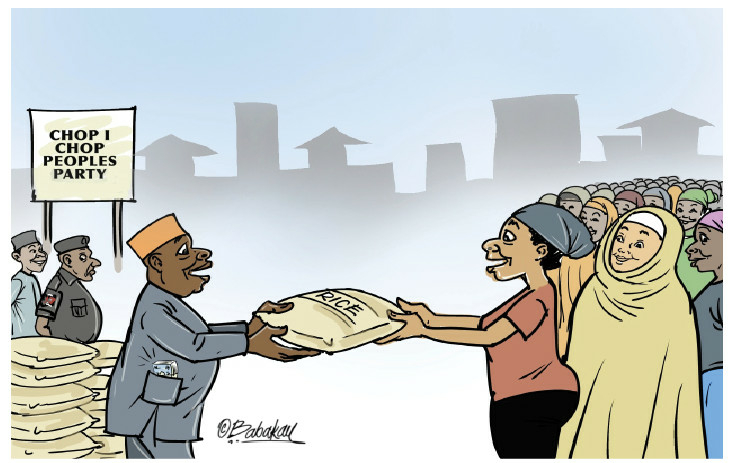
It begins quietly. A few bags here, a few wrappers there. Then it gathers momentum. Trucks appear like migrating birds, unloading their cargo of compassion into expectant hands. The atmosphere becomes festive. Music plays. Names are chanted. Photographs are taken with the seriousness of historical documentation, as if future generations will study these moments as turning points in national development.
The items themselves have undergone steady innovation. There was a time when a bar of soap was considered a respectable gesture. Then came spaghetti, slender and symbolic, suggesting both nourishment and modernity. Now, the two-kilogram bag of rice stands as the gold standard of electoral diplomacy. It is large enough to impress, yet small enough to distribute widely.
One almost expects a national honours list dedicated to those who have advanced the science of election-season generosity, complete with medals shaped like cooking pots.
The Science of Stomach Infrastructure
The phrase “stomach infrastructure” has entered the political vocabulary with remarkable ease, as if it were always there, waiting to be discovered. It sounds technical, almost like a line item in a national budget. One imagines committees debating its allocation, experts presenting data, and policymakers nodding gravely while pretending not to understand the arithmetic.
In practice, it is much simpler. It is the recognition that while roads may take years to build, hunger operates on a daily schedule. A citizen may not see a bridge completed within a political term, but he can certainly see a bag of rice emptied within a week, sometimes sooner if relatives visit unexpectedly. The immediacy is persuasive.
Politicians understand this with admirable clarity. Why invest solely in promises that require time, coordination, and the cooperation of multiple institutions when one can also invest in something that produces instant gratitude? It is not an either-or decision, of course. It is simply that one option photographs better and guarantees applause without follow-up questions.
Voters, for their part, are not participants in this exchange by accident. They understand the value of what they receive. The rice is real. The fabric is tangible. The cash, when available, is refreshingly unambiguous. These are not theoretical benefits. They are not subject to bureaucratic delay or committee review.
It is a system built on mutual understanding, even if it leads to outcomes that everyone later claims to regret while standing in longer queues.
A Masterclass in Optimism
Alongside the distribution of goods comes the distribution of optimism. Campaign speeches in Nigeria are exercises in confident forecasting. Security will be restored. The economy will stabilise. Jobs will multiply with the enthusiasm of unpaid interns who never resign.
One cannot help but admire the certainty. It suggests a level of control over events that would impress even the most seasoned historians and perhaps confuse reality itself. If one did not know better, one might assume that governance is a straightforward process, occasionally delayed only by the absence of the right individual with enough conviction.
History, however, has a habit of complicating such narratives. Leaders across time have entered office with similar confidence, only to discover that reality is less cooperative than anticipated. Plans encounter resistance. Policies produce unintended consequences. Timelines stretch like elastic bands under pressure.
Yet this does not diminish the quality of the promises. If anything, it enhances them. After all, a promise that acknowledges difficulty is less exciting than one that assumes it away entirely and replaces it with applause.
The Logistics of Belief
What makes this system particularly effective is not merely the distribution of goods or the articulation of promises. It is the logistics of belief. Elections require a certain suspension of disbelief, a willingness to accept that this time, the outcome will differ significantly from previous iterations, despite familiar faces and familiar speeches.
This belief is not entirely irrational. Each election does, in fact, produce change. New individuals assume office. Policies shift, sometimes subtly, sometimes more visibly. The system evolves, even if not always in the ways initially imagined or advertised on campaign banners.
The challenge lies in the scale of expectation. When promises are expansive and timelines compressed, the gap between expectation and outcome widens into something almost architectural. This gap is then filled with explanations, justifications, and, occasionally, new promises that sound remarkably like the old ones with minor adjustments.
Meanwhile, the rice has been consumed, the fabric has faded, and the cycle prepares to repeat with admirable discipline and coordination.
An Economy of Small Decisions
It is tempting to view this entire process as a grand deception, but that would overlook its more interesting feature. It is sustained not by a single act of manipulation, but by millions of small decisions made by individuals acting within their circumstances and constraints.
A voter accepts a bag of rice because it provides immediate value. A politician distributes it because it yields immediate support. Neither action, taken alone, explains the broader outcome. Together, they create a pattern that persists over time with the reliability of a national tradition.
This is the quiet engine of the system. It does not rely on grand conspiracies or secret meetings. It operates through incentives that are visible to all participants and quietly accepted. Changing it would require altering those incentives, a task that is considerably more complex than delivering another truckload of goods with branded stickers.
A National Diet of Irony
There is, undeniably, a comic element to all of this. A nation of over two hundred million people, rich in resources and ambition, periodically reduces its political discourse to items that can fit into a shopping bag and be consumed before the week ends. It is a scene that invites laughter, if only to manage the alternative.
Yet the humor carries an edge. The same system that produces these moments also shapes governance outcomes in ways that are less amusing. Decisions influenced by short-term exchanges have long-term consequences that do not arrive with music or applause.
It is a bit like paying for a lifetime subscription with a one-time discount voucher. The savings feel immediate. The bill arrives later, usually with interest and no option for refund.
The Final Distribution
As the election approaches, preparations will intensify. More trucks will be loaded. More speeches will be written. More assurances will be delivered with unwavering confidence and carefully rehearsed sincerity.
Citizens will gather, observe, accept, question, and decide. Some will take the rice and vote according to their broader judgment. Others will align their votes with the generosity received. Many will do a combination of both, navigating the situation as best they can, balancing principle with practicality.
In the end, the two-kilogram bag of rice is not just a symbol of electoral strategy. It is a mirror. It reflects a political culture shaped by immediacy, constraint, adaptation, and a certain pragmatic acceptance of how things work, even when everyone knows they could work better.
The views expressed by contributors are strictly personal and not of Law & Society Magazine.