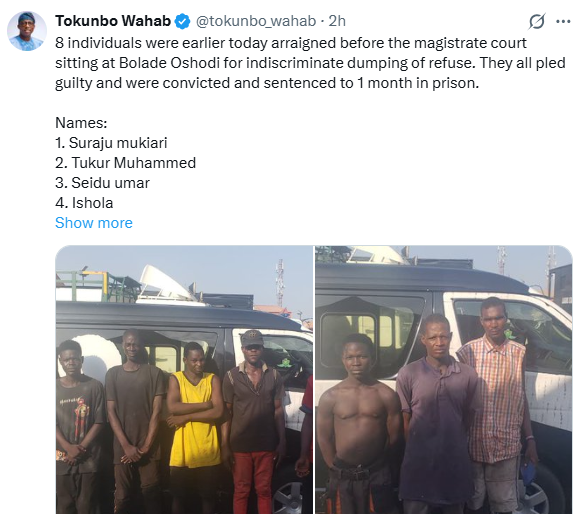
Lagos, Nigeria — Eight residents of Lagos have been sentenced to one month in prison for indiscriminate waste disposal, a move that has reignited debate over Nigeria’s strained correctional system and its reliance on incarceration for minor offenses.
The convicts — Suraju Mukiari, Tukur Muhammed, Seidu Umar, Ishola Jimoh, Goodluck Osigbo, Yusuf Abubakar, Mustapha Musa, and Immam Muhammed — were arraigned on Sunday at a magistrate court in Bolade, Oshodi. According to Lagos State Commissioner for Environment and Water Resources Tokunbo Wahab, all eight defendants pleaded guilty and were immediately convicted and sentenced.
The swift sentencing has drawn renewed scrutiny to Lagos State’s aggressive sanitation enforcement policies, which authorities say are necessary to combat widespread environmental violations in Africa’s most populous city.
But the case has also exposed deeper tensions within Nigeria’s criminal justice system — particularly the heavy reliance on custodial sentences for low-level offenses at a time when the country’s prisons are already buckling under severe overcrowding.
A Prison System Under Extreme Pressure
Nigeria’s correctional facilities currently hold more than 80,000 inmates nationwide, according to 2026 figures, with an estimated 64 to 67 percent awaiting trial — some for years without conviction.
Reports from the Nigeria Correctional Service (NCoS) paint a stark picture of systemic collapse: facilities designed for far fewer occupants are routinely stretched far beyond capacity, forcing inmates into extreme living conditions, including sleeping in shifts or standing due to lack of space.
In some facilities, overcrowding has reached such levels that basic hygiene and healthcare are severely compromised, contributing to disease outbreaks and elevated mortality risks. Funding shortages have also left daily feeding allowances for inmates critically low, further intensifying concerns about humane treatment standards.
Critics Question Justice Priorities
The Lagos convictions have intensified criticism from legal observers and rights advocates, who argue that Nigeria’s justice system is increasingly punitive toward petty offenders while failing to adequately prosecute more serious economic and corruption-related crimes.
Some critics say this imbalance reflects a deeper systemic failure — one in which non-custodial sentencing options such as community service, fines, or restorative justice programs are underutilized, despite being designed specifically to ease prison congestion.
They warn that sending low-level offenders into already overcrowded prisons risks hardening minor offenders while worsening institutional strain.
At the same time, broader public frustration persists over perceptions that major financial crimes and alleged corruption cases often move slowly through the courts, or result in delayed accountability.
A System at a Breaking Point
With more than half of Nigeria’s prison population awaiting trial and infrastructure operating far beyond intended capacity, the country’s correctional system is widely viewed as overstretched and under-resourced.
Officials have acknowledged the pressure, with the Nigeria Correctional Service seeking increased funding to upgrade facilities and manage rising inmate numbers. But reform advocates argue that without faster judicial processes and wider adoption of non-custodial sentencing, overcrowding will continue to worsen.
For now, cases like the Lagos convictions underscore a growing national dilemma: how to enforce urban order without further burdening a prison system already nearing breaking point.