From the Food, Memory and Healing Series, By Kirsten Okenwa
I fell in love with Louisiana state, USA, long before I ever set foot in it. It began with stories. Through novels and quiet virtual wanderings, I found myself drawn to its towns and parishes, places like Lafayette, Baton Rouge, and New Orleans. But one place stayed with me more than the others, Breaux Bridge, a small town known as the Crawfish Capital of the World.
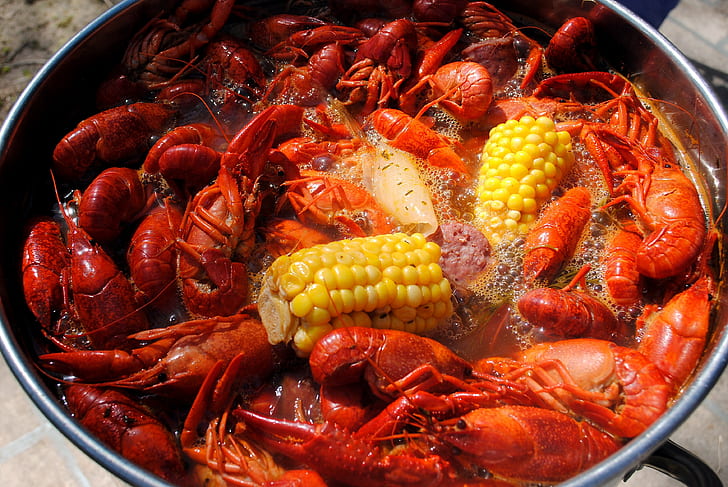
It was easy to imagine myself strolling through the town on food tours, enjoying crawfish served in every possible way, music and laughter filling the air, and joining the annual crawfish festival that gathers people from near and far to celebrate not just food, but culture. It felt like a place where cooking is not simply sustenance, but continuity. I was drawn to that, to the idea of food as memory, as gathering, as something that holds people together.
The more I learned, the more Louisiana revealed itself as a place deeply shaped by land. Agriculture is not incidental here, it is foundational. Fertile delta soils support the cultivation of sugarcane, rice, sweet potatoes, cotton, and pecans, and the state leads in the production of crawfish, shrimp, oysters, and even alligators. Across its parishes, farming is not just an occupation, it is an economic backbone and a way of life. There is a rhythm to it, a continuity between land, labour, and livelihood that is difficult to ignore. In places like New Orleans, even environmental restoration takes on an agricultural dimension, with discarded Christmas trees repurposed to rebuild wetlands, protect fragile coastlines, and create habitats for birds, fish, and crustaceans. It is a system that, at its best, nourishes.
But somewhere along this journey of admiration, I encountered something that unsettled me. Within the same state that celebrates food, land, and agricultural abundance lies Louisiana State Penitentiary, a place where the relationship between land and labour takes on a very different meaning. Angola is the largest maximum-security prison in the United States, situated on land that was once a slave plantation and named after Angola in Africa, where many of the enslaved people who worked that land were taken from. Today, many of those incarcerated there, the majority of whom are Black men, work the same fields, planting and harvesting crops under conditions that, in many accounts, echo the past more than they depart from it.
Formerly incarcerated individuals have described long hours under the sun, minimal pay, and harsh oversight. Some speak of men collapsing from heat exhaustion, while others describe the pressure to continue working despite illness or physical limitation. One former prisoner, Lamont Gross, recounted seeing men suffer heat stroke in the fields, and Mwalimu Johnson, who spent years incarcerated at Angola, described the prison as a sophisticated plantation. The continuity is difficult to ignore. Land that once extracted labour through slavery continues, in another form, to demand labour from those with limited freedom to refuse.
This is where my admiration paused, because I found myself holding two truths at once. On one hand, a place like Breaux Bridge, where food is culture, memory, and community. On the other, Angola, where land and labour exist within systems of control and constraint. Both are part of Louisiana, and it would be easy to separate them, to celebrate one and ignore the other, but they are connected. They share soil, they share history, and they are shaped by the same land, which raises difficult questions. What does it mean for a place to be celebrated for its food systems while parts of that system are rooted in exploitation? Can land nourish and oppress at the same time? What does dignity look like in agricultural labour?
To be clear, not all prison agriculture operates under the same conditions. Across the United States, some correctional facilities run agricultural programs aimed at rehabilitation, where individuals gain skills in farming, participate in food production, and in some cases contribute to systems that feed prison populations or surrounding communities. There are examples of programs that aim to be restorative, where growing food becomes a pathway to learning, responsibility, and even healing.
But there are also critiques. Scholars and researchers have pointed to the ways prison agriculture can oscillate between rehabilitation and exploitation, where what is presented as skill-building can, in certain contexts, reproduce unequal power dynamics, particularly when labour is poorly compensated or conditions are harsh. The line between meaningful work and coercion is not always clear.
As someone drawn to food systems, these tensions matter to me, because food is not just about what we eat, it is about how it is grown, who grows it, under what conditions, and with what level of dignity. My connection to Louisiana began with stories of food, community, and land, but it deepened when I encountered its complexities. It reminded me that food systems are never neutral. They carry history, reflect power, and reveal both care and harm.
I have not yet been to Louisiana, but it has already shaped how I think. It has sharpened my understanding that advancing food systems must go beyond productivity and abundance, and must also include dignity, fairness, and restoration. A truly nourishing system is not only one that feeds, it is one that does not harm the people who make that feeding possible.
Perhaps one day, I will walk through Breaux Bridge and sit at a table where food is shared slowly and stories move as easily as the dishes passed around. And if I do, I will carry with me not just admiration for what is visible, but an awareness of what lies beneath, because to truly engage with food, land, and memory, we must be willing to hold both; the pot, and the prison.
Kirsten Okenwa writes on food, memory, livelihoods, and community life, with a growing focus on legumes, tisanes, indigenous foods, and rural African food systems.