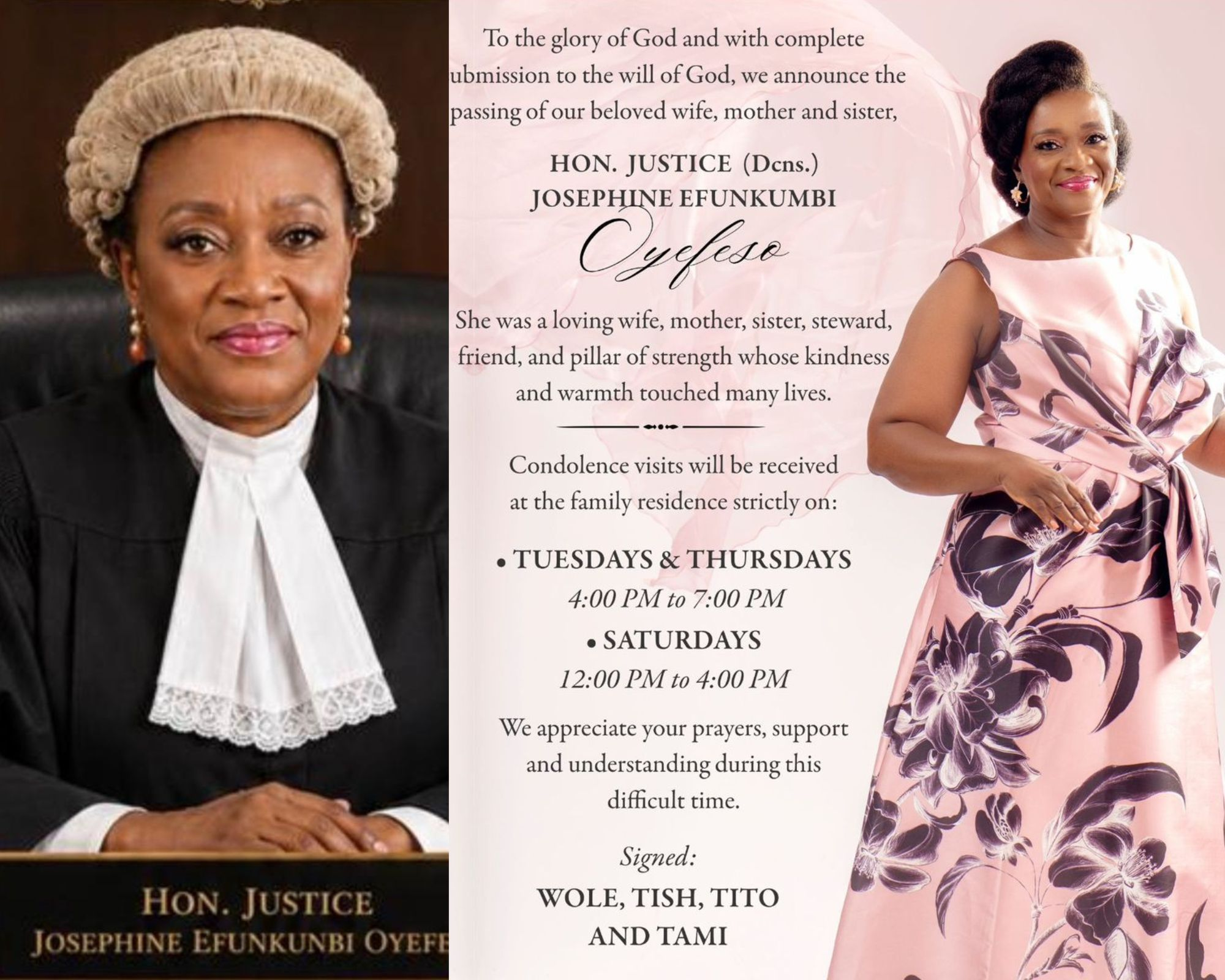
The Nigerian legal community has been thrown into mourning following the sudden death of Honourable Justice Josephine Efunkunbi Oyefeso of the Lagos State High Court, Eti-Osa Judicial Division, whose passing on May 15, 2026 has triggered an outpouring of grief across the Bench, Bar and wider judicial circles.
In an emotional condolence message, the Nigerian Bar Association (NBA), Eti-Osa Branch, described her death as a devastating blow not only to the Lagos judiciary but to the entire legal profession, portraying the late jurist as a rare figure whose influence extended far beyond the courtroom.
“To the members of the NBA Eti-Osa Branch, Her Lordship was more than a Judge; she was a guardian, mentor, motherly figure and pillar of support,” the branch said in a statement signed by its Chairman, Olanrewaju Obadina.
The branch said Justice Oyefeso embodied integrity, diligence, compassion and an unshaken commitment to justice, noting that she remained deeply invested in strengthening the justice system until her final days.
Her death has reignited conversations within legal circles about the immense institutional memory and mentorship often lost when senior jurists pass away unexpectedly.
Widely respected for her calm disposition and intellectual depth, Justice Oyefeso built a reputation as one of Lagos State Judiciary’s most versatile and reform-minded judges. During her decades on the bench, she handled matters across Commercial, Criminal, Civil, Family and Lands divisions, while also serving as an Alternative Dispute Resolution Judge and immediate past Chairman of the Lagos Multi-Door Courthouse Governing Council.
Her judicial career began in 2001 after years in legal practice and the corporate sector. Following her call to the Nigerian Bar in 1986, she worked with Babalakin & Co. before moving into banking, where she rose to become Company Secretary and Legal Adviser.
Justice Oyefeso’s educational journey reflected the international pedigree that later shaped her legal philosophy. She earned a Bachelor of Arts degree in History from the University of Lagos, obtained an LLB from the University of Warwick in the United Kingdom, and later completed an LLM at the University of Lagos.
Beyond adjudication, she became a visible advocate for inclusion, mediation and women’s advancement within the legal profession.
Only months before her passing, Justice Oyefeso participated in an international webinar organised by the National Association of Women Judges of Nigeria in collaboration with the International Association of Women Judges. The event focused on work-life balance, accessibility in court systems and the structural barriers confronting women in law.
At the conference, she led discussions on maternity leave, caregiving responsibilities, career interruptions and institutional reforms needed to support female legal professionals. Colleagues say her interventions reflected the same empathy and reformist thinking that defined her years on the bench.
A CEDR Accredited Mediator and Fellow of the Institute of Chartered Mediators and Conciliators, she was widely regarded as a bridge-builder who consistently pushed for fairness, dialogue and accessible justice.
Within the Eti-Osa Judicial Division, lawyers recalled a judge whose courtroom combined firmness with humanity and whose relationship with the Bar helped foster mutual respect rather than hostility.
“She carried herself with grace and humility while continuously fostering cordiality between the Bench and the Bar,” the NBA Eti-Osa Branch stated.
As condolence visits continue, tributes from judges, lawyers, colleagues and former associates have continued to pour in, many describing her passing as the end of an era.
For many within Nigeria’s legal establishment, Justice Oyefeso represented a generation of jurists who saw law not merely as procedure, but as service.
Her death leaves behind not just grieving colleagues and loved ones, but also unresolved questions about succession, mentorship and the growing emotional strain within Nigeria’s overburdened justice system.
Though the courtroom seat she occupied now stands empty, her imprint on Lagos’ legal history appears certain to endure.