


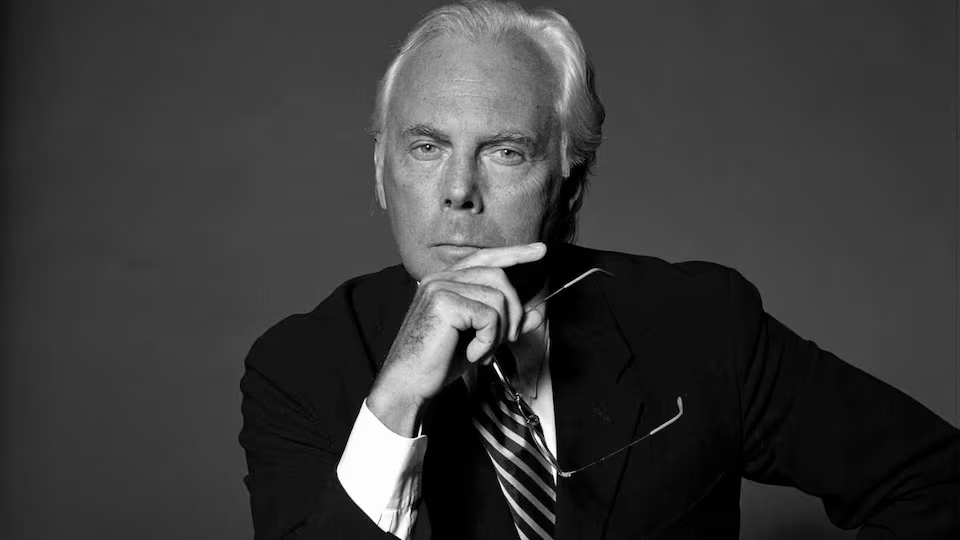
The Italian brand owner whose fluid suits reinvented power dressing and ultimately led to a global brand worth billions.
The Times
Giorgio Armani was not merely the most commercially successful clothes designer of the late 20th century, but also a prime mover in the revolution that transformed fashion from the preserve of an elite into an all-pervasive commodity targeted at the many.
When Armani presented his first collection in 1975, there still remained a rigid division between what was regarded as high fashion and all other clothing, which, apart from trends in the new youth sector, was largely utilitarian. Celebrated designers made their names and fortunes by concentrating on couture; one-off garments tailored by hand for a select, well-heeled clientele. What was seen on the catwalk would influence the mass market, but few women could hope to own a piece that bore a designer’s name.
Armani, however, had little interest in couture; he did not stage a show of it until 2005. This was perhaps because he had never formally trained as a designer, coming to fashion instead through jobs as a window dresser and menswear buyer at a Milan department store. From the start, his focus was the customers he had encountered there, the smartly turned out middle class that bought ready-to-wear or, in Italian, pronta moda.
Having grown up under the fascist government of Benito Mussolini and then having lived through the social changes of the Sixties, Armani had a dislike for clothing that resembled a uniform and imposed conformity. Accordingly, when he began to design, he turned his attention first to that emblem of male hierarchy, the suit.
In a radical innovation that became his signature style, Armani dispensed with the jacket’s traditional construction — the shoulder padding, stiffeners and linings that gave it an air of martial authority. Then he narrowed the lapels, lengthened the coat, moved the buttons and enlarged the pockets. What emerged was a fluid and relaxed look, a suit that, in his words, “gives confidence without defining personality”.
As he was quick to appreciate, this was an image sought by a vast new group of customers: working women. Made in neutral colours and cut generously rather than close to the body, his clothing projected a feminine identity appropriate to the office, and in the Eighties his so-called power suits became a staple of many a female executive’s wardrobe. “I realised that they [women] needed a way to dress that was equivalent to that of men,” he said. “Something that would give them dignity in their work life.”
The consumerist boom of that decade, and the aspirational way of life that remained its most potent legacy, were central to the business’s rapid expansion. Ironically, it was a film which pointed up the emptiness of materialism — American Gigolo (1980) — that made a star as much of Armani’s clothes for men as it did of the actor wearing them, Richard Gere. Armani was quicker than others in grasping the value to be had in associating his brand with celebrity, the popular embodiment of success, and was the first designer to open a public relations office in Hollywood.
Before long, the Armani name was among the most recognisable and visible in what was becoming for the first time an industry with global reach. By the early Eighties, he had established lower-priced lines, such as Emporio Armani and Armani Jeans, which aimed at volume sales rather than exclusivity. It was an approach that inverted the received wisdom of fashion, but by offering an affordable taste of the good life to the newly flush professional classes and the young, it showed how fashion might greatly broaden its appeal and influence.
Much later, Armani himself would complain that the fame of his models (such as David and Victoria Beckham) had come to overshadow what it was they were endorsing. Yet without doubt, the glamorous yet narcissistic images created for his media campaigns had played their part in the rise of a culture that worshipped the superficial. The conspicuous display of brand logos, much associated with Armani, was perhaps only its most obvious manifestation.
It was a moot point to what extent fashion and its handmaiden advertising had fuelled, or simply responded to, this desire to be sold expensive dreams. Certainly, Armani had done no more than his rivals, such as the conglomerate Louis Vuitton Moët Hennessy, and often with less vulgarity, in taking advantage of the forces at work — be it the economic awakening of Asia or the availability of easy credit — to give people what they craved.
By comparison with other designers, Armani was something of a paradox. If fashion is about defining the moment, then his clothes rarely strove to be fashionable. He experimented little once his brand was established, and he nearly always wore just a blue T-shirt and white or black trousers. He called such conservatism “consistency”, and he was perhaps correct in deducing that his customers bought Armani more for the spirit that the clothes expressed than for their cut. Again, however, it was revealing that someone who had sold the world on a vision of easygoing Mediterranean style should in person be very much a northern Italian, an austere perfectionist driven by a relentless work ethic.
The second of three children, Giorgio Armani was born in 1934 in Piacenza, 45 miles southeast of Milan. His father, Ugo, was an accountant for a haulage company, but it was his strict mother, Mariù, who did more to mould him. Both had what he described as “a simple elegance”. He grew up during the Second World War, when the family often had little to eat and regularly had to take shelter from Allied bombing raids. “War,” he once said, “taught me that not everything is glamorous.” His father was later imprisoned for nine months on account of his membership in the Republican Fascist Party.
As a teenager, Armani was severely injured when he and a group of friends flung a bag of explosives that they had found on to a fire. He lost his hair (which grew back straight rather than with its previous curls), and for three weeks he had to lie in bed with his eyes closed. His sight was never again perfect, and afterwards he often wore sunglasses, even indoors, to shield himself against strong light.
His initial ambition was to become a doctor, and for three years he studied medicine at the University of Milan. A period spent at an army hospital while undertaking military service scotched this inclination, and he turned instead to photography. With some pictures of his sister that he had taken, he approached La Rinascente, Milan’s leading department store, and soon found himself working on its window displays.
By the mid-Sixties, he had been taken on by a contemporary of his, Nino Cerruti, to revamp the latter’s Hitman menswear range. Cerruti later denied any suggestion that he had “discovered” Armani; Armani, he said, “discovered himself… men like Armani are so rare that, when one emerges, even the blind are aware of it.”
It was while with Cerruti that Armani learnt the economics of fashion — how saving an inch of fabric tots up on an order for 1,000 pairs of jeans. No less important, however, was his meeting at the same period with Sergio Galeotti, an architectural draughtsman who would become his partner in both his private and professional life.
It was Galeotti who, in 1973, persuaded Armani to set up as a freelance designer and to open an office in Milan. They formed the fashion company together two years later. Although at first it only supplied the ideas rather than controlling production, Galeotti negotiated a contract with their manufacturer that gave the pair an unprecedented level of supervision over such ready-to-wear clothing.
The company had early success in America. In 1982, Armani refused to show for a season as a protest against criticism of a collection of his inspired by the work of the Japanese director Akira Kurosawa (together with neo-realist cinema, Oriental minimalism was one of his chief influences). As a result, Time magazine featured him on its cover, and sales in the US tripled in a year. The relative informality of Armani’s suits appealed to those who otherwise felt uncomfortable wearing one, such as Americans; they also became seemingly ubiquitous in the media and entertainment professions.
After Galeotti’s death from Aids in 1985, Armani grew more introspective. He later reflected how, “Sergio made me believe in myself. He made me see the bigger world” and when asked in a rare interview about the greatest failure of his career he replied: “Not being able to stop my partner dying.” Yet to the surprise of many, even this personal loss failed to halt the business’s expansion. Unlike most designers, Armani proved surprisingly adept at finance and asserted greater control over the company’s manufacturing capacity. The Nineties were marked by a growing diversification, into sunglasses, accessories, sportswear and even restaurants, such as above its store in Knightsbridge. In 1987, Armani supplied the costumes for the Prohibition-era film The Untouchables. Other notable clients of the period included the England, Liverpool and Chelsea football teams.
By 2001, the company’s turnover was $1.6 billion (Armani ultimately built a personal fortune of $12.1 billion). That year, he became the first living designer to be given a retrospective show at the Guggenheim Museum in New York, and in 2007 he was the first to broadcast a show live on the internet. As property and travel became the new touchstones of the middle classes, Armani set up a household goods division and, in 2010, opened a hotel in the Burj Khalifa, Dubai.
By its 35th anniversary in 2010, the business had 300 shops and several thousand other points of sale in 37 countries. Armani occasionally lamented that he had little time to enjoy the wealth it brought him, and noted that he was smiling in only a few photographs. He owned houses in St Tropez, Antigua and Manhattan, but was happiest at that on Pantelleria, a volcanic island south of Sicily.
In later years he treated himself to ever larger yachts, but when not travelling for promotional work spent most of his time in the studio above his store in Milan. Although essentially a modest man, and shy in public — he never learnt English fluently — he had a reputation for being an exacting employer who dictated rather than delegated. “Re Giorgio” (King Giorgio) remained chief executive and creative director of his company until his death.
He was seen frequently with his nieces and nephew, and had recently announced succession plans involving his niece Silvana and his long-term right-hand Leo Dell’Orco. However, he believed that the company which bore his name was now so synonymous with modern living that it would continue to prosper whoever was at the helm.
“Life,” he once said, “is a movie. And my clothes are the costumes.”👊🏽
Giorgio Armani, fashion designer, was born on July 11, 1934. His death at the age of 91 was announced on September 4, 2025
Culled from The Times








Giorgio Armani’s passing marks the end of an era—he wasn’t just a designer, but a visionary who redefined modern elegance and left a timeless legacy in fashion.