Accra’s refusal of MTN’s support for citizens evacuated from South Africa is more than a diplomatic gesture. It raises a larger West African question: when citizens are in distress, who should carry the bill—the state, or whoever is willing to help?
ACCRA — It was GH¢20 million—about US$1.79 million or ₦2.40 billion at current exchange rates.
But Ghana’s decision to turn it down has opened a much larger argument about what a government owes its citizens.
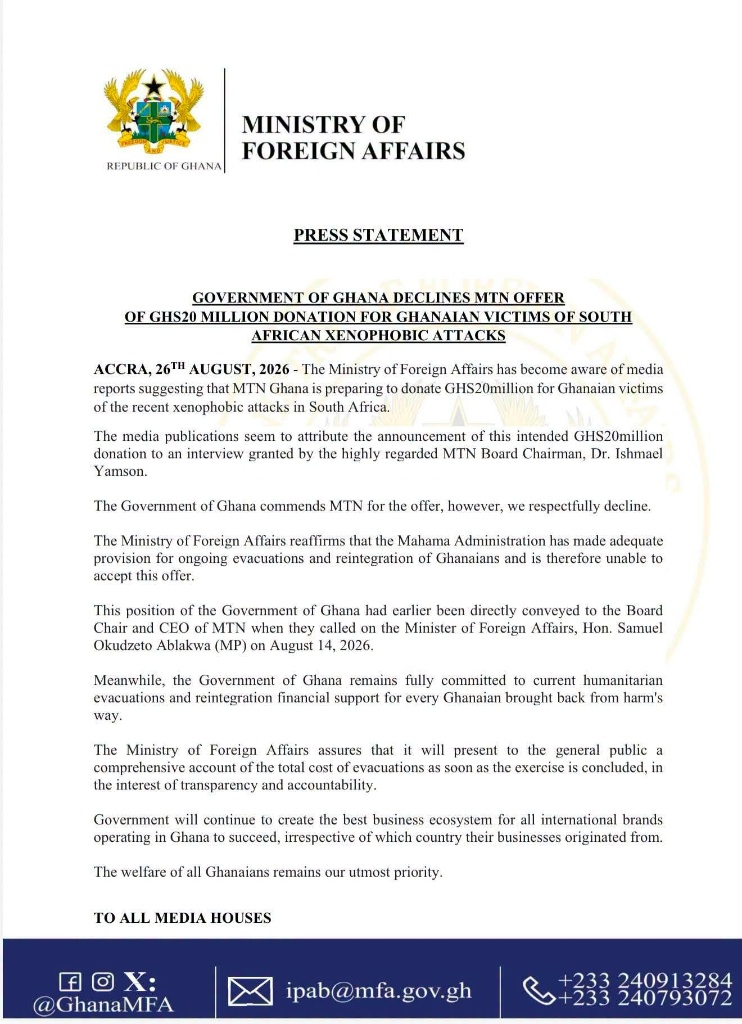
On Wednesday, Ghana declined a proposed GH¢20 million support package from MTN Ghana for citizens affected by the wave of xenophobic attacks in South Africa. The Ministry of Foreign Affairs said the government had already made adequate financial arrangements for the evacuation and reintegration of affected Ghanaians and therefore could not accept the offer.
The money was not being offered by an obscure organisation. MTN Ghana’s board chairman, Dr Ishmael Yamson, said the company initially set aside GH¢10 million (roughly US$894,000 or ₦1.20 billion) to welcome returning Ghanaians before doubling the amount and proposing a longer-term fund to help them rebuild their lives.
The gesture was generous.
Accra still said no.
There is something unusually confident about that response.
The Ghanaian government did not suggest that MTN’s offer was unwelcome. It commended the company and made clear that it would continue to support an environment in which international businesses could operate and prosper. Its objection was narrower: the government had already provided for the operation and would assume responsibility for it.
It also promised something that gives the decision greater significance. Once the evacuation exercise is completed, the Ministry said it would publish a comprehensive account of its total cost in the interest of transparency and accountability.
The message from Accra was therefore not that corporations should stay out of humanitarian crises.
It was that the existence of corporate generosity does not relieve the state of its own obligations.
That is a very different proposition.
A government paying its own bill
Ghana’s position becomes more interesting when the scale of the operation is considered.
The country has been conducting successive evacuations of citizens from South Africa following the attacks. By August 17, the government had received its 11th batch under the second phase of the evacuation programme, with 87 more Ghanaians arriving in Accra. Officials said the government would continue supporting their reintegration.
The programme has not been presented as a one-off rescue flight followed by a farewell at the airport.
Ghana has talked about evacuation and reintegration.
That second word is important.
Getting a frightened citizen out of a dangerous country is the immediate task. What happens after arrival is the harder measure of whether the state has actually taken responsibility. A person who has lost a livelihood abroad may need transport, temporary accommodation, documentation, counselling, financial support, employment assistance or help restarting a business.
Evacuation gets the headlines.
Reintegration determines what happens afterwards.
Ghana has said it intends to account for both.
The Nigerian comparison needs a little more honesty
This is where the Ghanaian example becomes useful for Nigeria—but not in the simplistic way that social media comparisons often suggest.
Nigeria has not left its citizens entirely to private rescuers.
In June and July 2026, the Federal Government conducted a series of evacuations of Nigerians affected by xenophobic attacks in South Africa. The Foreign Affairs Ministry said the operation was fully funded by the Federal Government, with Air Peace and South African Airways operating the flights. By July 15, 1,490 Nigerians had been evacuated.
That is a significant fact and should not be lost in the Ghana comparison.
Nor was the use of a private airline itself evidence of government abdication.
Nigeria has used private carriers as part of state-organised evacuation exercises before. During the 2023 Sudan crisis, NEMA recorded Air Peace among the aircraft used in a Federal Government evacuation operation and separately thanked the airline’s chairman for offering free evacuation from Aswan. The government, NEMA and other agencies coordinated the wider operation.
The real comparison, therefore, is not Ghana versus Nigeria on whether governments evacuate citizens.
Both have done so. The more revealing question is what happens after the rescue.
How much is budgeted?
Who is responsible for reintegration?
How quickly does assistance reach returnees?
What is the total cost?
What was spent per person?
What did government learn from the exercise?
And, perhaps most importantly, will citizens be able to see the answers?
That is where Ghana’s promise of a comprehensive public accounting deserves attention.
BY THE NUMBERS
| Amount | Approximate value |
|---|---|
| GH¢20 million | US$1.79 million |
| GH¢20 million | ₦2.40 billion |
| GH¢10 million | US$894,000 |
| GH¢10 million | ₦1.20 billion |
Conversions based on August 27, 2026 mid-market rates; actual bank/market rates may vary.