By Kachi Okezie, Esq.
In Rome, where the achievements of civilisations are etched into history, three young Nigerians have written a remarkable new chapter for their country.
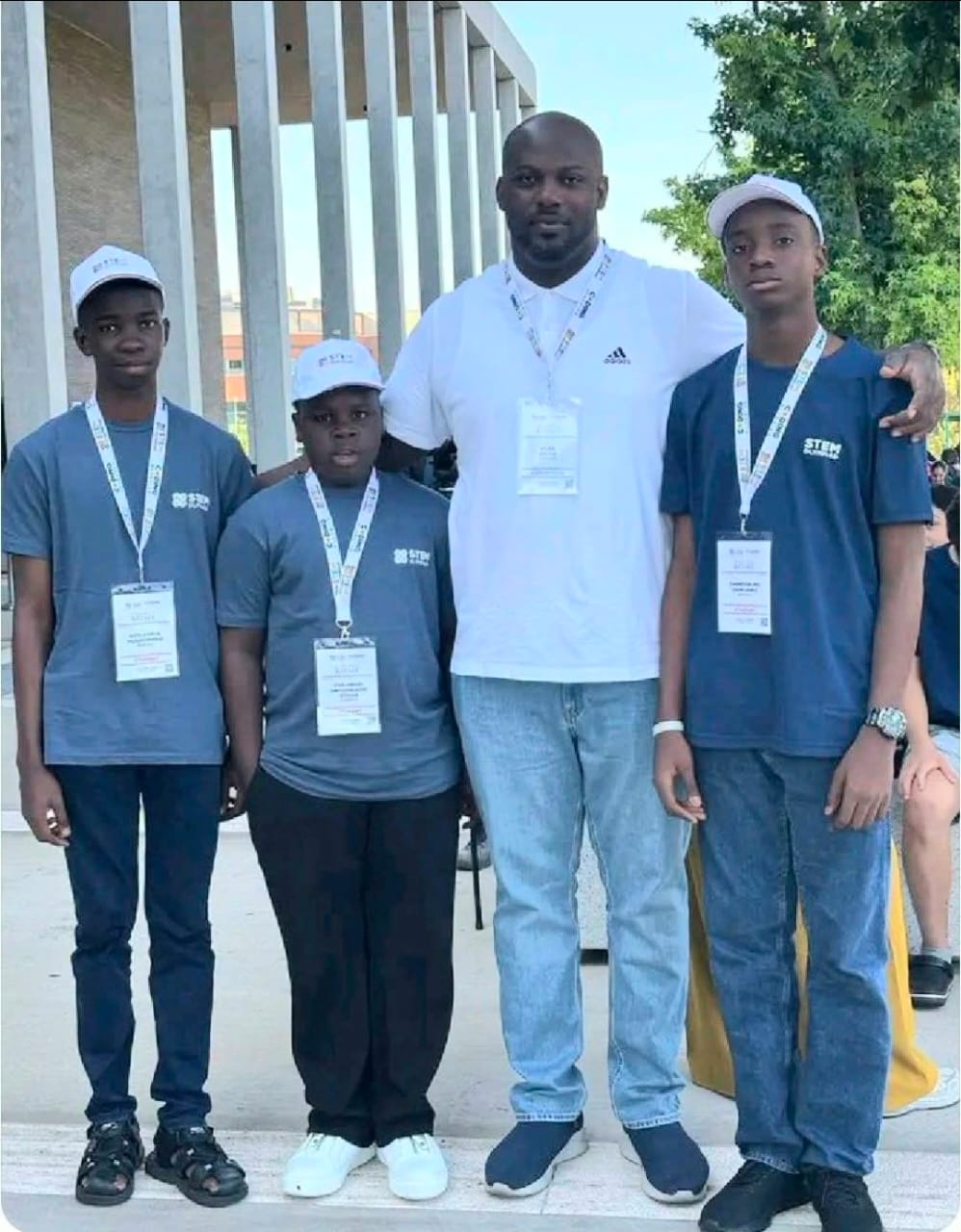
Eleven-year-old Egejurum Onyedikachi, 13-year-old Onwubiko Chimdiebube and 17-year-old Don Anele Munachimso emerged as gold medalists at the 2026 International STEM Olympiad Grand Finale, defeating competitors from more than 150 countries at the Università Campus Bio-Medico di Roma. Egejurum was named the world’s best in Primary Mathematics, Chimdiebube won gold in Mathematics for Grades 9–11, while Munachimso claimed gold in Science. The medals are extraordinary. The story behind them is even more so.
These victories were not products of chance. They were the outcome of vision, discipline and an unwavering belief that Nigerian children can compete with the very best in the world when given the opportunity. At the centre of that belief stands Alex Onyia.
At a time when conversations about Nigeria’s educational decline often dissolve into excuses about inadequate funding and weak institutions, Onyia chose action over lamentation. Rather than wait for government, he built a model that government itself should be studying.
Earlier this year, through the Southeast Mathematics Olympiad, Onyia created a platform that attracted more than 11,500 students from across the five southeastern states. From this vast reservoir of talent emerged the three champions who would eventually carry Nigeria’s flag to Rome.
He understood, however, that discovering brilliance is only half the task. Too many gifted Nigerian children never reach the global stage because talent is routinely defeated by poverty, bureaucracy and institutional neglect. So he personally funded visas, flights, accommodation, mentorship by dedicated teachers Anthony Iwegbu Tochukwu and Chisom Unachukwu, and educational visits to the Colosseum, Vatican City and the Italian Parliament. He did not simply sponsor a competition; he invested in lives and expanded horizons. That distinction is important.
Too often, educational philanthropy stops at scholarships or donations. Onyia’s intervention is different because it creates an ecosystem. It identifies talent, rewards merit, equips teachers, broadens exposure and nurtures ambition. It replaces patronage with excellence and charity with empowerment.
This philosophy has defined his broader work through Educare, the education technology platform serving over one million students and more than 300,000 parents across Africa. For years, Onyia has championed technology-driven learning, stronger STEM education, teacher development and greater accountability within the education sector. While many diagnose Nigeria’s educational crisis, he has consistently demonstrated that meaningful reform begins with practical action.
His work deserves recognition not simply because it produced three gold medals, but because it has exposed a truth that policymakers can no longer ignore.
Nigeria does not suffer from a shortage of talent. It suffers from a shortage of opportunity, often created by poor leadership and worse policymaking.
The participation of more than 11,500 students in a single regional Olympiad should permanently settle any doubts about the country’s intellectual capacity. Across every region of Nigeria are children with exceptional promise. What remains scarce are visionary leaders and institutions willing to discover, nurture and challenge them.
That reality should unsettle policymakers. If one private citizen could produce three world champions through vision, commitment and personal investment, what excuse remains for governments with far greater resources and constitutional responsibility?
This question is especially urgent in states where education, and STEM education in particular, continues to receive little more than rhetorical attention. Every neglected science laboratory, every poorly equipped classroom, every undertrained mathematics teacher and every cancelled academic competition represents not merely administrative failure but lost human potential. In an economy increasingly driven by science, technology and innovation, neglecting STEM education is no longer just poor policy; it is economic self-sabotage.
The response to Onyia’s bold vision should not be admiration alone. It should be replication. Every geopolitical zone should establish rigorous STEM Olympiads that feed into a transparent and merit-based national competition. Governments should support, not smother, credible private initiatives through funding partnerships and enabling policies.
Corporate Nigeria should invest in talent development with the same enthusiasm it celebrates innovation. Universities, research institutes and technology companies should create structured mentorship programmes for exceptional students, while the media should elevate academic excellence to the same status accorded sporting achievement.
Above all, Nigeria needs a fundamental shift in mindset. We have spent decades debating educational decline. It is time to begin celebrating, and systematically reproducing, educational excellence.
Alex Onyia has provided a blueprint. His example demonstrates that determined leadership, strategic investment and an uncompromising commitment to merit can transform lives and strengthen nations. His patriotism is not expressed in speeches or slogans but in measurable outcomes, in classrooms improved, opportunities created and young Nigerians empowered to stand confidently among the world’s best.
Yet there is also a sobering lesson. A country of more than 230 million people cannot depend on the vision and generosity of a handful of exceptional citizens. The discovery and development of gifted children should never be a private burden; it is a public responsibility. Governments exist precisely to create the conditions under which excellence becomes commonplace rather than exceptional.
As Egejurum Onyedikachi, Onwubiko Chimdiebube and Don Anele Munachimso return from Rome bearing gold medals and renewed dreams, they remind us of what Nigeria can become when talent meets opportunity. Their success is not merely a celebration of three brilliant young minds. It is an indictment of every system that leaves countless others undiscovered.
Alex Onyia has shown that the road from Enugu to Rome exists. The challenge before Nigeria is whether we will widen that road until every gifted child, regardless of birthplace or circumstance, has the chance to walk it.
The medals won in Rome will inspire pride today. The example set by Alex Onyia should inspire policy tomorrow. If it does, these three young champions may one day be remembered not simply as winners of gold medals, but as the pioneers of a long-overdue educational renaissance.