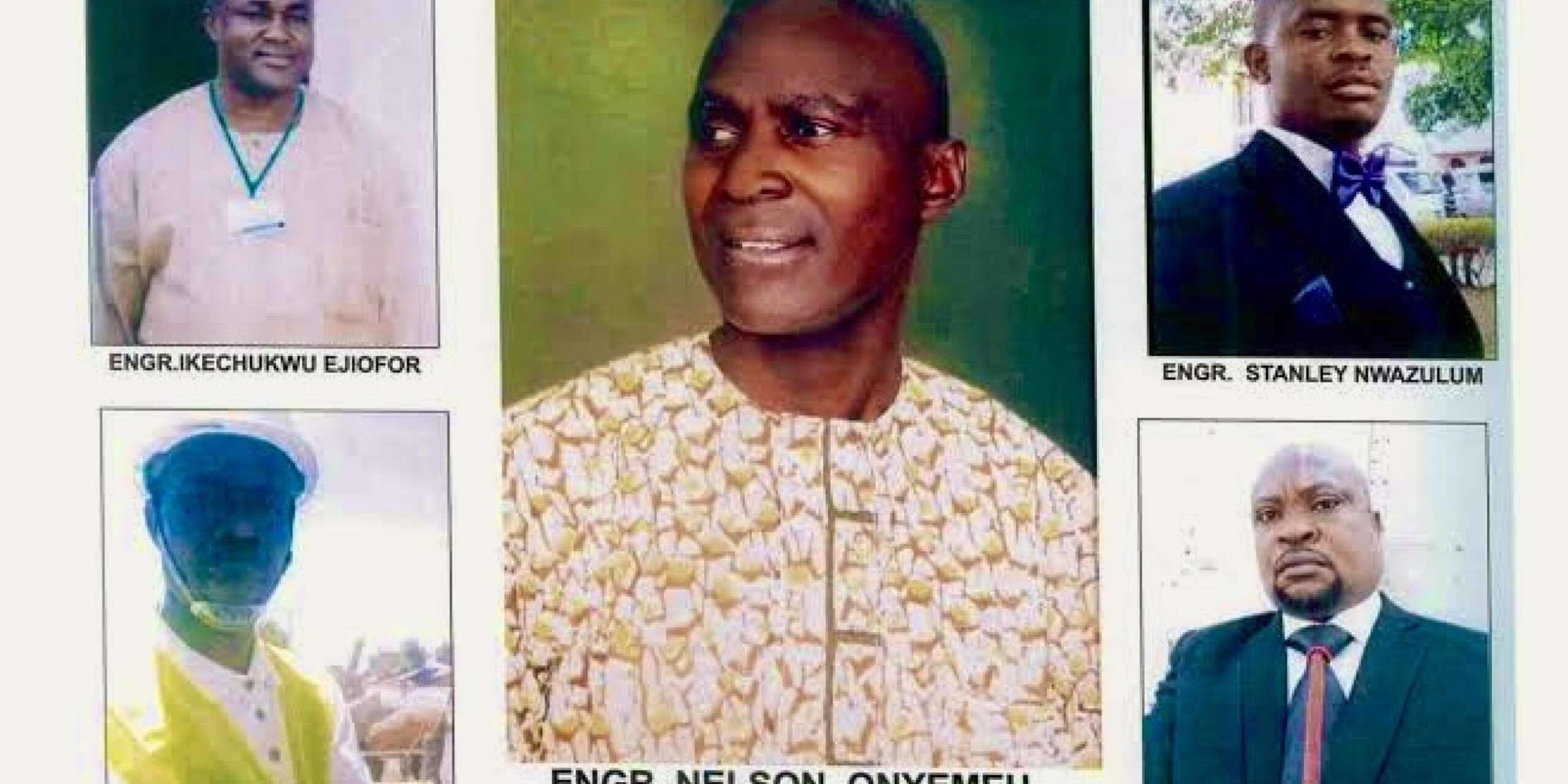
On the morning of November 3, 2021, five consulting engineers left Enugu in an official project vehicle for what should have been another routine assignment on the African Development Bank-funded Abakaliki Ring Road project in Ebonyi State. They never returned.
Nearly five years later, the disappearance of the five professionals—now widely referred to as the NELAN Five—remains one of Nigeria’s most troubling unresolved cases, raising persistent questions about public accountability, the integrity of criminal investigations and the ability of the justice system to provide answers to grieving families.
Their disappearance has generated criminal prosecutions, conflicting narratives, disputed forensic evidence, repeated protests, petitions to federal institutions and growing calls by civil society organisations for an independent review of the investigation. Yet the central question that has haunted the case since 2021 remains unanswered: What happened to the five engineers?
The engineers—Engr. Nelson Onyemeh, the Managing Director of NELAN Consulting Limited, Engr. Ernest Edeani, Engr. Ikechukwu Ejiofor, Engr. Samuel Aneke and Engr. Stanley Nwazulum—were part of the consultancy firm engaged through an international competitive bidding process to supervise the multi-billion-naira road project financed by the African Development Bank. Their role, according to project records, was to independently monitor construction, ensure compliance with contractual specifications and certify work in accordance with the Bank’s procurement and quality assurance requirements.
According to the families, disagreements developed during the execution of the project over issues relating to supervision, certification of completed works and adherence to African Development Bank procedures. They have consistently maintained that the engineers resisted attempts to depart from contractual standards and have questioned whether those disagreements may have been connected to the disappearance. Senator David Umahi, who was Governor of Ebonyi State at the time and is now Minister of Works, has consistently denied any involvement in the disappearance, while the state government maintained that the engineers were victims of criminal violence linked to the security situation in parts of the state.
The official account initially described the incident as an abduction by unknown gunmen allegedly connected to the Effium/Ezza-Effium communal conflict. Weeks later, however, the then governor publicly stated that the engineers had been killed and buried in the bush by suspected attackers, even as investigations by the police and the Department of State Services were still in progress. That pronouncement shocked the families, who questioned how such a conclusion could be reached before investigations had been completed and without the recovery and identification of the bodies.
Security agencies subsequently arrested suspects who were arraigned before the Ebonyi State High Court in Charge No. HKW/7C/2022 on allegations relating to the disappearance. Yet the criminal proceedings have done little to resolve the mystery. Court records indicate repeated adjournments, the absence of some defendants and, at one stage, judicial concern over delays in the prosecution. In May 2025, three defendants were reportedly admitted to bail after the prosecution informed the court that they had benefited from an amnesty programme of the Ebonyi State Government.
For the families, however, the most troubling development remains the unresolved forensic evidence.
Skeletal remains presented as those of the missing engineers were subjected to independent DNA analysis commissioned by the families. According to their legal representatives, the results did not match the missing men, with one set of remains reportedly identified as belonging to a female. Those findings reinforced the families’ insistence that the fate of the engineers has never been conclusively established.
Over the years, the widows of the five engineers have refused to allow the matter to fade from public memory. They have petitioned President Bola Tinubu, the National Human Rights Commission, the National Judicial Council, the Nigerian Bar Association, security agencies and other public institutions, urging a fresh and independent federal investigation. In March 2026, they staged a protest in Abuja, demanding that the authorities establish what happened to their husbands and, if they are dead, recover and identify their remains.
Their campaign has attracted the support of civil society organisations, including the Rule of Law and Accountability Advocacy Centre (RULAAC), which has argued that the case raises broader concerns about accountability, transparency and the obligation of the State to conduct credible investigations into enforced disappearances and other serious crimes. Human rights advocates have similarly maintained that unresolved disappearances erode public confidence in the justice system and undermine the rule of law.
The families have also questioned aspects of the investigation, including reports that a key investigator was removed during the inquiry, the handling of forensic evidence and the pace of the criminal proceedings. They have alleged a wider cover-up and urged federal authorities to revisit every aspect of the case. Those allegations have been rejected by officials associated with the matter, and no court has made findings establishing the claims.
Nearly five years after the engineers disappeared, the case continues to present difficult questions that extend beyond one road project or one state. It touches on the safety of professionals working on public infrastructure, the independence of consultants engaged to oversee publicly funded projects, the confidence of development partners in procurement processes and, above all, the ability of the criminal justice system to establish the truth when serious crimes occur.
For the wives and children of the five engineers, however, the matter is painfully simple. They are still waiting for answers.
Until those answers emerge through an investigation that commands public confidence, the story of the NELAN Five will remain more than an unresolved disappearance. It will stand as a continuing test of Nigeria’s commitment to accountability, transparency and the rule of law.