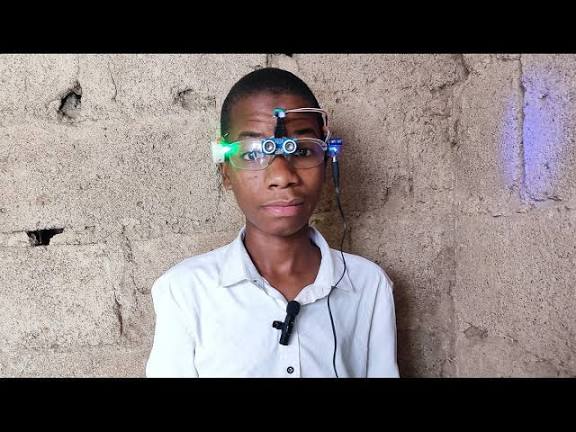
Growing up in Kano, Khalifa Aminu saw first-hand the difficulties visually impaired people faced simply trying to move around their communities. Rather than accepting those difficulties as inevitable, he began looking for a technological solution.
With little more than curiosity, persistence and affordable electronic components, the self-taught 20-year-old began developing a pair of smart glasses designed to help visually impaired people detect obstacles and navigate their surroundings more safely.
His early prototype used ultrasonic and infrared sensors to identify objects in the wearer’s path and provide an alert. But Aminu did something that is often missing from the development of new technology: he put the device in the hands of someone who would actually use it.
A visually impaired man in his community tested the prototype and provided feedback that directly influenced its development. The beeping alerts were replaced with voice prompts, the hardware was made smaller and wireless controls were added.
That process of building, testing and listening helped produce Glass V2, Aminu’s latest version.
The new device goes beyond basic obstacle detection. It incorporates artificial intelligence and camera tracking to provide users with more information about their surroundings and a greater sense of spatial awareness.
The technology remains at the prototype stage and will require extensive testing before its effectiveness, safety and commercial viability can be properly established. But the significance of Aminu’s work lies partly in how he arrived at this point.
He did not start with a university laboratory, a large research team or a multinational technology company. He started with a problem he could see around him and taught himself enough electronics and programming to begin tackling it.
That is precisely the sort of grassroots innovation Nigeria should be nurturing.
Aminu’s work has now attracted attention beyond Kano. The National Commission for Persons with Disabilities invited him to Abuja to demonstrate the technology and explore its potential for local production.
He has also received backing from the Kano Patriotic Front, which has provided workspace and financial support to help him continue developing his inventions.
Such support could prove decisive. A promising prototype can easily remain just that—a prototype—without access to proper equipment, engineering expertise, testing facilities and sustained funding.
The need for affordable assistive technology is enormous. The World Health Organization estimates that more than 2.5 billion people worldwide need one or more assistive products, with demand expected to rise substantially in the coming decades. Access is particularly limited in low- and middle-income countries, where cost, availability and inadequate support systems remain major barriers.
Nigeria therefore needs to look beyond importing assistive devices and begin asking what can be designed and produced locally for the particular circumstances of its own people.
Aminu’s glasses are one small response to that challenge, but they point in an important direction.
If the project is to move from an impressive invention to a reliable product, Aminu will need more than encouragement. He will need experienced engineers and software developers, proper testing, access to manufacturing facilities, intellectual-property support and, above all, continued engagement with visually impaired users.
Government agencies, universities, technology companies, philanthropists and disability organisations should be asking how they can help young innovators like him make that transition.
There is a tendency in Nigeria to celebrate young inventors briefly when their work attracts public attention and then move on to the next story. That is not enough. The real test is whether the country can build an environment in which an idea developed by a 20-year-old in Kano can be tested rigorously, improved, manufactured affordably and eventually reach the people who need it.
Aminu has already done the hardest part: he saw a problem and decided to do something about it.
Now Nigeria has an opportunity to do something about his idea.
This is the kind of innovation that should be encouraged—not merely applauded.