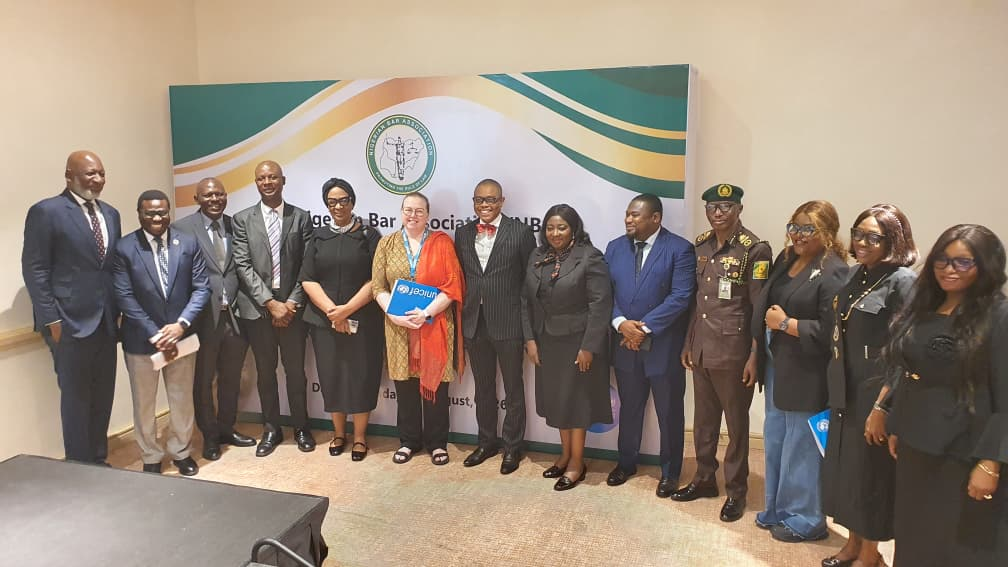
- * The Bar, UNICEF demand child-sensitive justice as thousands of vulnerable children confront detention, delays and inadequate legal representation
The Nigerian Bar Association and UNICEF have launched a nationwide partnership to expand free legal representation for children, warning that a justice system that leaves vulnerable children without lawyers risks turning legal vulnerability into a lifelong disadvantage.
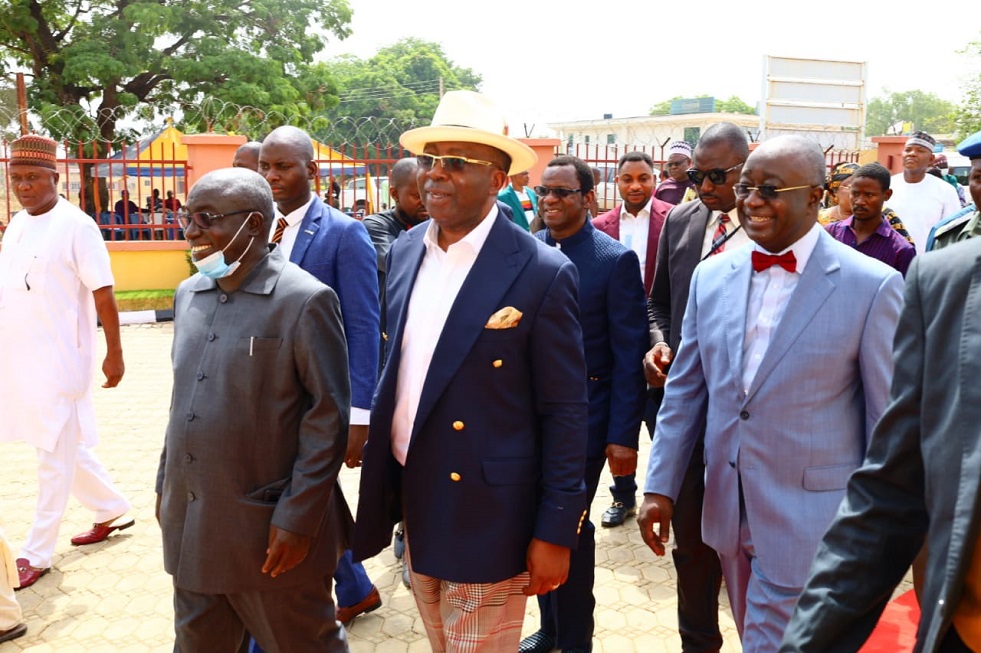
The partnership, formally launched in Abuja on Monday, is designed to mobilise lawyers across the country to provide pro bono representation to children, strengthen links between the justice and child-protection systems and improve the ability of legal practitioners to handle cases involving children.
For the NBA President, Mazi Afam Osigwe, SAN, the initiative goes to the heart of what the legal profession is supposed to do.
He said the absence of legal representation for a child who cannot afford a lawyer was not simply a gap in service but a failure of the justice system.
“Access to justice is not a privilege. It is the fundamental right of every child,” was the thrust of the message delivered at the gathering on behalf of the Attorney-General of the Federation, as stakeholders pressed for a justice system that treats children differently from adults.
UNICEF Country Representative in Nigeria, Wafaa Saeed, said children encountering the justice system continue to face detention without legal representation, prolonged case delays, weak referral systems and inadequate access to diversion and support services.
“Access to justice is not simply a legal issue. It is a child protection issue, a development issue, and a matter of human dignity,” Saeed said.
The partnership seeks to address that gap by strengthening pro bono legal services, building the capacity of lawyers, improving referral pathways and supporting diversion and rehabilitation for children in conflict with the law.
When the law arrives without a lawyer
The stakes are particularly high for children who come into contact with the criminal justice system.
A child who does not understand the proceedings, has no lawyer to make an application for bail or diversion and remains in detention while a case moves slowly through the courts can spend months in custody for an offence that might ultimately attract a non-custodial response.
UNICEF’s national assessment of children and young adults deprived of liberty in Nigeria identified detention, institutional weaknesses and gaps in services as significant problems requiring coordinated reform.
The organisation’s own example is stark: a child can spend months in detention for a minor offence simply because nobody is available to advocate for diversion or alternative care, only for a lawyer’s intervention to result in release, reunification with family and a return to school.
For the NBA, that is precisely where pro bono service must become practical rather than ceremonial.
Osigwe called on NBA branches to establish or strengthen child-focused pro bono schemes, urged law firms to dedicate professional time to child-protection cases and asked Senior Advocates of Nigeria to mentor younger lawyers in child-sensitive practice.
He also challenged lawyers to regard pro bono work as part of the profession’s public responsibility, rather than as an optional act of charity.
The missing child-sensitive approach
The stakeholders’ concern goes beyond the availability of lawyers.
Several speakers at the meeting questioned practices that can turn ordinary court procedures into disproportionately harsh experiences for children, including the reluctance to entertain oral applications for bail and the continued tendency to process children through systems designed primarily for adults.
The NBA President argued that courts should function as enablers of justice and questioned why an oral application for bail should be rejected where circumstances make immediate intervention necessary.
The debate reflects a wider concern over whether procedure is sometimes being allowed to overshadow the central question: what serves the best interests of the child?
UNICEF has urged judicial officers to adopt child-sensitive procedures, including mandatory age determination and consideration of diversion where a child is brought before a court.
That proposal is significant because age can determine whether a child is protected by the special safeguards of child justice or processed as an adult offender.
Presumption of innocence cannot disappear
Another concern raised at the meeting was the apparent erosion of the presumption of innocence in the treatment of children accused of offences.
Speakers questioned the practice of moving children away from their parents and communities to face prosecution in distant states, and the tendency to attach the label of “criminal” to children whose cases have not been determined by a court.
A child accused of an offence remains entitled to due process.
That principle does not disappear because the accused is poor, without representation or unable to navigate the justice system.
Nor should the fact that a child has been accused become a justification for exposing that child to an environment likely to cause further harm.
UNICEF’s position is explicit: every child who is a victim, survivor, witness or accused deserves fair treatment, due process and the opportunity to have their voice heard.
Beyond the courtroom
The partnership also recognises that lawyers cannot repair the child justice system alone.
The NBA’s opening remarks specifically identified government institutions, the judiciary, police, correctional authorities, Legal Aid Council, civil society organisations, development partners and community actors as essential to the process.
UNICEF similarly called for stronger coordination among lawyers, social workers, police officers, correctional personnel and judicial officers, with diversion and rehabilitation prioritised where appropriate.
That multidisciplinary approach matters because a child who enters the justice system often needs far more than a lawyer.
The child may need a social worker to trace the family, a counsellor to address trauma, a police officer trained in child protection, a court equipped to hear the matter appropriately and a system capable of ensuring that the child can return safely to school and community life.
Nigeria’s child-protection system remains under considerable pressure. UNICEF’s 2025 data showed that two out of every three Nigerian children live in multidimensional poverty, while the organisation has repeatedly called for stronger investment in child protection, social welfare and public services.
The test is what happens after launch day
The NBA-UNICEF partnership is significant, but its success will ultimately be measured outside the conference room.
It will be measured by the child who gets a lawyer before spending months in detention.
It will be measured by the child whose age is properly established before arraignment.
It will be measured by the child diverted from custody and reunited with family.
It will be measured by the survivor of abuse who is able to navigate the justice system without being further traumatised.
And it will be measured by whether children who come into contact with the law emerge with a future rather than a criminal identity.
Saeed put the test plainly: the partnership should produce a justice system in which no child faces the law alone, detention remains a last resort and rehabilitation takes precedence over stigma.
For the NBA, the challenge is equally clear. As Osigwe said, every child should have a lawyer ready to stand beside them when their rights are violated.
The question now is whether Nigeria can build the machinery around that lawyer capable of ensuring that the child’s rights survive every stage of the justice process.