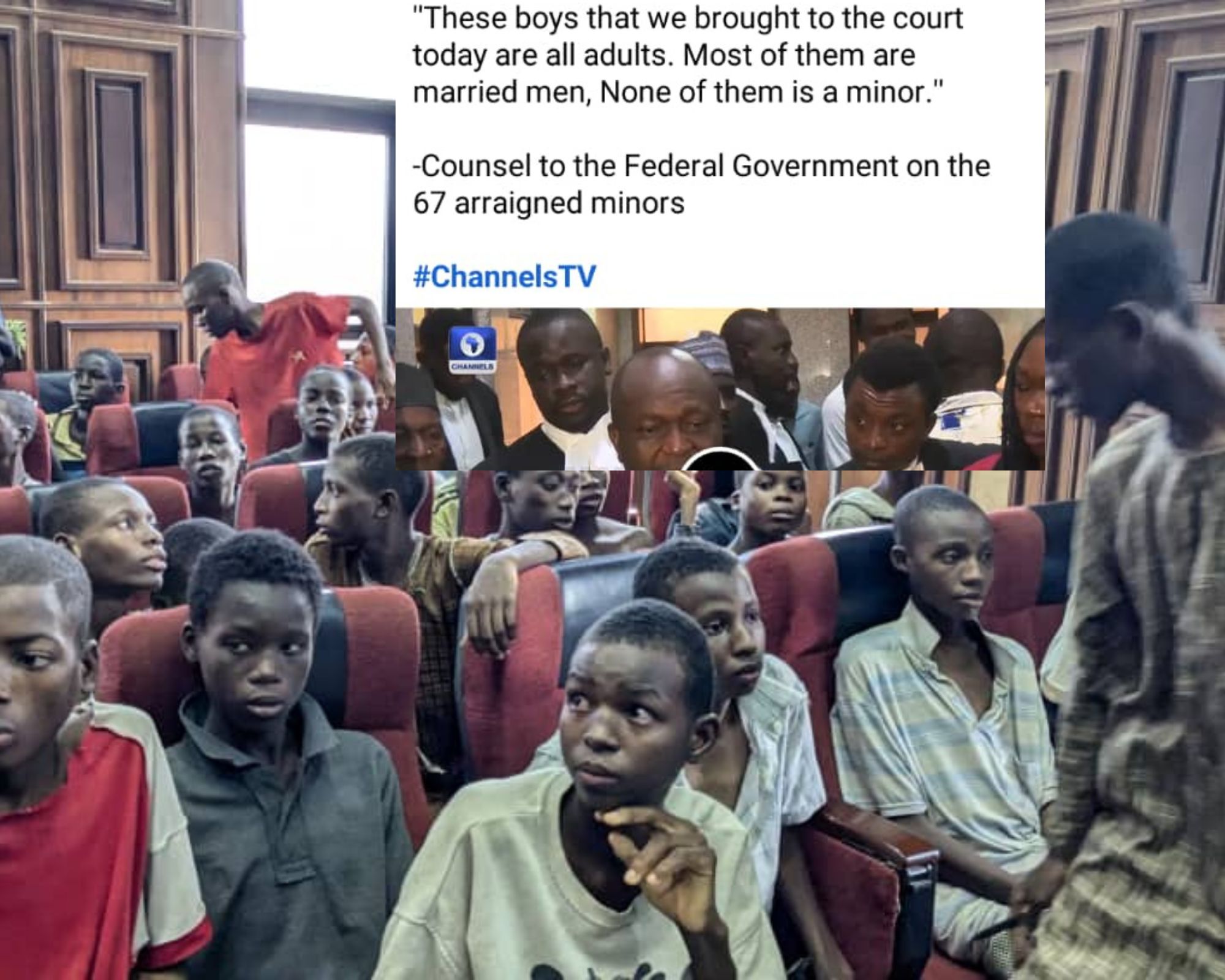
The shortage of specialised facilities, weak social-welfare services and inadequate rehabilitation programmes are leaving children in conflict with the law dangerously exposed
A child who comes into conflict with the law is supposed to encounter a justice system that recognises the difference between childhood and adulthood, protects the child’s dignity and seeks, wherever possible, to correct behaviour without destroying the young person’s prospects of returning to society.
In Nigeria, however, that principle can become difficult to sustain once the child leaves the courtroom.
Concerns raised at a recent Nigerian Bar Association-UNICEF, justice-sector gathering in Abuja point to a deeper institutional problem: the country has recognised in law that children require special treatment, but has not built enough of the infrastructure needed to make that protection meaningful.
There are too few specialised facilities, inadequate rehabilitation programmes and a serious shortage of professionally trained social workers, while children who should be kept apart from adult offenders can still find themselves within the correctional system alongside people many years their senior.
The Federal Capital Territory, participants noted, does not have a borstal institution, leaving Kaduna as the nearest facility for children requiring such placement. They also put the number of borstal institutions nationwide at only three, while citing the closure of a facility in Enugu after funding became insufficient to keep it operating.
For a country with millions of children and a legal framework that recognises their particular vulnerability, the gap between what the law prescribes and what the state can actually provide is difficult to overlook.
A system built around adults
Nigeria’s laws do not treat children in conflict with the law as ordinary adult offenders. The Child Rights Act and the Nigerian Correctional Service Act provide safeguards intended to ensure that children are treated according to their age and circumstances, including separation from adult inmates and access to specialised correctional and rehabilitation arrangements.
The same principle is reflected in international law. Article 37 of the Convention on the Rights of the Child provides that deprivation of liberty should be used for children only as a measure of last resort and for the shortest appropriate period, while children deprived of their liberty should generally be separated from adults.
The problem emerges when a child reaches a point at which the law requires a specialised response but the necessary institution is unavailable.
A court may determine that a child should be placed somewhere appropriate, yet an appropriate facility may be hundreds of kilometres away or, in practical terms, unavailable. A social worker may recommend an alternative to detention, but there may be no properly funded programme capable of taking responsibility for the child.
The result can be a justice process in which institutional limitations gradually determine the outcome.
When a building is mistaken for rehabilitation
The situation reportedly encountered in Enugu illustrates another weakness in the country’s approach to juvenile detention. Participants at the Abuja gathering said a borstal facility had been built but was subsequently shut because there was not enough money to operate it.
The lesson extends beyond Enugu.
A rehabilitation institution is not created simply by putting up walls, installing beds and attaching an official name to a building. Children placed there require teachers and counsellors, healthcare and vocational training, social workers and properly trained correctional personnel, together with programmes that keep them connected to their families and prepare them for life outside the institution.
Without those services, the physical facility may provide somewhere to keep a child without providing much of what the child actually needs.
UNICEF’s assessment of children and young adults deprived of liberty in Nigeria has previously identified gaps in detention facilities, services and institutional capacity, underscoring the need for alternatives to detention and stronger rehabilitation arrangements.
The consequence is a familiar one in public administration: infrastructure is easier to announce than the sustained investment required to keep it functioning.
The danger of putting children among adults
Few failures in the juvenile justice system carry more serious consequences than the detention of children alongside adults.
An adult correctional facility is designed around a population with different needs, experiences and risks. A child placed there may be exposed to violence, intimidation and criminal influences at precisely the stage of life when the state should be helping the child develop the skills and discipline necessary for adulthood.
The consequences may continue after release. A child who spends months in detention can lose valuable time in school, become disconnected from family and return to the community carrying the stigma and psychological effects of imprisonment. Exposure to adult offenders can also introduce young people to criminal networks and behaviour that they might otherwise never have encountered.
UNICEF has previously warned against children being held in adult correctional facilities in Nigeria. In November 2024, following the detention of children and young people in connection with the #EndBadGovernance protests, the organisation welcomed President Bola Tinubu’s directive for their release and reiterated the need to keep children away from adult correctional facilities.
The consequences of getting this wrong are therefore not confined to the period of detention. They can shape the child’s prospects long after the prison gate opens.
Why should a child be taken far from home?
The concerns raised in Abuja also included the movement of children across state boundaries for prosecution, sometimes leaving them far from their parents and communities.
There can be legitimate reasons for moving an accused person, particularly where safety or jurisdiction is involved. But when the accused is a child, distance carries consequences that deserve careful consideration.
Parents may struggle to attend proceedings or find a lawyer. Relatives may be unable to visit regularly. The court may receive less information about the child’s home circumstances, while the child loses the support of the people most likely to help with rehabilitation.
The family is not simply an audience to a child’s case. In many circumstances, it is part of the solution.
A juvenile justice system that separates a child from that support without compelling reason risks making rehabilitation harder than it needs to be.
The social workers who are missing from the picture
Much of the public conversation about criminal justice revolves around police officers, prosecutors, lawyers, judges and correctional officials. Less attention is paid to the professionals who can help determine what happens to a vulnerable child before the case becomes a custodial matter.
A properly trained social worker can investigate a child’s circumstances, trace parents or relatives, assess the home environment, identify abuse or neglect and advise the authorities on what intervention would best serve the child.
That work should not begin after a child has spent weeks in detention.
Participants at the Abuja gathering argued that trained social workers should be available at police stations, where early intervention could help identify children who need protection, family support, counselling or other forms of assistance rather than being pushed further into the criminal justice process.
The quality of that intervention matters. Social work cannot be treated as a convenient administrative function that can be handed to anyone available. It requires professional training and an understanding of child development, family dynamics, abuse, neglect and rehabilitation.
UNICEF’s child-protection work in Nigeria similarly emphasises the need to strengthen social-welfare services and professional capacity in dealing with vulnerable children.
A child who arrives at a police station because of homelessness, neglect, abuse, poverty or family breakdown may need protection long before the state decides whether the child should be prosecuted.
If the first substantial intervention comes only after arrest, an opportunity to deal with the underlying problem may already have been lost.
Who bears the cost of imprisonment?
The question of funding also surfaced during the Abuja discussions, with participants arguing that states should contribute to the feeding and care of inmates committed to correctional facilities through their courts instead of leaving the financial burden largely to the Federal Government.
The debate is broader than the cost of feeding prisoners.
When a state prosecutes an offence and its court orders detention, there is an obvious public cost attached to that decision. The same applies when children are remanded following proceedings before state courts. Yet responsibility for financing correctional facilities and maintaining prisoners has historically been caught in the wider tension between federal and state responsibilities.
The funding question becomes even more important when governments are expected to provide alternatives to imprisonment.
Diversion programmes, family interventions, social workers, counselling, vocational training and rehabilitation all require money. So does incarceration.
The choice is therefore not between spending and not spending. It is partly a choice between spending on rehabilitation and spending later on the consequences of failed rehabilitation.
The reported closure of the Enugu facility demonstrates what happens when capital expenditure is not matched by sustainable operational funding. A government may build a facility, but unless it can pay the people who work there, maintain the infrastructure and provide the programmes that give the institution a purpose, the investment will not achieve what it was intended to achieve.
What happens after the child leaves custody?
The real measure of a juvenile justice system should extend beyond the courtroom and beyond the prison gate.
A child who has been accused of an offence may eventually be released, acquitted, diverted or convicted. Whatever the outcome, the state still has to confront the question of what happens next.
Is the child able to return to school? Is there a family capable of providing support? Has abuse or neglect been addressed? Does the child have access to counselling or vocational training? Is there anyone monitoring the child’s reintegration into the community?
Without answers to those questions, release can amount to little more than a return to the circumstances that produced the original problem.
A child who has spent time in detention and returns to the same poverty, family instability, lack of education or harmful environment may be no better prepared to avoid another encounter with the law.
That is where rehabilitation becomes more than a slogan.
It is a long process that begins with understanding why the child came into conflict with the law and continues until the child has a realistic chance of rebuilding a normal life.
The cost of giving up on children
There is a temptation to regard children accused of offences primarily through the lens of the harm they may have caused. Victims deserve justice, and communities have a legitimate interest in safety. None of that should be diminished.
But public safety also depends on what happens to young offenders.
A child who can be redirected away from crime represents a future problem prevented. A child who is exposed to adult criminal environments, removed from school and returned to an unstable home without meaningful support may become considerably harder to reintegrate.
The choice is therefore not between being soft on crime and protecting children.
It is about recognising that rehabilitation can itself be an instrument of public safety.
The state cannot legislate rehabilitation into existence
Nigeria has already accepted, through its laws and international commitments, that children require a justice response different from that applied to adults.
What remains inadequate is the machinery needed to deliver that promise.
Specialised facilities must not only be constructed but kept open. Social workers must be properly trained, employed and deployed where children first come into contact with the state. Rehabilitation programmes need predictable funding, while federal and state authorities must resolve the financial responsibilities attached to custody.
Courts, police, correctional institutions and social-welfare agencies also need to work as parts of the same child-protection chain rather than as disconnected offices that encounter the child at different stages.
The question facing Nigeria is therefore larger than where to keep children accused of offences.
It is whether the country is prepared to invest in what happens to them before, during and after their encounter with the law.
A child who enters the justice system has not ceased to be a child. The state may have a duty to hold that child accountable where an offence has been established, but it also has a responsibility to ensure that the punishment does not become a permanent sentence against the child’s future.
If Nigeria wants safer communities tomorrow, it cannot afford to abandon vulnerable children today.